As universities pilot agentic AI for advising and administrative tasks, its place in teaching and learning remains unclear. Experts say decision-makers will need to look carefully at reliability, risks and partners.
Via EDTECH@UTRGV
Your new post is loading...
From
www
As universities pilot agentic AI for advising and administrative tasks, its place in teaching and learning remains unclear. Experts say decision-makers will need to look carefully at reliability, risks and partners. Via EDTECH@UTRGV
From
www
Swedish classrooms swap laptops for books, pens and paper, raising concerns from the tech sector. Via Peter Mellow, Luc Deleplanque
Luc Deleplanque's curator insight,
May 8, 12:04 PM
Doit on appliquer une fois de plus le "balancier décisionnel"... le fameux "tout l'un, tout l'autre"... !? Oui, généraliser à 2 ans l'usage des tablettes est une extrémité difficile à soutenir... Oui, l'abstraction des écrans et des applications jusqu'à 14 ou 15 ans est largement discutable... La mesure, le compromis sont parfois plus efficace que des solutions tranchées et partisanes, qui sont souvent limitées en perspective comme en clairvoyance.
"Microlearning works for busy people. And that's probably not the type of insight you came here for, but it's a place to start. The strongest argument for microlearning is their convenience. But can and should everything fit into such bite-size content? That's a question I see more and more organizations struggling with. There is no time (or budget allocation) to allow for long-form training that can plausibly resolve all of the many learning gaps. Given the many concerns everywhere around the globe, there is also direction lacking from executives to really focus on noncritical training." Via EDTECH@UTRGV
EDTECH@UTRGV's curator insight,
May 8, 4:48 PM
"Instead of thinking of microlearning as a replacement, we should just think of it as part of a system. One where each format plays a role in how people first learn, build, and retain knowledge."
From
er
"The SAMR + AI Matrix is a structured learning design tool that aligns the SAMR Model with Bloom's Taxonomy, mapping levels of technological use to cognitive demand to guide instructors in determining how artificial intelligence (AI) could impact student work. This matrix is operationalized through a five-step framework that helps instructors deliberately design for the presence of AI in learning experiences." Via EDTECH@UTRGV
EDTECH@UTRGV's curator insight,
May 8, 5:01 PM
"[T]he SAMR + AI Matrix, when applied alongside disciplinary expertise, offers a structured approach to positioning GenAI as a tool that supports students' preparation to make meaningful contributions in their field."
From black box to learning lab: how open, scalable systems can turn AI access into real literacy for students. Via EDTECH@UTRGV
EDTECH@UTRGV's curator insight,
May 7, 11:49 AM
"AI is moving so quickly that for many users, it might as well be magic. And when something feels like magic, people stop asking questions. That’s exactly what students can’t afford to do."
Loïc Sartieaux's curator insight,
May 8, 10:57 AM
Un article passionnant de eCampus News rappelle une idée essentielle : utiliser l’IA ne suffit plus. Les étudiants doivent apprendre à comprendre ses limites, questionner ses réponses et développer leur esprit critique.
� Plusieurs points m’ont particulièrement marqué :
• L’IA peut donner une réponse “convaincante”… sans qu’elle soit correcte
Dans l’enseignement, cela pose une vraie question :
À mes yeux, le défi des prochaines années sera là : former des citoyens et professionnels capables de collaborer avec l’IA sans devenir dépendants de celle-ci.
What are the burdens and benefits that GenAI technologies and the policies designed around these technologies create, and are these burdens and benefits fairly distributed among students, on the one hand, and teachers, on the other? More generally, can assessment be fair or be made to be more fair in the age of GenAI? These are the kind of questions that the Fair Educational Assessment in the Age of GenAI (FAIR-ASSESS) project at Leiden University tries to answer. Via Nik Peachey
Nik Peachey's curator insight,
May 7, 5:16 AM
This is a really useful article - GenAI and assessment: how fair is it? https://media-and-learning.eu/subject/artificial-intelligence/genai-and-assessment-how-fair-is-it/ Towards the end there is also a link to a PDF report with 32 rules and 27 recommendations for the implementation of GenAI is assessment.
From
apnews
Two years ago, Josephine Timperman arrived at college with a plan. She declared a major in business analytics, figuring she’d learn niche skills that would stand out on a resume and help land a good job after college. But the rise of artificial intelligence has scrambled those calculations. The basic skills she was learning in things like statistical analysis and coding can now easily be automated. “Everyone has a fear that entry-level jobs will be taken by AI,” said the 20-year-old at Miami University in Ohio." Via EDTECH@UTRGV
EDTECH@UTRGV's curator insight,
May 6, 1:13 PM
"The rise of artificial intelligence is prompting college students to second-guess their career paths."
AI replaces information overload with tunnel vision, creating faster decisions but hidden risks. Organizations must build AI literacy. Via EDTECH@UTRGV
EDTECH@UTRGV's curator insight,
May 5, 2:47 PM
"AI doesn't just filter information. It narrows it. Like blinders on a horse, it blocks out the periphery and presents a single, coherent path forward."
From
evolllution
As AI use becomes common in the workforce, institutions of higher education must train students to be fluent in the technology, so they can evolve with it. Via EDTECH@UTRGV
EDTECH@UTRGV's curator insight,
May 5, 2:50 PM
"Competency means knowing how to operate the tools. Frankly, our students can gain competency quickly through a weekend workshop, YouTube videos or simple trial and error. Fluency, on the other hand, means understanding what the tools can and cannot do. It requires recognizing the assumptions baked into systems trained on imperfect data, asking who benefits and who bears the costs when AI is deployed in a hiring process, a courtroom or a healthcare setting."
"Artificial intelligence is rapidly progressing and poised to reshape the workforce in the near future. The higher education sector is in a unique position, as both an employer of millions of workers and a system that prepares students for the labor force.
At the annual ASU+GSV Summit last week, four college leaders talked to Higher Ed Dive to weigh in on two questions: What about AI’s use in higher education are you most excited for? And what has you most concerned?" Via EDTECH@UTRGV
EDTECH@UTRGV's curator insight,
May 4, 12:47 PM
"[P]eople have to be thoughtful about deploying AI. Think of it as an amplifier. The largest amplification capacity for any human being is an AI agent."
Whether students vote with a ballot or with their feet, the outcome of the vote sometimes has unintended consequences. Voting offers limited information, and that’s true whether voting with your ballot or with your feet. When you chose Smith over Jones, was it because of a policy position, a party identity, personal familiarity, or because you liked their name better? And if it was based on a policy position—most votes aren’t, at least directly—did you understand the nuances behind the policy? Via EDTECH@UTRGV
EDTECH@UTRGV's curator insight,
May 4, 12:50 PM
"Conflicting desires play out beyond electoral politics. I’m seeing it in the push-pull of students wanting a more robust on-campus college experience while simultaneously crowding into online classes. The desire for a robust on-campus experience conflicts with the desire for a convenient schedule." |

The promise of artificial intelligence in higher education isn't to replace human work but to create space for the human interaction students value most. Via Peter Mellow, Luc Deleplanque
Luc Deleplanque's curator insight,
May 8, 12:23 PM
Les Formateurs et Enseignants sont Extraordinaires...!!!
"Une machine peut faire le travail de cinquante hommes ordinaires. Aucune machine ne peut remplacer le travail d'un homme extraordinaire." de Elbert Green Hubbard Oui, la dimension humaine que nécessite la formation restera se qui rend la prestation unique et extraordinaire... bien heureusement ! Ce qui n'empêche pas les humains extraordinaires de se faire assister pour développer encore davantage leur atouts et avantages !?
"The implications of AI literacy, or lack thereof, are far-reaching. They extend beyond national ambitions to remain “a global leader in this technological revolution” or even prepare an “AI-skilled workforce,” as the executive order states. Without basic literacy, citizens and consumers are not well equipped to understand the algorithmic platforms and decisions that affect so many domains of their lives: government services, privacy, lending, health care, news recommendations and more. And the lack of AI literacy risks ceding important aspects of society’s future to a handful of multinational companies." Via EDTECH@UTRGV
EDTECH@UTRGV's curator insight,
May 8, 4:52 PM
"AI literacy refers to “a set of competencies that enables individuals to critically evaluate AI technologies; communicate and collaborate effectively with AI; and use AI as a tool online, at home, and in the workplace.”
What can we learn about screen time limits by closely examining the first round of phone ban impact research? Via Ana Cristina Pratas
From
www
Generative artificial intelligence has unsettled higher education, raising fears that students will lose the ability to think. Drawing on classroom experience and student feedback, we argue that grounded inquiry sharpens judgement in Earth science teaching by limiting AI to set sources and auditing its claims. Via EDTECH@UTRGV
EDTECH@UTRGV's curator insight,
May 7, 11:47 AM
"The challenge in AI use is therefore not how far students should rely on AI but whether universities can help them ask questions that expose uncertainty rather than conceal it."
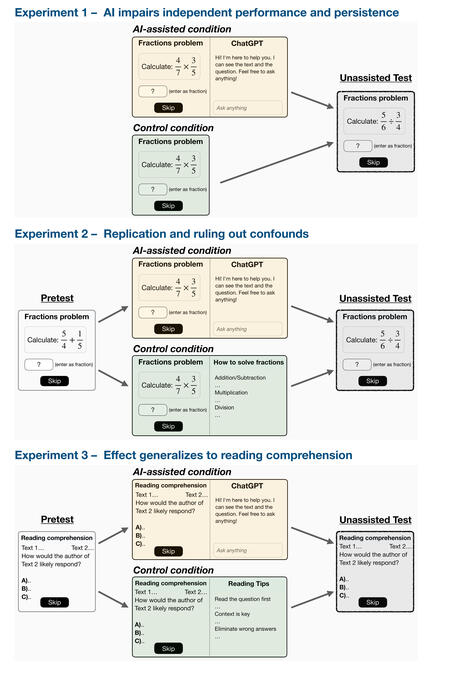
Causal evidence that AI assistance reduces persistence and impairs unassisted performance across math reasoning and reading comprehension tasks.
Learn more / En savoir plus / Mehr erfahren:
https://www.scoop.it/topic/21st-century-learning-and-teaching?tag=Gust-MEES
https://gustmees.wordpress.com/
https://gustmees.wordpress.com/2026/05/05/when-convenience-overwhelms-human-intelligence/
Via Gust MEES
Gust MEES's curator insight,
May 7, 7:39 AM
Causal evidence that AI assistance reduces persistence and impairs unassisted performance across math reasoning and reading comprehension tasks.
Learn more / En savoir plus / Mehr erfahren:
https://www.scoop.it/topic/21st-century-learning-and-teaching?tag=Gust-MEES
https://gustmees.wordpress.com/
https://gustmees.wordpress.com/2026/05/05/when-convenience-overwhelms-human-intelligence/
From
ai
Gemma 4 est disponible avec des entrées de texte, audio et image, et une fenêtre de contexte longue allant jusqu'à 256 000 jetons. En savoir plus Google uses AI technology to translate content into your preferred language. AI translations can contain errors.
Découvrez les dernières mises à jour des applications Gemini, qui incluent des améliorations des capacités de l'IA générative, un accès étendu et plus encore.
From
www
"Missouri. Utah. LA Unified School District. Bend-La Pine Schools. Medford School District. What do all of these states and school districts have in common? They’re all taking steps to restrict the use of technology and screens in their classrooms, after years of schools increasing their use of laptops." Via EDTECH@UTRGV
EDTECH@UTRGV's curator insight,
May 6, 1:21 PM
"Some worry that the push to remove technology from schools will keep students from being tech literate, or that removing all screens may mean limiting an opportunity for individualized instruction."
From
www
"Human-in-the-loop (HITL) has emerged as the default answer to concerns about AI trust, safety and governance. The logic is that when AI systems make decisions that affect people, a human should be involved." Via EDTECH@UTRGV
EDTECH@UTRGV's curator insight,
May 5, 2:53 PM
"In safety-critical environments, insisting that humans be in every real-time loop does not make systems safer. Designing for reliability does."
Alessandro Cerboni's curator insight,
May 6, 11:36 AM
Quando gli scenari fisici richiedono una decisione istantanea Con l'intelligenza artificiale applicata alla fisica, il ciclo di feedback è spesso inferiore al secondo. Prendiamo ad esempio la guida nel mondo reale. Un cambio di corsia con un veicolo che si avvicina rapidamente in un punto cieco, una frenata improvvisa o un pedone che scende dal marciapiede: queste situazioni si verificano in frazioni di secondo. Per la formazione del conducente in tempo reale o la prevenzione delle collisioni, un essere umano non può essere "presente" nel momento in cui è richiesta un'azione. Qualsiasi sistema che attenda l'approvazione umana introduce latenza e fragilità proprio quando il determinismo è più importante. I ritardi riducono drasticamente l'efficacia del feedback. Se un conducente viene avvisato immediatamente dopo aver ignorato un segnale di stop, può ricordare il momento esatto, capire cosa è successo e modificare il proprio comportamento. Se lo stesso avviso arriva minuti dopo, quando ci si trova in un contesto di guida completamente diverso, l'opportunità di apprendimento è in gran parte persa. Il contesto in tempo reale è ciò che rende il feedback utilizzabile.
What if the greatest danger of #AI is not the technology itself… but the way we think? This reflection is part of a broader journey through #ReverseTHINKing—where we move from awareness to responsibility, from reaction to understanding. Image created by ChatGPT, click please to enlarge. Introduction Since the beginning of the internet, FREE services have…
Learn more / En savoir plus / Mehr erfahren:
https://www.scoop.it/topic/21st-century-learning-and-teaching?tag=Gust-MEES
https://gustmees.wordpress.com/
Via Gust MEES
Gust MEES's curator insight,
May 4, 11:04 AM
What if the greatest danger of #AI is not the technology itself… but the way we think? This reflection is part of a broader journey through #ReverseTHINKing—where we move from awareness to responsibility, from reaction to understanding. Image created by ChatGPT, click please to enlarge. Introduction Since the beginning of the internet, FREE services have…
Learn more / En savoir plus / Mehr erfahren:
https://www.scoop.it/topic/21st-century-learning-and-teaching?tag=Gust-MEES
https://gustmees.wordpress.com/
"Artificial intelligence has rapidly shifted the instructional landscape. Tools that can generate explanations, draft essays, and summarize complex topics are now readily available to students. This accessibility has led some to question whether deep instructor content knowledge still holds the same importance. The answer is an unequivocal yes." Via EDTECH@UTRGV
EDTECH@UTRGV's curator insight,
May 4, 12:48 PM
"Strong instruction in an AI-rich classroom depends on strong content knowledge" |

Your new post is loading...
"Experts say the strongest easy wins for agentic AI are administrative, where the work is high-volume and repetitive."
"Experts suggest that agentic AI’s near-term future in education is strongest in administrative efficiency and advising, while its role in teaching and learning remains uncertain and ethically complex."