 Your new post is loading...
Looking for a Textbook on Generative AI in Education?
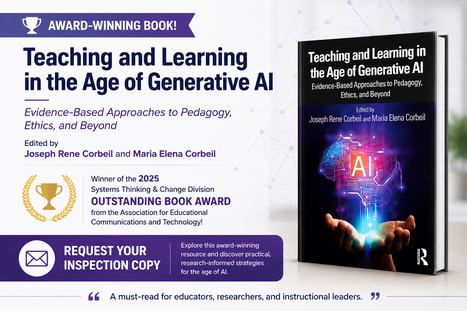
Teaching and Learning in the Age of Generative AI: Evidence-Based Approaches to Pedagogy, Ethics, and Beyond Edited by Joseph Rene Corbeil & Maria Elena Corbeil (2025) 🏆 Winner of the 2025 Systems Thinking & Change Division Outstanding Book Award from the Association for Educational Communications and Technology! If you are designing a course that addresses generative AI in education, this award-winning volume provides a research-driven, classroom-ready foundation. Rather than offering hype or fear, this book helps educators:
- Ground AI integration in learning theory and research
- Address academic integrity with thoughtful, practical strategies
- Redesign assessment for an AI-enabled world
- Explore ethics, bias, privacy, and institutional responsibility
- Leverage AI to enhance critical thinking and digital literacy
Bookended by historical and forward-looking analyses of AI in education, the chapters move beyond surface-level discussions to provide evidence-based approaches for real classrooms—K–12, higher education, and professional learning environments.
This text is ideal for:
- Undergraduate and graduate teacher education programs
- Curriculum & Instruction courses
- Educational Technology programs
- Higher education faculty development
- School technology coordinators and talent development professionals
Adopting a GenAI textbook for an upcoming semester? We invite you to request an inspection copy and explore how this resource can support your students in navigating AI with skill, ethics, and informed judgment.
Request your inspection copy today.

|
Scooped by
EDTECH@UTRGV
May 29, 11:08 AM
|
Iowa State University has announced a new effort aimed at ensuring its use of AI is ethical and trustworthy.
|
|
Scooped by
EDTECH@UTRGV
May 29, 10:59 AM
|
"If you designed for the web in 1999, you remember the feeling while the Hamster Dance video was playing in the background. Pages were handmade — for a lot of us, the WYSIWYG editor was Notepad — the conventions were improvised, the JavaScript was rough, and some of the most popular things online were gloriously, defiantly pointless, like the Hamster Dance."
|
|
Scooped by
EDTECH@UTRGV
May 28, 11:41 AM
|
"Most AI literacy curricula begin and end with the same lesson: here’s how to use ChatGPT responsibly. Learn to prompt. Check your sources. Don’t plagiarize. That’s not AI literacy. That’s a typing tutorial for 2023."
|
|
Scooped by
EDTECH@UTRGV
May 28, 11:34 AM
|
"As the school year ends for many, I see twelve emerging trends in AI that will both create profound change and risk intelligence deprivation unless we chart a new course. AI is becoming conversational, multimodal, agentic, and increasingly embodied/physical. It will not just help students write papers. It will help companies replace tasks and alter workflows; governments redesign services; scientists solve the world’s biggest problems; militaries accelerate decision-making; and agentic robots act in the world as a form of embodied cognition. But this future will not arrive evenly."
|
|
Scooped by
EDTECH@UTRGV
May 28, 11:30 AM
|
College students are increasingly worried that artificial intelligence will upend their future career plans.
|
|
Scooped by
EDTECH@UTRGV
May 28, 11:23 AM
|
AI literacy goes far beyond basic prompt writing. Learn strategies for building understanding of how AI tools work, how to use them effectively to support teaching, learning and research, where their limitations lie and the ethical implications surrounding their use
|
|
Scooped by
EDTECH@UTRGV
May 27, 1:01 PM
|
Without guardrails on the use of AI tools, students are left to find their own way and make their own decisions for using the technology.
|
|
Scooped by
EDTECH@UTRGV
May 27, 12:57 PM
|
"Much is being said about the impact of artificial intelligence in the hands of students resulting in too many A’s being granted. We are seeing colleges and universities across the country cracking down on grade inflation."
|
|
Scooped by
EDTECH@UTRGV
May 27, 12:51 PM
|
"The concept of early engagement is a necessity for online instructors in higher education to establish social connectedness with learners. The practice is based on Garrison et al.’s (1999) model for the Community of Inquiry (CoI). The CoI model suggests that the optimum online learning experience occurs when social, cognitive, and teaching presences converge [1]. However, social presence is more than simply one of three components; social presence is a foundational element. Social presence exists to establish an emotional connection."
|
|
Scooped by
EDTECH@UTRGV
May 27, 12:46 PM
|
"The 2026 State of EdTech report provides insights into the state of K-12 education through the lens of education technology leaders—professionals who play a critical role ensuring technology is safe, reliable, and effective in supporting student learning, teaching, and district operations."
|
|
Scooped by
EDTECH@UTRGV
May 26, 11:00 AM
|
Purpose-built AI systems can analyze patterns in student performance, identify specific skill gaps, and connect those gaps directly to instructional recommendations. Done well, this doesn't remove the teacher from the equation. It sharpens the teacher's ability to act.
|
|
Scooped by
EDTECH@UTRGV
May 26, 10:57 AM
|
Learning how to question and analyze are skills that must be honed and practiced. Educators must help train minds to look for flawed arguments, misuse of data, or outright lies so we can ensure that as students form their own thoughts on issues, they are grounding them in reality.
|
|
|
Scooped by
EDTECH@UTRGV
May 29, 11:14 AM
|
"A recent ransomware attack on Instructure's Canvas LMS has raised concerns across the higher education community about cybersecurity, data privacy, third-party risk, and institutional preparedness."
|
|
Scooped by
EDTECH@UTRGV
May 29, 11:03 AM
|
The 2026 EDUCAUSE Horizon Report should be read as a leadership document, not just a technology report, for higher education leaders.
|
|
Scooped by
EDTECH@UTRGV
May 29, 10:54 AM
|
"Since the release of ChatGPT, in 2022, colleges and universities have been engaged in an experiment to discover whether artificially intelligent chatbots and the liberal-arts tradition can coexist. Notwithstanding a few exceptions, by now the answer is clear: They cannot. AI-enabled cheating is pretty much everywhere. As a May New York magazine essay put it, 'students at large state schools, the Ivies, liberal-arts schools in New England, universities abroad, professional schools, and community colleges are relying on AI to ease their way through every facet of their education.'”
|
|
Scooped by
EDTECH@UTRGV
May 28, 11:38 AM
|
"Demis Hassabis just told Sequoia Capital he expects AGI by 2030. He has the strictest definition in the field. The timelines from every major lab are moving up, not back. Schools should be paying attention — because the ground under their value proposition is shifting the way it shifted when we left the farms."
|
|
Scooped by
EDTECH@UTRGV
May 28, 11:31 AM
|
Vibe coding can feel instant, but it is not simply pressing a button and getting a finished app.
|
|
Scooped by
EDTECH@UTRGV
May 28, 11:26 AM
|
Students don’t need help from their educators to keep up with AI. But what we can do is encourage them to question it more. Here’s how
|
|
Scooped by
EDTECH@UTRGV
May 28, 11:20 AM
|
Aka, what I learned when I help to map the ~300 tasks involved in every L&D project to AI's strengths and limitations.
|
|
Scooped by
EDTECH@UTRGV
May 27, 12:59 PM
|
AI should never replace teachers in collaboration or expertise, but should shine a light on the insights that spark deeper conversations.
|
|
Scooped by
EDTECH@UTRGV
May 27, 12:55 PM
|
"When students and educators think of asynchronous courses, they envision something akin to a correspondence course, lacking an available professor with disengaged students struggling to understand assignments in isolation, all within a disconnected learning environment. This type of course structure has the potential to leave students with high levels of stress and anxiety, feelings of apathy, and an overabundance of reading materials, without the requisite expertise to guide them through the learning process."
|
|
Scooped by
EDTECH@UTRGV
May 27, 12:48 PM
|
47% This is the percentage drop in brain activity measured among participants in an MIT Media Lab study who used ChatGPT, compared to those who wrote without AI assistance. This is not a philosophical finding. It is a neurological one, recorded via EEG, from the actual brainwaves of real people while they worked.
|
|
Scooped by
EDTECH@UTRGV
May 27, 12:43 PM
|
"Some K-12 teachers say they are using AI on the job, but around eight in ten say they've received no formal guidance on applying the tools their work"
|
|
Scooped by
EDTECH@UTRGV
May 26, 10:59 AM
|
Cybersecurity ranks as the No. 1 priority for education technology leaders in the United States, according to the latest State of Ed Tech report from CoSN, yet insufficient cybersecurity staffing and the lack of a dedicated budget are key barriers.
|
































"Instead of thinking of microlearning as a replacement, we should just think of it as part of a system. One where each format plays a role in how people first learn, build, and retain knowledge."