Educators favor cellphone bans, but research shows that while new rules have reduced phone usage in schools, there has been little academic change.
Via Peter Mellow

 Your new post is loading...
 Scoop.it! Educators favor cellphone bans, but research shows that while new rules have reduced phone usage in schools, there has been little academic change. Via Peter Mellow No comment yet.
Sign up to comment
Scoop.it!

Blog personal de Garcia Aretio donde reflexiona sobre educación a distancia y virtual, educación universitaria, publicaciones y distinciones Via LGA
Scoop.it!

From
www

Experts say going back to school for a graduate degree is one way to hedge against a rapidly changing labor market. Via EDTECH@UTRGV 
EDTECH@UTRGV's curator insight,
April 30, 12:57 PM
"Typically, enrollment in graduate school increases during recessions as workers seek to advance or to move to another industry with better career prospects or pay. Today, more people in a survey said they plan to go back to school within a year, even though the economy is doing well."
Scoop.it!

From
ai
Google offers various AI-powered programs, training, and tools to help advance your skills. Develop AI skills and view available resources. Via EDTECH@UTRGV
EDTECH@UTRGV's curator insight,
April 30, 12:58 PM
"Explore foundational concepts in artificial intelligence. Learn how AI works and how to effectively use it in your daily work."
Scoop.it!

Well once again, trying to make a living got in the way of sharing information, so apologies for the long delay since the last of these newsletters. Hopefully I can get back on track soon and start producing at least one each month. Anyway, excuses aside, there are some really great tools and interesting articles (mainly about AI of course) in this edition. Via Nik Peachey
Scoop.it!

Listening to faculty concerns about generative AI can help institutions respond with more clarity, precision, and trust. Via EDTECH@UTRGV
EDTECH@UTRGV's curator insight,
April 29, 12:59 PM
"[B]efore institutional leaders ask faculty to do more with GenAI, a more useful first step might be to ask a simpler question: What exactly are faculty worried about?"
Scoop.it!

Via LGA
Scoop.it!

When used in the right way AI seems to help test scores and save teacher and staff time, say Syracuse University's Jeff Rubin and Andrew Joncas Via EDTECH@UTRGV
EDTECH@UTRGV's curator insight,
April 28, 11:59 AM
"Syracuse University has gone all in on the AI revolution, deploying Claude AI to 30,000+ students, faculty members, and staff. Along the way, school leaders say they've developed effective AI use cases both in the classroom and beyond, ranging from test practice to course schedule management."
Scoop.it!

Insights about AI in the classroom from three education conferences I attended in California. Via EDTECH@UTRGV
EDTECH@UTRGV's curator insight,
April 28, 12:04 PM
"We all know we’re supposed to check what AI spits out. But Victoria Yaneva, director of data science and AI at the National Board of Medical Examiners, said there’s growing evidence that humans are getting worse at doing so. People who are enthusiastic about AI are more likely to miss errors, she said. AI skeptics are better at catching them."
Scoop.it!

Explore Bloom's revised taxonomy and learn how it classifies learning goals for modern educational practices. Via EDTECH@UTRGV
EDTECH@UTRGV's curator insight,
April 27, 12:13 PM
"Bloom's revised taxonomy is a guide for classifying learning goals based on how complex they are. It helps teachers and Instructional Designers organize learning from simple recall of facts to higher-order thinking skills."
Scoop.it!

From
innogath
Deep research with sources, auto diagrams & branching pages, and a project notebook for writing and publishing. Via Nik Peachey 
Nik Peachey's curator insight,
April 25, 1:45 AM
Ask a question and get a structured report with clickable citations, not a wall of text. Every finding can branch into a sub-topic, and the tool auto-draws a knowledge map so you can see how your research fits together. https://innogath.com/ The site has a useable free subscription
Scoop.it!

School leaders must move beyond experimentation and build AI systems that prioritize governance, purpose, and data integrity. Via EDTECH@UTRGV
EDTECH@UTRGV's curator insight,
April 24, 9:39 AM
"Becoming “AI-ready” isn’t about chasing the newest shiny platform; it requires districts to build intentional systems that guide how AI is evaluated, implemented, and governed."
Scoop.it!
"We are living through a fundamental shift in what work is for. As AI takes on more routine cognitive tasks, the uniquely human capacity to imagine, connect, and create meaning becomes the primary source of organizational value. Yet most companies are still measuring performance metrics prioritized for a different era: inventory turnover, cost per lead, and utilization rates." Via EDTECH@UTRGV
EDTECH@UTRGV's curator insight,
April 23, 8:38 AM
"These metrics were designed to optimize extraction. They are poorly equipped to cultivate imagination." |
Scoop.it!

La IA agéntica se distingue de la IA generativa en su capacidad de realizar operaciones complejas funcionando en entornos dinámicos... Via LGA
Scoop.it!

Researchers looked at more than 150,000 prompts from more than 4,400 K-12 teachers interacting with AI. Here's what they found. Via EDTECH@UTRGV
EDTECH@UTRGV's curator insight,
April 30, 12:59 PM
"Teachers, the research suggests, are generally using the tool to help them build curriculum content and as a sounding board, all with an eye toward better helping students."
Scoop.it!

"Generative artificial intelligence is pushing teaching and learning away from a model centered on producing answers and academic artifacts and toward one that places greater weight on process, judgment, reflection, and applied thinking. In conversations with campus leaders, three priorities emerged." Via EDTECH@UTRGV
EDTECH@UTRGV's curator insight,
April 29, 12:57 PM
"It's important to create a safe space for our students and for our faculty as well, where they can share their perspectives, concerns, fears, ideas about generative AI." 
Claudia Hernandez's curator insight,
May 24, 8:35 PM
The article discusses how generative AI is changing higher education by shifting the focus from simply producing answers to emphasizing critical thinking, reflection, and problem-solving. Campus leaders identified three main priorities for teaching and learning with AI: supporting faculty development, encouraging thoughtful AI integration, and preparing students for responsible AI use in real-world settings.
Scoop.it!

From
er
"Driven by a bottom-up partnership between the Faculty Center for Teaching and Learning and the Division of Digital Learning, the University of Central Florida established an evolving campus infrastructure of policies, training, and a national conference to guide the ethical and effective integration of generative artificial intelligence into teaching and learning." Via EDTECH@UTRGV
EDTECH@UTRGV's curator insight,
April 29, 1:01 PM
"The bottom-up approach used by the DDL and FCTL to kick-start the development of resources and programming on AI use in teaching and learning has evolved into a strong foundation of faculty support for this rapidly advancing technology."
Scoop.it!

How can AI improve student thinking? Explore powerful, classroom-tested strategies that turn AI into a debate partner, tutor, and catalyst for deeper learning. Via Ana Cristina Pratas
Scoop.it!

If we design AI systems that shortcut the learning process, we risk undermining the very purpose and value of education. Via EDTECH@UTRGV
EDTECH@UTRGV's curator insight,
April 28, 12:01 PM
"AI is rapidly reshaping education, but not always in ways that support learning. A growing number of AI tools promise to “help” students by doing assignments, writing papers, solving problem sets, or even completing exams automatically.
While these tools may appear convenient, they raise an important question: Are they removing barriers to learning, or removing learning itself?"
Scoop.it!

"[T]he AI trends reshaping eLearning by 2030 aren't coming from EdTech start-ups. They're coming from the raw compute infrastructure being built right now, the same forces powering ChatGPT, scientific research, and software engineering. Those forces are heading straight for your LMS. Let's break down exactly what's coming, and what you need to do about it." Via EDTECH@UTRGV
EDTECH@UTRGV's curator insight,
April 27, 12:15 PM
"AI in 2030 will become the backbone of eLearning, while human roles will have shifted toward strategy and oversight."
Scoop.it!

How do you know if your students are thinking critically in the classroom? Here are examples that might be good indicators. Via EDTECH@UTRGV
EDTECH@UTRGV's curator insight,
April 27, 12:19 PM
"What Are Indicators Of Critical Thinking?...Students ask more questions than the teacher. Questions are valued over answers. Questions are revisited, updated, and revised."
Scoop.it!
From
payhip
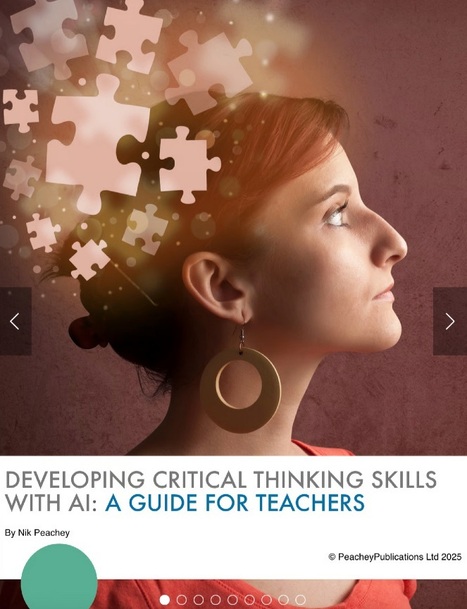
This groundbreaking book flips the script, showing how AI, when used wisely, can enhance rather than replace our students' thinking. Written by award-winning teacher trainer Nik Peachey, Developing Critical Thinking Skills With AI is your complete task-based guide to using AI tools like ChatGPT to cultivate logic, curiosity, and independent thought in your classroom. Via Nik Peachey
Scoop.it!

From
teachonline
Tools and Trends When Artificial Intelligence (AI) Becomes the First Source of “Confidence and Trust” in Learning March 16, 2026 Tools and Trends During a recent discussion, a colleague asked a retired educator: “What are the two feelings you most want your students to have toward you to be... Via EDTECH@UTRGV
EDTECH@UTRGV's curator insight,
April 24, 9:51 AM
During a recent discussion, a colleague asked a retired educator: “What are the two feelings you most want your students to have toward you to be effective?” The educator answered immediately: “Confidence and trust. Not engagement. Not motivation. Not achievement. Confidence and trust.” |