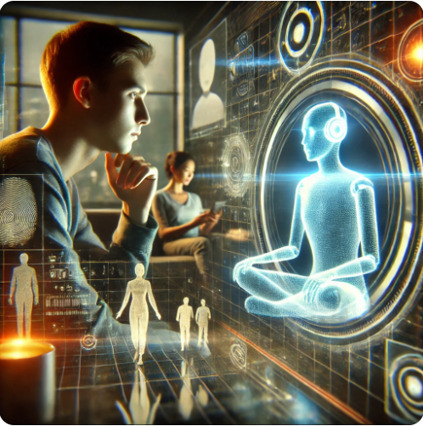
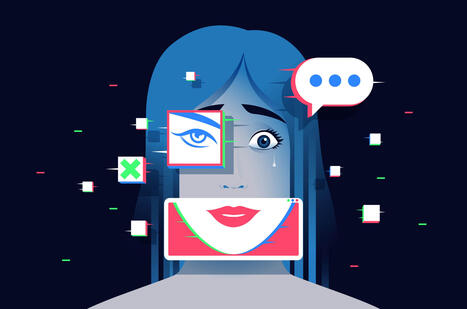
ReverseTHINKing thoughts Image created by ChatGPT, click please to enlarge. Introduction – When technology reflects who we are Over the past decade, I have published several articles and tutorials (2014–2025) offering alternative perspectives on the Internet and, more recently, on Artificial Intelligence. #RealWorld and #VirtualWorld are bidirectional.Each influences the other.In 2014, I published an article…
ReverseTHINKing thoughts Image created by ChatGPT, click please to enlarge. Introduction – When technology reflects who we are Over the past decade, I have published several articles and tutorials (2014–2025) offering alternative perspectives on the Internet and, more recently, on Artificial Intelligence. #RealWorld and #VirtualWorld are bidirectional.Each influences the other.In 2014, I published an article…
El texto ¿Y si la IA nos muestra el espejo de nuestra sociedad? plantea una reflexión profunda y provocadora sobre la inteligencia artificial no como una entidad autónoma y neutral, sino como un reflejo amplificado de los valores, sesgos y decisiones humanas. El autor sostiene que el verdadero riesgo de la IA no es tecnológico, sino cognitivo y ético, ya que los sistemas inteligentes reproducen los datos y las lógicas de poder con las que son entrenados (Mees, 2025). En este sentido, la IA actúa como un espejo que devuelve a la sociedad una imagen de sus propias contradicciones, miedos y ataques morales. Uno de los aportes más relevantes del texto es la idea de que el mundo virtual ha comenzado a moldear el mundo real, influyendo en la construcción de opiniones, emociones y juicios éticos. Cuando los ciudadanos delegan el pensamiento crítico a algoritmos optimizados para la eficiencia y la conveniencia, se genera un círculo vicioso que debilita la autonomía intelectual y la participación democrática (Mees, 2025). El autor advierte que la amenaza para la democracia no proviene de una IA autoritaria impuesta desde arriba, sino de una sociedad que renuncia voluntariamente al esfuerzo de pensar. En conclusión, el texto subraya que la IA constituye una auténtica prueba de estrés moral para la sociedad contemporánea. Su impacto dependerá menos de la tecnología en sí y más de la educación crítica, ética y cívica de los ciudadanos, capaces de cuestionar, reflexionar y asumir responsabilidad frente a los sistemas que utilizan.
Este artículo propone una mirada profunda y crítica sobre cómo la inteligencia artificial (IA) no es simplemente una herramienta neutral, sino un espejo de nuestros valores, sesgos y decisiones como sociedad. El autor plantea que la IA refleja fielmente las lógicas de poder, prejuicios y prioridades que están presentes en los datos con los que se entrena, lo cual tiene implicaciones éticas y culturales importantes. Desde una perspectiva educativa, este texto invita a cuestionar cómo usamos y enseñamos IA en los contextos de aprendizaje: si dejamos que algoritmos optimizados por conveniencia influyan en cómo pensamos o tomamos decisiones, corremos el riesgo de debilitar la autonomía intelectual del alumno. Relacionándolo con los contenidos de la asignatura de educación digital, este artículo subraya la importancia de cultivar una educación crítica, que no solo utiliza tecnologías emergentes, sino que también forme ciudadanos capaces de analizar y evaluar de manera ética y reflexiva las herramientas digitales. En resumen, más que temer a la IA en sí, deberíamos reflexionar sobre qué tipo de sociedad queremos construir y cómo podemos enseñar a las futuras generaciones a pensar críticamente sobre la tecnología y su impacto en nuestras vidas.
Learn how structured think-aloud methodologies help faculty assess higher-order critical thinking, metacognitive skills, and AI use in higher education.
"[I]f AI can generate essays and solutions, the focus of educators needs to shift from evaluating their final products to equipping and assessing students on critical thinking, self-regulation, and motivational skills. Effective assessment techniques need to provide insight into a learner’s thought processes in real time."
How can teachers use AI in practical, low-risk ways that will save them time and reduce their workload – without compromising their professional judgement?
“Your ability to ‘get good outcomes using AI’ tracks with your ability to ‘get good outcomes without AI.' AI does not replace strong teaching; it amplifies it. The educators who benefit most are those who use AI as a second thinker, a teaching assistant, or a proofreader – not as a decision-maker."
"[I]f we integrate AI thoughtfully — anchored in pedagogy, aligned with course content and designed to promote cognitive effort — we can help students build the skills that will matter most in an AI-integrated world: critical thinking, problem-solving and the ability to verify and challenge AI itself."
Learning in the AI age: Education 5.0 Patrick Blessinger Learning is for human flourishing, but only if we can see flourishing as something more than economic productivity, something more than employability, something more than credentials, though these things are very important.
"[K]nowledge is now universally abundant and available to everyone, but it is fragmented, contested, and increasingly filtered through algorithms.
The aim of learning today should be to move from survival to meaning, from authority to participation, from control to co-creation, from power to rights, and from fragmentation to coherence."
"Much of the conversation around artificial intelligence (AI) is framed in fear. White-collar professionals are increasingly anxious about AI replacing cognitive work once thought untouchable, a concern captured in The Atlantic’s piece on the worst-case future for white-collar workers. Blue-collar workers have their own version of this fear as employers test automation that shows up in the real world as robots and drones doing physical jobs once reserved for people, including delivery and warehouse work, like Amazon’s reported testing of humanoid delivery robots.
The anxiety is real. But what if we are asking the wrong question?"
"Publicly accessible generative artificial intelligence (AI) is predicted to transform how learners construct knowledge and the skills needed for professional success across industries...[T]his article explores learning through dialogue, supporting knowledge construction, leveraging AI tools, and implications for instructional designers and educators."
"In a world where access to information is practically endless, the mark of an expert educator will be the ability and the humility to embrace AI to 1) center learners throughout a learning experience; 2) facilitate knowledge construction with and among AI, learners, and other stakeholders; 3) support learners in applying what they know and identifying what they do not know; and 4) nurture critical thinking and problem-solving skills across all modalities."
The community for coaches, consultants, and educators who want to turn their frameworks and expertise into AI agents and workflows their clients can actually use.
In his May 29, 2024 class, Jiang Xueqin explains that an American invasion of Iran would be a catastrophic mistake:
If Trump were to win a second term, he would likely contemplate invading Iran. While an initial invasion would seem successful, American forces would quickly become bogged down in Iran's mountainous terrain.
The American invasion would be similar to Athens' invasion of Sicily in 415 BCE, as described in Thucydides' The Peloponnesian War. Despite its initial successes, the Athenians couldn't re-supply themselves, and their entire expedition was wiped out.
This disastrous defeat turned the war in Sparta's favor, and spelled the downfall of the Athenian empire.
Could the American empire in Iran suffer the same fate as the Athenian empire in Sicily?
"Navigating budget shortfalls and limited mental health staff, Interlachen Jr.-Sr. High School, where Phillips works, is using an AI platform to vet students’ mental health needs."
"The top-tier tools have consistently been super valuable for me—in my teaching, in my job at the City University of New York, and as a dad of two daughters. To save you the time and effort of sifting through the chaff, I’m sharing the ones I find most useful."
"[W]hen AI is designed as a tutor that asks questions instead of simply giving answers – and when students are also required to explain their reasoning to classmates – the technology can support learning rather than replace it."
"The tension between personalized learning demands and standardized evaluation mechanisms presents a persistent challenge in contemporary education. This study proposes a comprehensive personalized education assessment framework driven by generative artificial intelligence technologies. The framework adopts a five-layer hierarchical architecture integrating data collection, processing, intelligent analysis, assessment generation, and feedback optimization components."
"Experimental participants exhibited significantly higher learning gains (Cohen’s d = 0.56), with particularly pronounced effects among initially lower-performing students. The framework also enhanced learner engagement and satisfaction compared to conventional assessment approaches. These findings suggest that generative AI can effectively operationalize personalized assessment at scale while maintaining pedagogical quality and transparency."
"Dealing with students who plagiarize now seems like a piece of cake compared to ones who use AI to write their papers. I could usually deter students from plagiarizing by demonstrating how easy it is for teachers to find it...However, the rise of AI has completely changed that approach."
"Discouraging students from using AI involves a two-prong approach. First, they should see that it won’t help them pass the course. And second, they must realize they are missing opportunities for the teacher to help them actually improve their writing."
"Last Tuesday, I asked Claude to prepare a competitive analysis. Not in a chat window. Not through a prompt. I opened Cowork, pointed it to a folder on my desktop, and said what I needed. It read my files. It cross-referenced data from Slack through a connector. It pulled calendar context. It produced a document — formatted, structured, sourced — and saved it to my working folder. I didn’t open a single application. I didn’t navigate a single menu. I didn’t click through a single interface."
"Cowork reads files on your desktop, modifies documents, creates deliverables, and operates within your working folder — asking for confirmation before significant actions, working autonomously within defined boundaries."
Ce guide, destiné à toute personne en mesure de produire une ressource pédagogique (communauté enseignante, communauté étudiante, services supports, etc.), vise à vous accompagner sur le cycle de vie d’une ressource et de voir, pour chaque étape, comment limiter son impact environnemental, tout en conservant la qualité pédagogique de la ressource et son accessibilité.
"[L]ow-income urban school districts are also feeling the brunt of the E-rate expansion reversal — from both an infrastructure and affordability perspective."
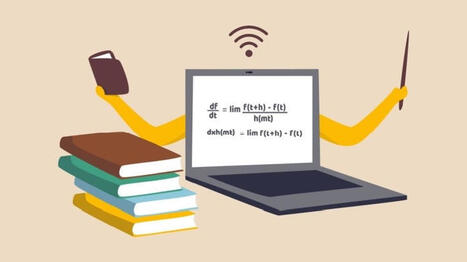
Learn why and how teachers can use generative AI to streamline lesson planning, personalize explanations, and automate retrieval practice—without losing instructional control.
Learn why and how teachers can use generative AI to streamline lesson planning, personalize explanations, and automate retrieval practice—without losing instructional control.
To get content containing either thought or leadership enter:
To get content containing both thought and leadership enter:
To get content containing the expression thought leadership enter:
You can enter several keywords and you can refine them whenever you want. Our suggestion engine uses more signals but entering a few keywords here will rapidly give you great content to curate.




 Your new post is loading...




















ReverseTHINKing thoughts Image created by ChatGPT, click please to enlarge. Introduction – When technology reflects who we are Over the past decade, I have published several articles and tutorials (2014–2025) offering alternative perspectives on the Internet and, more recently, on Artificial Intelligence. #RealWorld and #VirtualWorld are bidirectional.Each influences the other.In 2014, I published an article…
Learn more / En savoir plus / Mehr erfahren:
https://www.scoop.it/topic/21st-century-learning-and-teaching?tag=Gust-MEES
https://gustmees.wordpress.com/