 Your new post is loading...
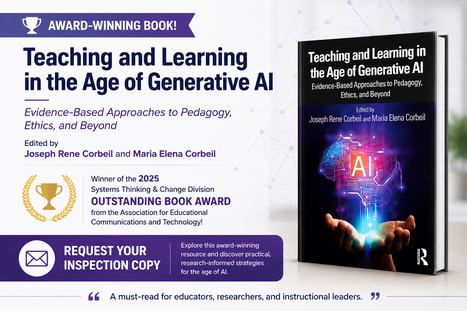
Looking for a Textbook on Generative AI in Education?
Teaching and Learning in the Age of Generative AI: Evidence-Based Approaches to Pedagogy, Ethics, and Beyond Edited by Joseph Rene Corbeil & Maria Elena Corbeil (2025) 🏆 Winner of the 2025 Systems Thinking & Change Division Outstanding Book Award from the Association for Educational Communications and Technology! If you are designing a course that addresses generative AI in education, this award-winning volume provides a research-driven, classroom-ready foundation. Rather than offering hype or fear, this book helps educators:
- Ground AI integration in learning theory and research
- Address academic integrity with thoughtful, practical strategies
- Redesign assessment for an AI-enabled world
- Explore ethics, bias, privacy, and institutional responsibility
- Leverage AI to enhance critical thinking and digital literacy
Bookended by historical and forward-looking analyses of AI in education, the chapters move beyond surface-level discussions to provide evidence-based approaches for real classrooms—K–12, higher education, and professional learning environments.
This text is ideal for:
- Undergraduate and graduate teacher education programs
- Curriculum & Instruction courses
- Educational Technology programs
- Higher education faculty development
- School technology coordinators and talent development professionals
Adopting a GenAI textbook for an upcoming semester? We invite you to request an inspection copy and explore how this resource can support your students in navigating AI with skill, ethics, and informed judgment.
Request your inspection copy today.

|
Scooped by
EDTECH@UTRGV
July 10, 11:36 AM
|
Aligned to existing ISTE standards and principles, the expanded Profile of an AI-Ready Graduate defines six roles and associated skills and practices students should have mastered when they graduate.
|
|
Scooped by
EDTECH@UTRGV
July 10, 11:31 AM
|
"Here’s the quip nobody wants on a mug: revolutions don’t build things. A revolution hands you a new way of seeing, a great story, and a merch table. The building happens after, and it’s slow and unglamorous and done entirely by the people willing to raise a hand and say this isn’t right yet. That’s evolution and that’s where the actual work lives. And here’s the part worth saying out loud: it worked."
|
|
Scooped by
EDTECH@UTRGV
July 9, 10:53 AM
|
An evolutionary psychologist is challenging the popular understanding of kids and technology.
|
|
Scooped by
EDTECH@UTRGV
July 9, 10:41 AM
|
Students take a photo of their environment, at school, home, or in the community, and ask AI to identify problems within that setting without offering solutions.
|
|
Scooped by
EDTECH@UTRGV
July 9, 10:36 AM
|
"Whether you lean into the topic or not, it’s undeniable that generative tools provide speed and scale (even when incorrect). Naturally, we gain efficiency in deliverables and process automation. The question is: what do we lose when we use AI?"
|
|
Scooped by
EDTECH@UTRGV
July 9, 10:30 AM
|
State education leaders outline how they've tried to ease anxieties about the fast-evolving technology.
|
|
Scooped by
EDTECH@UTRGV
July 8, 11:25 AM
|
Streaming solved the problem of access. Now, we must solve the problem of engagement.
|
|
Scooped by
EDTECH@UTRGV
July 8, 11:20 AM
|
Conversations with Kevin Hogan: Equal Opportunity Schools CEO AJ Gutierrez on why more than half of students ready for advanced coursework go unidentified and how combining survey data, predictive analytics, and human judgment can change that.
|
|
Scooped by
EDTECH@UTRGV
July 8, 11:16 AM
|
"There’s a moment, working with AI, when you stop knowing exactly what you’re doing. Not because you get lost technically, but because your relationship with the tool changes completely. That’s where something cracks. Not in the technology, but in our role."
|
|
Scooped by
EDTECH@UTRGV
July 8, 11:11 AM
|
Use of the AI-powered tools to boost students’ writing and studying skills comes with advantages and disadvantages.
|
|
Scooped by
EDTECH@UTRGV
July 7, 12:51 PM
|
Higher education was designed for a world in which access to knowledge, expertise, feedback, mentorship, and authentic learning experiences were inherently scarce. By making many forms of intelligence increasingly abundant, AI is inherently redefining the existing paradigm.
|
|
Scooped by
EDTECH@UTRGV
July 7, 12:47 PM
|
Two teachers learn what happens when they trust a tool to solve a problem.
|
|
|
Scooped by
EDTECH@UTRGV
July 10, 11:38 AM
|
"Typically, a company identifies a pain point (document processing, customer churn prediction, etc.) and spins up a proof of concept with a small team. It works in the lab, and leadership gets excited. Then it tries to operationalize it, and everything falls apart."
|
|
Scooped by
EDTECH@UTRGV
July 10, 11:33 AM
|
"As online education expands, educators face growing challenges in maintaining emotional connections with students while sustaining their own well-being. Emotional intelligence has long been recognized as a cornerstone of effective teaching, yet in digital spaces, cues are harder to read, and connection requires new strategies. This article explores how AI, when applied ethically, can amplify, not replace, the human touch in online classrooms"
|
|
Scooped by
EDTECH@UTRGV
July 10, 11:27 AM
|
Why most organizations measure deployment, but can't close the adoption gap—and the leadership discipline that changes outcomes.
|
|
Scooped by
EDTECH@UTRGV
July 9, 10:43 AM
|
Want to better understand how you're using Claude? Try this feature.
|
|
Scooped by
EDTECH@UTRGV
July 9, 10:40 AM
|
Brad Olsen and Jobin Thomas argue that EdTech is a tool, not a standalone solution, and it needs a proper support system to succeed.
|
|
Scooped by
EDTECH@UTRGV
July 9, 10:33 AM
|
"Now, many families and educators are having a tech rethink. Emerging research on the negative impact of student immersion in social media, and concerns about students becoming overly reliant on AI, have contributed to those anxieties. A nationally representative online survey conducted in February and March by the EdWeek Research Center captured this sentiment. It found that strong majorities of teachers and administrators in middle and high schools say that that the parents they’re in touch with believe the amount of time students spend with technology is too high."
|
|
Scooped by
EDTECH@UTRGV
July 8, 11:29 AM
|
"Rote memorization is a better way to learn things like math facts and vocabulary words than whatever the latest trendy method is at the moment."
|
|
Scooped by
EDTECH@UTRGV
July 8, 11:22 AM
|
Most social learning programs start and end with discussion boards. But real social learning looks nothing like a forum thread.
|
|
Scooped by
EDTECH@UTRGV
July 8, 11:18 AM
|
Learn practical strategies for managing technology change in higher education, reducing change fatigue, and partnering with IT to support teaching success.
|
|
Scooped by
EDTECH@UTRGV
July 8, 11:13 AM
|
Teacher burnout rates have remained high since COVID-19, but experts say artificial intelligence is still a promising solution if done right — and at scale.
|
|
Scooped by
EDTECH@UTRGV
July 7, 12:55 PM
|
AI must evolve beyond a simple information dispenser; it must design structured environments that respect human perceptual organization, guiding the learner seamlessly toward a comprehensive and lasting understanding of the whole.
|
|
Scooped by
EDTECH@UTRGV
July 7, 12:49 PM
|
"Today, we are releasing a fully fleshed out version, 30 skills aligned with each of these roles to help model using AI to support our uniquely human skills,” said Richard Culatta, CEO of the organization."
|
|
Scooped by
EDTECH@UTRGV
July 7, 12:45 PM
|
This article explores the cognitive science behind why the expert blind spot exists—and what L&D professionals can do about it.
|






















Interesting article about the use of AI to support teens’ mental health - With Teens Comfortable Confiding in AI, Should Schools Embrace It for Mental Health Care? https://www.edsurge.com/news/2026-03-03-with-teens-comfortable-confiding-in-ai-should-schools-embrace-it-for-mental-health-care