We asked 3,001 parents, 3,001 children and 300 teachers across six European countries how AI, technology and changing expectations are reshaping education.
AI tools may be evolving quickly, but we have a deep research base we can draw on to determine how they help meet—or undermine—any particular learning goal. Kathryn Palmer’s recent Inside Higher Ed article “The ‘Nonexistent’ Research on AI’s Benefits for Education” raises an important concern. Colleges and universities are investing heavily in generative artificial intelligence even though evidence about when, how or whether these tools improve student learning remains limited. Some studies even suggest that unguided use could undermine learning.
Google is disabling Search in schools that choose not to use its AI features. The company says it will turn Gemini, Gemini Notebook, Gemini in Classroom, and Google Search “entirely off” unless administrators turn them on.
OpenAI a annoncé que les utilisateurs de ChatGPT peuvent désormais verrouiller certaines conversations afin de renforcer la confidentialité lorsque d'autres personnes sont susceptibles d'avoir accès à leur écran ou à leur appareil.
Explore how the science of learning can guide AI in teaching and higher education, helping instructors support student learning with evidence-based strategies.
"When AI is used to scaffold learning by prompting students to explain their reasoning, offering feedback on drafts that students must then revise, or modeling problem-solving strategies, it can align well with what we know about effective learning."
La educación superior necesita estudios más rigurosos sobre la enseñanza y el aprendizaje centrados en la IA y los resultados del aprendizaje. Necesitamos estudios que vayan más allá de las actitudes, las percepciones y la adopción para examinar la transferencia, la retención y el desarrollo de habilidades a largo plazo. Ese trabajo llevará tiempo, y debería hacerlo.
Pero mientras tanto, debemos resistir la tentación de dejar que la incertidumbre nos empuje hacia extremos, ya sea un entusiasmo acrítico o una prohibición total. La ciencia psicológica ofrece un camino intermedio: una forma de evaluar las prácticas de IA con respecto a lo que ya sabemos sobre cómo funciona el aprendizaje. Si los profesores y las instituciones anclan las decisiones de IA en estos principios fundamentales, pueden actuar ahora con prudencia y, al mismo tiempo, permanecer abiertos a revisar sus enfoques a medida que crece la base de evidencia.
"New AI-powered summaries help teachers identify common questions, learning strengths and areas needing support, while Google also introduces direct publishing of Gemini-built apps to Google Sites"
"Teachers can now view an overall summary of student engagement, along with common themes from student interactions such as recurring questions, areas of strength and suggested areas for support. They can also review individual student chat transcripts for added context and to check the accuracy of the AI-generated insights."
"A student relying on AI throughout a course encounters a distinct set of failures at each stage of learning: hallucinations when gathering information, sycophancy when testing their understanding, over-automation that replaces rather than supports genuine learning during assignments, and feedback that overlooks the misconceptions, reasoning, and growth opportunities that a human instructor would recognize."
Un sondage effectué par YouGov pour le think tank européen Interface montre que les enfants de plus de 11 ans utilisent quasiment autant les IA génératives que leurs parents. Mais ceux-ci sous-évaluent cette fréquence d’utilisation. Les enfants souhaiteraient les utiliser moins souvent.
Discover practical strategies for redesigning assignments in the AI era, strengthening student learning, promoting academic integrity, and keeping teaching human-centered.
"A team of researchers wants to know whether artificial intelligence (AI) may hold the key to faster, more useful feedback that can improve teaching and learning."
Instead of banning AI and schools prescribing how students must learn, let's empower students to decide when technology helps, when it doesn't, and how they learn best. We're Asking the Wrong Questions About AI As schools respond to AI, I'm seeing a familiar pattern.
AI Trivia Time A quick, classroom-ready way to build AI literacy through questions, discussion, and play. AI Trivia Time is a free, educator-led trivia game that helps students explore important AI concepts without requiring student accounts or prior AI knowledge. Choose the age range that bes
"Many higher education institutions treat artificial intelligence (AI) in education as a single category. A four-layer framework helps institutional leaders distinguish AI adoption from AI readiness and identify gaps in AI policies and investments, including limited support for profession-specific AI competency."
The proposed framework distinguishes four layers of AI integration: AI for education, AI in education, AI of the profession, and AI literacy.
"While each answers a different question, serves a different audience, and has a different primary lead, all four should be coordinated under one institutional strategy."
"In the debate podcast vs. blog, start by thinking about what your learners need to learn, not just which format you prefer...the best approach is not to pick one format over another, but to make sure employees get the support they need when they need it."
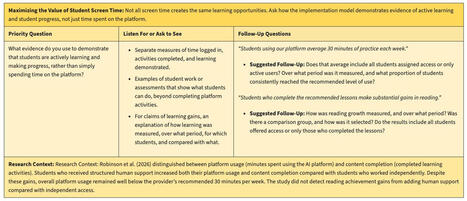
The goal of this guide is to help district leaders ask what it will take for students to consistently engage with and meaningfully benefit from an AI product in their schools. It complements existing district procurement processes by focusing on student engagement and the conditions needed to support it. The questions are informed by Robinson et al. (2026), "Access is Not Enough: Human Support Improves Engagement with AI Tutoring." They are discussion prompts, not a product evaluation rubric.
"Online learning has become increasingly popular in recent years, and students have a lot to say about what they want from their online courses.
A recent survey by McKinsey found that students want flexibility, social interaction, high-quality content, support, and value for money from online learning."
"[S]tudents globally cited these top-three reasons: fear of becoming more distracted by studying online, getting bored if the learning experience is not motivating, and lacking discipline to complete the online program."
The implementation of AI should not preclude universities from imparting skills that last a lifetime, including the ability to think critically, defend a conclusion and recognize when it is time to learn something new.
"Industries will change, technology will change and jobs will change. What can endure is the ability to think critically, exercise judgment, recognize gaps in one’s knowledge and determine how to close them."
To get content containing either thought or leadership enter:
To get content containing both thought and leadership enter:
To get content containing the expression thought leadership enter:
You can enter several keywords and you can refine them whenever you want. Our suggestion engine uses more signals but entering a few keywords here will rapidly give you great content to curate.


 Scoop.it!





 Your new post is loading...


















Learning analytics and data-driven education: A growing field