 Your new post is loading...
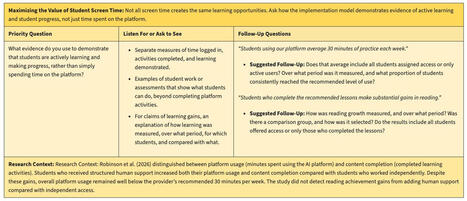
The goal of this guide is to help district leaders ask what it will take for students to consistently engage with and meaningfully benefit from an AI product in their schools. It complements existing district procurement processes by focusing on student engagement and the conditions needed to support it. The questions are informed by Robinson et al. (2026), "Access is Not Enough: Human Support Improves Engagement with AI Tutoring." They are discussion prompts, not a product evaluation rubric.
Via Dr. Tom D'Amico (@TDOttawa)
"Online learning has become increasingly popular in recent years, and students have a lot to say about what they want from their online courses. A recent survey by McKinsey found that students want flexibility, social interaction, high-quality content, support, and value for money from online learning."
Via EDTECH@UTRGV
Por Cristóbal Súarez Desde la popularización de la Inteligencia Artificial Generativa (IAG), nov de 2022, asistimos a un cambio -no solicit...
Via LGA
The implementation of AI should not preclude universities from imparting skills that last a lifetime, including the ability to think critically, defend a conclusion and recognize when it is time to learn something new.
Via EDTECH@UTRGV
Por Mercedes Leticia Sánchez Ambriz y Carlos Bravo Reyes Los avances en las herramientas de los ecosistemas de la inteligencia artificial g...
Via LGA

|
Rescooped by
michel verstrepen
from Digital Delights
October 22, 5:22 PM
|
The Q & A Series AI Isn't Just Taking Jobs.It's Making It Harder for People to Prove What They Can Do. Dr. Stephen Murgatroyd examines the most pressing questions around how AI is weakening the link between education, early-career work and the signals employers once trusted. Dr.
Via Ana Cristina Pratas
Google is expanding access to AI-generated STEM simulations, Deep Review document checking and Earth AI research tools. ETIH covers the pilots, access arrangements and research findings in this edtech news story.
Via EDTECH@UTRGV
L’entreprise de Mark Zuckerberg a été condamnée, suite à l’affaire Cambridge Analytica, à payer 25 milliards de dollars dans l’État américain du Nouveau-Mexique pour avoir menti à ses utilisateurs concernant la confidentialité de leurs données. C’est l’une des plus lourdes sanctions contre une entreprise du numérique jamais prononcées.
Via Intelligence Economique, Investigations Numériques et Veille Informationnelle
AI is quickly changing. These tips from university librarians can help people keep pace with the shifts as they approach their research.
Via EDTECH@UTRGV
This report documents the findings and methodology of the consensus research project on Generative AI's impact on learning in K-20 U.S. education.
Via Dr. Tom D'Amico (@TDOttawa)
Some people are abandoning office jobs for teaching, health care and the trades. But the new paths can come with trade-offs
Via EDTECH@UTRGV
Compare AI literacy courses for teachers in 2026: Flint, MagicSchool, Google, Microsoft Elevate, CodeAI, ISTE, Common Sense and OpenAI Academy. Cost, time, certificates and staff progress tracking.
Via Dr. Tom D'Amico (@TDOttawa)
|
Explore how the science of learning can guide AI in teaching and higher education, helping instructors support student learning with evidence-based strategies.
Via EDTECH@UTRGV
"New AI-powered summaries help teachers identify common questions, learning strengths and areas needing support, while Google also introduces direct publishing of Gemini-built apps to Google Sites"
Via EDTECH@UTRGV
As students increasingly turn to AI for learning, understanding its limitations is critical to ensuring it supports learning.
Via EDTECH@UTRGV
|
|
Rescooped by
michel verstrepen
from Digital Delights
October 22, 5:22 PM
|
Tools and Trends What Happens When Everyone Has an AI Tutor? October 16, 2026 Tools and Trends For most of human history, the best way to learn anything was to be rich. Alexander the Great had Aristotle. The children of merchants and aristocrats had governesses, masters and private tutors.
Via Ana Cristina Pratas
Fifty-nine percent of K-12 educators used AI tools last year, and 64% of them say it freed up time for the parts of the job that matter most to them.
Via Dr. Tom D'Amico (@TDOttawa)
OpenAI’s AI Skills Jams drew more than 1,600 US educators. Feedback from 802 participants found 92% left with reusable tools, while 29% wanted more hands-on time. ETIH’s edtech news coverage examines classroom examples and the limits of the findings.
Via EDTECH@UTRGV
Some of tech's most powerful leaders are treating AI like it's alive. It could have profound consequences for our world and your own personal safety.
Via EDTECH@UTRGV
"Early generative AI models, circa 2017-2022, were “stochastic parrots.” That is, they generated language by choosing the statistically most likely next word based on patterns in their training data, rather than truly understanding what they were saying. Beginning in 2023, artificial intelligence labs began releasing large language models (LLMs) that had evolved beyond autoregressive next-token prediction, as researchers call it. For many people, the stochastic parrot definition stuck."
Via EDTECH@UTRGV
"Muse hit 5 million downloads in just 3 weeks, even faster than long-established AI apps like OpenAI's ChatGPT, Anthropic's Claude, and Elon Musk's Grok. ChatGPT took 56 days to reach 5 million downloads; Claude hit the mark at 103 days; and Grok needed 492 days to reach the milestone."
Via EDTECH@UTRGV
"The scale of unauthorized or previously unknown actions by AI agents keeps getting bigger by the day. More than 100 organizations have now received a metaphorical knock on the door from OpenAI after it discovered their AI agents have in some way tampered with their systems, while other AI labs are finding the same uncomfortable discoveries. It’s caused many in the field to call for better, more robust accident investigators, with the ultimate aim of stopping such actions happening in the first place by understanding how they’ve happened at all. But any investigations are pointless if the AI can’t be tracked. And it’s increasingly difficult to do so."
Via EDTECH@UTRGV
|
























"[S]tudents globally cited these top-three reasons: fear of becoming more distracted by studying online, getting bored if the learning experience is not motivating, and lacking discipline to complete the online program."