 Your new post is loading...
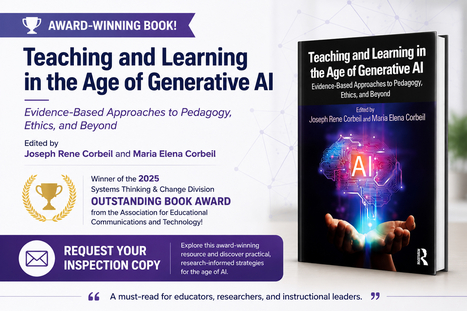
Looking for a Textbook on Generative AI in Education?
Teaching and Learning in the Age of Generative AI: Evidence-Based Approaches to Pedagogy, Ethics, and Beyond Edited by Joseph Rene Corbeil & Maria Elena Corbeil (2025) 🏆 Winner of the 2025 Systems Thinking & Change Division Outstanding Book Award from the Association for Educational Communications and Technology! If you are designing a course that addresses generative AI in education, this award-winning volume provides a research-driven, classroom-ready foundation. Rather than offering hype or fear, this book helps educators:
- Ground AI integration in learning theory and research
- Address academic integrity with thoughtful, practical strategies
- Redesign assessment for an AI-enabled world
- Explore ethics, bias, privacy, and institutional responsibility
- Leverage AI to enhance critical thinking and digital literacy
Bookended by historical and forward-looking analyses of AI in education, the chapters move beyond surface-level discussions to provide evidence-based approaches for real classrooms—K–12, higher education, and professional learning environments.
This text is ideal for:
- Undergraduate and graduate teacher education programs
- Curriculum & Instruction courses
- Educational Technology programs
- Higher education faculty development
- School technology coordinators and talent development professionals
Adopting a GenAI textbook for an upcoming semester? We invite you to request an inspection copy and explore how this resource can support your students in navigating AI with skill, ethics, and informed judgment.
Request your inspection copy today.

|
Scooped by
EDTECH@UTRGV
Today, 1:03 PM
|
As generative AI has become embedded in the tools students use to search, write, create, translate, organize, and receive feedback, the boundary between "using AI" and "not using AI" has become increasingly difficult to define. More importantly, treating AI use as a binary choice does little to help students understand the different roles AI can appropriately play in learning.
|
|
Scooped by
EDTECH@UTRGV
Today, 1:00 PM
|
"“Presence is a sense of being in a place and belonging to a group” [1]. This article is a comparative review examining the effects of social presence, as well as the importance of instructional immediacy, on student instructional success, and the necessity of considering learner gratification within traditional educational settings and emergency remote teaching (ERT) in higher education settings. Considerable research on the significance of social presence in the online learning community has been conducted, yet there is still much to learn."
|
|
Scooped by
EDTECH@UTRGV
Today, 12:54 PM
|
Why higher education needs trust, critical thinking, and authentic assessment, not surveillance alone.
|
|
Scooped by
EDTECH@UTRGV
October 29, 3:08 PM
|
Explore the podcast vs. blog discussion to determine which format best meets your learning needs and preferences.
|
|
Scooped by
EDTECH@UTRGV
October 29, 3:03 PM
|
"Exposure to artificial intelligence runs through the tasks you do each week, not the role on your badge. Here’s how to measure yours and lower the risk."
|
|
Scooped by
EDTECH@UTRGV
October 29, 2:58 PM
|
Aka, how to innovate the learning experience & improve outcomes with game design
|
|
Scooped by
EDTECH@UTRGV
October 28, 10:50 AM
|
Artificial intelligence is rapidly changing career paths so it's up to us to prepare students with skills that empower them across all fields and jobs
|
|
Scooped by
EDTECH@UTRGV
October 28, 10:46 AM
|
VR, AR and AI can expand training opportunities, but physical practice remains essential when workers must handle equipment, coordinate with teams and perform correctly in high-risk situations.
|
|
Scooped by
EDTECH@UTRGV
October 27, 9:25 AM
|
"New AI-powered summaries help teachers identify common questions, learning strengths and areas needing support, while Google also introduces direct publishing of Gemini-built apps to Google Sites"
|
|
Scooped by
EDTECH@UTRGV
October 27, 9:20 AM
|
Explore why relevance is the key to meaningful training engagement and how learning leaders can move beyond completion to build capability.
|
|
Scooped by
EDTECH@UTRGV
October 27, 9:15 AM
|
Being a student should be about more than completing assignments. Much ink has been spilled over how to respond to artificial intelligence use in education. Harvard College Dean David J. Deming frames cheating with AI as a “temptation”; students know it’s wrong, but we just can’t help ourselves — so assignments have to be restructured to make cheating impossible. We think this framing is mistaken. Instead, we should consider AI misuse to stem from the failure to cultivate curiosity in students."
|
|
Scooped by
EDTECH@UTRGV
October 27, 9:10 AM
|
"In schools around the world, AI is increasingly embedded in education technology to facilitate administration, teaching, learning and assessment. Curricula that promote the development of children’s AI knowledge, skills and/or values may be taught in a number of ways: as a required or elective subject; as part of information and communication technology (ICT)/information technology (IT) teaching; or as a cross-curricular or extra-curricular activity (UNESCO, 2022). None of this is inevitable nor universal."
|
|
|
Scooped by
EDTECH@UTRGV
Today, 1:05 PM
|
Nearly four-in-ten U.S. adults are in an online community. These virtual third spaces can take many forms, like Facebook groups, online video games or fandom forums on Reddit.
|
|
Scooped by
EDTECH@UTRGV
Today, 1:02 PM
|
As institutions work to set technology priorities and budgets for the year ahead, now is the time to determine what to add, what to consolidate, and where to get more from existing investments.
|
|
Scooped by
EDTECH@UTRGV
Today, 12:57 PM
|
"Practitioners know what good output looks like and should own the final call, with operations handling the plumbing."
|
|
Scooped by
EDTECH@UTRGV
October 29, 3:10 PM
|
Deciding whether students should use AI requires balancing safety with the developmental need to learn about managing risk.
|
|
Scooped by
EDTECH@UTRGV
October 29, 3:04 PM
|
And most employers prefer to hire workers with a college degree, even if the job doesn’t require one. Despite fears that AI will replace many entry-level white collar jobs, new data shows that many employers still want workers with a college degree.
|
|
Scooped by
EDTECH@UTRGV
October 29, 3:01 PM
|
"We see AI interfaces every day, and many of them already follow the basic best practices of designing for AI. But what happens when the task is more complex: when generating an answer takes minutes rather than seconds, and the subject of research has many sides to it?"
|
|
Scooped by
EDTECH@UTRGV
October 28, 10:52 AM
|
"Generative AI has made eLearning faster and cheaper to produce, but it can also make it easier to optimize for completion rates while neglecting capability. Organizations should judge AI-assisted training by what employees can actually do afterwards."
|
|
Scooped by
EDTECH@UTRGV
October 28, 10:49 AM
|
Discover how ChatGPT-powered job interview practice helps students build language skills, strengthen professional communication, and gain confidence through scaffolded learning.
|
|
Scooped by
EDTECH@UTRGV
October 28, 10:44 AM
|
Clearly, many aspects of everyday living have begun to change in the emerging, evolving age of AI. Higher education must acknowledge and adapt to those changes and anticipate the ones yet to come. Some faculty members fail to recognize that the world has changed and we must respond to those changes in how and what we do to prepare learners for their careers and personal aspirations. It is frustrating for many to be required to redesign their teaching content and methods in response to the larger worldwide technological changes. Yet, here we are—the world in fact has changed.
|
|
Scooped by
EDTECH@UTRGV
October 27, 9:23 AM
|
Ban or no ban, students are going to use AI. Let’s make sure they have the skills to navigate it, says Common Sense Media’s chief program officer.
|
|
Scooped by
EDTECH@UTRGV
October 27, 9:18 AM
|
A meta-analysis of gamified learning finds real but small effects, and shows which design choices make the difference. What that means for points, badges and leaderboards in your course.
|
|
Scooped by
EDTECH@UTRGV
October 27, 9:13 AM
|
"If you’ve been using AI at work this year, you’ve probably noticed something strange. You’re faster than ever, and your days aren’t any shorter."
|
|
Scooped by
EDTECH@UTRGV
October 26, 11:05 AM
|
"Online learning has become increasingly popular in recent years, and students have a lot to say about what they want from their online courses. A recent survey by McKinsey found that students want flexibility, social interaction, high-quality content, support, and value for money from online learning."
|
























"[S]tudents globally cited these top-three reasons: fear of becoming more distracted by studying online, getting bored if the learning experience is not motivating, and lacking discipline to complete the online program."