


Eventbrite - Lucy Gray & Steve Hargadon - The Global Education Conference Network/GlobalEd Events presents Global Education Fair Registration for Attendees - Friday, May 4, 2018 - Find event and registration information.

 Your new post is loading...
 Scoop.it! Eventbrite - Lucy Gray & Steve Hargadon - The Global Education Conference Network/GlobalEd Events presents Global Education Fair Registration for Attendees - Friday, May 4, 2018 - Find event and registration information. 
No comment yet.
Sign up to comment
Scoop.it!

When President Donald Trump and first lady Melania Trump arrived on the White House South Lawn Tuesday morning to formally welcome French President Emmanuel Macron and his wife, Brigitte, one thing was clear: The first lady commanded attention.
Scoop.it!

There are more American adults who have dropped out of college than who have dropped out of high school. Via Mel Riddile
Scoop.it!

As the CEO of one of modern society's most grandiose experiments struggles to put the pieces of his company back together, it remains to be seen if Facebook can ever regain the trust that it may have once had among end users.
Via Brian Yanish - MarketingHits.com
Scoop.it!

[You owe it to yourself to read this. Despite what I thought I knew, I found it harrowing. -JL]
"When I downloaded a copy of my Facebook data last week, I didn’t expect to see much. My profile is sparse, I rarely post anything on the site, and I seldom click on ads. (I’m what some call a Facebook “lurker.”) Via Jim Lerman
Scoop.it!
"Sir Nicholas Winton ... organised the rescue and passage to Britain of about 669 mostly Jewish Czechoslovakian children destined for the Nazi death camp."
"None of the other videos on-line show the complete story of Sir Nicholas Winton''s appearance on the 'That's Life' TV show. This video places all the various clips that are available in one place. It starts with an introduction featuring Sir Nicholas and Esther Ranzen the show's main presenter."
Dennis Swender's insight:
"Why did I do it? Why do people do different things. Some people revel in taking risks, and some go through life taking no risks at all." -- Sir Nicholas Winton, 1988
In light of escalating and largely unsubstantiated revelations of past and current political, ethical and moral misdeeds, it is a refreshing change to remember the courageous actions of individuals like the late Sir Nicholas Winton. This highly successful British stockbroker skipped a planned Swiss ski vacation to organize the mass evacuation and subsequent placements to England of 669 Jewish children from Czechoslovakia in 1938-39. Besides securing seven evacuation trains over a 7 month period, he found adoptive parents, secured entry permits and raised the funds to cover the costs of the children's transit. Whatever costs these donations didn't cover, Winton paid for out of his own pocket. Winton joins an impressive list of individuals (e.g., Norman Borlaug, Oskar Schindler, Mother Teresa) whose contributions to humanity far surpass the norm of benevolence and risk-taking. It is noted that Winton continued his humanitarian efforts with other groups.
Scoop.it!
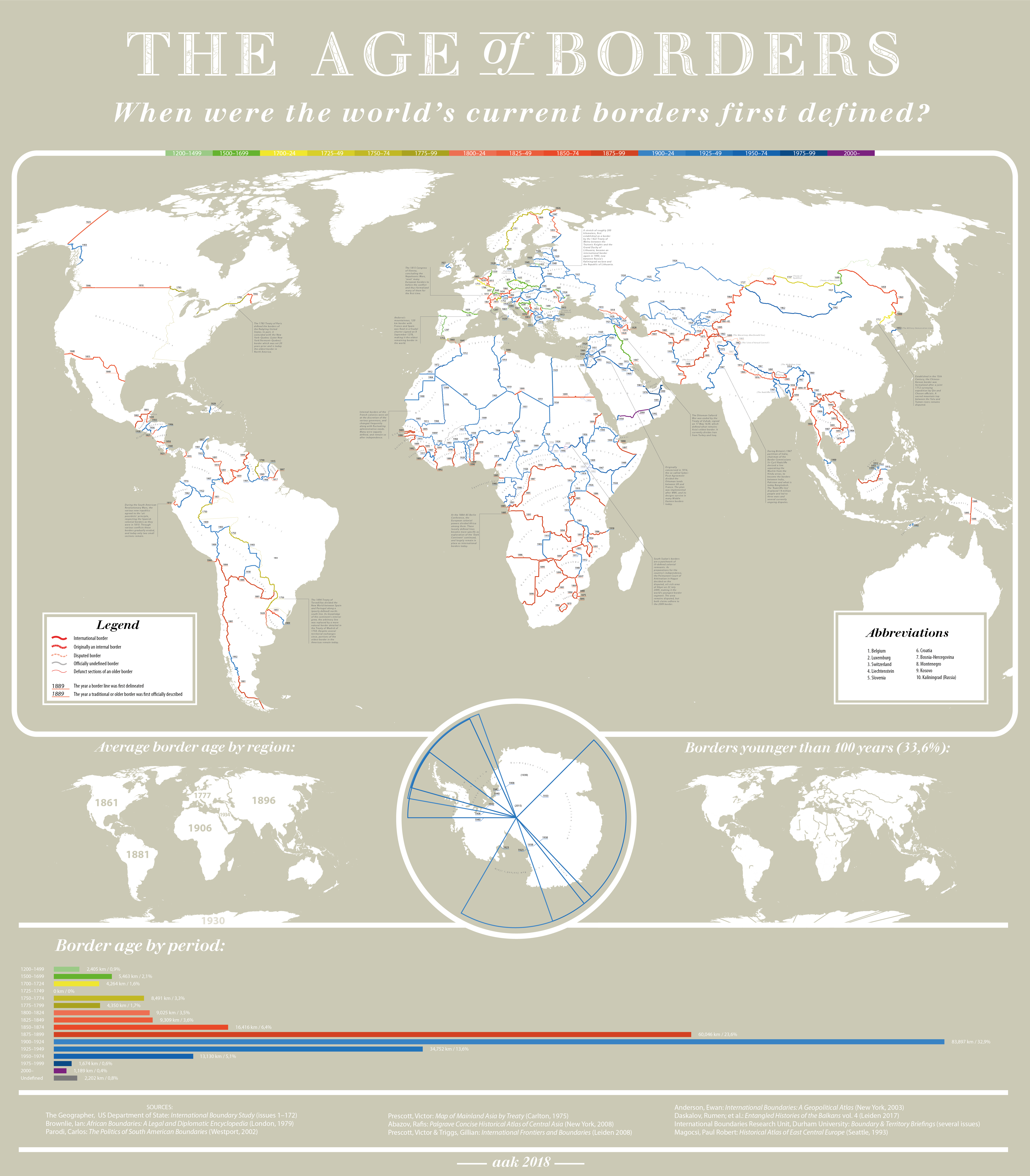
"The creation date of (almost) every international border. Full-size image here."
Tags: infographic, worldwide, borders, political, historical.
Scoop.it!

From
www

A list of videos, articles, and other resources to help librarians be more culturally literate.
Dennis Swender's insight:
Not just librarians, but students and educators as well.
Scoop.it!

Chris Hedges and Cornel West in Conversation: Wages of Rebellion by The New School on Livestream - Livestream.com
Scoop.it!

From Iran to Scotland, here's how 9 different countries celebrate April Fools' Day.
Scoop.it!

edWeb.net professional learning communities (PLCs) offer free webinars and CE certificates for educators. Join to get advice and exchange ideas with peers. Via Dr. Tom D'Amico (@TDOttawa)
Scoop.it!

April Fool’s Day is probably one of those classroom holidays you can’t escape—no matter how hard you try. So why not embrace it and teach your students a few things at the same ti…
Scoop.it!

A 2017 Case Western Reserve Law Review by JD Candidate Katlyn Ayn Patton
Dennis Swender's insight:
Note references to Tinker v. Des Moines Independent Community School District (1969), Hazelwood School District v. Kuhlmeier (1988), Bethel School District v. Frazer (1986), Burch v. Barker, Morse V. Frederick, and "in loco parentis" doctrine.
|
Scoop.it!

By now most of us are aware that the quality of our learning depends on a number of different factors, some of which are easier to control than others. But the more we understand about why and how everyday things can affect our ability to commit new information to memory, the more effective our learning will be. Via Elizabeth E Charles
Scoop.it!

How the new federal funds could help.
I’ve never heard a student or professor complain that a book didn’t cost enough. Complaints about textbook costs have been around at least since the 80’s, and probably before that I know because I remember making them myself. And yet, adoption of OER has been slower than many of us had hoped.(...) - Inside Higher Ed, by Matt Reed, 2018/03/28 Via ESR_Info
Scoop.it!

Scoop.it!

Introductory courses can open doors for students, helping them not only discover a love for a subject area that can blossom into their major but also feel more connected to their campus. Via Kim Flintoff

Kim Flintoff's curator insight,
April 18, 2018 6:05 PM
Introductory courses can open doors for students, helping them not only discover a love for a subject area that can blossom into their major but also feel more connected to their campus. But on many campuses, teaching introductory courses typically falls to less-experienced instructors. Sometimes the task is assigned to instructors whose very connection to the college is tenuous. A growing body of evidence suggests that this tension could have negative consequences for students.
Scoop.it!

From
jarche
Even after four years of study, many students leave their institutions of higher learning only to find themselves inadequately prepared for what is next. University graduates often go on to get a certificate in an applied area in hopes of getting a job. Frequently graduate students who do not go into academia will find themselves adrift. Via Edumorfosis
Scoop.it!

Communicating meaningfully is becoming more difficult than ever before. While technology has created an ever increasing number of ways to communicate rapidly over great distances, people are now so insulated and protected by these devices that we’re losing the skills and abilities to communicating in the most influential way – face-to-face. There’s a real danger to the maintenance of meaningful communications and personal and professional relationships. If you become overly dependent on email or text messages, you focus on the object – not the person. These messages are typically short, sequential and directed. There’s no instantaneous interaction or connection that allows the other person to understand the tone, inflection or emotion that is carried with the words. The sender cannot express or effectively project the elements of trust, confidence, credibility and concern that are crucial to developing and building a relationship. That failure to communicate face-to-face has a phenomenal impact on business and success. There are certain topics of conversation where face-to-face communication will absolutely be the best way to achieve clarity and understanding needed for beneficial action, for example: • Negotiating salaries, vacations and termination • Resolving a dispute or a conflict between two or more people or organizations • Seeking clarification after written communications has failed Communicating with impact and influence face-to-face also requires discipline, determination and self-control. Begin with the following eight must have steps: 1. Make your time together count. Everyone has the right to speak. Earn the right to be heard. Think about what you want to say before you say it. Every word counts. Tailor what you say to meet your listeners’ needs. 2. Pay attention by listening for the unspoken emotions. Do not let your eyes dart away and drift off, since that signals you are no longer paying attention. Wait to speak only when the person has finished what they want to say. Hear their words and read their face so that you gain maximum understanding of the why behind their words. 3. Honor the other person’s time. Prepare ahead of time. Match the message to the opportunity. Get to the point quickly. Don’t frustrate your listener by taking too long to get the key message across. Avoid rambling and cluttering your message with unnecessary points. Ask for a clear and specific action. Watch the time. Don’t take 20 minutes when you only asked for 10. 4. Prepare for your face-to-face meeting ahead of time. KNOW your listener. What do they: • K - Know about your topic? • N - Need to know to take the action you want them to take in the time frame you have for this conversation? • O - Opinion about your topic? • W - Who is your listener? What additional information do you know about your listener to help you customize your message for them? Tailor your agenda and message to achieve the understanding you need and to influence your listener to take action. 5. Watch your body language. Avoid non-verbal abuse. Every movement you make counts. Your behavior and non-verbal cues are as important as the words you say. Don’t fidget, act nervous or allow your posture to convey uncertainty, insincerity, or dismay. 6. Be sincere and authentic. Speak in your authentic voice. Be genuine and allow others to see the real you. 7. Maintain the power of the floor. Be interesting and remain interesting. You are losing your listeners if they: • Begin working on their Blackberry, iPad, iPhone, etc. • Start nodding off • Start side conversations • Interrupts you When any of the above scenarios happen, Stop! Break the flow! Earn their attention! Get back on track! 8. Ask for specific feedback about the points you raised, the manner in which you presented, the way you responded. Ask for balanced feedback about how to improve and immediately begin applying this feedback. Technology-driven communication will improve if you first focus on improving the most important method first – face-to-face communication.
Scoop.it!

What makes students think that the workload in a course is heavy or light? Sometimes it’s the amount of content and the array of different topics covered in the course. However, it can also be that the course covers complex content or content students find difficult which gives it that heavy label. Via EDTECH@UTRGV

EDTECH@UTRGV's curator insight,
April 5, 2018 7:46 PM
How much of the work we require from students is essential?
Scoop.it!

Faculty are increasingly hired on the Walmart model as temps.
Via Jules Rochielle
Scoop.it!

A new video is released for a congressional briefing.
Via Jules Rochielle
Scoop.it!

The Senate has voted 97–2 to advance the Stop Enabling Sex Traffickers Act, a controversial initiative meant to crack down on sex trafficking on the internet.
Scoop.it!

Poverty, disease, murder, racism, and environmental destruction, oh my! Despite daily news headlines, Steven Pinker argues all these bad things are getting progressively better.
Scoop.it!

Is your alma mater the most beautiful high school in your state?
|






