ED 262 KCKCC Su '26
5.8K views | +10 today
ED 262 KCKCC Su '26
Your new post is loading...
Scooped by Dennis Swender
May 31, 2018 2:25 PM
Scoop.it!

NAEP Mathematics and Reading Highlights

NAEP Mathematics and Reading Highlights | ED 262 KCKCC Su '26 | Scoop.it
The 2017 grades 4 and 8 mathematics and reading results are in!
No comment yet.
Scooped by Dennis Swender from Daily Magazine
May 31, 2018 1:50 PM
Scoop.it!

Build Empathy with Listening and Tolerance  

What can you do to build and sustain empathy?

A suggestion: Cultivate listening and tolerance in your organisation.


• Making the effort to encourage listening and tolerance – and modelling these behaviours for others – will build empathy and rapport, and eventually motivation and trust.

• The sad fact is, listening and tolerance for other points of view are slowly disappearing.


Via Edwin Rutsch, THE OFFICIAL ANDREASCY
No comment yet.
Scooped by Dennis Swender
May 23, 2018 1:41 PM
Scoop.it!

How Unequal School Funding Punishes Poor Kids

How Unequal School Funding Punishes Poor Kids | ED 262 KCKCC Su '26 | Scoop.it

"School budgets are moral documents, revealing not only how much society values education as a public good, but how we value the children of different communities. Today, with a reactionary administration seeking to privatize public education further, children living in extreme deprivation stand to lose the most."

No comment yet.
Scooped by Dennis Swender
May 21, 2018 1:36 PM
Scoop.it!

School Spending Per Pupil Increased by 3.2 Percent

School Spending Per Pupil Increased by 3.2 Percent | ED 262 KCKCC Su '26 | Scoop.it
The amount spent per pupil for public elementary-secondary education increased by 3.2 percent to $11,762 during the 2016 fiscal year.
Dennis Swender's insight:
To see the top 10 school districts by current spending per pupil, see the graphic Top 10 Largest School Districts by Per Pupil Current Spending:  http://www.census.gov/library/visualizations/2018/comm/school-finances.html
No comment yet.
Scooped by Dennis Swender
May 21, 2018 1:08 PM
Scoop.it!

My Congressional District

My Congressional District | ED 262 KCKCC Su '26 | Scoop.it
An interactive web tool that provides access to selected statistics about your Congressional district.
Dennis Swender's insight:
Includes population and other demographics, e.g., housing, workers, socio-economic, education, businesses
No comment yet.
Scooped by Dennis Swender from Top Universities
May 14, 2018 11:15 PM
Scoop.it!

Top Universities In The World 2018  

Top Universities In The World 2018   | ED 262 KCKCC Su '26 | Scoop.it

A number of top universities in the world 2018 list is published on collewikipedia.com. They are providing information regarding best universities you need to refer to when deciding which universities to apply to. If you really want to be among the best of the best, visit our website now.


Via College Wikipedia
No comment yet.
Scooped by Dennis Swender from Collaborationweb
May 14, 2018 1:47 PM
Scoop.it!

Problems are Interconnected -- And so are Solutions - The Donella Meadows Project

Problems are Interconnected -- And so are Solutions - The Donella Meadows Project | ED 262 KCKCC Su '26 | Scoop.it
The way it is usually told, the message Everything is Connected to Everything Else is not fun to hear. It is intended to cause repentance and reformation. More often, of course, it causes guilt, fear, and an uncontrollable urge to avoid environmentalists.

What we are rarely told is that solutions are as interconnected as problems. One good environmental action can send out waves of good effects as impressive as the chain of disasters that results from environmental evil.

Take energy efficiency, for example. That doesn’t mean deprivation of creature comforts; it means insulating houses, driving cars with better mileage, and plugging in appliances that deliver the same service for less electricity. Amory Lovins of the Rocky Mountain Institute says we could reduce electricity use in the U.S. by 70% with already-proven and currently-economic efficiency measures. We could cut our $430 billion annual energy bill in half just by being as efficient as Japan and West Germany are.

Via David Hain
Ian Berry's curator insight, June 30, 2017 7:34 PM
Good reminder of the power of both/and. When it comes to solutions to problems acceptance of both/and is often the key to finding the third alternative
Sunny Ye's curator insight, July 15, 2017 2:32 AM
The butterfly effect
Scooped by Dennis Swender from Collaborationweb
May 14, 2018 1:46 PM
Scoop.it!

Collaborative working and the benefits it brings

Collaborative working and the benefits it brings | ED 262 KCKCC Su '26 | Scoop.it

From winning sports teams to globally successful businesses, there are so many examples of how collaboration in teams can produce incredible results. Building and developing a collaborative culture within your team is key to improving the share of knowledge throughout your business, which will ultimately lead to a more efficient working environment. Whilst many people like the idea of working in a collaborative environment, they aren’t always willing to undertake the investment required to establish a fully collaborative workforce. 

As the working world becomes increasingly global, and teams are split across different geographies and time zones, the need for collaboration has never been so important. With new technologies and cloud-based systems offering teams the ability to communicate information and share knowledge, businesses should utilise the opportunities available to improve the collaboration amongst their teams. 


Via David Hain
No comment yet.
Scooped by Dennis Swender from Collaborationweb
May 14, 2018 1:43 PM
Scoop.it!

Random Acts Of Leadership™ | Collusion vs Collaboration

Random Acts Of Leadership™ | Collusion vs Collaboration | ED 262 KCKCC Su '26 | Scoop.it
A group of talented individuals does not necessarily translate into a high performing team.  That’s why sometimes the underdog seemingly comes out of nowhere to win.  In fact, high performing teams know that to succeed they must depend on each other as much, if not more, than their individual talents.

Perhaps even more importantly, they act as if their success is dependent on the success of others.  They also believe that they can truly count on each other to do what is best for their team, to be treated with respect and fully supported no matter what.


The answer to this one question – can we count on each other when it really counts – can reveal whether your team is colluding for mediocrity or collaborating for greatness.

Via David Hain
No comment yet.
Scooped by Dennis Swender
May 14, 2018 1:21 PM
Scoop.it!

Student ROI more dependent on degree than status of institution

Student ROI more dependent on degree than status of institution | ED 262 KCKCC Su '26 | Scoop.it

"When it comes to student return on investment, differences in marketplace value among fields of study means that students are often able to earn higher salaries with significantly less education, because what they make no longer depends on 'how many degrees'" are earned or 'where you go to college,' said Anthony Carnevale, director of Georgetown University's Center on Education and the Workforce, during a recent episode of 'In Focus' from Georgetown's School of Continuing Studies.".
"

Dennis Swender's insight:
"More is less" -or-"less is more," more or less
No comment yet.
Scooped by Dennis Swender from Leading Schools
May 7, 2018 1:14 PM
Scoop.it!

School shooting: ‘discipline policies made it nearly impossible to suspend students’

School shooting: ‘discipline policies made it nearly impossible to suspend students’ | ED 262 KCKCC Su '26 | Scoop.it
Broward County Public Schools "had rewritten its disciplinary policies to make it nearly impossible to suspend, expel, or arrest students for behavioral problems including criminal activity."

Via Mel Riddile
No comment yet.
Scooped by Dennis Swender
May 3, 2018 2:30 PM
Scoop.it!

Where to Work in Education

Where to Work in Education | ED 262 KCKCC Su '26 | Scoop.it
There are many jobs to choose from within education, and a deep need for excellent people. This guide to the (not always simple) landscape of education careers should help you navigate the field and find the place where you fit best.
Scooped by Dennis Swender from Edumorfosis.it
May 1, 2018 2:16 AM
Scoop.it!

5 eLearning benefits for students opting for Online Learning

5 eLearning benefits for students opting for Online Learning | ED 262 KCKCC Su '26 | Scoop.it

One of the important benefits of this type of learning is the education backup that helps students to recover lost files. The potential and contribution of an educational backup and online learning are extremely beneficial and overwhelming for a student.


Via Edumorfosis
No comment yet.
Scooped by Dennis Swender from Creative teaching and learning
May 31, 2018 2:04 PM
Scoop.it!

Why Walmart is paying for employees to go to college

Why Walmart is paying for employees to go to college | ED 262 KCKCC Su '26 | Scoop.it

"Subsidizing workers’ tuition is a good marketing move—and it should also help with the retail giant’s abysmal retention rate ..."


Via Leona Ungerer
No comment yet.
Scooped by Dennis Swender
May 29, 2018 12:10 AM
Scoop.it!

Four Rules for Learning How to Talk To Each Other Again

Four Rules for Learning How to Talk To Each Other Again | ED 262 KCKCC Su '26 | Scoop.it
Leading an evidence-based life just might help us have a less-polarized national conversation.
No comment yet.
Scooped by Dennis Swender from Daily Magazine
May 21, 2018 1:37 PM
Scoop.it!

New Starbucks policy: No purchase needed to sit in cafes | abc7chicago.com

New Starbucks policy: No purchase needed to sit in cafes | abc7chicago.com | ED 262 KCKCC Su '26 | Scoop.it
Starbucks announced a new policy Saturday that allows anyone to sit in its cafes or use its restrooms, even if they don't buy anything.

Via THE OFFICIAL ANDREASCY
No comment yet.
Scooped by Dennis Swender
May 21, 2018 1:26 PM
Scoop.it!

States Leading Per Student Spending

States Leading Per Student Spending | ED 262 KCKCC Su '26 | Scoop.it
Current expenditures for public elementary-secondary school systems.
No comment yet.
Scooped by Dennis Swender from eflclassroom
May 15, 2018 1:16 PM
Scoop.it!

Using Image Prompts to Inspire Writing & Speaking Activities by @NikPeachey

Using Image Prompts to Inspire Writing & Speaking Activities by @NikPeachey | ED 262 KCKCC Su '26 | Scoop.it

Via Dr. Tom D'Amico (@TDOttawa) , Juergen Wagner
Ttoo2's curator insight, September 21, 2017 12:04 PM
This has been demonstrated numerous times in my time as an educator. Reminders are always good!! 
Scooped by Dennis Swender from Top Universities
May 14, 2018 11:15 PM
Scoop.it!

Top University In US

Top University In US | ED 262 KCKCC Su '26 | Scoop.it

Find the Top University in US for quality education and affordable tuition fees with collegewikipedia.com.We have compiled a list of Top Universities in United States according to their web ranking based on the popularity of the University.If you are interested in studying in US, Visit our website.

3

Via College Wikipedia
No comment yet.
Scooped by Dennis Swender from Collaborationweb
May 14, 2018 1:47 PM
Scoop.it!

You Do Not Think Alone

You Do Not Think Alone | ED 262 KCKCC Su '26 | Scoop.it
“The Thinker,” Auguste Rodin’s bronze sculpture, has become a visual cliché, a common representation of deep thought — a figure, gazing down, chin on hand, completely alone. This is utterly misleading, according to the authors of “The Knowledge Illusion,” which carries the subtitle: “Why We Never Think Alone.” Steven Sloman, a professor at Brown University, and Philip Fernbach, a professor at the University of Colorado’s Leeds School of Business, argue that our intelligence depends on the people and things that surround us, and to a degree we rarely recognize. Knowledge, they say, is a community effort. Sloman answered questions from Mind Matters editor Gareth Cook. 

Via David Hain
No comment yet.
Scooped by Dennis Swender from Collaborationweb
May 14, 2018 1:46 PM
Scoop.it!

Two heads are better than one: why collaboration is key to disruption

Two heads are better than one: why collaboration is key to disruption | ED 262 KCKCC Su '26 | Scoop.it
Now, an increasing number of start-ups and established companies are realising the benefits of collaboration.

Challenging, rather than collaborating, leads to the demise of many start-ups, which fail to understand how their industry operates and how best they can maximise their place within it. Having a great idea is essential but, if we can combine this with buy-in from organisations who already possess power, we’re really cooking with fire.

It’s a simple concept: if a start-up shares the same goals as its more-established counterparts, it should seek to work collaboratively in order to drive real change. We are achieving this by collaborating with relevant industry bodies in health, progressing our mission to change the way the world views health and wellness, and this same approach can be adopted by entrepreneurs across many different industries.

Via David Hain
No comment yet.
Scooped by Dennis Swender from Collaborationweb
May 14, 2018 1:43 PM
Scoop.it!

How to Collaborate When You Don’t Have Consensus

How to Collaborate When You Don’t Have Consensus | ED 262 KCKCC Su '26 | Scoop.it
The conventional model of collaboration in business is to go to a lot of meetings to try to get agreement on five things:

What is our common purpose?
What is the problem?
What is the solution to the problem?
What is the plan to execute the solution?
Who needs to do what to execute the plan?


Answering these questions typically involves a delicate dance of managerial authority and employee adaptation. A boss may have a solution in mind, but could face potential downsides by enforcing it unilaterally. Those who disagree may drag their feet in implementing the plan or otherwise sabotage the team’s efforts. So instead, teams collaborate: A boss leads everyone to see the problem the same way (probably the way the boss does), and then to agree on a way forward.

But what if the people in the room are working at cross-purposes? What if they can’t even agree on what the problem is, much less how to solve it? What if there is low trust among them, and no one who can control the situation? What if the only thing people can agree on is that the situation is unacceptable and must be changed?


Via David Hain
Dennis Swender's insight:
Applicable for the earlier  "Agree-Disagree" exercise?
No comment yet.
Scooped by Dennis Swender from Educational Technology News
May 13, 2018 2:16 AM
Scoop.it!

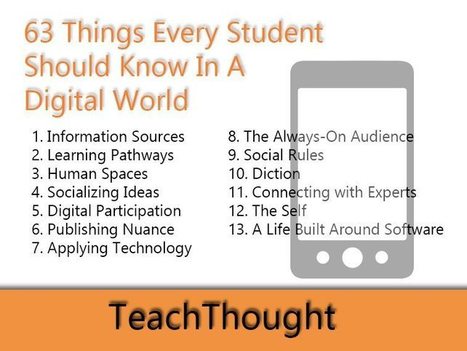
63 Things Every Student Should Know In A Digital World

63 Things Every Student Should Know In A Digital World | ED 262 KCKCC Su '26 | Scoop.it

"It could be argued—and probably argued well—that what a student fundamentally needs to know today isn’t much different than what Tom Sawyer or Joan of Arc or Alexander the Great needed to know.


Communication.Resourcefulness.Creativity.Persistence.


How true this turns out to be depends on how macro you want to get. If we want to discuss our needs as humans in broad, sweeping themes, then food, water, shelter, connectivity, safety, and some degree of self-esteem pretty much cover it.


Via EDTECH@UTRGV
No comment yet.
Scooped by Dennis Swender from Into the Driver's Seat
May 5, 2018 11:51 PM
Scoop.it!

3 vital ways to measure how much a university education is worth

3 vital ways to measure how much a university education is worth | ED 262 KCKCC Su '26 | Scoop.it

"...we asked our panel of presidents – from the University of Michigan, University of Oregon and The Ohio State University: If you had to devise just one tool or metric to help the general public assess the value of a particular college or degree, what would it be and why?"


Jim Lerman's insight:


To me, these are interesting and important perspectives and, perhaps, a bit surprising.


Via Jim Lerman
No comment yet.
Scooped by Dennis Swender from Edumorfosis.it
May 1, 2018 12:51 PM
Scoop.it!

The what, how and why of university education (Peter McPhee) 

Higher education is going through a time of great change. Some people have begun to question the role that universities play in today's society. Peter McPhee takes a step back in order to explore three fundamental questions: What is higher education? How should we teach in the 21st century? And why does higher education matter? Professor McPhee draws on his extensive experience in the sector to offer a global perspective on the role of higher education in the world today.

Peter McPhee is an academic and former Provost of the University of Melbourne. He has also published widely on the history of France.


Via Peter Mellow, Edumorfosis
No comment yet.