 Your new post is loading...

|
Rescooped by
Dennis Swender
from Top Social Media Tools
January 9, 2016 3:54 AM
|
But I’m going to assume that you have at least a decent grasp of how to manage your team and content strategy.
Instead, I want to focus on the second main point – tools.
I’m going to share with you 15 tools that can help you create better content as a team, while minimizing the chance of mistakes.
You definitely won’t need all of them, but you’ll probably want to use at least one from each of the four main classes of tools.
Via Jeff Domansky
|
|
Rescooped by
Dennis Swender
from Edumorfosis.it
January 9, 2016 3:52 AM
|
The challenge for human resources officers to provide upgraded training materials to a workforce that can be scattered across many states and countries is tough, especially when budgets are limited. By using eLearning mobile apps that allow employees to learn on their terms and their location choices, you can take down impediments to ensuring each employee has the same access to learning materials, regardless of where they work and what shift they are on.
Here are four of the most innovative eLearning mobile apps for your employees. They will allow you to implement innovative training programs without starting from scratch to build your own app or crippling your budget. Some are even free. If you have to revolutionize the way you train employees but don't want to re-invent the wheel, these apps are for you.
Via Edumorfosis
|
|
Rescooped by
Dennis Swender
from Edumorfosis.it
January 9, 2016 3:50 AM
|
Instructional design is the way that we organize eLearning. It’s the way we take a block of content and refine it into a learning project with value, strategy, goals, and measurable outcomes. The Why Good Instructional Design Infographic presents very practical points to help your company understand the ‘why’ of good instructional design and give it the respect it deserves.
Good Instructional Design helps you and your learners to understand your business: Good Instructional Design maximizes learner engagement: Instructional Designers know how to select and prioritize: Training is a science, not an artInstructional Designers don’t just get results; they measure them too
Good learning objectives have to be measurable and performance-based, and they have to demonstrate a real improvement. Instructional Design encompasses some different methods to analyze exactly what learners have gained from an eLearning program.
Without talented instructional design, an eLearning project might not fail, but it won’t meet it’s potential. Hopefully, you can use this information to turn your company into ID black belts, and start using eLearning that changes your organization and makes you and your colleagues happier, more productive, and highly skilled individuals.
Via Edumorfosis
|
|
Rescooped by
Dennis Swender
from Edumorfosis.it
January 9, 2016 3:48 AM
|
The future is not a fixed point. It is ours to create. This forecast previews five disruptions that will reshape learning over the next decade. Responding to them with creativity rather than fear will be critical to preparing all learners for an uncertain future.
An explosion of innovation has been transforming how we think about learning and how we organize talent and resources for learning experiences and has effectively unbundled “school” as we knew it. The tightly bound relationships and resource flows that used to deliver instruction, develop curriculum, perform assessment, grant credentials, and provide professional development are dissolving. Teaching and learning have become uncoupled from traditional educational institutions and are now available through and enhanced by a vibrant learning ecosystem.
Across industries and institutions, the digital explosion has caused a similar breakdown of traditional assumptions, models, and relationships. It has also created unexpected possibilities for those willing to experiment with the novel recombination of resources, talent, and technology. For example, cities struggling to do more with less have been reorganizing to systematically take advantage of citizen contributions.
Publishers faced with declining revenue models have been restructuring to leverage tablet computing and social media applications. U.S. board-certified doctors have been reorganizing resources so as to be available to patients 24/7 via mobile communications and video conferencing in order to improve access to healthcare.
Via juandoming, Edumorfosis
|
|
Rescooped by
Dennis Swender
from Edumorfosis.it
January 9, 2016 3:47 AM
|
Our public service allows you to create realtime chat rooms based on twitter hashtag. Invite users and perform the presentations online without any additional software! Add your friends or colleagues to help you with moderation.
All you need is to sign in with twitter.
Via Edumorfosis
|
|
Rescooped by
Dennis Swender
from Edumorfosis.it
January 9, 2016 3:46 AM
|
Well, there you have it – 27 powerful ideas for integrating technology into lessons, assignments, projects, etc., in fun, meaningful ways. And if these tools and ideas aren’t enough to keep you busy exploring and having fun with your students throughout the year, be sure to stop back regularly for more great ideas, tools, and resources!
Via Edumorfosis
|
|
Rescooped by
Dennis Swender
from Educación a Distancia y TIC
January 9, 2016 3:34 AM
|
In all the discussion about learning management systems, open educational resources (OERs (link is external)), massive open online courses (MOOCs (link is external)), and the benefits and challenges of online learning, perhaps the most important issues concern how technology is changing the way we teach and - more importantly - the way students learn. For want of a better term, we call this “pedagogy.” What is clear is that major changes in the way we teach post-secondary students are being triggered by online learning and the new technologies that increase flexibility in, and access to, post-secondary education. In looking at what these pedagogical changes are and their implications for students, faculty, staff, and institutions, we consider:
Via manuel area, LGA
|
|
Rescooped by
Dennis Swender
from Into the Driver's Seat
December 7, 2015 10:46 AM
|
|
|
Rescooped by
Dennis Swender
from :: The 4th Era ::
December 7, 2015 10:43 AM
|
I’ve had many relationships with my creativity, some healthy, some adverse and a few rare negligent patches. We’ve been on the road together long enough that I’ve seen what happens when I feed it and what I lose when I starve it (mainly, my judgment, sanity and ability to be polite to people who do careless things).
All of my work, professional and personal, design and writing, follows this rough shape:
Via Jim Lerman
|
|
Rescooped by
Dennis Swender
from Into the Driver's Seat
December 6, 2015 5:44 AM
|
"Whether you’re new to the Twitter game or a seasoned pro, there’s always something to learn. Teachers know that better than anyone. Learning is a lifelong process and figuring out social media is no different. I was pretty excited to come across this handy chart of quick tips for teachers using Twitter because it showcases the A-to-Z tips which will help you get off to a good start. Literally. It’s an A-to-Z walkthrough. Pretty good. In this graphic from Fedena (a school management software maker), you’ll likely spot more than a few tips you already know. However, you should be able to discover a couple new ones that will help you up your Twitter game. For example, I really like the second tip on how to properly use Twitter. There’s certainly a level of etiquette you should follow. Don’t be spammy. Don’t over-tweet or overshare, and don’t take credit for someone else’s work. That’s a super handy tip to always keep int he back of your mind whether you’re talking about social media or just life in general!"
Via John Evans, Dean J. Fusto, Jim Lerman
The more data you have about your audience before sharing content, the better you can tailor that content to engage and drive action - here are ten tools to help research your target audience.
Via Marc Wachtfogel, Ph.D., malek, massimo facchinetti
|
|
Rescooped by
Dennis Swender
from Tools for Teachers & Learners
November 26, 2015 8:09 AM
|
With Snip, you can add your own voice, ink and annotations to an image and share it with your friends/co-workers in ways that you can't share snips today.
Via Nik Peachey
Website Creator: Imaginet makes it easy to create a professional website in minutes!
Via imaginetsa
|
|
|
Rescooped by
Dennis Swender
from Top Social Media Tools
January 9, 2016 3:54 AM
|
It’s great if you know a little bit of coding so that you can make small changes yourself.
But for 99% of bloggers out there, it makes no sense to learn how to build a pop-up tool from scratch.
Instead, you can save yourself hundreds of hours of frustration and effort and just use a tool. You can find a free tool for just about any basic function. And even if you want a more complete tool, they typically don’t cost more than $50 a month.
I’ve put together a list of 25 great tools—divided into 4 main categories—that you can immediately use to improve your blog....
Via Jeff Domansky
|
|
Rescooped by
Dennis Swender
from Edumorfosis.it
January 9, 2016 3:50 AM
|
As online and blended learning reshapes the landscape of teaching and learning in higher education, the need to encourage and support faculty to move from delivering passive, teacher-centered experiences to designing active, student-centered learning increases. Our new social era is rich with simple, free to low-cost emerging technologies that are increasing experimentation and discovery in the scholarship of teaching and learning. While the literature about Web 2.0 tools are impacting teaching and learning is increasing, there is a lack of knowledge about how the adoption of these technologies is impacting the support needs of higher education faculty. This knowledge is essential to develop new, sustainable faculty support solutions.
Via Edumorfosis
|
|
Rescooped by
Dennis Swender
from Edumorfosis.it
January 9, 2016 3:50 AM
|
Online learning lags behind other industries in adopting new technologies. This is not because people in online learning are not interested in new technologies; it’s because we’re not a high-revenue industry compared to giant industries like consumer goods. When the Internet of Things started to become real, investors thought first about Internet-enabled refrigerators and cars. Investment in Internet-enabled learning devices came along years later.
We’ve now reached the point, however, where researchers at places like the University of Wisconsin-Madison are developing Internet-enabled physical simulation devices. The earliest applications in online learning are probably for high-stakes simulations: teaching skills in fields like surgery and defense, where learners really need to practice a lot before they go out and try their new skills in the real world. Eventually, these devices will send detailed reporting to learning management systems, in roughly the same way that an online quiz or a SCORM module can report to an LMS.
Via Edumorfosis
|
|
Rescooped by
Dennis Swender
from Edumorfosis.it
January 9, 2016 3:48 AM
|
Designing courses is passé! In a world where the shelf-life of knowledge and skills are rapidly shrinking, where best practices of yore yield increasingly little or no return on investment, where exceptions are the norm, and constant change and flux the new normal, designing set courses using SME-defined content is like trying to build a dam to rein in the surging waves of a tumultuous ocean. We have to think agile, instant, accessible, contextual, micro-sized, real time… We need to uberize organizational learning.
Via Edumorfosis
|
|
Rescooped by
Dennis Swender
from Edumorfosis.it
January 9, 2016 3:46 AM
|
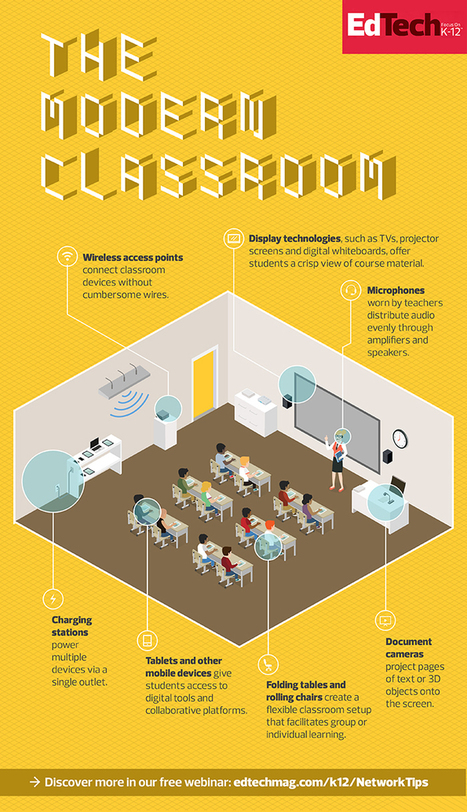
District administrators took ample time to consider everything from the physical classroom setup to the technology that would be used by students. And although tablets, Chromebooks, charging stations and document projectors all made the final cut, Landeck particularly praised the audio distribution system that the district installed in each classroom.
“It’s a wonderful technology, and a lot of research has been done to show actual student [engagement as well as achievement] increase dramatically when one of these systems is put in,” Landeck said.
Read through the infographic below to find out which tools benefit students and teachers in Pajaro Valley Unified School District, and then listen to EdTech’s free, recorded webinar to learn more about the back-end technologies that power learning.
Via Edumorfosis
|
|
Rescooped by
Dennis Swender
from Educación a Distancia y TIC
January 9, 2016 3:34 AM
|
|
|
Rescooped by
Dennis Swender
from Into the Driver's Seat
December 7, 2015 10:47 AM
|
"Whether you’re new to the Twitter game or a seasoned pro, there’s always something to learn. Teachers know that better than anyone. Learning is a lifelong process and figuring out social media is no different. I was pretty excited to come across this handy chart of quick tips for teachers using Twitter because it showcases the A-to-Z tips which will help you get off to a good start. Literally. It’s an A-to-Z walkthrough. Pretty good. In this graphic from Fedena (a school management software maker), you’ll likely spot more than a few tips you already know. However, you should be able to discover a couple new ones that will help you up your Twitter game. For example, I really like the second tip on how to properly use Twitter. There’s certainly a level of etiquette you should follow. Don’t be spammy. Don’t over-tweet or overshare, and don’t take credit for someone else’s work. That’s a super handy tip to always keep int he back of your mind whether you’re talking about social media or just life in general!"
Via John Evans, Dean J. Fusto, Jim Lerman
|
|
Rescooped by
Dennis Swender
from Into the Driver's Seat
December 7, 2015 10:46 AM
|
25 Tips To Deal With Digital Distractions by TeachThought Staff Ed note: This post has been updated from a 2012 post One of 21st-century life’s cruelest ironies is that technology...
Via Dean J. Fusto, Jim Lerman
The best free online & offline business video presentation software tool that allows you to create awesome animated business video explainers & multimedia presentation..
Via Baiba Svenca
|
|
Rescooped by
Dennis Swender
from Into the Driver's Seat
December 6, 2015 5:44 AM
|
25 Tips To Deal With Digital Distractions by TeachThought Staff Ed note: This post has been updated from a 2012 post One of 21st-century life’s cruelest ironies is that technology...
Via Dean J. Fusto, Jim Lerman
|
|
Scooped by
Dennis Swender
November 26, 2015 8:10 AM
|
Are you a learning manager looking to invest in analytics? Don’t start until you’ve read our 10-point checklist.
|
|
Rescooped by
Dennis Swender
from Into the Driver's Seat
November 26, 2015 8:07 AM
|
Crellin views the students' local community as one of the primary resources for learning. They take any opportunity they can to use what’s around them as the catalyst for a lesson or project. Crellin promotes learning that is rooted in what is local -- the unique history, environment, culture, economy, literature, and art of their community. This is valuable because it makes learning relevant to students, resulting in higher engagement and igniting students' passion for enacting change within the world around them.
Via Jim Lerman
|

























Neil Patel suggests 15 content collaboration tools worth a look. Several may be new to you.
aggiungere la vostra comprensione ...
best team, best tools; best team, better tools.better content no brainer