


Learn the basics of a Facebook marketing strategy from advertising, to sharing content and managing a community, to understanding and leveraging Insights.
Via Joemktg, massimo facchinetti

 Your new post is loading...
 Scoop.it! Learn the basics of a Facebook marketing strategy from advertising, to sharing content and managing a community, to understanding and leveraging Insights. Via Joemktg, massimo facchinetti
Scoop.it!
Tools and activities that can be used to teach L2 grammar... Via Yuly Asencion, Let's Learn IT, Lawrence Buck
Scoop.it!

Whether you're creating an infographic or coming up with a logo, you may be in need of a good handwriting font. Check these out! They're some of the best for free.
Via Dr. Tom D'Amico (@TDOttawa)
Scoop.it!

PinterestHow to Become a Google Certified EDUCATOR Ready to get Google Certified? Find out what it takes to become a Google Certified Educator. In this video, I will walk you through the process, the exam, the content covered, share free resources, and tips to help you pass! Plus, get a sneak peek of the Google … Via Dr. Tom D'Amico (@TDOttawa)
Scoop.it!
Scoop.it!

There is little doubt that piracy of subscription or member-only access content is damaging to publishers and societies. Does the same hold true for open access journals? Angela Cochran explores some of the dangers piracy poses to open access content. Via Ana Cristina Pratas
Scoop.it!

This reading list was originally published in a report for the Tow Center for Digital Journalism: Toward a Constructive Technology Criticism. It reflects a broader, more generous definition of what… Via Ana Cristina Pratas
Scoop.it!

I’m quickly drafting a unit for the Creative Commons Certification on “Legal vs Technical Openness”. This is to address the difference between something that is shared according t… Via Ana Cristina Pratas
Scoop.it!


Oskar Almazan's curator insight,
June 20, 2017 3:01 AM
It’s been more than five years since online education got a massive boost when three free online courses, all taught by Stanford professors, launched in October 2011. Each of these courses has had over 100,000 students. Soon after that, Coursera, edX, and Udacity were launched and the media started calling the courses provided by these websites “MOOCs”: Massive Open Online Courses. Since then more than 700 universities around the world have launched free online courses. By the end of 2016, around 58 million students had signed up for at least one MOOC. Many countries around the world (e.g. India, Mexico, Thailand, Italy, and more) have launched their own country-specific MOOC platform.
Scoop.it!

Scoop.it!

This article provides a simple tutorial on use of gganimate package in R to create animated graphics. Create GIF images to improve your data visualizations Via Mark E. Deschaine, PhD |
Scoop.it!

Marketing is critical to get your practice information out to the public. When is the last time you took a close look at your practice and its online presence? If the person in your office responsible for marketing is more than 35 years old, they are likely not up to date with all the marketing possibilities to get your practice information to the medical consumer. Even if you have been practicing in the same location for years, there is likely competition in your area as well as new patients that are looking for you (but don't know about you yet). And if you are new to an area, like my practice, savvy marketing can help get the word out to patients that would like to know of your medical practice and services! I have a single employee so far. She is a recent university graduate that wants to stay in Charlottesville, Virginia. No matter that her undergraduate degree was anthropology/archeology, she is already a huge help in getting my marketing package together. Young folks these days are very well versed in anything online and tech related. My gal has so far ordered new business cards, updated my Facebook page and created brochures that I can use to spread the word about my practice services: all important things that I just couldn't get around to doing myself! Here are a few suggestions: 1: Facebook and other social media: People want to see what your practice is up to but more importantly, they will share it with many others. Additionally, many patients use Facebook similar to how I used the Yellow Pages not so long ago! Get your young staff member to manage your page, include updates about your practice, photos, and relevant health articles that are important to your patient population. 2: Brochures: Do you have a brochure for your practice? You would be amazed how far and wide these will travel from patient to patient! Even if you have had your practice for 20 years, it does no harm to have a well-designed brochure with thoughtful content. There are many websites that have brochure designs for free. They are easy to manipulate and not very costly to have printed (we are having ours done at a local print shop). 3: Business Cards: Have you had the same business cards for a long time? Why not update them with new colors and layout to be more eye catching? Like brochures, they tend to get passed from person to person. 4: Logo and Printables: Perhaps it is time to update your practice logo? This gives a brand new face to your practice. Find a local graphic art service and see what they can come up for you. Remember, the logo is often the first thing patients notice! 5: Advertising: I quit using newspapers long ago to advertise my practice. Hardly anyone looks at them anymore and most content is now online at any rate. So, consider some novel advertising approaches: • Put your practice information on pharmacy bags or grocery carts at your local retailers. • Sponsor community events like 5K races or school sports teams. • Get car magnets for all the staff and reimburse them to place on their cars (gift cards can work in place of monetary reward). • Don't forget the little things with your logo that people love to have such as water bottles, baseball caps, and t-shirts 6: Participate in the community: Volunteer your office at community events, whether it is a health fair and you measure blood pressure and glucose for attendees or sponsor a section of road to clean (with your name on the road sign). People love to find their doctors at these events; it makes them feel proud that they come to your practice and I have found that patients talk to other people. Make sure they spread "happy talk" about you and your staff. 7: Office décor: It's time to take a hard look at your office space. Is it decorated in pink or mauve from the last century? Time for an update! Also check to see if the furniture looks worn or the walls are scuffed. How about stains on the carpet? Finally, look really closely to see how clean your office is. Often a deep clean will brighten up the appearance of your space. I know there are many other ideas that would work for you. Don't let the world pass you by! Update your profile, marketing and office space. You will be glad you did! Via Plus91
Scoop.it!
Ongoing debates surrounding Open Access to the scholarly literature are multifaceted and complicated by disparate and often polarised viewpoints from engaged stakeholders. At the current stage, Open Access has become such a global issue that it is critical for all involved in scholarly publishing, including policymakers, publishers, research funders, governments, learned societies, librarians, and academic communities, to be well-informed on the history, benefits, and pitfalls of Open Access. In spite of this, there is a general lack of consensus regarding the advantages or disadvantages of Open Access at multiple levels. This review aims to to be a resource for current knowledge on the impacts of Open Access by synthesizing important research in three major areas of impact: academic, economic and societal. While there is clearly much scope for additional research, several key trends are identified, including a broad citation advantage for researchers who publish openly, as well a Via Leo Havemann
Scoop.it!
In today’s post, I am sharing with you some interesting tips I learned from Jonathan Wylie to help you record your iPad screen an
Via Dr. Tom D'Amico (@TDOttawa)
Scoop.it!
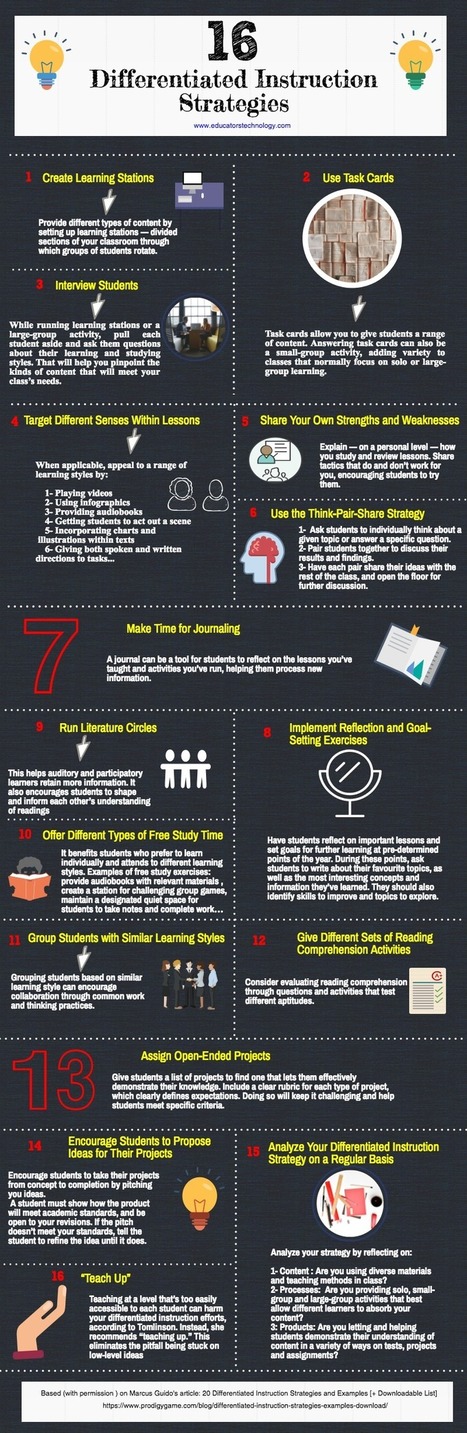
Free resource of educational web tools, 21st century skills, tips and tutorials on how teachers and students integrate technology into education Via Dr. Tom D'Amico (@TDOttawa) 
Koen Mattheeuws's curator insight,
June 28, 2017 2:33 AM
Volgende week staat de zomerdriedaagse binnenklasdifferentiatie op de agenda. Deze poster sluit perfect aan bij het thema.

Joyce Valenza's curator insight,
June 28, 2017 9:26 AM
Wonderful practical tips for libraries as well as libraries.
Scoop.it!

Ana Cristina Pratas's curator insight,
June 11, 2017 5:43 AM
"How do we create a space within our schools (with all their political, technical, and institutional realities) that truly embodies a spirit of self-determination and agency for our students. How do we free our students from the shackles of corporate and commercial Web spaces without creating some new kind of shackle?
And, how do web build a platform for the practical, valuable, discernible activities of building on the Web while also grappling to understand the Web on which we build in deep and discerning ways?
For me, the answer lies in pushing beyond the pragmatic and practical goals of the project where we often begin and end. And, like Woolf in a Room of One’s Own, I want to spend my time here dwelling on the the inextricable, in this case, why we in higher education must teach our communities to grapple with the Web in these deep and discerning ways — how the Web, and our culture, and our systems of education are bound up with each other and why they demand a particular responsibility of us."
Scoop.it!

Want to know why the NextGen LMS is not just an eLearning portal? Check 9 characteristics of the NextGen Learning Management System. Via Ana Cristina Pratas
Scoop.it!

Students often find themselves uploading their content — their creative work — into the learning management system. Perhaps they retain a copy of the file on their computer; but with learning analytics and plagiarism detection software, they still often find themselves having their data scanned and monetized, often without their knowledge or consent. — Audrey... Read More Via Ana Cristina Pratas
Scoop.it!

About a month ago, Hewlett Foundation’s open educational resources grantees gathered in Canada to reflect on progress in the OER field and how equity plays a role. Coming out of the conference, we asked education program officer TJ Bliss what trends he’s keeping an eye on in the OER space. Where are we i Via Ana Cristina Pratas
Scoop.it!

Image credit:I've used two sources for the above collated image. The image of the head was sourced from https://pixabay.com/en/art-sculpture-scrap-sculpture-human-1699977/ while the image of the network was sourced from https://commons.wikipedia.org/wiki/File:Egoi_network.png Call for Proposals We are excited to invite you to submit a proposal for a chapter in our edited book, Ecologies of open: Inclusion, intersections, and… Via Ana Cristina Pratas
Scoop.it!
Can online learning disrupt the status of higher education? When I moved to Silicon Valley to study at Stanford University four years ago, I thought so. Enrollment in online courses at the college level had multiplied by nearly ten-fold from 2003 to 2013. The promise was that online learning could replicate the live classroom, but also make course content available to anyone at any time with a lower cost.
Today, the story is different. The answer to the question of whether online learning has revolutionized higher education is a clear “not yet.” A new study[i] shows that for students who have access to both online and in-person classes, taking online courses led to lower grades in their current and future courses. Those students are also less likely to remain enrolled in their institutions.
Another recent study[ii], which is quite controversial, argues that online learning in higher education is actually a waste of taxpayers’ money. It turns out that, in many cases, it is actually not much cheaper than in-person classes; besides that, the earnings students make later in life due to online course-taking compared with what they would have earned without online enrollment do not surpass the social costs online learning incurs. Via LGA, juandoming, Edumorfosis
Scoop.it!

The 60 YouTube channels that will make you smarter were selected from this master list. In here you can find many captivating channels that for some reason or other didn’t quite reach the shortlist… Via Ana Cristina Pratas, Cindy Riley Klages, Mark E. Deschaine, PhD |










RYZZ is coming. It’s a new approach to MarTech for B2B Marketers.
#MarTech #DigitalMarketing