



Free resource of educational web tools, 21st century skills, tips and tutorials on how teachers and students integrate technology into education
Via Dr. Tom D'Amico (@TDOttawa)

 Your new post is loading...
 Scoop.it! Free resource of educational web tools, 21st century skills, tips and tutorials on how teachers and students integrate technology into education Via Dr. Tom D'Amico (@TDOttawa) No comment yet.
Sign up to comment
Scoop.it!
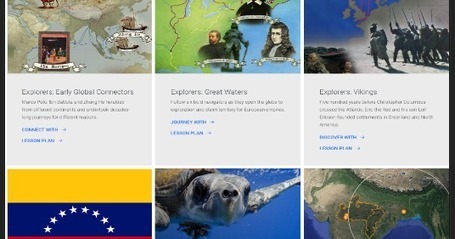
"Since the release of its web-based version, Google Earth has been tremendously incorporated into educational contexts by teachers from all around the world. ..." Via Leona Ungerer, Jim Lerman
Scoop.it!

Online learning has gone down the ‘all fur coat and no knickers’ route. It’s more presentation than pedagogy, more look and feel than learning. Rather than focus on what makes learning a success in terms of understanding, retention and recall, it allows the learner to skate across the surface of a thin layer of crisply designed but thin ice. It often creates the illusion of learning by illustrative graphics/animation that, as Mayer often showed, actually inhibit rather than help retention. That old adage, which is as good a summary of learning theory as any, that ‘less is more’, has been abandoned by a glut of over-engineered graphics, animation and effec
Scoop.it!

Gone are the days when patients quietly endured long waiting room times and blindly followed their doctor’s advice. The Internet has turned patients into active consumers who take their healthcare into their own hands. Patients are also turning to social networking and online review sites for information, advice and to vent their frustrations. Patients searching for a general practitioner near them results in scores and scores of pages reveal information, both good and bad, about medical practices and healthcare organizations. The social media space has become a popular forum for patients to discuss health issues, share healthcare experiences and interact with healthcare professionals. A 2012 consumer survey conducted by PricewaterhouseCoopers revealed as much as one-third of consumers in the United States actively use social media to discuss doctors and health concerns. While this no doubt poses a threat for medical providers, social media can be used as a powerful force in your marketing plan. Providers can use social media to better engage the patients they have and also to attract new patients. In this way, medical practices gain an upper hand when it comes to damage control and building a credible, trustworthy brand. It’s not uncommon for patients to have questions in-between appointments with the doctor. These may just be quick questions or situations the patient feels warrant a doctor’s input. Trying to get in touch with doctors on the phone can be difficult considering their busy schedules. In cases like these, social media can help increase patient access to the doctor so patients don’t have to put up with long hold times or wait until their next appointment. Social networking sites like Facebook and LinkedIn allow users to create profiles, both personal and professional. You can post helpful information on a profile, such as call-in hours or hours when a staff member is available to answer questions via email or chat. These little conveniences help make it easier for patients to adhere to treatment guidelines and reduce frustration levels. Marketing Your PracticeAccording to Pew Research Center, an estimated 44 percent of online users use the Internet to look for information on doctors. Considering the total number of Internet users surpassed the 4 billion mark in 2018, this is a marketing opportunity no practice can afford to miss. The key to a strong marketing strategy lies in joining networks that your patients (and ideal, future patients) are on. Marketing on social media sites benefits a medical practice in many ways, including: Establishing an online brand Building your reputation Interacting with patients Interacting with prospective patients Video exposure for your practice Obtaining valuable feedback Establish Yourself as an ExpertWhile encouraging visitor interactions make up the bulk of what social media sites do, these networks also offer prime opportunities for sharing information with interested parties. Many network users are looking for health-related information, be it on the network itself or on other sites. Posting informative articles about things your patients may be interested in is a good way to establish yourself as an expert and thought leader in your field. Video MarketingVideo marketing on social media sites offers yet another way to post informative content on subjects patients can use. You can present all types of information, from procedure demonstrations to telling stories about how the practice got started. Unlike articles, video offers a more real-world effect that works well when it comes to engaging visitors who are looking for information. Things to Keep in MindAs powerful an impact as social media engagement can have on the success of your medical practice, results don’t happen overnight. More than anything else, persistence, patience and time are key to growing your practice online. However, the more active you are on social media, the faster you’ll likely see results. Over time, patients searching for a new physicians office will help display your practice higher up in the results, which is where most online users look. It’s also important to have a marketing strategy in place that lines up with the short- and long-term goals you have for your practice. Since staying engaged on network sites does require time and effort, assigning this task to a staff member or even hiring a marketing specialist may be a good idea if your schedule is already full. Via Plus91
Scoop.it!

The best online collaboration tools boost productivity by helping teams work together more efficiently. We've tested the most popular apps, and these are the top performers.
Scoop.it!

20 Uses For Virtual Worlds In The Classroom
Scoop.it!

Learn the difference between a bot, chatbot, and robot.
Scoop.it!

Last week I gave a webinar through UCI on transitioning from teaching to instructional design. I shared my story of moving from teaching to instructional design as well as tips for finding a job. While this presentation was primarily aimed at teachers, much of the content also applies to others looking to change careers. The recording is now available on YouTube. Via Elizabeth E Charles
Scoop.it!

eLearning engagement is complicated. It needs a number of elements to come together. We cover several of these topics including: Commitment Communication Content Delivery Motivation Analysis and Iteration
To keep things simple, (and engaging!), we’ve anchored our thoughts against our own formula for engagement: Via Edumorfosis
Scoop.it!

Last month’s article discussed the many benefits of computer-based assessments, but it ended with a caveat. Technology cannot make a poorly designed assessment better—it just scales a poorly designed assessment to more people. In fact, the hardest part of developing good online assessments often happens offline—developing assessments that are reliable, fair, valid, and transparent. Via Edumorfosis
Scoop.it!

"Imagine keeping track of each student’s digital footprint, class attendance, and individual needs. Essentially, this is what learning analytics does. Learning analytics is defined as the measurement and dissection of data about learners used to optimize their learning experience. Learning analytics makes learning personal and tailored. With learning analytics, educators can assess where learning gaps occurred. In universities, learning analytics is being used to predict student success or identify students who are “at risk.” While there is much excitement about learning analytics and the ways it can shape the classroom and transform education, it is not without flaws." Via EDTECH@UTRGV 
EDTECH@UTRGV's curator insight,
August 15, 2018 1:34 PM
This concern was the inspiration for our new edited book titled, "Responsible Analytics and Data Mining in Education: Global Perspectives on Quality, Support, and Decision-Making" https://amzn.to/2OBOmd8
Scoop.it!

Students can now find child friendly animated gifs in a safe search environment using Gif4Kids. They can add gifs to all sorts of projects! Via Dr. Tom D'Amico (@TDOttawa)
Scoop.it!

Open up a group for you company, team, community, class or school Every group has channels -- channels are like topics in a group the special thing about channels is that they can look differently one can be a chat and one can be a calendar and another channel can be for files and there are 8 more types of channels you can use for your group Via Nik Peachey 
Nik Peachey's curator insight,
August 10, 2018 12:25 PM
Fed up with Facebook? This just might be the answer. The probelm is getting people to register though. |
Scoop.it!

Many students use their smartphones more often than their laptops to browse the web, shop, and access important files. That's why we nee Via Dr. Tom D'Amico (@TDOttawa)
Scoop.it!

Free resource of educational web tools, 21st century skills, tips and tutorials on how teachers and students integrate technology into education Via Dr. Tom D'Amico (@TDOttawa) , Jim Lerman
Scoop.it!

This article is not about online classes and/or technology in the classroom. We need technology and teachers. Via Nik Peachey
Scoop.it!

There are several problems with the idea that students can acquire core-knowledge in any subject using this approach. Firstly, research has shown it to have zero effect on comprehension. The key issue is that this approach assumes children are largely identical; that the teacher has sufficient personal core-knowledge to teach it – and beyond; and the standardised text is revealing a true picture of the student. Via Edumorfosis
Scoop.it!

WIRED set out to examine how technology is shifting our relationships with books. Here's what we found out.
Scoop.it!

A new report shows that Google still tracks your location even if you thought you opted out.
Scoop.it!

NEW PODCAST! 20 Tech Tips to Shake Up Learning
Scoop.it!

By using cybergogy to heutagogy pedagogical approach, we can teach and prepare our students to survive and thrive in a global economy and help them become capable to apply skills and competence effectively Via Edumorfosis 
Edumorfosis's curator insight,
August 15, 2018 8:45 AM
Pedagogy is a field of study of past centuries. In the 21st century educators must move towards Heutagogy ...
Scoop.it!

“AnanseTheTeacher” is a gamified learning app which unites 2 themes: CULTURE AND TECHNOLOGY. It explores the use of Technology in encouraging Reading & the study of practical S.T.E.A.M - (Science, Tech, Engineering, Arts and Maths) while promoting the Ghanaian culture and identity.While you enjoy folklore and cultural education, you also create science experiments with everyday materials. This app makes, reading and learning STEAM fun. Via Nik Peachey
Scoop.it!

The Trump administration is considering an overhaul of a 26-year-old federal rule that is seen variably as a barrier to innovation and an important guardrail against substandard instruction. Via EDTECH@UTRGV
Scoop.it!

The technology is being used to help students memorize STEM coursework and improve writing skills, among other things. |






