


IT will have to be on the lookout for hidden biases and take action to minimize the harm...

 Your new post is loading...
 Scoop.it! IT will have to be on the lookout for hidden biases and take action to minimize the harm... No comment yet.
Sign up to comment
Scoop.it!
According to Dr Nolen Gertz, Assistant Professor of Applied Philosophy, there is a tendency in technological production called the “leisure-as-liberation Via Ana Cristina Pratas
Scoop.it!

This article is part of a collection of op-eds from thought leaders, educators and entrepreneurs who reflect on the state of education technology i Via Ana Cristina Pratas
Scoop.it!

Technology has the potential to enhance aspects of education - but we must never allow it to replace the vital human element of teaching, says Kester Brewin Via Ana Cristina Pratas 
Ana Cristina Pratas's curator insight,
January 24, 2019 6:02 AM
"Most importantly, the efficiencies that digital tools offer are often about the removal of the body: humans are expensive; AI’s don’t need lunchbreaks or sick pay. And this is the most profound question that we must face: what are we educating for? Hi-tech education platforms are very good at individualised learning, but what about group collaboration, argument and discourse? Teachers are bodies in the room because education is ultimately about becoming more human, about empathy, about relationships, about something physical rather than virtual, about the whole body, not just the enlarged mind.
Interestingly, this "return to the body" is what we are slowly seeing return in the aftermath of the digital revolution. Independent bookshops are springing up again. People are looking for the authentic, for craft beers and artisan furnishings, things that have the touch of the human all over them. Yet the danger here is that these things are only open to those who can afford them; only the rich can have what is "real".
We cannot be anti-tech. To make tools is part of what it is to be human. But the greater part is to be reflective users of these tools, and we must be clear that not all that is possible is desirable. If we hold education – as opposed to sterile knowledge acquisition – dear, then we must fight hard against the increasing march of "screenification", and speak up clearly for the vital place of the body in schools for all, regardless of wealth, before school bodies themselves become a thing of the past."
Scoop.it!

The best of the week from the world of learning, design, and technology. A snackable collection from hundreds of sources. Via juandoming
Scoop.it!

Check how to make your Learning Platform feel like a consumer product and find out whether a different, modern approach to learning is needed today or not. Via juandoming
Scoop.it!

Visionary's curator insight,
April 3, 2019 10:10 AM
Google compiles enough data to build comprehensive portfolios of most users—where you go, and what you do. Visit google.com/dashboard to learn more about yourself. #google
Scoop.it!
The rate of mechanical advancement has brought the field of online training far since our unique article. While the characteristics we talked about stay pertinent, more have gone to the fore. Here…
Scoop.it!

Artificial intelligence in digital learning won’t replace humans, it makes them better at their jobs. Find out how in this infographic. Via Yashy Tohsaku
Scoop.it!

Microsoft Excel makes virtually every business function more efficient. So, in order to grow, you need to know how to use it. Here are the best online resources for learning Excel. Via Yashy Tohsaku
Scoop.it!
Scoop.it!
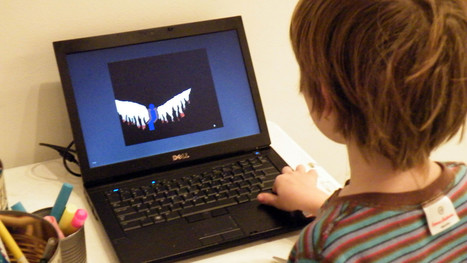
By Katrina Schwartz // KQED MindShift As technology becomes a more common feature of classrooms and computer-based testing becomes the norm, even the youngest learners are being pushed to master keyboarding and computing skills. But what does it feel like for a kindergartener, whose family has faithfully followed the American Academy of Pediatric’s suggestions to limit screen time, to arrive at school and immediately be assessed on a computer?
In her PBS MediaShift essay, Jenny Shank describes the tensions emerging between parents with low-tech child rearing styles, teachers frantically trying to prepare students for computer-based tests that could determine the future of their careers, and districts following the latest trends. Shank’s essay gives voice to that “stuck in the middle” feeling when a parent supports the idea of technology integration in school generally, but isn’t sure she thinks it’s being done well.
Shank writes: “I’m all for teaching kids about technology, which will be a part of their personal and work lives forever. But shouldn’t they learn how to write software programs rather than how to scan a text and answer multiple-choice questions on a screen? Shouldn’t they learn about how to assemble computer hardware, build an object with a 3-D printer, or shoot and edit digital video footage rather than passively watch as a computer reads them a book? Many studies suggest that when people read on a screen rather than paper, they read less attentively and retain less. So why aren’t schools using computers for what these machines are actually good at instead?”...
For linked post, click on title above or here: http://ww2.kqed.org/mindshift/2015/03/15/parents-struggle-to-balance-screen-time-rules-with-digital-homework/
For the PBS MediaShift essay referred to in the text above, visit here: Via Roxana Marachi, PhD
Scoop.it!

By Jordan Baker, The Sydney Morning Herald "As classrooms across the country embrace digital textbooks, one Sydney school has declared the e-book era over and returned to the old-fashioned hard copy version because it improves comprehension and reduces distraction.
For the past five years, Reddam House's primary and junior high school classes have used e-textbooks on iPads. But the consistent feedback from the students has been that they preferred pages to screens. Teachers also found the iPads were distracting and did not contribute to students' technology skills, prompting the school to announce that students should no longer use digital textbooks, and must revert to hard-copy versions instead."We hadn't completely gone away from hard copy," said principal Dave Pitcairn. "We kept year 11 and 12 hard copy. When [students] got to year 11, and now had the comparison between digital and hard copy, they preferred the hard copy. "The ease of navigation through the textbook was easier with the hard copy. I believe they learn better the more faculties they use, the more senses they use in research and reading and making notes."
Teachers at the eastern suburbs private school, which regularly appears on the HSC top-ten honours list, reported that iPads were hindering learning."...
For full story, visit:
Via Roxana Marachi, PhD |
Scoop.it!

Job description Part of your life. Part of tomorrow. We make life easier, safer and greener – with technology that achieves more, consumes less and is accessible to everyone. Microelectronics from Infineon is the key to a better future.
Scoop.it!

Rather than asking whether technologies are making us better or making us worse, Nolen Gertz investigates what we think "better" and "worse" mean, and what role this thinking has played in our tech. Via Ana Cristina Pratas
Scoop.it!

Virtual Reality? Augmented reality? Social media? Here we explore how we define emerging media. Via Ana Cristina Pratas
Scoop.it!

Since fall 2014, mobile devices officially outnumber people on the planet. With the ubiquitous access to mobile technologies, social media has become a global phenomenon. According to the data portal Statista, the power of social networking is such … Read more Via juandoming
Scoop.it!

With AgensGraph, an Education Service Company 34-years in the Making Builds a Big Data Graph Database for Education SANTA CLARA, Calif. — Bitnine Global, Inc. (“Bitnine”) One of the biggest advanta… Via juandoming
Scoop.it!

How many times have you encountered a problem or challenge in your own life and conducted a quick Google search to find a solution? If you’re like most, this is a daily occurrence. From a business perspective, the rise of the self-service, DIY culture presents a unique opportunity to develop a...
Scoop.it!

In recent years, the slideshow presentation has become so ubiquitous in our schools that it has become rare to walk into a lesson and not see one on display. However, teaching from a slideshow can either support or hamper learning, depending on the slideshow design. Via Nik Peachey 
Hamza Yousaf's comment,
April 6, 2019 4:21 PM
The New Gadgets of 2019 has been launched, These amazing features and stylish Gadgets is becoming famous in 2019 & ahead.
https://bit.ly/2VrK8I3
Scoop.it!

The possibilities that technology offers us to improve learning are tremendously exciting. In the past few years, the question has shifted from whether technology should have a place in the classroom to understanding how technology can be integrated into lessons to achieve specific learning goals. Via Elizabeth E Charles
Scoop.it!

The 70-20-10 model is a well-known approach to how we learn at work and is used in many organisations all over the world. How does modern eLearning fit into an established model for how we learn? Via Yashy Tohsaku
Scoop.it!

Speer isn’t alone in seeking to refresh the discussion forum as the key source of person-to-person interaction in online courses. Educators are pursuing a variety of strategies for fostering student engagement. One approach is to emphasize quality and thoughtfulness of responses over quantity and frequency. Another puts the instructor in the driver’s seat, steering conversations to sharper insights as they might from the front of a classroom.
Scoop.it!

"With 92% of US middle and high school students online daily, 24% of them "almost constantly,"* it's time schools had some help with social media! Two national nonprofit organizations, each with a decade and a half of experience in education and Internet safety – #iCANHELP and Net Family News Inc. – are getting ready to pilot a social media helpline for US schools that's modeled on some of the best social media support for youth in the world.
Part 411 and part 911 for social media problems, it'll be a place schools can call or email for help with cyberbullying, sexting, reputation and other issues involving students and staff in their communities – help with navigating sites and apps, reporting abuse, getting content taken down that violates terms of service, etc. This kind of helpline is new only in the US – there are Internet helplines all over Europe and in Australia and New Zealand (our model is the UK's), and US school communities deserve one too. We want to bring schools best practices in social media support drawn from the fine work of researchers, nonprofits, and service providers all over our country and the world. It will be available in the form of real-time help on the phone or via email and a Web site with a growing searchable database of stories and case studies of how school communities resolve social media problems."
For full post and video, click on title above or here: https://www.indiegogo.com/projects/a-social-media-helpline#/story Via Roxana Marachi, PhD 
Mokopu Maanaso's curator insight,
May 23, 2025 3:46 PM
The helpline aims to assist schools with cyberbullying, online reputation issues, and more by offering real-time support and guidance on navigating social media platforms. Modeled after similar services in Europe and Australia, it will provide help via phone, email, and a website with resources and case studies to promote safer and more informed social media use in school communities.
Scoop.it!

By Heidi Stevens [image by Heleen Sitter/Getty-Lifesize]
Spelled out in the new book, "The Learning Habit: A Groundbreaking Approach to Homework and Parenting That Helps Our Children Succeed in School and Life" (Perigree), the study aims to guide parents through an academic landscape that barely resembles the one we knew as kids — starting, of course, with the number and ubiquity of screens populating it.
"What we observe," they write, "are children who can relate to screens with ease, but have few social or communication skills; kids who can play video games for hours, but can't read a book for longer than 10 minutes; kids who can text and tweet, but can't focus on a challenging math problem or make sense of a few paragraphs in a history book."
Sure, but they're going to college in record numbers! "We are graduating children who lack the skills to survive, much less thrive, in college," write the authors. "Once first in the world in college-graduated students, the United States is now 10th. Almost half of our students who enter college do not graduate."
We've got a mess on our hands, Jackson told me by phone. And we're not, in many cases, eager to tackle it.
"Parents aren't looking to make lifestyle or habit changes unless something isn't working," said Jackson, a neuropsychological educator. "Many families are struggling with something they're not connecting with screen time: moodiness at bedtime, fighting to get out of the house in the morning, anxiety — which (are hallmarks) of too much screen time."...
***
..."The Learning Habit study found that students who spend 45 total minutes per day consuming media — computer, phone, tablet or television — can maintain an A average.
"After 45 minutes of use, however, grades slowly but steadily declined," write the authors. "After three hours of use, grades rapidly declined. … After four hours, children had virtually zero likelihood of academic success."
Parents who took part in the study reported their children used media for an average of 90 to 120 minutes per day. "Yet when asked specific questions about the devices, the total was commonly between six and eight hours per day," write the authors."...
For full post, click on title above or here: http://www.chicagotribune.com/lifestyles/ct-children-screen-time-balancing-20140909-column.html ; Via Roxana Marachi, PhD |






