


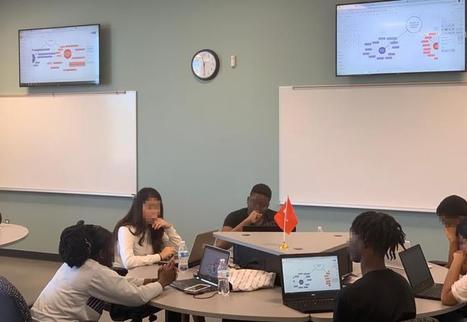

There are three critical issues that are expanding the gap between the modern classroom and today's digital tools--here's why we hvae to address them.
Via EDTECH@UTRGV, Elizabeth E Charles

 Your new post is loading...
 Scoop.it! There are three critical issues that are expanding the gap between the modern classroom and today's digital tools--here's why we hvae to address them. Via EDTECH@UTRGV, Elizabeth E Charles No comment yet.
Sign up to comment
Scoop.it!

Are today’s students spending too much time in front of computer screens? The more important question is: are students engaged in powerful learning experiences and, whenever possible, given voice and choice in what, how, and when they learn? Digital technology can powerfully facilitate this process, if thoughtful adults deploy it wisely. Otherwise, it can be mind-numbing, or worse. Via John Evans
Scoop.it!

The parents buy smartwatches for their children so they can track and monitor them, but not everyone is convinced that it’s a good strategy. In 2017, Germany regulators banned the sale of smartwatches aimed at children referring to them as spying devices. In addition, the European Consumer Organisation (BEUC) also issued a public service announcement regarding security and privacy concerns surrounding children’s smartwatches. Many schools are also banning smartwatches for kids. They have their reasons. Via Jim Lerman
Scoop.it!

Scoop.it!

Scoop.it!

The printed book just won’t die. But another print-based technology—the copy machine—is disappearing from many academic libraries, as librarians swa Via Peter Mellow
Scoop.it!

Right now, all sorts of technology, including educational software, is “adaptive.” That means it’s pre-programmed to take certain steps, based on what a user—say, a student—does. In simple terms, if a kid taking an adaptive test gets an answer right, the system knows to give that kid a tougher question next. (Think of this as a much more sophisticated, computerized version of those choose-your-own adventure books you might have read as kid.) Via Kim Flintoff 
Kim Flintoff's curator insight,
July 30, 2019 10:48 PM
Right now, all sorts of technology, including educational software, is “adaptive.” That means it’s pre-programmed to take certain steps, based on what a user—say, a student—does. In simple terms, if a kid taking an adaptive test gets an answer right, the system knows to give that kid a tougher question next. (Think of this as a much more sophisticated, computerized version of those choose-your-own adventure books you might have read as kid.) Plenty of experts would call those systems “AI” and plenty of vendors market their educational software that way. But these so-called “rule-based” systems aren’t the “fancy, sexy AI” that’s grabbing headlines, said Robert Murphy, a senior policy researcher for the RAND Corporation. That’s because all the information is already pre-programmed. The machine can’t get any better at a particular task.
Scoop.it!

The following is the latest installment of the Toward Better Teaching advice column. You can pose a question for a future column here.Dear Bonni,“An Via Peter Mellow
Scoop.it!

To follow along with the text of this presentation, view the Google Slides version of the talk as I give it: [This version below has image descriptions, so may be the best version if you are using … Via Peter Mellow
Scoop.it!

Chatbots are trending and they are the talk of the tech world. In this article, discover the role chatbots are playing in educational mobile apps. Via Peter Mellow
Scoop.it!

Florence Martin, Kiran Budhrani, and Chuang Wang wrote an interesting paper on faculty perception of their readiness to teach online: Faculty readiness to teach online is a state of faculty preparedness for online teaching. Via Peter Mellow
Scoop.it!

Learn how Intelligent Tutoring Systems (ITS) and Augmented Reality (AR) provide powerful paradigms for the next generation of advanced learning systems. Via LGA
Scoop.it!

It seems everyone is interested in big data these days. From social scientists to advertisers, professionals from all walks of life are singing the praises of 21st-century data science. Via Elizabeth E Charles |
Scoop.it!

One evening last week, I collapsed into bed after homework was finished, lunches were packed, and bedtime stories were read and happened upon an impassioned Los Angeles Times op-ed by high school political science teacher Jeremy Adams. In it, Adams decries his students’ lack of interest in reading and places the blame squarely on smartphones. My kids are still young, but I’m always thinking of how to instill in them a passion for books, so I read on...on my smartphone. Via John Evans
Scoop.it!

There are as many proponents of smartwatches for children as there are opponents to the idea of children wearing technology on their wrists. Whatever side of the fence you are on, take a moment to find out with us just how amazing these devices can be. Via Jim Lerman
Scoop.it!

Smartwatches are loaded with functionality that makes a teacher’s life easier. And they are becoming increasingly popular. According to a Technavio report on the global classroom wearables technology market, the wrist-worn wearables sector held the largest share in the market in 2017. Via Jim Lerman
Scoop.it!

Last year, Khan Academy trained more than 200 Compton teachers to use its tutorials in their classrooms. This year, the district is also using Khan Academy to help high schoolers study for the SAT. And Compton officials are paying to use a dashboard that shows teachers and administrators how students are doing in their online lessons. Now that the district is a paying customer, Compton teachers with tech support questions get to jump to the front of Khan’s queue. Via Edumorfosis
Scoop.it!

Four-and-a-half years after Amazon first released Alexa, its voice-activated virtual assistant, the technology is finding its footing in education Via Peter Mellow
Scoop.it!

“Teaching online allows faculty members to be at the forefront of a revolution in education.” For context, Boon did not anticipate teaching online when he did. In fact, he often jokes that he ventured into the online space accidentally. When another faculty member slated to develop a core course for the Online Master of Computer and Information Technology (MCIT) realized they would be unable to teach it as planned, Loo assumed the responsibility. That pivotal decision quickly revealed itself to be an opportunity to enhance his pedagogical approach to teaching both online and on-campus. Via Peter Mellow
Scoop.it!
Moving a course from brick-and-mortar to online requires rethinking how you deliver content, replicate in-class interactions and pinpoint areas for improvement. Via Peter Mellow
Scoop.it!

Working with subject matter experts (SMEs) is sometimes a challenging undertaking, especially if your SME has never been a part of a learning project. Despite what many instructional designers think, SMEs aren't wild little mythical creatures lurking in the shadows waiting to pounce on your project. Via Peter Mellow
Scoop.it!

We all agree that accessibility is the right thing to do. What concrete steps should IT professionals take in order to support access for learners, fa Via Peter Mellow
Scoop.it!

Scoop.it!

The question of whether or not to allow students to use smartphones, laptops and other technology in the classroom has been long-debated, and at times Via Peter Mellow
Scoop.it!

What is datafication? And how does it affect education? These questions were put to me ahead of conference discussion panel recently. While writing a few notes, it quickly became apparent I needed some categories to sort out my thinking. In simple terms, datafication can be said to refer to ways of seeing, understanding and engaging with the world through digital data. This definition draws attention to how data makes things visible, knowable, and explainable, and thus amenable to some form of action or intervention. However, to be a bit more specific, there are at least ten ways of defining datafication. Via Elizabeth E Charles |






