


Learning Now TV is a live-streamed internet TV channel bringing you the latest L&D news,views and issues.
Via Ana Cristina Pratas, juandoming

 Your new post is loading...
 Scoop.it! Learning Now TV is a live-streamed internet TV channel bringing you the latest L&D news,views and issues. Via Ana Cristina Pratas, juandoming No comment yet.
Sign up to comment
Scoop.it!

The four informal digital learning methods identified in this article are in keeping with the discontinuation of the training plan as of January 1, 2019, in favour of a skills development plan aimed at a more personalized approach focused on training objectives that target specific skills. Via Nik Peachey, LGA 
Gilbert C FAURE's comment,
February 5, 2020 6:31 AM
social networks on the frontline, no content curation?
Scoop.it!

Today, the classroom is much more dynamic and innovative than it used to be. While in years past, the classroom was seemingly immune to digitization, that’s no longer the case. Nearly every kid of every age has a smartphone and a digital-first mentality. Via Elizabeth E Charles, LGA
Scoop.it!

"Whether it be malicious hacking, malware, espionage or data loss, we are more at risk of becoming victims of cybercrime than ever before. This trend is only set to increase exponentially into the future." Via EDTECH@UTRGV 
Karol Michalski's curator insight,
January 24, 2021 6:35 AM
ESCM - czyli Europejski MIesiąc Cyberbezpieczeństwa to coroczna kampania mająca na celu uświadomienie większej ilości ludzi z zagrożeniem internetowym.
Scoop.it!

"Serious games present a relatively new approach to training and education for international organizations such as NATO (North Atlantic Treaty Organization), non-governmental organizations (NGOs), the U.S. Department of Defense (DoD) and the U.S. Department of Homeland Security (DHS). Although serious games are often deployed as stand-alone solutions, they can also serve as entry points into a comprehensive training pipeline in which content is delivered via different media to rapidly scale immersive training and education for mass audiences. The present paper introduces a new paradigm for more effective and scalable training and education called transmedia learning." Via EDTECH@UTRGV
Scoop.it!

"Wouldn’t it be great if your students could figure things out on their own with little to no help from you? Some learners are successful without any help. They seem to get it innately, almost without trying. They’re naturals at gathering information, connecting the dots, and figuring out the relevance before moving on to the next challenge. Not all students learn like that, though. When they are engaged in online elearning, students may not even be aware of course expectations." Via EDTECH@UTRGV
Scoop.it!

Virginia Commonwealth University is using an automated grading tool to give students the coding practice they need without overwhelming instructors. Via EDTECH@UTRGV
Scoop.it!

The Education Department's new state authorization regulations could curb their options as consumer advocates when overseeing out-of-state institutions. Via EDTECH@UTRGV
Scoop.it!

Like the observation about the future often attributed to the science fiction writer William Gibson, digital transformation (Dx) is already here, but it's not yet evenly distributed. EDUCAUSE research shows that 13% of colleges and universities are engaging in digital transformation today, 32% are developing a Dx strategy, and another 38% of higher education institutions are exploring Dx.1 With only 16% of institutions investing no time in Dx, higher education truly is driving to digital transformation. EDUCAUSE defines digital transformation as a series of deep and coordinated workforce, culture, and technology shifts that enable new educational and operating models and transform an institution's operations, strategic directions, and value proposition. Via Edumorfosis
Scoop.it!

You want your courses to be fantastic. You want to catch your learners’ attention, engage them, and provide a “flat learning curve” experience. But designing a perfect learning experience can take a lot of time. Via Edumorfosis
Scoop.it!

Custom chatbots are just starting to see their full potential tapped by a myriad of businesses in many different sectors. This is especially true in the eLearning sector as administrators are beginning to realize how these automated instant messaging tools can streamline customer service and provide a valuable resource to the learners using their product. Via Edumorfosis
Scoop.it!

When it comes to facilitating online classroom engagement, discussion boards are a great go-to. They’re practically omnipresent; a tool used in every virtual classroom in every college curriculum. Ideally, the boards not only fuel student engagement, but they also facilitate critical thinking and a sense of community in online environments. Via Edumorfosis
Scoop.it!
|
Scoop.it!
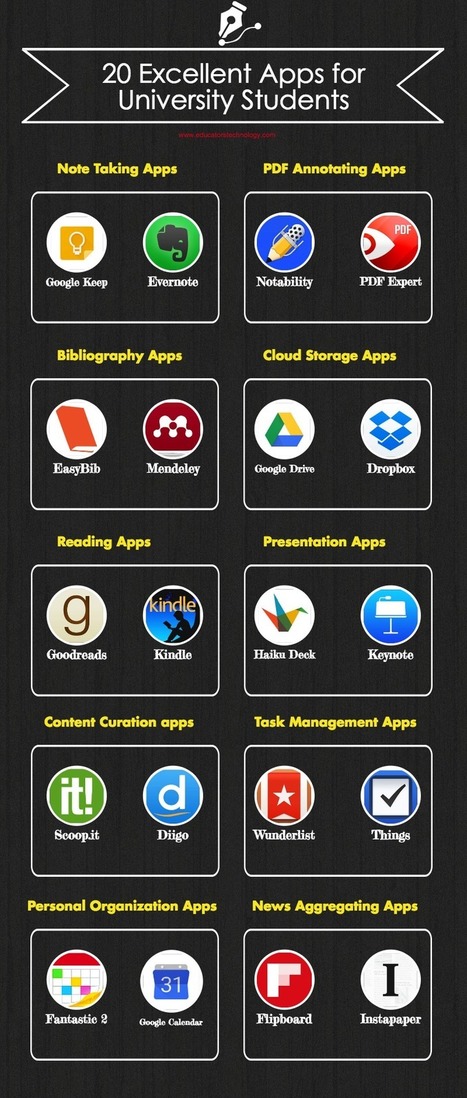
Free resource of educational web tools, 21st century skills, tips and tutorials on how teachers and students integrate technology into education... Via LGA
Scoop.it!

Alejandro's curator insight,
March 2, 2020 8:19 PM
In the current society, there is a obvious need to create new learning spaces and settings in relation with the media world in order to prepare students better for the world into which they will be exposed in the future. In fact , the focus needs to be on developing high level skills that help students accomplish complex real world tasks. this entails the incorporation of problem-based activities , and the planning of a teaching model for a digital world. This technological outbreak requires integrating platforms and resources into both the teaching and learning processes.
On the other hand, This change in education means deciding on pedagogical grounds or methodologies in order to select what is the best option for students. For instance in the text was evidence a need to inquire on how to implement online resources in the current syllabus and how to make this transition without affecting students' performance.
Scoop.it!

In the United States and worldwide, traditional PCs saw positive growth in the fourth quarter of 2019 and for the full year, ending "seven consecutive years of market contraction." Via EDTECH@UTRGV
Scoop.it!

"The point of the Modern Learning body of work is to consider things which are ‘real’ today, but will be pervasive in the 3-5 year window: do we understand what they are, where their potential lies, what the early case studies are, how they fit into our broader learning methodology, potential risks, the layers of hyperbole and marketing, what is fad, and what is fact." Via EDTECH@UTRGV
Scoop.it!
When it comes to facilitating online classroom engagement, discussion boards are a great go-to. Online discussions are practically omnipresent. Via EDTECH@UTRGV
Scoop.it!
"Custom chatbots are just starting to see their full potential tapped by a myriad of businesses in many different sectors. This is especially true in the eLearning sector as administrators are beginning to realize how these automated instant messaging tools can streamline customer service and provide a valuable resource to the learners using their product." Via EDTECH@UTRGV
Scoop.it!

"People can learn more deeply from words and pictures than from words alone. It can be called the multimedia learning hypothesis (Mayer, 2005). My experience teaching with videos supports the idea that students not only learn more deeply but also faster. Consequently, the syllabus can be enlarged when classes take advantage of multimedia means -as it happened." Via EDTECH@UTRGV
Scoop.it!

Podcasting for education has become increasingly popular in the past decade. This article explores four genres of podcast and how they can be used in online courses. The genres include: The Chat Show, The Narrative, The Tutorial and The Quick Burst. Each genre has its own strengths and weaknesses for supporting student learning, but each can also be employed for different learning tasks. Educators can seek out podcasts from each genre to incorporate in their teaching, or similarly inspire students to create their own podcasts after exploring the features of each genre. Via EDTECH@UTRGV 
Bart van Maanen's curator insight,
July 25, 2019 5:05 AM
Ook in het onderwijs kunnen podcasts wat betekekenen, maar ook daar moet het publiek in ogenschouw worden genomen. Goede opmerkingen over vorm en geluidskwaliteit (ivm. aandachtsspanne van de leerlingen).

Marco Bertolini's curator insight,
July 29, 2019 5:42 AM
What can you do with podcasting in online courses? Here are some interesting examples ;)
Scoop.it!

Our networks are great places for serendipitous connections. But they are not safe places to have deeper conversations or to expose our points of view, I noted last year in coffee, communities, and condescension. The difference between an open social network (e.g. Twitter) and a private online community (e.g. Mattermost) is that the latter is often based on mutual trust. While community members may disagree, they respect each other. They are not shaming people in public, as happens frequently on Twitter with its loose social ties. Via Edumorfosis
Scoop.it!

While the field of eLearning has many innate benefits and continues to evolve itself overtime to meet the needs of the general student populace, there are still many inherent limitations to eLearning. These need to be accepted and dealt with in order to administer a course with maximum efficacy. Via Edumorfosis
Scoop.it!
"One of my absolute favorite things is inserting checkboxes into a Google Sheets spreadsheet. I really don’t know how I lived my life without this feature. It’s so easy and useful! When using a Google Form make sure you go to the Responses tab and have your Google Form results go to a Google Sheets spreadsheet. Now add checkboxes to the spreadsheet.
Google Forms "You can use a Google Form so so many things, one idea is to have students submit late work or other requests for your attention via a Google Form. The idea of students emailing me their work sends shudders down my spine. My email is a MESS. I will likely miss the email and I need a better system to allow me to go through all the notifications. A Google Form is the way to go." Via Jim Lerman
Scoop.it!
The point of the Modern Learning body of work is to consider things which are ‘real’ today, but will be pervasive in the 3-5 year window: do we understand what they are, where their potential lies, what the early case studies are, how they fit into our broader learning methodology, potential risks, the layers of hyperbole and marketing, what is fad, and what is fact. Via Edumorfosis |






