Your new post is loading...

|
Rescooped by
Romain
from Newsletter navale
October 14, 2013 9:39 AM
|
Pour ceux qui ne seraient pas encore convaincus, les récentes déclarations du délégué général pour l'armement confirment la situation d'extrême tension du budget militaire. Lors de son audition devant la commission des Affaires étrangères, de la Défense et des Forces armées du Sénat dans le cadre de l'examen du projet de loi de programmation 2014-2019, Laurent Collet-Billon a été clair : le report de charges du programme 146 (celui qui concerne les équipements) flirte avec la ligne rouge. « Sous l'hypothèse des ressources prévues [...], le report de charges du P146 sera stabilisé durant la nouvelle LPM à son niveau de fin 2013, prévu à environ 2 milliards d'euros, ce qui n'est pas rien en regard des environ 10 milliards d'euros de dépenses annuelles, les ressources prévues ne permettant pas de le résorber. Il n'y a donc pas de marges pour gérer des aléas sur les ressources », a-t-il déclaré. En clair, cela signifie que, chaque année d'ici à 2019, il manquera toujours 2 milliards d'euros pour régler les factures reçues ou non encore reçues mais correspondant à des prestations réalisées. A noter que ce chiffre ne concerne que le seul programme 146 : si l'on extrapole à l'ensemble du ministère, le report de charges atteint 3 milliards. Même si la DGA a l'habitude de jongler avec sa trésorerie, c'est sans doute la première fois qu'une loi de programmation militaire va démarrer avec un tel niveau de report de charges. A 2 milliards, cela passe encore. « Les intérêts moratoires payés aux industriels restent maîtrisés et on privilégie les paiements aux PME ou aux sous-traitants les plus fragiles », assure-t-on aux « Echos ». Plus riches, les grands maîtres d'oeuvre comme Thales, Dassault ou DCNS peuvent faire preuve d'une certaine patience avant d'être payés. Des fins de mois stressantes Au-delà de ce seuil de 2 milliards en revanche, la DGA basculerait en cessation de paiements, croulant sous un trop-plein de factures. C'est d'ailleurs ce que laisse entendre Laurant Collet-Billon quand il évoque les « hypothèses de ressources prévues » : pour que la LPM démarre avec 2 milliards de report de charges « seulement », encore faut-il que Matignon relâche les 700 millions d'euros bloqués cette année (surgel et réserve de précaution). Si ce n'est pas le cas, où si la défense doit financer les surcoûts des opérations extérieures, les conditions d'exécution du budget 2014 seraient « pénibles », a-t-il déclaré, avec un art prononcé de l'euphémisme. Faute de marge de manoeuvre, la DGA s'apprête donc à vivre des fins de mois stressantes d'ici à 2019. A la moindre annulation de crédit, la ligne rouge de la cessation de paiements serait franchie. Alain Ruello, Les Echos
Via Patrick H.
|
|
Rescooped by
Romain
from Newsletter navale
October 14, 2013 9:37 AM
|
Le départ annoncé du groupe coréen STX du capital de STX Europe ne tire pas de larmes aux syndicats des chantiers de Saint-Nazaire et Lorient, après l’annonce de la Korea Development Bank de céder STX Europe. Reste que l’avenir de 2 140 salariés des chantiers et des 4 000 autres que comptent les sous-traitants de Saint-Nazaire et Lorient mobilise syndicats et élus locaux. Tous demandent que l’État organise un nouveau tour de table avec des actionnaires investis et, si possible, français. Nationalisation, participation de DCNS, Alstom (l’ancien actionnaire historique des chantiers), Technip, EDF, Areva, Total… Un sujet qui se retrouve désormais sur la table du Premier ministre et voisin nantais Jean-Marc Ayrault. Et ne devrait pas tarder à arriver sur celle du ministre de la Défense Jean-Yves Le Drian, dont les racines politiques sont fichées en Bretagne et à Lorient. Où STX emploie 140 salariés et où DCNS dispose de l’un de ses principaux chantiers. Le même Jean-Yves Le Drian qui rappelait clairement à Patrick Boissier, PDG de DCNS, qu’en étant son premier actionnaire et son premier client, c’était bien lui le patron sur les évolutions stratégiques… Face au changement – déjà évoqué en mai dernier – d’un actionnaire détenant 66,6 % du capital, la plupart des élus et syndicats demandent à ce que l’État français, qui détient le tiers restant depuis une décision de Nicolas Sarkozy (via le FSI) joue un rôle majeur dans la recomposition du capital.
Via Patrick H.
|
|
Rescooped by
Romain
from Newsletter navale
October 14, 2013 9:36 AM
|
PORT KLANG: Malaysia’s Littoral Combat Ships (LCS) will begin operations in 2018 and will be the main asset of the Royal Malaysian Navy (RMN) in safeguarding the country’s waters and sovereignty, said Defence Minister Datuk Seri Hishammuddin Tun Hussein. He said six LCS will patrol the nation’s waters especially in areas of high economic activity. At the same time, he said the Defence Ministry will also procure critical assets from countries which have a close relationship with Malaysia in the defence industry. “Procuring defence assets this way is more cost effective and faster with lower risks as compared to developing an an indigenious (defence) industry,” he told a media group, including from Bernama, that was specially invited to tour two of the ships here yesterday. The LCS were the KD Kelantan and KD Laksamana Tun Abdul Jamil. Elaborating further, Hishammuddin said the LCS initiative was a short-term measure to achieve ‘self-reliant’ status in developing the local defence industry and that major development like the LCS by using local companies would continue to be a model for procurement of defence assets for the nation. He said the ministry was also making efforts to procure important assets like amphibious landing ships, fighter aircraft and tanks. Meanwhile, he said the ministry was also drawing up plans to further boost the country’s defence capabalities which among others included setting up a marine operations force and building a new RMN base in Bintulu, Sarawak. As such, Hishammuddin said in Budget 2014, the ministry would try to get a higher allocation to enable the procurement of new assets and equipment as well as upgrading existing assets in all three branches of the armed forces with the priority given to the Eastern Sabah Safety Zone (ESSZONE)
Via Patrick H.
|
|
Rescooped by
Romain
from Newsletter navale
October 14, 2013 9:36 AM
|
PATUXENT RIVER NAS, Md., 10 Oct. 2013. Air traffic control experts at the Northrop Grumman Corp. Electronic Systems segment in Woodland Hills, Calif., is joining the Honeywell Inc. Aerospace sector in Clearwater, Fla., on a project to upgrade precision landing systems aboard U.S. Navy aircraft carriers and amphibious assault ships. Officials of the Naval Air Systems Command (NAVAIR) at Patuxent River Naval Air Station, Md., have announced their intention to award five-year contracts to Northrop Grumman and Honeywell to upgrade and improve Navy Precision Approach Landing Systems (PALS) on carriers and big-deck amphibs. The contracts to Northrop Grumman and Honeywell have yet to be negotiated, and should be awarded in February, Navy officials say. The contracts, which will be basic ordering agreement (BOA), will be for services and materials to fabricate, modify, repair, replace, upgrade, and improve PALS components, assemblies, and associated hardware. PALS provides precision landing information to air traffic controllers and pilots during final approach while landing aircraft aboard aircraft carriers and amphibious assault ships. Northrop Grumman and Honeywell are to return the system to a level of serviceability comparable to a new system, and will include previously produced and delivered navigation and communication systems and equipment, to include fault isolation, assembly, disassembly, and refurbishment of parts, components, assemblies, and material for the PALS navigation and communication systems. JPALS is an all-weather landing system based on real-time differential correction of the GPS signal, augmented with a local area correction message, and transmitted to the user via secure data links. The onboard receiver compares the current GPS-derived position with the local correction signal to deliver a three-dimensional position that is accurate enough for all-weather approaches via an instrument landing system (ILS)-style display.
Via Patrick H.
|
|
Rescooped by
Romain
from Newsletter navale
October 14, 2013 9:31 AM
|
... Remis à la Marine nationale en novembre 2011, L’Adroit, qui a été admis au service actif en mars 2012, quittera en effet la flotte française dans un peu plus d’un an. Il n’a, en effet, pas vocation à être acheté par la marine, qui en est certes satisfaite, mais doit atteindre la prochaine loi de programmation militaire (2020 – 2024) pour espérer voir la commande de ses patrouilleurs de nouvelle génération, les BATSIMAR... ...DCNS doit donc trouver un client export pour reprendre son bateau. En l’espèce, plusieurs prospects seraient intéressés, notamment en Amérique latine (on parle de l’Uruguay), mais aussi en Afrique. Dans ces deux régions, les besoins en moyens de surveillance et de contrôle des zones maritimes sont en effet très importants, notamment dans le cadre de la protection des installations offshore et des réserves halieutiques, ainsi que la lutte contre les trafics illicites.... Lire l'intégralité de l'article sur Mer et Marine : http://www.meretmarine.com/fr/content/dcns-cherche-vendre-ladroit
Via Patrick H.
|
|
Rescooped by
Romain
from Newsletter navale
October 14, 2013 9:30 AM
|
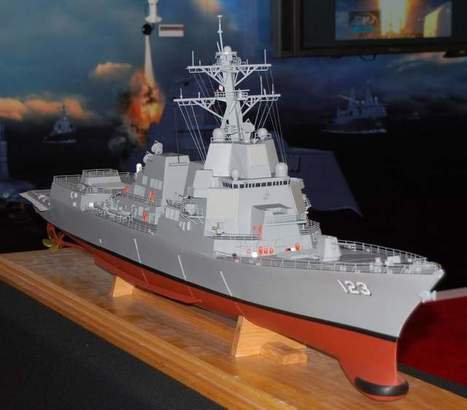
WASHINGTON — Raytheon’s years of trying to break Lockheed Martin’s near-stranglehold on the top rung of US Navy radar programs paid off Thursday with the service’s announcement that the electronics giant has won the contract to build a new radar for the Aegis Combat System. Raytheon beat out Lockheed and Northrop Grumman to build the Air Missile Defense Radar (AMDR), a new dual-band system that will provide the electronic eyes for the Lockheed-produced Aegis system. The AMDR will replace SPY-1D radars in new-construction Aegis ships. Plans call for the first AMDR ship to be ordered in fiscal 2016. AMDR-fitted Flight III ships will replace Flight IIA Arleigh Burke-class destroyers now in production. Raytheon’s AMDR uses an existing X-band radar horizon search radar and a newly developed S-band integrated air and missile defense radar designed for long-range detection and engagement of advanced threats. The radars are brought together through a radar suite controller (RSC) to integrate, coordinate and manage the system. The AMDR suite also will be integrated with SPQ-9B radars onboard Flight III destroyers. Raytheon will receive up to $1.63 billion to develop, test and deliver the AMDR. The initial contract announced Oct. 10 is a $385.7 million cost-plus-incentive-fee contract, using $157 million in fiscal 2013 funding already appropriated. The Navy is asking for $240 million in AMDR research and development funding in the 2014 budget request. It is not yet clear what effect sequestration budget cuts could have on the Navy’s AMDR plans. Adm. Jonathan Greenert, chief of naval operations, testified to Congress on Sept. 18 that with sequestration, “the new Air and Missile Defense Radar would be delivered on only four ships, as compared to seven under our PB-14 [President’s Budget for FY2014] submission, between 2021 and 2024.” A key requirement for the AMDR is to be scalable. The version to be fitted on the Flight III destroyers, for example, is to have a diameter of 14 feet, while a larger and more powerful version can be fitted on bigger ships. Controversy about the AMDR has focused on the basic Burke-class’s ability to supply enough electrical power and have the right stability characteristics to mount the sensors. Precise details of the system’s characteristics remain classified. This year, Lockheed withstood a challenge from Raytheon and Boeing to take over management of the Aegis system. The Combat System Engineering Agent (CSEA) contract awarded March 4 gave the company — which along with the Navy developed the system starting in the 1970s — management rights over Aegis through May 2018. As a sub-contractor, Raytheon also produces key components of the Aegis system. The company also makes the Standard surface-to-air missiles that equip all Aegis cruisers and destroyers. The CSEA contract is part of a series of reforms led by Sean Stackley, the Navy’s top acquisition official, to inject more competition into the service’s business relationships. Strenuous efforts to turn previously proprietary systems like Aegis into open architecture configurations also are a major aspect of that effort. The AMDR competition was fought by Lockheed, Raytheon and Northrop Grumman. Stackley — by all accounts a stern task master — has been routinely upbeat when discussing what he’s seen from the AMDR competition. The victory by Raytheon impressed at least one Wall Street analyst, who noted a trend after July’s win of the Next Generation Jammer development contract, a key element in the Navy’s airborne electronic attack mission. Raytheon won over BAE, Northrop Grumman and ITT Exelis. BAE is protesting that decision.
Via Patrick H.
|
|
Rescooped by
Romain
from Newsletter navale
October 14, 2013 9:30 AM
|
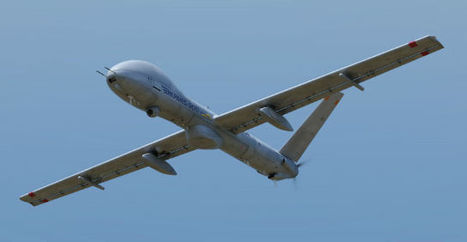
The Chilean navy is evaluating a possible procurement of Elbit Systems' Hermes 900 tactical unmanned air vehicle for maritime patrol tasks. In 2011 Elbit won a contract to supply Hermes 900 systems to the Chilean armed forces, with the nation's air force currently operating three UAVs on strategic reconnaissance missions. One of these is equipped with a maritime search radar. Santiago selected the type after a competition also involving the Israel Aerospace Industries Heron. A larger system based on Elbit's combat-proven Hermes 450, the Hermes 900 has a maximum take-off weight of 1,100kg (2,420lb), including a payload capacity of up to 300kg. With a 15m (49.2ft) wingspan, the type can be flown to an altitude of more than 30,000ft (9,140m).
Via Patrick H.
|
|
Rescooped by
Romain
from Newsletter navale
October 14, 2013 9:28 AM
|
The New Zealand MoD has confirmed its preferred tenderers for the Royal New Zealand Navy’s (RNZN) ANZAC Frigate Systems Upgrade project to include MBDA as the provider of Sea Ceptor for the Local Area Air Defence (LAAD) system; subject to the New Zealand (NZ) Government’s final approval to proceed. Sea Ceptor will equip frigates HMNZ Te Kaha and Te Mana with the latest generation naval air defence system capable of protecting not only the host ship but also combined joint allied forces in the vicinity. Following a meeting in Wellington on 4th October 2013, Mr Des Ashton, the NZ MoD Deputy Secretary of Defence (Acquisition), said: “The primary objective of the ANZAC Frigate Systems Upgrade project is to restore the ship’s combat capability and utility to a comparative level to that of a current generation, new release Combat System. This is required to counter the combined challenges of an increased level of threat sophistication coupled with obsolescence of some of the current systems. We also want to leverage off advances in technology over the past 20 years and incorporate additional functionality and performance through the selection of modern Combat System Elements. The LAAD Sea Ceptor system is a key component of the overall project ensuring that crucial constituents of the RNZN fleet are best equipped to respond to the emerging threats and protect not only the frigates themselves but also high value units in company.”
Commenting on the New Zealand selection of Sea Ceptor, Dr Andrew Murrison MP, UK Minister for International Security Strategy, said: "The UK Government is pleased that the New Zealand Ministry of Defence is pursuing the procurement of Sea Ceptor, the same system that the Royal Navy has procured for their Type 23s and plans to cross deck onto the Type 26 Global Combat Ship. The UK is immensely proud of this product - it is a real example of UK innovation and will form the bedrock of air defence for the Royal Navy for decades to come. This decision by New Zealand further demonstrates the strengthening of our maritime security cooperation." Steve Wadey, Managing Director MBDA UK, said: “I am delighted that New Zealand has selected Sea Ceptor. The NZ Government’s procurement of Sea Ceptor for the ANZAC FSU project will be the first export success for this highly capable weapon system and proof that MBDA is able to meet such challenging requirements. This success has been supported by the UK Government during discussions with the New Zealand Ministry of Defence, a cooperation that will continue through the life of the project.”
The appeal of Sea Ceptor is creating significant interest in a number of markets around the world and its versatility makes it the ideal choice for the ANZAC upgrade. As an active radar system, Sea Ceptor does not require the dedicated tracker/illuminator radars on which semi-active systems depend. Sea Ceptor deploys the CAMM (Common Anti-Air Modular Missile) which, due to its soft launch technology, requires no efflux management system. This minimizes the system’s mass and footprint thereby allowing for greater flexibility regarding ship installation positions. CAMM missile canisters are compatible with a wide range of vertical launch systems.
On the 9th September 2013, the United Kingdom’s (UK) Royal Navy contracted with MBDA for the manufacture of the Sea Ceptor system for its frigate fleet. The UK will replace the Seawolf missile system in their Type 23 frigates with Sea Ceptor before migrating it to their new build Type 26 frigates.
Via Patrick H.
|
|
Scooped by
Romain
October 14, 2013 9:06 AM
|
Ancien élève de l'école spéciale militaire de Saint-Cyr et de l'Inalco, le général Jean Heinrich a, entre autres, dirigé le service Action puis la direction des opérations de la Direction générale de la sécurité extérieure (DGSE). Premier directeur de la DRM (Direction du renseignement militaire), il est aujourd'hui président du directoire du groupe Geos qui se définit comme "le leader en Europe continentale de la prévention et du management des risques". Dans le débat sur les sociétés militaires privées qui agite depuis plusieurs mois le Landerneau de la défense, il est un partisan de leur légalisation en France et s'en explique dans un entretien.
Le Point : Le débat sur la possibilité d'autoriser en France les sociétés militaires privées, actuellement interdites par la loi de 2003 sur le mercenariat, s'intensifie. Qu'en pensez-vous ? Jean Heinrich : Je déplore une grande confusion à ce sujet. On mélange des notions différentes. Je ne suis pas à l'aise avec la nouvelle terminologie employée par le SGDNS (Secrétariat général de la défense et de la sécurité nationale), qui parle d'EMSP (entreprises militaires et de sécurité privées). À mes yeux, il est préférable de parler en termes spécifiques de deux réalités différentes : d'une part les sociétés militaires privées (SMP) qui peuvent disposer de blindés, d'artillerie, d'avions et agir au nom d'un État et, d'autre part, les SSP (sociétés privées de sécurité) qui protègent des intérêts privés. Les grandes sociétés militaires privées sont connues : Executive Outcomes en Angola et, en Guinée-Bissau, MPRI (Military Professional Ressources, Inc) en Croatie et en Bosnie, Blackwater (aujourd'hui Xe Services) en Irak, etc. Comment situer les sociétés de sécurité privées (SSP), qui protègent des intérêts d'entreprises ? Les sociétés de sécurité privées ne possèdent pas de moyens militaires. Elles sont utilisées dans ces "zones grises" de moins en moins sûres, dans lesquelles les expatriés et les missionnaires envoyés par les entreprises doivent pouvoir travailler en toute sécurité. Désormais, les entreprises ont l'obligation légale d'assurer la sécurité de leurs personnels. La jurisprudence est très nette : si la protection, l'information et la sûreté des employés ne sont pas assurées, ces derniers peuvent attaquer leur employeur au civil, voire au pénal, et les tribunaux leur donnent généralement raison. Mais la vraie question porte sur le transfert aux privés des armes autres que d'autoprotection, et le droit de s'en servir. Des hélicoptères, des mitrailleuses lourdes ou des blindés, ce n'est pas pour l'autodéfense... Le problème de la France est que l'État ne sait pas ce qu'il veut. C'est une difficulté majeure, d'autant plus que les armées ne sont pas unanimes. Il y existe deux tendances. La première, que je qualifie de "conservatrice", estime qu'il est impossible de confier au privé ne serait-ce qu'une partie des prérogatives régaliennes, illustrées par le port des armes. On ajoute que si la défense s'adresse à des privés pour effectuer une partie de ses missions, alors qu'elle a été la bonne élève de la RGPP (Révision générale des politiques publiques), les politiques vont se tourner vers elle, et lui demander de réduire encore ses effectifs. Ce que les armées considéreraient comme intolérable. Aux États-Unis, l'envoi des armées en opération nécessite l'accord du Congrès, d'où le recours fréquent aux SMP qui, elles, se passent de cette autorisation. Mais en France, le Parlement n'a pas son mot à dire. Le chef des armées n'a aucun compte à rendre... Aux États-Unis, c'est le Pentagone qui envoie les privés en opération. Je peux témoigner que, lorsque j'étais adjoint au commandant de l'Ifor en Bosnie, MPRI était présente pour rehausser le niveau technique et opérationnel de l'armée bosniaque, afin qu'elle atteigne le niveau de l'armée bosno-serbe. Nous y étions opposés, mais le Pentagone l'avait décidé et donnait ses ordres à MPRI. Ils étaient transmis à l'ambassadeur à Sarajevo, qui m'invitait à écouter les directives qu'il donnait en personne à cette société militaire privée. C'est en ce sens que le pouvoir de l'exécutif se trouve renforcé... Vous discernez une première tendance "conservatrice" et opposée aux SMP dans les armées françaises. Quelle est la seconde ? C'est la tendance "pragmatique" qui, vous l'avez compris, recueille mon approbation. Ses partisans estiment que le recours au privé présente de nombreux avantages, et permet aux armées de se concentrer sur l'essentiel, en se déchargeant de fonctions "polluantes". D'ailleurs, les "contractors", comme on appelle en anglais les SMP et leurs employés, coûtent moins cher et sont bien plus efficaces dans certaines missions. À l'heure où la plupart des armées sont budgétairement contraintes de réduire leurs effectifs, les SMP sont un facteur d'économie et d'efficacité. De plus, l'opinion publique est beaucoup moins sensible à leurs pertes qu'à celles que pourraient subir des armées d'État. Ma mission à Sarajevo présentait certains risques, et j'étais protégé par d'excellents gardes du corps. Tous, et jusqu'à mon conducteur, étaient des chuteurs opérationnels venus du 8e régiment parachutiste d'infanterie de marine, formés à la chute libre à grand prix, et qui se retrouvaient dans une fonction pour laquelle ils étaient surqualifiés. Des contractors très bons dans le seul métier de garde du corps auraient parfaitement fait l'affaire. Comment les entreprises françaises agissent-elles, concrètement, pour répondre aux demandes de leurs clients ? Notre offre est vaste et va du conseil en amont à la gestion de crises en passant par la formation des personnels, l'organisation sécuritaire d'un chantier, l'accompagnement, la protection sur zone. Nous pouvons faire appel à des sous-traitants que nous connaissons et dirigeons qui, eux, sont armés à terre, voire en mer, où nous travaillons avec des marines nationales rémunérées pour ce service. Vous payez une armée nationale pour protéger vos clients ? N'est-elle pas supposée le faire aux frais de son gouvernement ? Mais si nous ne les payons pas, ils font autre chose ! Ils trouvent leur intérêt à travailler pour nous à un moment donné. Je pense qu'il serait nettement plus simple de faire comme les Espagnols, qui placent des privés en armes à bord de leurs thoniers. Pour l'instant, les thoniers français sont protégés par la marine nationale. Vous connaissez son format et son volume. Elle peut protéger trois ou quatre bateaux, pas des centaines. Il faut être sérieux ! Tous les États font appel, d'une manière ou d'une autre, au privé. Les Suisses proposent aux États et aux entreprises de signer un texte réglementant les SMP. De votre point de vue, est-ce un progrès ? Nous avons perdu au moins dix ans. Alors ministre de la Défense, Alain Richard m'avait demandé un rapport sur les SMP. À l'époque, j'avais déjà recensé 90 sociétés en Afrique, mais pas une seule française. Il faut arrêter de faire une fixation sur le mot "mercenaire", qui n'a jamais été défini. Les journalistes devraient cesser de se référer au folklore ancien brodé autour de trois pelés et deux tordus que j'avais délogés des Comores. Texte suisse ou non, nous aurons toujours en France la loi de 2003, qui nous interdit de fait de créer des sociétés militaires privées. De plus, nous sommes à moins de deux ans d'une élection présidentielle. Je ne vois pas les choses évoluer avant cette date !
|
|
Rescooped by
Romain
from Newsletter navale
October 14, 2013 6:19 AM
|
Indonesian Aerospace (IAe) handed over the first of three maritime patrol configured CN235 to the Indonesian navy at a ceremony in Bandung on 2 October. Indonesia’s defence ministry contracted IAe to build the three aircraft, designated as CN235 PATMAR, in 2009. They will complement the navy’s NC212s, providing long-range patrol missions across the Indonesian archipelago. The aircraft has been fitted with search radar, forward-looking infrared camera, IFF transponder, tactical navigation systems and a bubble window to equip it for a surveillance role. In addition, IAe says that the aircraft has been fitted with winglets to improve its stability. IAe adds that it has received expressions of interest from other countries in the Association of Southeast Asian Nations (ASEAN) that are interested in acquiring the CN235 PATMAR aircraft.
Via Patrick H.
|
|
Rescooped by
Romain
from Newsletter navale
October 14, 2013 6:19 AM
|
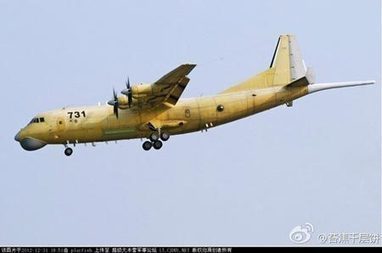
A Gaoxin-6 anti-submarine aircraft, modified from the Y-8 transport plane. (Internet photo) Facing the challenge of US and Japanese submarines operating within disputed territorial waters, the People's Liberation Army is preparing for a three-dimensional anti-submarine system consisted of aircraft, surface combat vessels and submarines, according to the Hong Kong-based Wen Wei Po. Meanwhile, the Tokyo-based Yomiuri Shimbun reported that the Japan Maritime Self Defense Force plans to increase the number of its submarines from 16 to 22 by 2021. Using Soryu-class diesel-electric submarines as an example, the paper stated that the size of the new Japanese submarines will become larger. As the first class of Japanese submarines to be equipped with air-independent propulsion system, the Soryu-class diesel-electric submarine can operate under water for nearly two weeks. The Soryu-class is also much more powerful than its predecessors, the Harushio and Narushio-class submarines, as it is equipped with Type 89 torpedoes and UGM-84 Harpoon anti-ship missiles. Even though Japan is not permitted under its constitution to have its own nuclear-powered submarine, conventional submarines like the Soryu-class are already a dangerous threat to China's maritime communication lines, the paper said, adding that Japanese submarines have a longer patrol range and more powerful weapons systems. In addition, the United States is deploying more submarines to the Asia-Pacific region. At the US military base in Yokosuka, there are between five and six submarines under the command of the Seventh Fleet. Next year, the US will deploy four more nuclear-powered submarines to Guam, while strategic targets in China are in range of the 154 Tomahawk cruise missiles equipped by a single Ohio-class ballistic missile submarine. To counter Chinese submarines in a potential conflict, Japan recently purchased 70 P-1 jet planes from Kawasaki Heavy Industries to replace its US-built P-3C jet. The delivery of the first two P-1 aircraft to the Japan Maritime Self-Defense Force took place on Mar. 26. In addition to fixed-wing aircraft, the country's new helicopter carrier, the Izumo, is able to carry 14 SH-60K anti-submarine helicopters into battle. Ships of the World, a Japanese military magazine, indicated that the Self-Defense Force currently has 44 destroyers and nine frigates to form the nation's surface combat fleet against the PLA Navy. While some of those destroyers are used in air defense operations, more of them are designated to combat Chinese submarines. Facing this new challenge, the PLA Navy must adopt new tactics to defend its submarines against a potential joint anti-submarine operation launched by the US and Japan. Cheng Chi-wen, chief editor of the Taipei-based Asia-Pacific Defense, said that what the PLA Navy needs most is fixed-wing aircraft for anti-submarine operations. Currently, China can only rely on its Y-8 transport aircraft for such a mission as it is capable of carrying torpedoes, depth charges and mines. Shi Hong, a Chinese military analyst, said China needs more fixed-wing aircraft because the patrol range for helicopters is too short. He added that several Y-8 transport aircraft have been modified into Gaoxin-6 anti-submarine aircraft. With more advanced systems and greater range, the PLA Navy Air Force can conduct anti-submarine operations as far as the Second Island Chain — a series of island groups that runs north to south from the Japanese archipelago to the Bonin and Marshall islands. In addition to maritime patrol aircraft, anti-submarine helicopters, surface combat vessels and submarines, an Underwater Sound Surveillance System will be a crucial weapon for the PLA Navy to monitor the movements of American and Japanese submarines, Shi said. However, China does not yet have such a sophisticated surveillance system, he added.
Via Patrick H.
|
|
Rescooped by
Romain
from Newsletter navale
October 14, 2013 6:18 AM
|
TAIPEI: A senior Taiwanese official has renewed a call for the United States to sell the island submarines and advanced fighters to bolster defence against China, local media reported on Tuesday. The call came despite a marked improvement in relations since Ma Ying-jeou of the China-friendly Kuomintang came to power in 2008. Ma was re-elected in January 2012. Despite warming ties, Beijing still refuses to rule out the use of force to reunify with Taiwan and has been strengthening its own forces. "The Chinese mainland's military might keeps growing at a fast pace in the past few years, posing a grave threat to Taiwan," deputy defence minister Yen Teh-fa told reporters on the sidelines of the US-Taiwan Defence Industry Conference in Annapolis, Maryland from September 29-Oct 1. The conference, the 12th since 2002, discussed Taiwan's Quadrennial Defence Review and examined the island's defence needs against an increasingly assertive Chinese military, Taiwan's state Central News Agency reported. Regarding hoped-for weapons acquisitions from the United States, the island's leading arms supplier, Yen said Taiwan now gives priority to submarines. In April 2001 then-President George W. Bush approved the sale of eight conventional submarines as part of Washington's most comprehensive arms package to the island since 1992. Since then, however, there has been little progress on the order because the United States has not built conventional submarines for more than 40 years. Germany and Spain have reportedly declined to offer their own designs for fear of offending China. The Taiwanese navy currently operates a fleet of four submarines, but only two of them could be deployed in the event of war. The other two were built by the United States in the 1940s. Taiwan is also looking for fighter aircraft more advanced than the current F-16s, Yen said.
Via Patrick H.
|
|
Rescooped by
Romain
from Newsletter navale
October 14, 2013 6:17 AM
|
NEW DELHI — Western competitors could face stiffer competition from the Russians in India’s forthcoming US $12 billion tender for the purchase of six conventional submarines. The Indian Defence Ministry is requiring that submarines in the competition be capable of mounting the Indo-Russian BrahMos cruise missile. India’s Defence Research and Development Organisation, which is jointly producing the BrahMos with Russia, has persuaded the MoD to incorporate the requirement for the tender, expected to be floated by the end of the year. DCNS of France, Navantia of Spain and HDW of Germany will offer their submarines in the competition. The Russians, meanwhile, told the Indian Navy this month that their Amur-class submarines could accommodate the BrahMos missile with little modification. No executive from DCNS, Navantia or HDW would comment on their boats’ ability to carry the missile. India is finalizing a formal tender to purchase six advanced conventional submarines with air-independent propulsion technology. The six submarines are to be purchased within the limitations of the Missile Technology Control Regime, which restricts the proliferation of missiles capable of flying beyond 300 kilometers, an MoD official said. BahMos is homemade and has a range of less than 300 kilometers, which would be best suited for the submarine, the MoD source said. The submarines are to have a surface speed of 12 knots and submerged speed of 19 knots. They will have a range of 50 to 60 days of navigation on the surface and 20 to 30 days of navigation submerged at 4 knots. Two of the six submarines are to be made in the overseas shipyard and the remaining four are slotted to be license-produced only in a state-owned shipyard. The major fire on the Russian-made Sindhurakshak last month has dropped the operational strength of the Indian Navy submarines to only 11. With the decommissioning of the aging German HDW-class submarines next year, the Indian Navy’s total submarine strength could fall to as low as seven by 2015. The fact that the Indian Navy’s submarine fleet size has dropped so low is a point of major concern in the ranks, especially since China’s sub fleet is more than 60, an official said.
Via Patrick H.
|
|
|
Rescooped by
Romain
from Newsletter navale
October 14, 2013 9:38 AM
|
TEL AVIV, Israel, Oct. 11 (UPI) -- Israel Aerospace Industries is developing a new missile warship that will give its navy greater firepower, but it's looking for foreign investors and says several countries are interested.
In the meantime, IAI, the flagship of Israeli's bustling defense industry, is moving ahead with a Defense Ministry order for three advanced Super Dvora Mark III patrol craft to boost protection for the Jewish state's natural gas fields in the eastern Mediterranean.
The Globes business daily reported the new design is still on the drawing board at IAI's Ramta plant in the Negev Desert city of Beersheva, but it will be the largest warship developed by the state-owned company amid an unprecedented upgrade for the navy.
The 96-foot vessel will be known as the Multirole Super Dvora. Nitzan Shaked, a reserve navy officer with command experience who's the general manager at the Ramta plant, observed: "We're in the preliminary development stage ... . The basic idea is to offer a ship with many more capabilities, while making sure it won't be too expensive or too big."
The MSD is the latest in IAI's line of surface combat ships, starting with the Dabur torpedo patrol boat. Fifteen of them remain in service.
The Dabur evolved into the larger and faster Dvora, which in turn produced the Super Dvora patrol craft that the navy still procures.
IAI announced in September the navy had ordered three more Super Dvora Mark IIIs to add to the four already in service, acquired under a 2004 contract.
Globes reported the aging Daburs will be mothballed when the new MSDs are commissioned.
The MSD is expected to be armed with various versions of IAI's Barak air-defense missile, which is also carried by the navy's three Saar 5-class corvettes, Israel's largest warships, and 8 Saar 4.5 coastal patrol craft.
The new craft will be equipped with the advanced radar developed by IAI subsidiary Elta systems, along with anti-missile defense systems and electo-optical systems for operating at night and in bad weather.
The Multirole Super Dvoras, like the Super Dvoras, will be powered by engines manufactured by Germany's MTU Aero Engines AG at its Detroit facility.
Otherwise, the MSDs will be fitted with Israeli systems, including the 25-30mm Typhoon cannon built by state-owned Rafael Advanced Defense Systems, and the communications systems made by Orbit Technologies.
Via Patrick H.
|
|
Rescooped by
Romain
from Newsletter navale
October 14, 2013 9:36 AM
|
Source : La Opinión de Murcia (Espagne) Le ministère espagnol de la défense affirme que la modification sera prête au début 2014 et que l’audit mené par Electric Boat confirme le diagnostic de la marine espagnole. Le ministère espagnol de la défense prévoit que la modification de la conception du futur sous-marin S-80 sera prête au début 2014, maintenant qu’il a été confirmé que le sur-poids du sous-marin est à l’origine des problèmes techniques qui ont provoqué un retard supplémentaire du programme. Concrètement, le sur-poids du sous-marin atteint 8%, ce qui sera corrigé en allongeant la coque de quelques 7 m. Depuis que Navantia a annoncé le nouveau retard en mai dernier, des ingénieurs de Electric Boat sont venus travailler avec les techniciens de la marine espagnole. L’audit qu’ils ont élaboré conclut que l’origine du problème réside dans un « contrôle inadapté du poids du sous-marin ». Cette analyse, rappelle le ministère, « confirme le diagnostic de la marine ». L’audit présente une série de recommandations pour corriger le problème. Pendant ce temps, les travaux continuent au chantier de Carthagène, avec pour objectif d’écarter de nouveaux problèmes. Un ingénieur d’Electric Boat restera en permanence sur le chantier pour servir de lien entre l’équipe aux Etats-Unis et les techniciens du chantier espagnol. Les sources indiquent que l’audit a identifié une série de circonstances qui ont pu influer sur le contrôle inadapté du poids, parmi lesquelles un « système de surveillance insuffisant » ou une « application inadaptée des procédures industrielles et des exigences de validation ». Solution américaine La solution que propose la compagnie américaine est d’allonger le sous-marin de quelques 7 m, tout en conservant les systèmes actuellement embarqués. Ainsi, puisque le ministère a refusé d’enlever le système de propulsion anaérobie, le problème sera solutionné. Navantia a calculé que le retard subi par le programme sera de 12 à 24 mois, qui s’ajoutent aux retards déjà accumulés par le programme. L'analyse de la rédaction : L’Espagne accepte ainsi l’assistance américaine jusqu’à la fin du programme. Un comble pour ce qui est pourtant présenté en Espagne comme un sous-marin de conception entièrement national.
Via Patrick H.
|
|
Rescooped by
Romain
from Newsletter navale
October 14, 2013 9:36 AM
|
US Navy : la première unité de F-35C activée (la VFA-101 Grim Reapers)
Source : Air et Cosmos C'est le 2 octobre dernier que I'US Navy a officiellement réactivé Ia flottille
VFA-101 "Grim Reapers" . Volant autrelois sur F-14, cette flottille est desormais Ia premiere unité de I'US Navy à aligner le F-35C. Basée à Eglin AFB, et rattachée à l'escadre de chasse du 33rd Fighter Wing, elle
formera les premiers pilotes operationnels de F-35 de Ia Marine américaine.
Pour l'heure, cinq F-35C de présérie ont volé. Deux sont arrivés a Eglin AFB (CF-6 et CF-7). A terme, il est prévu que Ia VFA-101 compte 15
avions. Le F-35C doit être operationnel dans I'US Navy en 2019.
Via Patrick H.
|
|
Rescooped by
Romain
from Newsletter navale
October 14, 2013 9:32 AM
|
...A l'invite du royaume saoudien, qui l'en a prévenu la veille, M. Le Drian a ainsi passé un long moment avec le roi Abdallah ben Abdelaziz Al-Saoud. Il s'est, en outre, entretenu – ce qui était prévu – avec les principales autres autorités du pays : le prince héritier ministre de la défense, le vice-ministre de la défense et le chef de la garde nationale. Les relations d'armement entre Paris et Ryad sont au mieux, notamment dans le domaine naval. Le royaume saoudien a confirmé que le contrat LEX (Life extension Sawari 1) entrait en exécution lundi : il vise la rénovation de quatre frégates et de deux pétroliers ravitailleurs saoudiens pour un montant officiel de 1,4 milliards d'euros, dont plus de la moitié revient aux entreprises françaises DCNS et Thalès, le reste étant réalisé par un chantier naval saoudien. Le contrat total dépasserait 2 milliards d'euros selon plusieurs experts. Il s'agit du premier contrat majeur passé avec ce pays depuis celui des avions ravitailleurs multi-rôles en 2007 (dans lequel la part française était faible), souligne-t-on dans l'entourage de M. Le Drian. L'autre nouvelle importante est la confirmation par Riyad du contrat Sawari 2, portant sur la poursuite de la modernisation des frégates. Ce programme est important car il doit préfigurer un contrat plus large d'acquisition de six frégates de nouvelle génération, les Fremm. Au-delà, c'est un contrat sur la fourniture de sous-marin qui est en ligne de mire....
Via Patrick H.
|
|
Rescooped by
Romain
from Newsletter navale
October 14, 2013 9:30 AM
|
Ukrainian state-owned arms trading company Ukroboronprom delivered several Konan 750 BR armored speedboats. The ships were designed and built by Skloplastic, a Ukroboronprom member. The Konan 750BR crew compartment is armored against bullets. The ship is designed as a self-righting boat. It can be fitted with a manned 12.7 mm machine gun.
General Specifications of the ship:
Length overall, m (with motor) 8.0
Body length 7.5 m
Maximum width, 2.7 m
Displacement hull maximum, 0.6 m
Power outboard max., Hp 1x290
The speed at maximum power, knots. 40-43
The angle of deadrise at the transom, hail. 22
The angle of deadrise amidships, hail. 25
Maximum capacity, pers. 6
The maximum number of seats, pcs. 5
Unladen weight, kg 2400
Load capacity, kg 1000
Weight, kg 3400
The volume of fuel, 400 liters
Cruising range with the Max speed, 130 miles
Cruising range with Cruies speed. 22 knots., 250 miles
Via Patrick H.
|
|
Rescooped by
Romain
from Newsletter navale
October 14, 2013 9:30 AM
|
WILLIAMSTOWN, Australia, Oct. 7 (UPI) -- The MK45 guns used on ships of the Royal Australian Navy are being overhauled by BAE Systems under a five-year contract. BAE Systems, which did not disclose the value of the award, said it will be the sole source provider of gun in-service support, removal, replacement and overhaul services to the country's navy. The contract follows the recent overhaul of a naval gun system for a navy ship. "Our Technical Services team demonstrated its capability by overcoming the challenges the project presented, including major realignment requirements when fitting the gun and loader on HMAS Stuart," said BAE Systems Director of Maritime Bill Saltzer. 'The overhaul of the remaining guns for the ANZAC fleet will be carried out at the BAE Systems shipyard in Williamstown, Victoria and then installation of the guns will be done in conjunction with the ASMD upgrade when the ships are dry berthed at the BAE Systems shipyard in Henderson, WA. "Accomplishing the gun overhauls concurrently with the ASMD upgrade will ensure these vital assets will not be out of service for any additional length of time. "It also means the Navy can also be confident that when the ships resume operation they will have both the benefits of the ASMD upgrade and a fully re-conditioned gun with an extended length of service," he said. ASMD is an acronym for anti-ship missile defense, which includes phased array radar and combat management system upgrades.
Via Patrick H.
|
|
Rescooped by
Romain
from Newsletter navale
October 14, 2013 9:29 AM
|
MANILA - Moving toward territorial defense, the country plans to acquire three submarines and so many other military assets, Northern Luzon Command head Major Gen. Gregorio Pio Catapang said . In a paper, Catapang said submarines, by their inherent stealth capability, may be deployed to monitor and protect the country's extensive maritime domains. These vessels are the conventional-powered or diesel-electric type and generally cheaper than nuclear-powered ones. Also being eyed is the acquisition of six frigates for anti-air warfare, 12 corvettes for anti-submarine warfare, 18 offshore patrol vessels, and three anti-mine warfare ships. However, Catapang’s paper did not specify when and how much it will cost the Philippines to complete these acquisitions. An earlier Philippine Navy (PN) study revealed that some P497 billion is needed to fully upgrade its fleet. Once it has this money, the Navy will acquire the above-mentioned items along with four sealift vessels, 18 landing craft utility vessels, three logistics ships, 12 coastal interdiction patrol boats, 30 patrol gunboats, and 42 multi-purpose assault craft that can be equipped with torpedoes and missiles. Also envisioned are eight amphibious maritime patrol aircraft, 18 naval helicopters, and eight multi-purpose helicopters. "Looking at the PN's inventory of mission essential equipment, it is very discernible that majority of our assets and vessels were acquired not necessarily because they fit into our strategy or operational requirement but because they are available as grant from the US or from our allies," the PN study said.
Via Patrick H.
|
|
Rescooped by
Romain
from Newsletter navale
October 14, 2013 9:28 AM
|
The island of Saipan — an unincorporated territory of the United States in the western Pacific Ocean — will be reconstructed as a military base to prepare for a potential missile attack by the People's Liberation Army over the Second Island Chain. The Second Island Chain is a series of island groups stretching from northern Japan to the Bonin and Marianas islands. It is the second defense line of the United States to prevent the expansion of China's maritime power in the Eastern Pacific after the First Island Chain, which extends from Alaska to the Philippines, Guam is currently the most important US military base in the Western Pacific with the Apra Harbor and Andersen Air Force Base. If a conflict were occur, China would likely attack the naval base at Guam with its newly developed DF-21D anti-shipping missiles.
Via Patrick H.
|
|
Rescooped by
Romain
from Newsletter navale
October 14, 2013 6:20 AM
|
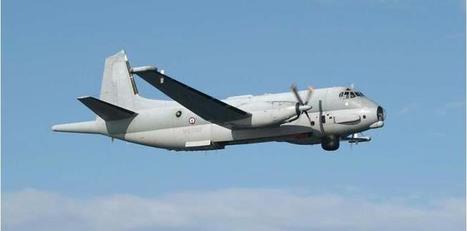
Lors de son déplacement de ce 4 octobre à Brest à l’occasion des 50 ans du site industriel de Thales, le ministre de la défense Jean-Yves Le Drian a signé le contrat de rénovation des Atlantique 2. D’une valeur de 400 millions d’euros, le contrat permettra de doter 15 avions (28 avaient été reçus entre 1989 et 1997) des performances requises pour assurer leurs missions opérationnelles jusqu’à leur retrait de service après 2030. Concrètement, les ATL2 amélioreront leur capacité à traiter les menaces modernes par tous les temps, que ce soit dans le cadre de la mission stratégique de dissuasion ou dans le cadre de conflits asymétriques : sous-marins silencieux et furtifs, embarcations rapides, véhicules terrestres, etc. Les avions pourront voler au-delà de 2030. Dassault Aviation sera responsable du développement du cœur système incluant le logiciel LOTI développé par DCNS. Dassault Aviation sera également en charge de l’intégration globale de l’ensemble des sous-systèmes et transformera à cet effet un avion « prototype » pour réaliser les essais en vol. Thales développera le sous-système radar/Identification ami-ennemi (IFF) et le Sous-système de Traitement Acoustique Numérique de dernière génération (STAN). Le radar bénéficiera des technologies les plus récentes dérivées de celles utilisées sur Rafale. Le STAN, adapté à tous les types de bouées acoustiques existants et futurs connus, permettra de détecter les cibles sur un spectre élargi de fréquences et de contrer les nouvelles menaces. DCNS développera le logiciel LOTI qui permet d’élaborer une situation d’ensemble à partir de différents senseurs et qui assure la mise en œuvre des armements, telles que les torpilles et les missiles. Ce système collaboratif permet à plusieurs opérateurs d’interagir en même temps. Le développement des consoles de visualisation tactique rénovée et le chantier des avions de série sont confiés au SIAé. La livraison du premier appareil rénové à la Marine nationale est prévue en 2018, celle du 15e appareil en 2023. A partir du 3e avion, c’est le SIAé (Service industriel de l’aéronautique) qui sera maître d’œuvre des opérations de rénovation.
Via Patrick H.
|
|
Rescooped by
Romain
from Newsletter navale
October 14, 2013 6:19 AM
|
Le premier bâtiment de projection et de commandement (BPC) russe Vladivostok sera mis à l'eau à Saint-Nazaire le 15 octobre prochain, a annoncé un communiqué mis en ligne sur le site de STX France, constructeur du navire. Le vice-premier ministre russe Dmitri Rogozine avait auparavant annoncé que les chantiers navals Dalzavod situés à Vladivostok, en Extrême-Orient, avaient été retenus pour assurer la maintenance du premier BPC russe. Le contrat de 1,2 milliards d'euros prévoyant la construction de deux porte-hélicoptères de type Mistral pour les forces navales russes a été signé en juin 2011. Le premier navire sera livré en 2014 et le second en 2015. M. Rogozine, qui supervise le complexe militaro-industriel, a antérieurement indiqué que l'industrie russe ne produisait pas les carburants et les lubrifiants requis pour les bâtiments de type Mistral.
Via Patrick H.
|
|
Rescooped by
Romain
from Newsletter navale
October 14, 2013 6:18 AM
|
NEW DELHI: Chinese and other submarines are fast stepping up their forays into the Indian Ocean region (IOR) but India continues to drag its feet in acquiring advanced helicopters that operate from warships to detect, track and kill such underwater predators.
The irony is that while the Navy is on track to induct four-five major warships every year over the next decade, with as many as 40 ships already on order in domestic shipyards, the anti-submarine warfare (ASW) helicopters to provide them with "close-in protection" are nowhere in sight.
The Navy currently has just 11 Kamov-28 and 17 Sea King ASW helicopters to defend its existing fleet of over 130 warships from enemy submarines on the prowl silently. While the Sea Kings are over 20 years old, the Kamov-28s are long overdue for a mid-life upgrade.
With only half of these aging helicopters operationally available at any given time, alarms bells have begun to clang loudly at this "critical operational gap" in the IOR which is getting "dense with foreign submarines", say sources.
The Navy is already grappling with a crippling shortage in missiles to arm the Israeli Barak-I anti-missile defence systems on its 14 frontline warships, including aircraft carrier INS Viraat, due to a seven-year-old CBI probe into kickbacks in the original contract.
"It's like a double-whammy. The protective shield around the warships is fast eroding," said a source. The ASW helicopters fly ahead of warships to "dunk" their sonars in the "tropical waters" of IOR to depths like 200-300 metres, listen for underwater electronic and other signals of submarines, track and then eliminate threats to "sanitize" the path for the fleet.
It has being almost a decade since the Navy initiated a case to acquire 16 new multi-role helicopters with potent ASW capabilities. But it's yet to fructify due to the government's slow decision-making process, coupled with squabbling between contenders European NH-90 and American Sikorsky-70B helicopters.
This contract is crucial since it is to be followed by a bigger deal for 123 helicopters — in the 9 to 12.5-tonne class with ASW capabilities as well as customized for amphibious assaults and commando operations — at a cost of over $3 billion.
The abysmal situation can be gauged from the fact that even aircraft carrier INS Vikramaditya, the rechristened Admiral Gorshkov slated for commissioning in mid-November after a $2.33 billion refit in Russia, has no ASW helicopters earmarked for it till now. "A carrier battle group requires at least 8 to 10 ASW helicopters," said a source.
Via Patrick H.
|
|
Rescooped by
Romain
from Newsletter navale
October 14, 2013 6:18 AM
|
Rohde & Schwarz UK Ltd has been down selected after a 12 month competition process run by BAE Systems to be the preferred partner for the design phase of the integrated communications system for the future Royal Navy’s Type 26 Global Combat Ship.
The Rohde & Schwarz proposal for the Type 26 is at the forefront of technology and includes innovative systems to truly deliver a state of the art communications system. This coupled with proven high reliability will in turn reduce the through life cost with respect to support and provide the Royal Navy with improved efficiency of resources, high system availability and operational performance.
This down select follows on from previous Rohde & Schwarz naval successes in the UK which include providing communications solutions to the Royal Navy’s Queen Elizabeth Class Aircraft Carriers, River Class Offshore Patrol Vessels and the Royal Fleet Auxiliary’s Bay Class Vessels.
In the international arena and not limited to, the supply to the Australian Hobart Class Air Warfare Destroyers, the Royal Dutch Navy LCF Frigates and Landing Platform Docking LPDs, and the Spanish Navy with the F100 Class Frigates and LPD of which all utilize communications solutions from Rohde & Schwarz.
Via Patrick H.
|