
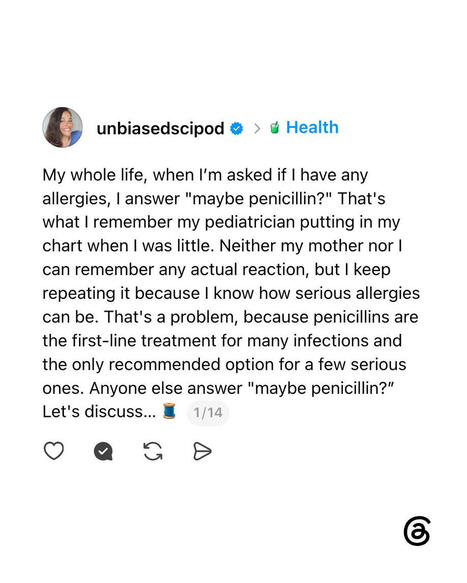
Anyone else have a "maybe penicillin" allergy?
Read more:
https://lnkd.in/e6xvAMiV
https://lnkd.in/ejJXXksW
https://lnkd.in/epHgKjsB
https://lnkd.in/dFCT7RNg
https://lnkd.in/eTHnGzma


|
Scooped by
Gilbert C FAURE
onto Allergy (and clinical immunology) September 21, 4:15 AM
|
 Scoop.it!
Anyone else have a "maybe penicillin" allergy?
Read more:
https://lnkd.in/e6xvAMiV
https://lnkd.in/ejJXXksW
https://lnkd.in/epHgKjsB
https://lnkd.in/dFCT7RNg
https://lnkd.in/eTHnGzma


 Your new post is loading...
 Your new post is loading...
Your new post is loading...
Scoop.it!
|
|
|
Scooped by
Gilbert C FAURE
Today, 8:26 AM
|
Scoop.it!

Allergy testing claims get paid when the details match. Bill 95004 for percutaneous tests and 95024 for intradermal tests, with one unit per test. Verify coverage and authorization first, document medical necessity, and check payer rules before you submit.
|
|
Scooped by
Gilbert C FAURE
October 7, 4:51 AM
|
Scoop.it!
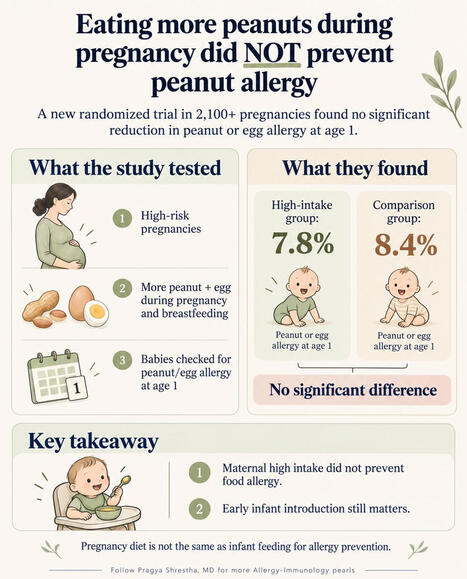
More peanuts in pregnancy ≠ less peanut allergy in babies.
A major new NEJM trial just tested this.
For years, families have asked whether eating more peanut during pregnancy could lower their baby’s risk of developing peanut allergy.
Now we have much better data.
A new randomized trial included more than 2,100 pregnancies in families at higher risk for allergic disease.
One group was asked to eat at least:
🥜 60 peanuts per week
🥚 6 eggs per week
They continued this during pregnancy and through the first 4 months after delivery while breastfeeding.
The comparison group ate substantially less peanut and egg.
At 1 year of age, the babies were evaluated for IgE-mediated peanut or egg allergy.
The result?
7.8% of babies in the high peanut-and-egg group developed peanut or egg allergy.
8.4% in the comparison group did.
That difference was not statistically significant.
So eating substantially more peanut and egg during pregnancy and breastfeeding did not prevent food allergy in the baby.
But here is the important part:
This does not mean peanut exposure does not matter.
The stronger evidence for prevention comes after the baby is born.
Early introduction of peanut into an infant’s diet, followed by regular ingestion, can reduce the risk of developing peanut allergy.
So the practical message for parents is:
👉 You generally do not need to avoid peanut or egg during pregnancy just to prevent allergy.
👉 Eating extra peanut during pregnancy has not been shown to prevent peanut allergy.
👉 Introducing allergenic foods at the right time during infancy still matters.
Food allergy prevention may be less about what mom eats during pregnancy and more about when the baby starts eating the food.
Were you ever told to eat more, or avoid, certain foods during pregnancy because of allergy risk?
|
|
Scooped by
Gilbert C FAURE
October 5, 4:08 AM
|
Scoop.it!
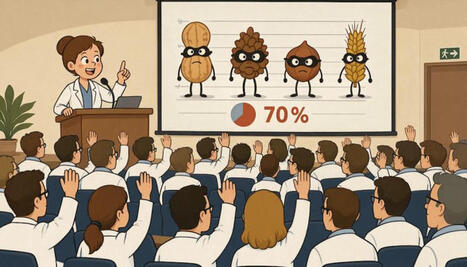
Onze végétaux alimentaires responsables de 85% des anaphylaxies aux végétaux
L’analyse de 753 anaphylaxies aux aliments végétaux révèle des profils différents selon l’âge, avec l’arachide chez les adolescents et le blé chez les adultes. Ce travail illustre surtout la valeur exceptionnelle du Réseau d’Allergo-Vigilance, qui transforme depuis 2002 les déclarations du terrain en connaissances utiles au diagnostic et à la prévention.
👉 Lire la suite : https://lnkd.in/e6nDe87i
|
|
Scooped by
Gilbert C FAURE
September 28, 10:55 AM
|
Scoop.it!

💊 Éruption cutanée sous antibiotique : allergie… ou simple réaction ?
🎬 Cette fois, M. Rousset débarque en urgence chez son allergologue… et panique face à une éruption sous amoxicilline.
Avec le soutien de Bioprojet, cet épisode des Scènes Allergo décrypte avec humour une situation fréquente mais souvent mal interprétée :
👉 Réaction immédiate ou retardée : comment faire la différence ?
👉 Faut-il arrêter le traitement ?
👉 Quand suspecter une vraie allergie ?
Un message clé : beaucoup d’allergies aux antibiotiques sont en réalité… de fausses alertes.
Regardez la vidéo pour démêler le vrai du faux !
#allergieantibiotique #amoxicillineetallergie #scenesallergo #tutorielallergologie
|
|
Scooped by
Gilbert C FAURE
September 27, 5:43 AM
|
Scoop.it!

The Journal of Allergy and Hypersensitivity Diseases - JAHD, the official international journal of the French Allergy Society, is proud to launch the JAHD Awards, a new initiative dedicated to recognising outstanding research, celebrating scientific excellence, and giving the most impactful JAHD articles the visibility they deserve.
JAHD will recognise two outstanding articles, with €1,000 awarded to each winner:
🏆 Best JAHD Article – Junior/FIT Award
🏆 Best JAHD Article – Senior Award
Eligible papers include original articles, short communications and systematic reviews published from 1 April 2026 onwards.
Articles will be shortlisted based on citations, downloads and usage, followed by assessment by the JAHD Editorial Board.
The announcement of the winners will be during the French Allergy Congress, in April each year, in Paris. JAHD Award winners will be invited to present their winning work during the congress
DON’T MISS THIS OPPORTUNITY!! Publish your research in JAHD https://lnkd.in/dME824DM, share your work with the allergy community, and give your research the opportunity to gain recognition through the JAHD Awards.
Please share the news with your network and support your juniors to achieve more!!!
Davide Caimmi Luc Colas Agnes Sze-Yin Leung Caroline Klingebiel Julien Goret Elizabeth Tham Grégory Bouchaud Ves Dimov, M.D. Olympia Tsilochristou Puya Dehgani Mobaraki Tu Trinh Rachel Peters Takeya ADACHI
Thank very much to all who made it possible Joana Vitte Eric Fromentin Tamazoust GUIDDIR Julien Cottet
Société Française d'Allergologie - SFA
Elsevier
|
|
Scooped by
Gilbert C FAURE
September 23, 11:32 AM
|
Scoop.it!
🤧 Allergies : pourquoi sont-elles en forte progression ?
En France, 39 % des adultes interrogés se déclarent allergiques. Et derrière ce chiffre se cachent des réalités très diverses : rhinite, asthme, allergies alimentaires ou encore anaphylaxie.
Pollens, pollution, changement climatique, évolution de nos modes de vie… notre environnement modifie notre exposition aux allergènes. En parallèle, la recherche ouvre de nouvelles perspectives : biothérapies ciblées, médecine personnalisée, outils numériques et intelligence artificielle.
Le nouveau numéro de Questions de santé publique propose un panorama des grandes avancées qui transforment aujourd’hui notre compréhension, notre prévention et notre prise en charge des maladies allergiques.
📖 À découvrir : De l’environnement à l’anticorps thérapeutique : nouvelles clés pour comprendre, prévenir et guérir les maladies allergiques
👉 Lire QSP n°53 : https://lnkd.in/eQcV7vzq
#SantéPublique #Recherche #Allergies #Prévention #Environnement #Innovation #IReSP #QSP
Joana Vitte Caroline Klingebiel Jeremy Corriger Julien Cottet Eric Fromentin Julien Goret Tamazoust GUIDDIR Ariane Nemni Virginie Doyen Pascal Demoly Camille Gautier Charlotte Hurson Veronique Lustgarten Séverine Fernandez céline palussière Isabelle Bossé Guillaume LEZMI Frédéric Bérard Luc Colas Laurent Guilleminault Sandrine SAILLET, PhD Valentine Trépied Mélanie Simony Robert Barouki Aurélia Tison An Xuan HOANG Meissan Terchi
|
|
Scooped by
Gilbert C FAURE
September 15, 4:03 AM
|
Scoop.it!
Having IgE against a food does not necessarily mean you will react when you eat it. What determines whether sensitisation becomes clinical food allergy?
This is a useful question to keep in mind when thinking about the relationship between eczema and food allergy.
Food allergens crossing damaged skin can drive sensitisation. But the intestine also needs to be considered: its barrier, its immune cells, and the conditions under which it encounters that food.
Katelin Davis and colleagues bring these pieces together in their Mucosal Immunology review, “Atopic dermatitis and food allergy: More than sensitization.”
https://lnkd.in/gzBw6rbD
One really interesting example cited in this review is work by Leyva-Castillo and colleagues in Immunity by Cell Press. In mice, mechanical skin injury drove intestinal mast cell expansion through a circuit involving skin-derived IL-33, intestinal IL-25 and type 2 innate lymphoid cells.
https://lnkd.in/gxiC9brC
The value of the MI review is in connecting findings like these with the broader clinical picture. It considers how skin inflammation might influence the intestinal response to food, alongside its role in initiating sensitisation.
What interests me here is the principle of how skin inflammation helps create the intestinal conditions in which a food reaction becomes more likely. How much of that persists once sensitisation is established? And could changing those conditions alter the response to food, even when food-specific IgE is already present?
|
|
Scooped by
Gilbert C FAURE
September 4, 11:17 AM
|
Scoop.it!
Annick BARBAUD from the Sorbonne University, France, presents their research findings published in Allergy:
A. Barbaud, L. H. Garvey, E. Phillips, et al., “Updated #EAACI Statement on Drug Hypersensitivity Skin Testing: Methodology and Non-Irritative Concentrations,” Allergy (2026), Read the article here: doi.org/10.1111/all.70466
#Allergy_journal
Watch videos of recent discoveries: journalallergy.com and youtube.com/@Allergy-TV
https://lnkd.in/em8YBxbP
|
|
Scooped by
Gilbert C FAURE
August 18, 8:42 AM
|
Scoop.it!
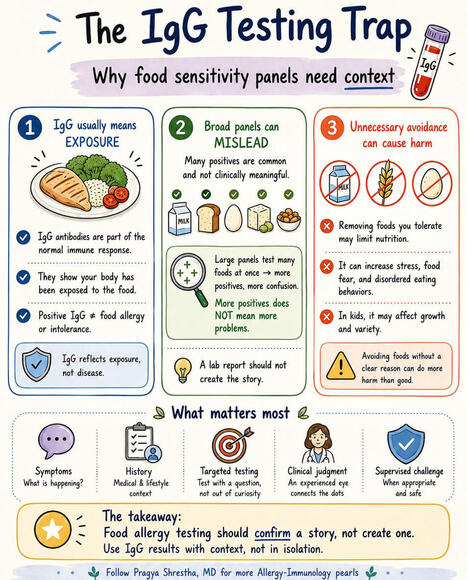
If your food sensitivity panel flagged 20 foods,
the problem may be the test - not your diet.
I see patients who arrive with pages of results showing “high” IgG to milk, wheat, egg, corn, soy, and dozens of other foods.
Naturally, they ask:
“Do I need to stop eating all of these?”
Usually, no.
Here is what is important to understand.
IgG is not the antibody we use to diagnose a typical food allergy.
Food allergy is usually evaluated with the history plus targeted testing for IgE, using skin testing or blood testing when appropriate.
Sometimes an oral food challenge is needed to confirm the diagnosis.
Food-specific IgG tells us something very different.
↳ It often means your immune system has been exposed to that food.
↳ Finding IgG against a food does not prove that the food is causing your symptoms.
↳ IgG4 responses may even be associated with immune tolerance rather than allergy.
That is why major allergy organizations recommend against using food IgG or IgG4 panels to diagnose food allergy or food intolerance.
And there is a real downside to these tests.
A report may label 20, 30, or even 50 foods as problematic.
Then someone starts removing:
Milk.
Wheat.
Egg.
Soy.
Nuts.
Fruit.
Vegetables.
Suddenly the diet becomes extremely limited, even though many of those foods were being eaten without any problem.
For children, unnecessary restriction can be especially concerning because they need enough calories, protein, vitamins, and minerals for normal growth.
So if a test tells you that you are “sensitive” to a long list of foods, ask an important question:
What exactly is this test measuring?
A positive antibody result is not automatically a diagnosis.
Your symptoms, the timing of the reaction, the food involved, and the right type of testing all matter.
Sometimes the best answer after an IgG panel is not to remove more foods.
It is to put foods back.
Have you ever been told to avoid a long list of foods based on an IgG test?
|
|
Scooped by
Gilbert C FAURE
August 17, 4:26 AM
|
Scoop.it!
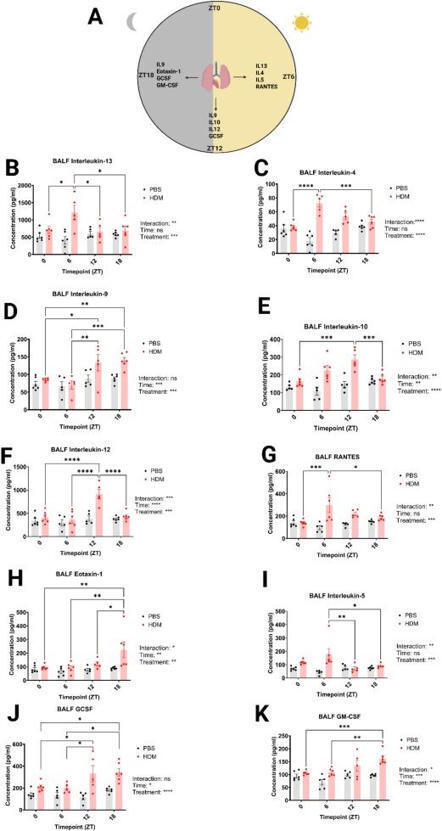
The club cell circadian clock regulates temporal patterns in leukocyte trafficking in chronic allergic airways disease from: Jafar Cain, Hannah Durrington, Amlan Chakraborty MRSB, David Bechtold and colleagues: https://lnkd.in/gnBxWnRP
|
|
Scooped by
Gilbert C FAURE
August 11, 8:57 AM
|
Scoop.it!

ChatGPT told me I have histamine intolerance.
I need testing for MCAS.
A patient said this to me today.
Her main symptom?
Bloating after eating certain “high histamine” foods.
I hear versions of this more and more.
“I need my histamine checked.”
“I need a DAO test.”
“I need testing for mast cell activation syndrome.”
Sometimes patients come in with a diagnosis already decided.
Sometimes they also have a specific list of labs they want ordered.
But medicine is rarely:
symptom → diagnosis → test
Bloating after certain foods does not automatically mean histamine intolerance.
And histamine intolerance is not the same thing as mast cell activation syndrome.
MCAS has specific clinical and laboratory criteria.
We look at the pattern of symptoms, whether multiple organ systems are involved, objective evidence of mast cell activation, and whether the entire clinical picture fits.
Mast cells can release histamine, tryptase, leukotrienes, prostaglandins, and other mediators.
This is also why people spend years studying medicine.
Knowing that a symptom can be linked to a diagnosis is the easy part.
The harder part is understanding:
↳ Which diagnosis actually fits
↳ Which diagnoses are more likely
↳ Which test is useful
↳ When that test should be drawn
↳ What can falsely raise or lower it
↳ And what the result actually means
Anyone can send a lab.
In many cases, you can even go directly to a commercial lab and order testing yourself.
The important part is interpreting that result in the context of your history.
That is where medicine lives.
So bring your questions to your physician.
Bring the symptoms.
Bring the timing.
Bring the foods, medications, photos, and patterns you have noticed.
But please try not to pressure your clinician into ordering a specific test simply because ChatGPT, Google, TikTok, or another source suggested it.
Testing should be guided by evidence and by your individual history.
AI can help you learn.
It can help you ask better questions.
But a symptom plus a search result is not the same as a diagnosis.
The nuance between the symptom, the test, and the person sitting in front of us still matters.
Have you noticed more people arriving at appointments with a diagnosis and laboratory list already generated by AI?
|
|
Scooped by
Gilbert C FAURE
August 1, 2:41 AM
|
Scoop.it!

🐾 Do you have #CatAllergy 🐱or have patients facing it?
Don’t miss this #JAHD ❣️manuscript on how sublingual #AllergenImmunotherapy 💧can support the treatment of this condition 🐈🐈⬛
Enjoy: https://lnkd.in/eV4mG4kB
|
|
Scooped by
Gilbert C FAURE
Today, 12:46 PM
|
Scoop.it!
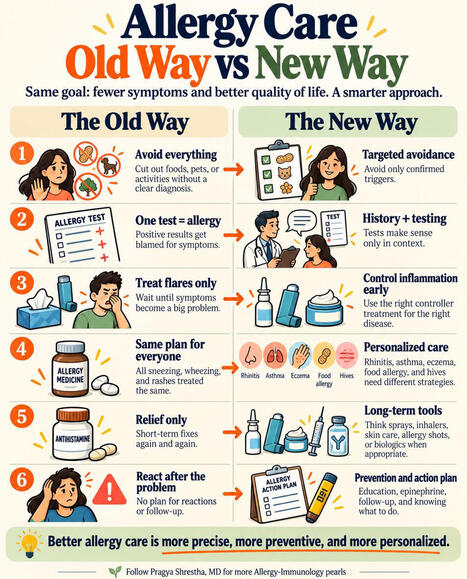
Allergy care has changed.
And in many ways, that is a good thing.
The old approach often looked like this:
↳ Avoid more and more things
↳ Blame every symptom on a positive test
↳ Wait until symptoms get bad
↳ Treat everyone the same
↳ Reach for short-term relief again and again
↳ Make a plan only after a reaction happens
That is not the direction we want to keep going.
Better allergy care is more precise.
It starts with the right question:
What is actually going on here?
Because sneezing, wheezing, eczema, hives, and food reactions are not all the same problem.
And they should not all be treated the same way.
The newer approach is more thoughtful:
1️⃣ Targeted avoidance
Avoid only confirmed triggers, not everything “just in case.”
2️⃣ History plus testing
A test alone does not diagnose allergy. Test results need context.
3️⃣ Earlier control of inflammation
For asthma, rhinitis, and eczema, the goal is not just to chase flares. It is to control disease earlier.
4️⃣ Personalized care
Rhinitis, asthma, eczema, food allergy, and hives each need their own strategy.
5️⃣ Long-term tools when needed
Sprays, inhalers, skin care, allergy shots, biologics, and food allergy planning all have a role in the right patient.
6️⃣ Prevention and action plans
Education matters. Follow-up matters. Knowing what to do in a reaction matters.
7️⃣ Early food introduction for babies
One of the biggest shifts has been infant feeding.
The old idea was to delay common allergenic foods like peanut and egg.
Now we know that, when babies are developmentally ready, early introduction of common allergenic foods can help lower food allergy risk, especially in the right setting and with the right guidance.
So the “new way” is not doing more for the sake of doing more.
It is doing the right thing, for the right condition, at the right time.
That means less fear.
Less guesswork.
And better care.
What change in allergy care do you think patients or even clinicians still misunderstand the most?
|
|
Scooped by
Gilbert C FAURE
October 12, 4:07 AM
|
Scoop.it!
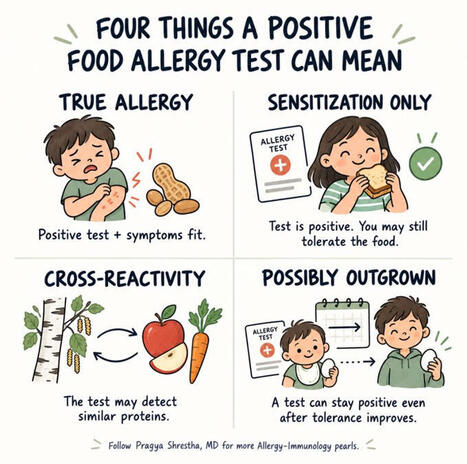
Your child tested positive for a food allergy.
But does that mean they are actually allergic?
Not necessarily.
This is one of the most common misunderstandings I see in my allergy clinic.
A positive skin prick test or blood IgE test does not automatically mean someone has a food allergy.
It means their immune system has made IgE antibodies that recognize the food.
But whether eating that food will cause a reaction is a different question.
Here are 4 things a positive food allergy test can mean:
1️⃣ TRUE FOOD ALLERGY
The test is positive AND the clinical history supports an allergic reaction.
For example:
A child develops hives, vomiting, or wheezing shortly after eating peanuts, and peanut testing is positive.
The history and test results fit together.
2️⃣ SENSITIZATION WITHOUT ALLERGY
This is where confusion often begins.
A child may test positive to milk, egg, or peanut but eat that food regularly without any symptoms.
That is called sensitization.
And sensitization does not always mean allergy.
👉 If someone regularly eats a food without problems, a positive test alone is generally not a reason to remove it from their diet.
3️⃣ CROSS-REACTIVITY
Sometimes, the immune system recognizes proteins that look similar.
For example:
Someone with birch pollen allergy may test positive to apple or carrot because these foods contain proteins similar to birch pollen.
Some people develop itching in the mouth when eating these foods, called pollen-food allergy syndrome.
Others may have positive tests without symptoms.
A positive result does not always mean a dangerous food allergy.
4️⃣ AN ALLERGY THAT MAY HAVE BEEN OUTGROWN
This is particularly important in children.
Some children outgrow milk, egg, wheat, or other food allergies over time.
But their allergy tests may remain positive even after they develop tolerance.
That is why we look at:
↳ Previous reactions
↳ Changes in skin test or specific IgE results over time
↳ Whether a supervised oral food challenge is appropriate
An oral food challenge, performed under medical supervision, is the gold standard for confirming whether someone can tolerate a food when the diagnosis remains uncertain.
Here is what I wish more parents knew:
A positive test does not tell us the whole story.
And a larger skin test or higher IgE level does not reliably predict how severe a future reaction will be.
Testing should be guided by the clinical history, not used as a broad screening tool without a clear reason.
Unnecessary food avoidance can affect nutrition, quality of life, and create significant anxiety for families.
Before eliminating a food based only on a test result, discuss it with an allergist.
If there is a history of a possible allergic reaction, do not try reintroducing the food at home without appropriate guidance.
We treat patients, not just positive test results.
Have you or your child ever been told to avoid a food based only on a positive allergy test?
|
|
Scooped by
Gilbert C FAURE
October 2, 10:40 AM
|
Scoop.it!

Basophil activation testing may allow clinicians to bypass the potentially dangerous oral food challenge in the diagnostic workup for food allergies. For an update on lab testing for the diagnosis of food allergies, refer to the new ARUP Consult Food Allergies topic: https://bit.ly/3VlK0xN
|
|
Scooped by
Gilbert C FAURE
September 27, 10:15 AM
|
Scoop.it!
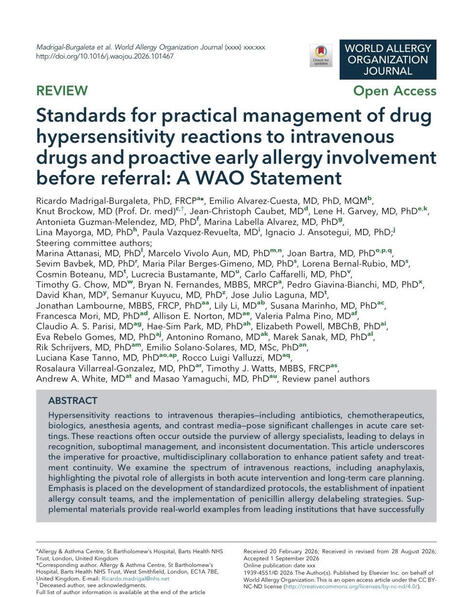
Our World Allergy Organization 🌏🌍🌎 statement on management of #DrugHypersensitivity of #Intravenous 💉 #Drugs
https://lnkd.in/erx9AhSB
|
|
Scooped by
Gilbert C FAURE
September 24, 10:56 AM
|
Scoop.it!

🎬 L’immunothérapie orale expliquée aux plus jeunes (et aux plus grands)
La vidéo “L’immunothérapie orale d’Edith, ou comment vaincre son allergie alimentaire” a reçu le label de la Société Française d’Allergologie (SFA).
Ce label atteste de la qualité scientifique et pédagogique du contenu, évalué par un comité indépendant, et de sa pertinence pour le parcours de soins des patients .
À travers une histoire simple et accessible, cette animation permet de mieux comprendre l’immunothérapie orale (ITO) : une prise en charge encadrée qui consiste à introduire progressivement l’allergène afin d’habituer l’organisme.
👉 Objectif : mieux informer, rassurer, et accompagner patients et familles dans la compréhension des allergies alimentaires et de leurs options de prise en charge.
Parce que chaque parcours est unique, ces décisions doivent toujours être discutées avec un professionnel de santé.
Découvrez la vidéo : https://lnkd.in/eZuW_EhS
#allergologie #allergiealimentaire #ito #educationtherapeutique #santepublique
|
|
Scooped by
Gilbert C FAURE
September 21, 4:15 AM
|
Scoop.it!
Anyone else have a "maybe penicillin" allergy?
Read more:
https://lnkd.in/e6xvAMiV
https://lnkd.in/ejJXXksW
https://lnkd.in/epHgKjsB
https://lnkd.in/dFCT7RNg
https://lnkd.in/eTHnGzma
|
|
Rescooped by
Gilbert C FAURE
from Mucosal Immunity
September 12, 11:11 AM
|
Scoop.it!

Airway epithelial cells as drivers of severe #asthma pathogenesis in this review from Bart Lambrecht, Gianni Marone and colleagues: https://lnkd.in/g9tZSgSV
|
|
Scooped by
Gilbert C FAURE
August 18, 1:41 PM
|
Scoop.it!
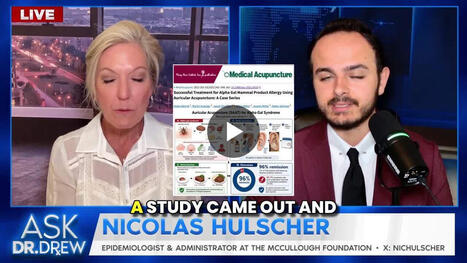
STUDY FINDS 96% OF ALPHA-GAL SYNDROME PATIENTS DECLARED COMPLETE REMISSION AFTER EAR ACUPUNCTURE
Nearly EVERYONE in the study could EAT MEAT AGAIN within weeks of undergoing Soliman Auricular Allergy Treatment.
There were ZERO adverse reactions.
https://lnkd.in/guxpVdfR | 12 comments on LinkedIn
|
|
Scooped by
Gilbert C FAURE
August 18, 7:58 AM
|
Scoop.it!

Allergie aux excipients.. : la revanche de l’allergène masqué
Les réactions d’hypersensibilité aux excipients restent rares mais sont trèsprobablement largement sous-diagnostiquées. Ce position paper de l’EAACI propose une démarche pratique pour les reconnaître, les confirmer et éviter des anaphylaxies répétées chez des patients faussement considérés comme allergiques à plusieurs médicaments.
https://lnkd.in/epEKDEQ3
|
|
Scooped by
Gilbert C FAURE
August 13, 4:38 AM
|
Scoop.it!
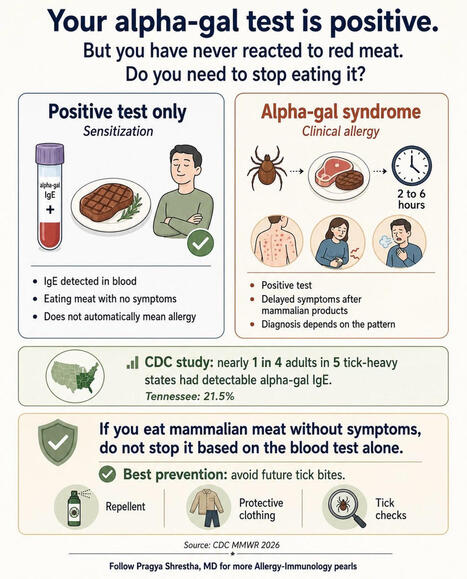
Positive alpha-gal test. No reaction to red meat.
Should you stop eating it?
I am seeing more patients with positive alpha-gal testing who have never had symptoms.
Many are worried that continuing to eat red meat could trigger a future reaction.
But a positive test alone does not mean someone has alpha-gal syndrome.
A recent CDC study found that nearly 1 in 4 adults tested in five tick-heavy states had detectable alpha-gal IgE.
In Tennessee, the rate was 21.5%.
These were mostly healthy blood donors, not patients with known allergic reactions.
This highlights an important difference:
↳ Sensitization: Alpha-gal IgE is detectable in the blood.
↳ Alpha-gal syndrome: Exposure to alpha-gal causes compatible symptoms.
If someone regularly eats beef, pork, lamb, or dairy without symptoms, they generally do not need to avoid those foods solely because a blood test is positive.
Unnecessary food avoidance can lead to:
↳ Anxiety around eating
↳ Nutritional restrictions
↳ Confusion about medications and vaccines
↳ An allergy diagnosis the patient may not actually have
Before diagnosing alpha-gal syndrome, we look for delayed symptoms after mammalian products:
↳ Hives or swelling
↳ Abdominal pain, vomiting, or diarrhea
↳ Wheezing or trouble breathing
↳ Dizziness or anaphylaxis
Symptoms often begin 2 to 6 hours after exposure.
That delay can make the connection easy to miss.
For someone with a positive test but no symptoms, the most useful preventive step is usually not automatically avoiding red meat.
It is preventing more tick bites.
Additional tick bites may increase alpha-gal IgE and may increase the risk of developing clinical reactions.
Use tick repellent.
Wear protective clothing outdoors.
Check your skin, clothing, children, and pets after spending time outside.
A positive allergy test shows immune recognition.
It does not always prove clinical allergy.
Have you ever been told to avoid a food because of a positive test, even though you had been eating it safely?
|
|
Scooped by
Gilbert C FAURE
August 6, 10:42 AM
|
Scoop.it!

Peanut allergy dropped 81%.
Not from a new drug. From a baby snack.
Here's how we found out.
Jewish children living in the UK had about 10 times higher rates of peanut allergy than Jewish children living in Israel.
The genetics were nearly identical.
The environment was not.
Many Israeli infants regularly ate Bamba, a peanut puff snack, during infancy.
That observation led to one of the most important food allergy studies ever performed.
The LEAP trial enrolled 640 infants at high risk for peanut allergy (severe eczema, egg allergy, or both).
Half were introduced to peanut between 4 and 11 months of age and kept eating about 6 grams of peanut protein a week until age 5. The other half avoided peanut completely.
The numbers at age 5:
↳ 17.2% of the avoidance group developed peanut allergy
↳ 3.2% of the consumption group developed peanut allergy
↳ An 81% relative risk reduction
It held up. LEAP-On followed the same kids after 12 months off peanut:
18.6% allergic in the avoidance group vs. 4.8% in the consumption group.
LEAP-Trio followed them into adolescence: 15.4% vs. 4.4%.
Younger siblings introduced to peanut early had an 18.3% sensitization rate, vs. 44.4% in siblings who weren't (a different outcome measure than clinical allergy).
For context: peanut allergy prevalence in Western countries had roughly doubled over the decade before LEAP, reaching 1.4% to 3.0% of children, during the era when avoidance was standard advice.
But LEAP teaches us something beyond peanut.
Culture matters.
Families around the world introduce peanut, sesame, lentils, yogurt, fermented foods, and tree nuts at very different ages, and that may shape how the developing immune system learns what is safe.
Separately, some population-level observations (different literature than LEAP) suggest children raised on minimally processed, legume- and fish-rich diets have lower food allergy rates in parts of Asia compared with Western populations. Associative, not causal.
That does not mean one food, or one country's diet, is the answer.
Food allergy is influenced by many factors.
↳ Genetics
↳ Early food introduction
↳ Eczema and skin barrier health
↳ The microbiome
↳ Vitamin D and other environmental exposures
↳ Diet diversity and food processing
Most likely, it's the combination that determines risk.
One observation from Israeli children eating Bamba changed how we feed infants around the world.
Sometimes the biggest advances in medicine begin with someone noticing that one community does things differently.
The next breakthrough may already be happening in someone's kitchen.
Have you noticed cultural food practices that you think medicine should study more closely?




