Your new post is loading...
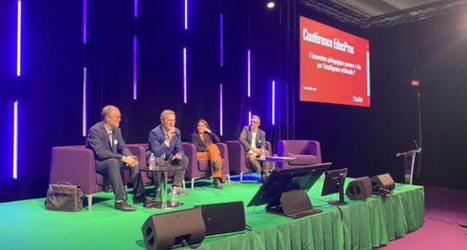
Tout serait bon (rien à jeter) dans les Intelligences Artificielles génératives ! De fait, tous les goûts semblent servis : création d’images, génération de présentations Powerpoint, sous-titrage ou traduction automatisé. Mais, faut-il vraiment tester tous les outils pour se forger un avis raisonnable ? Opus #3 de notre série sur les « Mythes de l’IA en formation »
Via Vedrenne Guy

|
Rescooped by
Bhushan Thapliyal
from Education 2.0 & 3.0
January 11, 2024 2:54 AM
|
Artificial intelligence (AI) is providing instructors and course designers with an incredible array of new tools and techniques to improve the course
Via Yashy Tohsaku
|
|
Rescooped by
Bhushan Thapliyal
from gpmt
January 4, 2024 5:09 AM
|
As we delve into the complexities of generative AI in the education sector, it's crucial to understand its challenges and limitations.
Via EDTECH@UTRGV, michel verstrepen
|
|
Rescooped by
Bhushan Thapliyal
from Edumorfosis.it
December 20, 2023 1:42 AM
|
In recent years, the meteoric rise of Artificial Intelligence (AI) has sent shockwaves through society on both economic and cultural levels. Seemingly poised to become as ubiquitous as email, this rapidly evolving technology is transforming many aspects of daily life—including how we teach and learn
Via Vladimir Kukharenko, LGA, Edumorfosis
|
|
Rescooped by
Bhushan Thapliyal
from Actus TICE Universitaires
November 22, 2023 4:10 AM
|
Qu'elle suscite la critique, qu'elle interroge ou qu'elle attire, l'intelligence artificielle ne cesse de faire parler d'elle. Particulièrement dans l'enseignement : dans les salles de classe ou les amphis, pour les professeurs, difficile de passer à côté. L'IA devient même un enjeu sur lequel il faut agir… dès à présent.
Via CIPE AMU
|
|
Rescooped by
Bhushan Thapliyal
from Education 2.0 & 3.0
November 22, 2023 3:59 AM
|
We test the best free AI slide tools for teachers to see which can help your presentations
Via Yashy Tohsaku
Maintenant que des outils utilisant l’intelligence artificielle (IA) générative comme ChatGPT sont facilement accessibles, le travail scolaire va forcément changer. Comment préserver l’intégrité académique? Comment déterminer ce qui est de la triche et ce qui est un usage acceptable? Voici quelques pistes pour guider la réflexion.
Via CIPE AMU
|
|
Rescooped by
Bhushan Thapliyal
from Education 2.0 & 3.0
November 9, 2023 3:07 AM
|
We need what has been called a ‘human-in-the-loop’ (HITL) to ensure the use of AI is based on our values as teachers and represent
Via Yashy Tohsaku
|
|
Rescooped by
Bhushan Thapliyal
from Actus TICE Universitaires
November 6, 2023 3:28 AM
|
Les générateurs d'images IA, tels que Stable Diffusion et DALL-E, créent des images depuis des textes, mais perpétuent des stéréotypes.
Via CIPE AMU
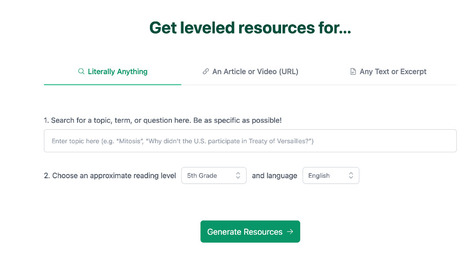
This is a free tool for creating a complete set of learning materials based on any topic, text or video.
Via Nik Peachey
|
|
Rescooped by
Bhushan Thapliyal
from Actus TICE Universitaires
November 3, 2023 4:21 AM
|
Résumé Résumé en français Les récents développements de l’intelligence artificielle (IA) ont suscité de grandes attentes quant à l’impact futur de l’IA dans l’éducation et l’apprentissage (IAEd). Ces attentes ont souvent été fondées sur une mauvaise compréhension des possibilités techniques actuelles, un manque de connaissances sur l’état de l’IA dans l’éducation et des visions excessivement … Continuer la lecture de « État de l’art et de la pratique de l’intelligence artificielle dans l’éducation (Holmes & Tuomi, 2022) [Traduction] »
Via CIPE AMU
|
|
Scooped by
Bhushan Thapliyal
November 2, 2023 4:00 AM
|
|
|
Rescooped by
Bhushan Thapliyal
from Edumorfosis.it
November 2, 2023 3:55 AM
|
This Guidance is designed to respond to this urgent need. However, a thematic set of guidance on GenAI for education should not be understood as a claim that GenAI is the solution to education’s fundamental challenges. Despite the media hyperbole, it is unlikely that GenAI alone will solve any of the problems facing education systems around the world. In responding to long-standing educational issues, it is key to uphold the idea that human capacity and collective action, and not technology, is the determining factor in effective solutions to fundamental challenges faced by societies.
This Guidance therefore aims to support the planning of appropriate regulations, policies, and human capacity development programmes, to ensure that GenAI becomes a tool that genuinely benefits and empowers teachers, learners and researchers. Building on UNESCO’s Recommendation on the Ethics of Artificial Intelligence, the Guidance is anchored in a human-centred approach that promotes human agency, inclusion, equity, gender equality, cultural and linguistic diversity, as well as plural opinions and expressions. The Guidance first looks into what GenAI is and how it works, presenting the diverse technologies and models available (Section 1), before identifying a range of controversial ethical and policy issues around both AI in general, and GenAI specifically (Section 2). This is followed by a discussion of the steps and key elements to be examined when seeking to regulate GenAI based on a human-centred approach – one that ensures ethical, safe, equitable and meaningful use (Section 3). Section 4 then proposes measures that can be taken to develop coherent, comprehensive policy frameworks to regulate the use of GenAI in education and research, while Section 5 looks into the possibilities for creatively using GenAI in curriculum design, teaching, learning and research activities. Section 6, concludes the Guidance with considerations around the long-term implications of GenAI for education and research.Guidance for generative AI in education and research.
Via Edumorfosis
|
|
|
Scooped by
Bhushan Thapliyal
January 11, 2024 3:00 AM
|
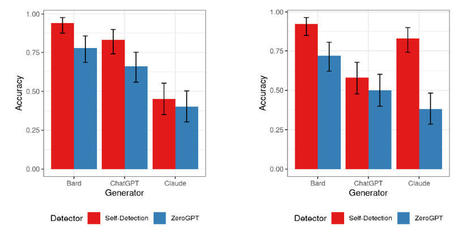
Un sujet de recherche universitaire étudie l'efficacité des outils de détection des contenus générés par l'IA. Dans un article, il présente l'idée de la détection directe de l'origine et évalue si les systèmes d'IA générative peuvent reconnaître leur production et la distinguer des textes écrits par des humains.Depuis que ChatGPT a rendu la création de contenu écrit beaucoup plus facile qu'elle ne l'aurait été autrement, une multitude de détecteurs de contenu d'IA ont vu le jour. Nombreux son
|
|
Scooped by
Bhushan Thapliyal
January 10, 2024 5:49 AM
|
Listen to this episode from Extra classe on Spotify. Mickaël Bertrand est professeur d'histoire-géographie au lycée Charles-de-Gaulle de Dijon. Depuis l'année dernière, il a constaté que ChatGPT était mal utilisé par les élèves et qu'il suscitait une défiance chez ses collègues professeurs. Il a donc décidé de se former pour apprendre aux élèves à s'en servir de façon éclairée. ChatGPT est donc entré dans sa classe et, aujourd'hui, les élèves s'en servent comme on se sert d'une calculatrice.Enseigner avec le numérique, sur la plateforme Canotech, Réseau Canopé. Et plus particulièrement : Les intelligences artificielles génératives, Animation vidéo, 3 m 32 sec, Réseau Canopé, 2023. L'intelligence artificielle conversationnelle comme assistant du pédagogue, Animation vidéo, 2 m 59 sec, Réseau Canopé, 2023.Cet épisode Extra classe peut vous intéresser : À l’école de l’IA - Parlons pratiques ! #29 (du 30 août 2023).Transcription bientôt disponible.Retrouvez-nous sur : Extraclasse.reseau-canope.fr Apple Podcasts Spotify Deezer Google Podcasts Podcast AddictExtra classe, des podcasts produits par Réseau Canopé. Émission préparée et réalisée par : Hélène Carbonnel Directrice de publication : Marie-Caroline Missir Coordination et production : Hervé Turri, Luc Taramini, Magali Devance Mixage : Laurent Gaillard Voix additionnelle : Magali Devance Contactez-nous sur : contact@reseau-canope.fr © Réseau Canopé, 2024
|
|
Rescooped by
Bhushan Thapliyal
from Edumorfosis.it
January 4, 2024 5:08 AM
|
Despite the buzz surrounding it, the prominence of prompt engineering may be fleeting. A more enduring and adaptable skill will keep enabling us to harness the potential of generative AI? It is called problem formulation — the ability to identify, analyze, and delineate problems.
Via Edumorfosis
IA, ces 2 lettres sont des coups de tonnerre dans l’écosystème du Learning. Source d’enthousiasme pour certains, d’inquiétude, voire pire, pour d’autres. Une posture ancrée dans 5 mythes de l’IA passés en revue dans cet article.
Via GREF Bretagne, Cap Métiers Nouvelle-Aquitaine
|
|
Scooped by
Bhushan Thapliyal
November 17, 2023 2:54 AM
|
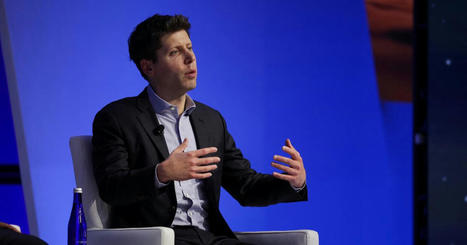
Sam Altman, le patron d’OpenAI, s’est également exprimé à propos des risques que fait peser l’Intelligence Artificielle générative sur la création artistique et les élections américaines.
|
|
Rescooped by
Bhushan Thapliyal
from Edumorfosis.it
November 14, 2023 4:37 AM
|
This document sets out the position of the Department for Education (DfE) on the use of Generative Artificial Intelligence (AI), including large language models (LLMs) like ChatGPT or Google Bard, in the education sector.
This statement: - is informed by the government’s white paper on a pro-innovation approach to AI regulation
- follows the government’s announcement to set up an expert Frontier AI Taskforce to help the UK adopt the next generation of safe AI
Via Edumorfosis
|
|
Rescooped by
Bhushan Thapliyal
from Edumorfosis.it
November 9, 2023 3:05 AM
|
It is well-documented and often repeated in teachers’ professional development that the right type of co-learning can deepen understanding and long-term knowledge gains. The critical question is, “What is the right type of co-learning?” Sometimes group projects work well. Sometimes one partner does all the work and another just coasts along for the ride. How are teachers supposed to grade these efforts? Give everyone the same grade? Let students grade each other’s contributions? Try to guess how much time each student put in? There is no perfect solution.
Via Edumorfosis
|
|
Rescooped by
Bhushan Thapliyal
from Edumorfosis.it
November 6, 2023 3:22 AM
|
While the reading and math “wars” have gotten a lot of attention in education in recent years, writing instruction has not received that same focus. That is, until the release of ChatGPT last year.
There isn’t really an agreed-upon approach to teaching writing, according to Sarah Levine, an assistant professor at Stanford University’s Graduate School of Education. But now that ChatGPT is here to stay, experts like Levine are trying to figure how to teach writing to K-12 students in an age of AI.
Via Edumorfosis
|
|
Scooped by
Bhushan Thapliyal
November 3, 2023 4:25 AM
|
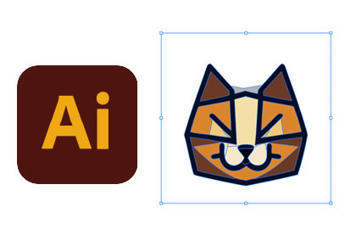
This tutorial teaches you a quick trick to generating editable vectors from scratch through simple text prompts. Let's get started!
|
|
Scooped by
Bhushan Thapliyal
November 2, 2023 4:13 AM
|
Les artistes qui poursuivaient les générateurs d'art par intelligence artificielle générative se sont heurtés à une pierre d'achoppement dans le cadre d'un procès inédit portant sur l'utilisation non compensée et non autorisée de milliards d'images téléchargées sur internet pour entraîner les systèmes d'intelligence artificielle, un juge fédéral ayant rejeté la plupart des plaintes.Le juge fédéral William Orrick a estimé que les plaintes pour violation du droit d'auteur ne pouvaient pas êtr
|
|
Rescooped by
Bhushan Thapliyal
from e-learning-ukr
November 2, 2023 3:57 AM
|
In December 2022, researchers from BKC, OpenAI, and Khan Academy and other experts gathered to discuss the impacts of generative AI on teaching and learning.
Via Vladimir Kukharenko
|