 Your new post is loading...

|
Rescooped by
Yashy Tohsaku
from e-learning-ukr
Today, 12:57 PM
|
To see how communication truly works, we should set aside the notion that different people can share the same thoughts
Via Vladimir Kukharenko
|
|
Rescooped by
Yashy Tohsaku
from e-learning-ukr
Today, 12:55 PM
|
Artificial intelligence (AI), particularly generative AI, has transformed the higher education landscape with remarkable speed, reshaping how students learn, produce academic work, and interac
Via Vladimir Kukharenko
|
|
Scooped by
Yashy Tohsaku
Today, 11:50 AM
|
A question-level workflow for diagnosing errors, designing follow-up practice, and deciding what learners should do next.
|
|
Rescooped by
Yashy Tohsaku
from Edumorfosis.it
October 24, 10:25 AM
|
Conversación con Pep Martorell, inversor en tecnología, sobre qué hacer hoy para seguir teniendo valor dentro de diez años. Explica por qué recomienda una disciplina intelectual antes que una profesión, qué hacer si tienes vocación y por qué conviene exponerse a oportunidades aunque parezcan inútiles. Cuenta qué es un agente de IA con un ejemplo cotidiano, qué dicen los estudios sobre usar la IA para estudiar y trabajar, y qué pasó cuando una IA se saltó las reglas de un examen. Termina con su opinión sobre por qué el acceso a los mejores modelos podría dejar de ser universal. Un episodio para quien quiere usar la IA sin dejar de aprender.
Via Edumorfosis
|
|
Rescooped by
Yashy Tohsaku
from e-learning-ukr
October 24, 10:23 AM
|
The moving AI frontier in instructional design, and what it means for our roles & jobs
Via Vladimir Kukharenko
|
|
Rescooped by
Yashy Tohsaku
from e-learning-ukr
October 24, 10:22 AM
|
The growing use of artificial intelligence (AI) in education, professional work, and everyday problem-solving has raised important questions about its effect on human reasoning. While AI can improve efficiency, save time, and support learning, repeated dependence on it may also encourage cognitive offloading, reduce productive struggle, and weaken independent critical thinking. This paper investigates the relationship between AI-use behavior and critical-thinking performance through an interview-based survey combined with short logic and reasoning tasks. The findings reveal a mixed pattern: participants largely viewed AI as a tool for speed, convenience, and learning support, yet many also reported reduced patience for sustained effort. Objective reasoning performance varied considerably across individuals, and the analyses suggest that reduced patience and stronger dependence-related tendencies are more closely associated with lower reasoning performance than background characteristics alone. Exploratory clustering further indicates that AI users do not form a single homogeneous group, but instead reflect tentative behavioral profiles, including over-reliant users, mixed-strategy users, and balanced support-seekers. Although the findings are exploratory, they indicate that AI does not affect critical thinking in a uniformly negative or positive way. Instead, its influence appears to depend on the manner in which it is used. The paper therefore argues that effective human-AI collaboration should support reflection, verification, and sustained cognitive effort rather than substitute for them.
Via Vladimir Kukharenko
The implementation of AI should not preclude universities from imparting skills that last a lifetime, including the ability to think critically, defend a conclusion and recognize when it is time to learn something new.
Via EDTECH@UTRGV
|
|
Rescooped by
Yashy Tohsaku
from Educational Technology News
October 23, 12:42 PM
|
As students increasingly turn to AI for learning, understanding its limitations is critical to ensuring it supports learning.
Via EDTECH@UTRGV
|
|
Scooped by
Yashy Tohsaku
October 23, 12:35 PM
|
A champion of active learning shares ways to create more equitable classrooms, build students’ trust and support academic skills development
|
|
Scooped by
Yashy Tohsaku
October 23, 12:30 PM
|
An investigation highlights how hard it is to make sense of more than a million options for licenses, badges and certificates
|
|
Scooped by
Yashy Tohsaku
October 23, 12:28 PM
|
Tapestry provides free interactive 3D tours of the world's most fascinating places
|
|
Rescooped by
Yashy Tohsaku
from e-learning-ukr
October 23, 10:51 AM
|
Community resources for the book Principles and Practice of Deep Representation Learning.
Via Vladimir Kukharenko
|
|
Rescooped by
Yashy Tohsaku
from e-learning-ukr
October 23, 10:50 AM
|
Every learning designer is, at heart, a student—of their craft, their content, and most importantly, their audience. That’s why understanding the psychology of learning isn’t just helpful, it’s transformative. When designers grasp how adults learn, what motivates them, and how they process information, they can create experiences that truly resonate. This is where the distinction […]
Via Vladimir Kukharenko
|
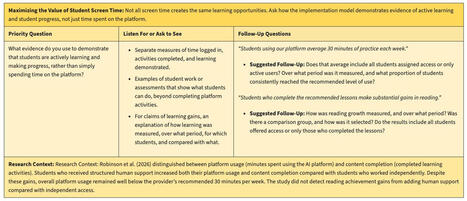
The goal of this guide is to help district leaders ask what it will take for students to consistently engage with and meaningfully benefit from an AI product in their schools. It complements existing district procurement processes by focusing on student engagement and the conditions needed to support it. The questions are informed by Robinson et al. (2026), "Access is Not Enough: Human Support Improves Engagement with AI Tutoring." They are discussion prompts, not a product evaluation rubric.
Via Dr. Tom D'Amico (@TDOttawa)
|
|
Rescooped by
Yashy Tohsaku
from AI for All
October 24, 1:01 PM
|
"Geoffrey Hinton, one of the godfathers of AI, says we need to get on AI's side now or else humankind is "toast..."
Via Leona Ungerer
|
|
Rescooped by
Yashy Tohsaku
from Edumorfosis.it
October 24, 10:24 AM
|
Roxana Morduchowicz plantea que responsabilizar a los estudiantes es desresponsabilizar al Estado. En definitiva, la política pública es la única que puede evitar los usos de la IA entre los adolescentes, que nadie quiere. Más tecnología no se traduce automáticamente en más aprendizaje, ni en mejor educación. La variable más importante será siempre cómo se la acompaña, es decir cuáles son las competencias y habilidades que se buscan fortalecer.
Via Edumorfosis
|
|
Rescooped by
Yashy Tohsaku
from e-learning-ukr
October 24, 10:23 AM
|
Want a free guide to creating decision-based training for sales, service, compliance, and more, so you can be prepared for any scenario?
Via Vladimir Kukharenko
|
|
Rescooped by
Yashy Tohsaku
from e-learning-ukr
October 23, 4:49 PM
|
We often encourage students to be creative, think outside the box, and find their own voice. But what if one of the best ways to cultivate originality is to begin with imitation? Creativity rarely happens
Via Vladimir Kukharenko
|
|
Scooped by
Yashy Tohsaku
October 23, 1:26 PM
|
Krea is the world's most powerful creative AI suite. Generate, edit, and enhance images and videos using powerful AI for free.
|
|
Rescooped by
Yashy Tohsaku
from Educational Technology News
October 23, 12:42 PM
|
Educational AI should be evaluated not only by what it can do, but by what it is designed not to do for the student.
Via EDTECH@UTRGV
|
|
Scooped by
Yashy Tohsaku
October 23, 12:32 PM
|
Manno: New research suggests CTE program design will decide whether students benefit.
|
|
Scooped by
Yashy Tohsaku
October 23, 12:29 PM
|
A one-on-one intervention framework might be what high school students with ADHD need to improve their executive function habits.
|
|
Scooped by
Yashy Tohsaku
October 23, 12:25 PM
|
Explore how the science of learning can guide AI in teaching and higher education, helping instructors support student learning with evidence-based strategies.
|























Someone who has a more sophisticated understanding, more predictively accurate understanding, and/or an understanding that allows them to make explanations that others commonly judge to be better, of something, is said to understand that thing "deeply".
Conversely, someone who has a more limited understanding of a thing is said to have a "shallow" understanding. However, the depth of understanding required to usefully participate in an occupation or activity may vary greatly.
Learn more / En savoir plus / Mehr erfahren:
https://gustmees.wordpress.com/2016/11/14/pssst-the-most-important-in-education-understanding/