 Your new post is loading...

|
Rescooped by
Susan Myburgh
from Edumorfosis.Work
July 28, 2021 6:44 PM
|
The last 12 months have been a time of immense uncertainty. The pandemic affected many jobs, uprooted career plans, and left people questioning their professional futures. Most of us, globally, were left wondering how to protect ourselves better and future proof our careers.
Job displacements are, of course, nothing new. Industrial revolutions of the past caused much concern with the population of their eras. History has demonstrated how labour markets adjust to new-normals, and evidence is also showing when labour-saving technology is adopted, labour is redirected to other areas of demand.
Via Edumorfosis
|
|
Rescooped by
Susan Myburgh
from Edumorfosis.Work
July 28, 2021 6:44 PM
|
There’s a black hole in digital transformation. The technology space race has propelled a new era for those of us who work at desks. But around an estimated 80% of the world’s workforce is "deskless" — and many have been left behind.
Instead of smart apps, many of the world’s 2.7 billion deskless workers contend with pen-and-paper, spreadsheets or clunky technology tools that are often ill-suited to the dynamic demands of frontline work. In a survey of more than 1,500 deskless workers, 60% report being unsatisfied with, or believe there is room for improvement in, the technology they use for work. It can slow them down and make them less engaged and less adaptable.
Via Edumorfosis
|
|
Rescooped by
Susan Myburgh
from Edumorfosis.Work
July 28, 2021 6:44 PM
|
Once thought to be relegated to the realm of video games, virtual reality is proving its utility in a slew of everyday functions, including human resources. As the cofounder and CEO of a VR company, I’ve seen that the technology is increasingly being used in employee training and retraining, ensuring people have the skills they need to thrive at work.
If you’re a business owner or manager, you may be considering harnessing the power of VR to keep your employees’ skills sharp. Discover the ways you can use VR to upskill and reskill your teams below, as well as how to do this effectively.
Via Edumorfosis
|
|
Rescooped by
Susan Myburgh
from Edumorfosis.Work
July 28, 2021 6:43 PM
|
A recent World Economic Forum (WEF) report highlighted that with over 85 million jobs expected to be displaced by 2025 as a result of automation (and broader digital transformation projects), the most competitive businesses will be those that choose to reskill and upskill current employees. - On average, companies estimate that around 40% of workers will require reskilling of six months or less
- 94% of business leaders report that they expect employees to pick up new skills on the job (which is a sharp uptake from 65% in 2018)
Via Edumorfosis
|
|
Rescooped by
Susan Myburgh
from Edumorfosis.Work
July 28, 2021 6:41 PM
|
The labor market position of older workers is cause for concern in many industrialized countries. Rapid population aging is challenging pension systems. The recent economic crisis has forced many older adults out of the workforce, into either pre-retirement or non-employment. Encouraging people to work longer and fostering the employability of older workers have become priorities for policymakers. Training specifically designed for older workers might help attain these goals, since it may refresh human capital and reduce the pay–productivity gap. Training older workers might also benefit employers and society as a whole.
Via Edumorfosis
|
|
Scooped by
Susan Myburgh
July 6, 2021 11:51 PM
|
Graphic design is basically the visual compositions used to solve problems and communicate ideas through typography, colors, imagery, and form. Since there’s no one way to do all of this, this is the reason why there are several types of graphic design, each specializing in its own area.
|
|
Scooped by
Susan Myburgh
July 6, 2021 11:50 PM
|
Lack of intelligence, education, or knowledge are the reasons some people aren't well-suited for data science or AI.
|
|
Rescooped by
Susan Myburgh
from Edumorfosis.Work
July 1, 2021 7:08 PM
|
From heavy industry to professional services, employers around the world are in a mad scramble for talent. As the first signs of a post-COVID future emerge, businesses are already working to identify new challenges and opportunities, and many have found that talent and workforce strategy are top of the agenda. This should come as no surprise – talent was already a leading business priority before pandemic struck – but many employers are no more prepared to bridge the talent gap than they were a year ago.
But rather than joining in the all-out race for talent, some HR professionals are looking to work smarter, not harder. In this case, that means embracing a new talent strategy model based entirely around skills and rethinking how organizations can acquire and retain them. By taking a strategic view of future skills needs and market supply/demand, top employers are moving toward a more practical approach to talent and reward practices that will enable increased flexibility and resiliency, all in the service of future-proofing their business.
Via Edumorfosis
|
|
Rescooped by
Susan Myburgh
from Edumorfosis.Work
June 29, 2021 5:38 AM
|
You won’t have missed that the world of work has gone through some significant changes in recent times. As we move into a new era of hybrid workplaces, which skills will be most needed and how can companies nurture them?
For its fifth annual Workplace Learning Report, online education platform LinkedIn Learning surveyed more than 1,200 learning and development (L&D) professionals and nearly 900 learners. It also looked at behavioural insights on how people use its platform and conducted interviews with leaders.
Via Edumorfosis
|
|
Rescooped by
Susan Myburgh
from Edumorfosis.Work
May 17, 2021 6:35 PM
|
In a previous post, I posited that we are on the precipice of the human capital era, where investing in human potential offers the greatest return on investment. Here I explain why the skills gap, is no longer a “gap” at all, but what my friend and co-author Chris Shipley has coined as the gaping “Skills Abyss” that will never close. That, I believe, is actually be a good thing. Hear me out.
Since the dawn of the first hand tools, humans have been filling the skills gap, that space between the people with the know how to use a tool to do a job and the demand for workers who have that smarts. Though the expertise transferred from one skilled person to the next has changed drastically across the millennia, the methods by which skills are transferred from one to another have barely budged. Someone with expertise passed along that knowledge to someone who wanted to learn the skill. Over time, the trades created an elaborate framework of apprenticeship. The early church and then universities documented the known world and developed pedagogy and curriculum to pass that knowledge from generation to generation.
Via Edumorfosis
|
|
Rescooped by
Susan Myburgh
from Edumorfosis.Work
May 16, 2021 7:10 PM
|
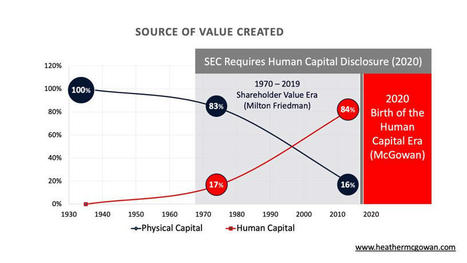
In late 2019 the Business Roundtable declared the end of the Shareholder Value Era. Business education from the 1980s to late 2019 preached that business existed to return profits to shareholders and investors at all costs. Many of those “costs” were humans which was reasonable in the 1970s as most human work was in contribution to production of physical asssets. Recent data from Aon shows that in 1975 tangible, physical assets comprised 84% of enterprise value on the S&P 500, while only 17% of that value was intangible, notably human capital.
Via Edumorfosis
Ethical communication includes all the information an audience needs to make an informed decision or take an informed stance on an issue and is not deceptive in any way. Whenever you communicate in business, you ask audiences to trust that you will provide information that is complete and true. If you intentionally violate that trust, you have engaged in unethical communication. Unethical communication can take several forms: withholding information, distorting information, and plagiarizing. Note that some of these choices can also be illegal in certain circumstances.
Via Bovee & Thill's Online Business Communication Magazines
|
|
|
Rescooped by
Susan Myburgh
from Edumorfosis.Work
July 28, 2021 6:44 PM
|
For the first time in the 11-year history of the Deloitte Global Human Capital Trends report, more business executives than human resources (HR) leaders responded to the survey, underscoring the importance of people-related concerns as organizations responded to the pandemic. Capturing the experiences of 6,000 global respondents—more than 60% of them executive-level professionals—the 2021 report specifically focuses on how COVID-19 changed perspectives on organizational preparedness; the challenges and opportunities inherent in disruption; and transformations in re-architecting work, unleashing the workforce, and adapting the workplace in order to thrive in the future.
Before COVID-19, only 29% of executives were focused on reimagining work. Today, that number has skyrocketed to 61%—showing that many organizations were ready to reinvent themselves.
Via Edumorfosis
|
|
Rescooped by
Susan Myburgh
from Edumorfosis.Work
July 28, 2021 6:44 PM
|
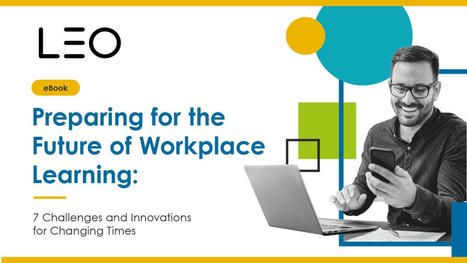
With the pandemic, mass working from home, and huge changes to working environments, 2020 saw incredible transformations across the working world. L&D teams had to pivot priorities, methodologies, and capabilities overnight. As we look at the world of learning through this period of drastic change, we must ask what has already happened, what we can learn from it, and how we can prepare for the future. In this ebook, we’re looking back over some of the biggest challenges this industry has faced to see what can be learned and how we can make workplace learning more sustainable in 2021 and beyond. We cover a wide range of topics including: - Learning technologies and systems
- Learning culture
- Building L&D capabilities
- Social and collaborative learning
- Proving and measuring learning ROI
- Combining L&D with other departments
- Coaching and mentoring
Via Edumorfosis
|
|
Rescooped by
Susan Myburgh
from Edumorfosis.Work
July 28, 2021 6:43 PM
|
Nothing gives you better clarity than a near death experience. It awakens you to the frailty of life, and the importance of living with purpose and meaning. The pandemic was a wake up call. It shook us out of our complacency. We started seriously looking into the way we lead our lives. Many of us decided that our jobs were dead ends, and quit in the “great resignation” wave. This mass exodus shows that people no longer want to waste their lives doing work that they don’t like and will search for better opportunities that offer growth and a future.
Via Edumorfosis
|
|
Rescooped by
Susan Myburgh
from Edumorfosis.Work
July 28, 2021 6:43 PM
|
La historia de la innovación tecnológica y el empleo en el Sur Global se escapa de la narrativa global sobre Futuro del Trabajo: rezagos en la adopción de tecnología, fallas en los sistemas de desarrollo de skills, condiciones laborales precarias y estancamiento económico relativo. El desafío, entonces, es detectar los factores estructurales que son importantes para el futuro del trabajo en el Sur Global y evaluar si estos factores agregan diversidad y contexto a la narrativa predominante.
5 elementos se vuelven clave para la construcción de una verdadera narrativa de FoW en América Latina: Skills, Tecnología, Instituciones de mercado laboral, Demografía y Desigualdad.
¿En qué medida los sistemas de educación infantil, formal y de adultos de la región logran con éxito el aprendizaje en general y la formación de habilidades relevantes para el futuro?
Esta mesa parte de los “Diálogos del Futuro del Trabajo del Sur Global”, una serie de 24 diálogos que reunirán a más de 75 expertos del Sur Global de la academia y la sociedad civil para unirse a las discusiones y contribuir con perspectivas heterogéneas sobre el futuro del trabajo.
Via Edumorfosis
|
|
Rescooped by
Susan Myburgh
from Edumorfosis.Work
July 28, 2021 6:41 PM
|
Ready or not we are firmly in a #workersmarket a market where workers hold the power in choosing who they will work for, where they will work and how they want to work. We are in a workers revolution similar to the '90's when many Gen Xers chose self employment over job security uncertainty. In this article I share some of the survey data we have gathered from workers including leaders around the worker mindset shifts happening that is causing many workers to rethink their future.
Via Edumorfosis
|
|
Scooped by
Susan Myburgh
July 6, 2021 11:53 PM
|
Nursing as a profession unit 2 fundamentals of Nursing...
|
|
Scooped by
Susan Myburgh
July 6, 2021 11:51 PM
|
Our short and ever-dwindling attention span. I’d happily take a bite-sized version of our concentration disorder. Consider this: The average human attention span is now shorter than a goldfish’s.A…...
|
|
Scooped by
Susan Myburgh
July 6, 2021 11:50 PM
|
Findings from the Spotlight Report on 21st Century Skills in Latin America and the Caribbean released highlighting innovations all of whom feature citizenship education and social and emotional learning programs.
|
|
Rescooped by
Susan Myburgh
from Edumorfosis.Work
June 30, 2021 8:55 PM
|
|
|
Rescooped by
Susan Myburgh
from Edumorfosis.Work
May 31, 2021 3:55 PM
|
Learning in the modern workplace is everyone’s responsibility – not just L&D but the manager and the individuals themselves. However, their roles and responsibilities will overlap as illustrated on this diagram below – and explained below.
Via Edumorfosis
|
|
Rescooped by
Susan Myburgh
from Les outils du Web 2.0
May 17, 2021 6:35 PM
|
ONLYOFFICE Workspace propose une solution de travail collaboratif open source ultra-complète qui va s’adapter à la taille et aux besoins de votre entreprise ou organisation.
Via Fidel NAVAMUEL
|
|
Rescooped by
Susan Myburgh
from Edumorfosis.Work
May 16, 2021 3:16 AM
|
The workplace of the future as we envisioned it became reality overnight, changing how businesses, government agencies, factories, and healthcare and educational institutions operate and how the worker and student experience plays a role in the future of work. The imperative to connect in the most secure, flexible, and productive ways possible – from anywhere, at any time -- is more critical than ever. Organizations that have fared best this year are typically further along with their workplace transformation and embrace this future of work. Hear how these customers have responded and scaled quickly to meet ever-changing opportunities and challenges. Are you ready for the future of work?
Via Edumorfosis
|




![[PDF] Is training effective for older workers? | Ten skills that employers want | Scoop.it](https://img.scoop.it/0a1zFu98hn_EGpPrybHM2Dl72eJkfbmt4t8yenImKBVvK0kTmF0xjctABnaLJIm9)







![[Podcast] Top 5 workforce skills to have in the US job market & how to build a strong personal... | Ten skills that employers want | Scoop.it](https://img.scoop.it/PpJP2yr3MkvXGpnqA2QjuDl72eJkfbmt4t8yenImKBVvK0kTmF0xjctABnaLJIm9)






