


Our students' future is an uncertain one. Their workforce will look much different than ours. Here are ways we can help them to be "future ready".
Via Dr. Tom D'Amico (@TDOttawa)

 Your new post is loading...
 Scoop.it! Our students' future is an uncertain one. Their workforce will look much different than ours. Here are ways we can help them to be "future ready". Via Dr. Tom D'Amico (@TDOttawa) No comment yet.
Sign up to comment
Scoop.it!

"The internet’s creator hopes to turn back a tsunami of fake news and online incivility." Via EDTECH@UTRGV
Scoop.it!

Each year microlearning comes with exciting new trends that organizations can leverage to create a better learning experience for their employees. So, how often do you adjust your training to meet new microlearning trends in order to deliver useful training? In this article, we'll be looking at the latest microlearning trends in L&D, and how you can leverage them to achieve better training ROI. Via Edumorfosis, Yashy Tohsaku
Scoop.it!

My free eBook, How Can You Use Personalized eLearning To Drive Employee Performance And Achieve Higher ROI, is designed to help you understand the value of adopting personalized eLearning. It additionally provides insights on how it can be used to craft learning experiences that are relevant and engaging. As an extension, they provide demonstrable gains for learners and businesses, which leads to a higher ROI. Via Edumorfosis, Yashy Tohsaku
Scoop.it!

Una forma que tiene el profesorado de asegurarse que aplica innovación educativa en sus asignaturas es utilizar las tendencias de innovación educativa, es decir, incorporar aquello que se dice actualmente que es innovación. Dentro de estas tendencias algunas se basan en la novedad de una determinada tecnología como por ejemplo BlockChain, Realidad Mixta, Realidad Aumentada Adaptativa, Learning Analytics, Sistemas Adaptativos Educativos, …… Via Gumersindo Fernández
Scoop.it!
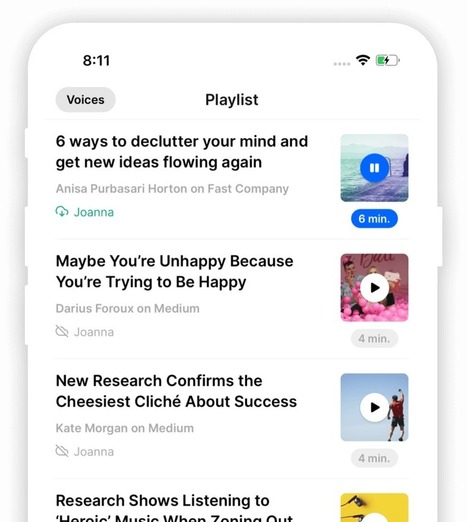
Playpost transforms every article on the web into audio using industry-leading high-quality voices. So you can listen to it just like Podcasts and Audiobooks. Via Nik Peachey 
Marco Bertolini's curator insight,
November 26, 2019 4:23 AM
Playpost; listen to articles in several languages as if they were podcasts. The voice and the reading quality are truely amazing 
Bart van Maanen's curator insight,
November 26, 2019 4:28 AM
Interessante toepassing, helaas niet geschikt voor ons prachtige Nederlands.
Scoop.it!

"Undoubtedly, with the advance of science and technology, online learning has become an easily accessible alternative form of education with huge potential. It offers a level of convenience and flexibility which is crucial to learners living in this fast-paced society. Yet it is lacking in aspects that traditional learning can only offer, such as socialising and hands on teachers. Will online learning replace traditional on-campus education one day? Or will traditional on-campus education continue to thrive and complement with online learning? Only the future holds the answer." Via EDTECH@UTRGV 
Loveneet Kaur's curator insight,
October 6, 2020 6:37 PM
Online education and learning is truly becoming a very common thing and it might be the future of learning. It provides so much flexibility to everyone working online and who doesn't like working from home. There's always a positive and negative side to the various concepts and in case of online learning, disadvantages can be lack of interaction and interest, technical difficulties but the positive side is that it can be fun as well and not just education. It helps people get better with hand son leaning which is important for the future as out technical world is progressing everyday.
Scoop.it!

GoBrunch is a revolutionary place where you can learn and share best practices through live webinars and virtual meetings... everything for free. Via Nik Peachey 
Nik Peachey's curator insight,
November 26, 2019 8:46 AM
This looks like a really great platform for educators.
Scoop.it!

The 21st century requires skills far different than those of the last century. Today’s workforce incorporates technology in nearly every aspect of their jobs and lives. Digital computing not only assists in task completion but in many cases, it has taken over repetitious duties. Technology also allows people to conduct professional and personal business on the go. We work, bank, socialize, learn, and entertain ourselves online. Via Edumorfosis, Yashy Tohsaku
Scoop.it!

Do tutors make a difference in online learning? A comparative study in two Open Online Courses Via Ana Cristina Pratas, juandoming 
Ana Cristina Pratas's curator insight,
November 21, 2019 10:44 AM
Abstract Two free fully online courses were offered by Peoples-uni on its Open Online Courses site, both as self-paced courses available any time and as courses run over four weeks with tutor-led discussions. We tested the hypothesis that there are no measurable differences in outcomes between the two delivery methods. Similar numbers attended both versions of each course; students came from multiple countries and backgrounds. Numbers of discussion forum posts were greater in tutor-led than self-paced courses. Measured outcomes of certificates of completion, quiz completion and marks gained were very similar and not statistically significantly different between the tutor-led and the self-paced versions of either course. In light of little discernible difference in outcome between self-paced learning compared with courses including tutor-led discussions, the utility of the time cost to tutors is in question. The findings may be relevant to others designing online courses, including MOOCs.
Scoop.it!

From
www

Tener una cuenta personal en Google abre la puerta a muchos servicios increíbles y gratuitos, como Google Drive, Google Docs o Youtube. Estas herramientas se usan en muchos ámbitos de la vida, ya sean profesionales o personales, pero sin duda un ámbito de lo más interesante es el ámbito educativo, ya sea para padres, profesores o alumnos y alumnas. Las herramientas que facilitan el proceso de enseñanza-aprendizaje tienen un valor incalculable. En este sentido, Google está potenciando una herramienta excelente de ayuda al aprendizaje, y no es otra que Google Classroom, dentro del pack de herramiengas de GSuite for Education. Via Gumersindo Fernández
Scoop.it!

"The study is a computer-based international assessment of eighth-grade students’ capacities to use information communications technologies in different ..." Via Leona Ungerer
Scoop.it!

Despite spending millions of dollars on fancy algorithms, Google Search can sometimes be a fickle beast. You know that the information you’re looking for is out there, but no matter what search terms you enter, you can’t find a suitable result. Via John Evans |
Scoop.it!

Before creating an eLearning course, find out as much as possible about your eLearning course target audience. Try these research methods. Via EDTECH@UTRGV
Scoop.it!

Welcome to a series of posts dedicated to 21st skills and assessment. In this post, I wish to elaborate on Critical Thinking. The idea of critical thinking is very important. In fact , I believe that when critical thinking begins... real learning has been sparked! Now that is exciting. I want to provide you some great… Via Dr. Tom D'Amico (@TDOttawa) 
Valeria BL's curator insight,
May 18, 2020 12:22 AM
Critical thinking is one of the most important aspects of Education in the 21 century. Developing critical thinking brings many opportunities for students to become free thinkers that allow them to make appropriate decisions for their benefit and for the collective wellness, in addition to opening their minds to create new things important to humanity. Thas is why developing critical thinking in classes is essential for education, this article shows some activities that can be useful to develop critical thinking.
Scoop.it!

"Walk into any high school in America, and there is a high probability that you will find some portion of the student body reading 1984, Brave New World, or Fahrenheit 451. Talk to middle school students, and chances are they are familiar with The Giver or The Hunger Games. Via Jim Lerman, Yashy Tohsaku
Scoop.it!

Want to share photos with your loved ones? Here are several practical methods, including Google Photos and a USB drive. Via Gumersindo Fernández
Scoop.it!

Memorize anything while playing a game! Tinycards is a brand new app created by the team behind Duolingo, the most downloaded education app in the world. Via Nik Peachey
Nik Peachey's curator insight,
November 25, 2019 1:10 AM
A useful tool for creating flashcards for revision and learning.
Scoop.it!

Supporter of Free Learning. Europe. Philosophy. Education. Knowledge. 21st Century School Librarianship. Big Data. English Language. APPS. Curation & Music. MAC Via Ana Cristina Pratas
Scoop.it!

I’m a huge fan of Twitter. I think it is a tool that has a challenging entry point, but with a little help and advice, it can be a powerful place to learn and build a great PLN. Via John Evans
Scoop.it!

Each free email provider listed here offers different benefits and all of these email services are popular choices. Via Juan Jesús Baño Egea
Scoop.it!

In diesem Video wird gezeigt, wie man Filme auf Stream zur Verfügung stellt, die nach einer bestimmten Zeit automatisch stoppen und vorbereitete Fragen zum bereits gesehenen Inhalt anzeigen. Die Fragen werden vorgängig in Forms erstellt und können dort dann auch ausgewertet werden. https://youtu.be/pxix6R2N0aI Via Guido Knaus
Scoop.it!

The trouble with designing eLearning in 2019 is that with all the different options and formats available, a designer may have a feeling that something in the visuals of an eLearning project isn't quite right. The problem is putting your finger on what's wrong and knowing what to do about it. But help is available! Bianca Woods suggested some visual design ideas recently during an interview." Via EDTECH@UTRGV 
EDTECH@UTRGV's curator insight,
November 21, 2019 4:00 PM
Poor visual design in e-learning is a pet peeve of mine. First impressions are important. If a poorly designed UX is the first thing students see, they'll start the course with a bad impression that may last throughout the course.
Scoop.it!

Think nothing good can come from encouraging students to use social media? Consider what these former students from Minarets and Design Science high schools in Central California are doing. I asked these students how they use social media as an academic tool and how that shaped both their high school and post-secondary success. Here's what I learned. Via John Evans 
Jared Solovei's curator insight,
December 15, 2019 4:23 PM
Just a quick list of ways that technology can be a positive force. This article provides many examples that can put technology's critics at ease.
|






