Your new post is loading...
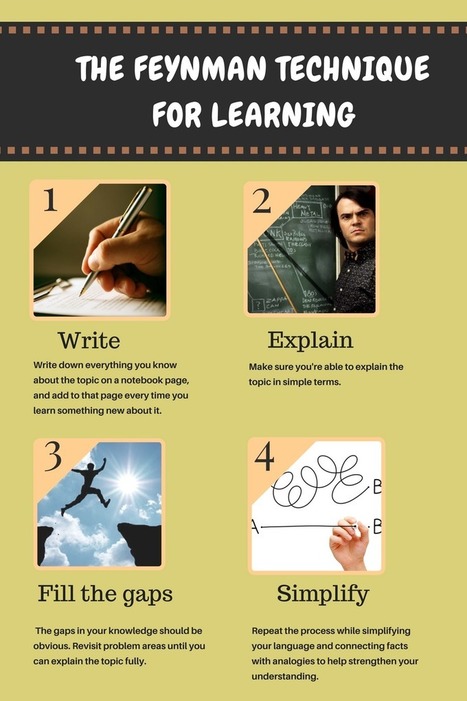
The Feynman Technique is perfect for learning a new idea, understanding an existing idea better, remembering an idea, or studying for a test. The Feynman Technique is a mental model that was coined by Nobel-prize winning physicist Richard Feynman. Known as the "Great Explainer," Feynman was revered for his ability to clearly illustrate dense topics… Learn more / En savoir plus / Mehr erfahren: http://www.scoop.it/t/21st-century-learning-and-teaching/?&tag=Radical+Pedagogy
Via Gust MEES

|
Rescooped by
michel verstrepen
from Edumorfosis.it
April 30, 2017 9:36 AM
|
As decision-makers look for new ways to take advantage of the data-rich environment of higher education, some of them have zeroed in on an application both powerful and practical: using information to solve problems.
“The idea is that Big Data and technology should lead to better decision-making,” says Benjamin Freakley, executive director of the Decision Theater Network at Arizona State University.
The Decision Theater (DT) is an immersive visual environment with powerful computing capabilities that let researchers, policy makers and students see problems — and potential solutions — in new ways. Users leverage this innovative space to bring advanced data visualization and sophisticated analytics to bear on policy decisions.
“We have the tools to visualize complex problems and build models of all the permutations of solutions scenarios,” says Freakley. “The visually stimulating environment increases collaboration. People see what the data indicates and are more willing to move off of anchored positions.”
Via Edumorfosis
I have my students work in Collaborative Learning Groups (CLG’s). I learned this from the amazing Jackie Gerstein. I intentionally design collaboration activities that they will do with their CLG. Writing COLLABORATION super huge at the top of your lesson plans is one of the things I suggest. The CLG group provides students a support …
Via Dr. Tom D'Amico (@TDOttawa)
|
|
Rescooped by
michel verstrepen
from Art of Hosting
April 20, 2017 2:12 AM
|
Open Space TechnologyCreative facilitation for groups
For groups of 5 to 5000, Open Space Technology is an effective and refreshing alternative to the conference format. Break down boundaries, build
Via F. Thunus
|
|
Rescooped by
michel verstrepen
from Art of Hosting
April 20, 2017 2:10 AM
|
|
|
Rescooped by
michel verstrepen
from Mobile Learning 21
April 18, 2017 12:21 PM
|
Want to know how using Live Streaming For Education will change the future of learning? Check 8 ways Live Streaming For Education will affect learning.
Via Adelina Moura
|
|
Rescooped by
michel verstrepen
from GBL
April 18, 2017 12:19 PM
|
Aurasma can encourage learners to go beyond the classroom to connect and enhance what they learn by pulling resources from the physical and the digital and then sharing those augmented reality scenes with others.
Learning Objectives: Write a multi-part fictional narrative that logically ties in with actual locations on the school campus.Create an engaging narrative experience for the reader through expressive and provocative narration, animation, and/or images.Evaluate and deconstruct the narratives of others through class-wide discussion and reflection of own narrative.
Via Alfonso Gonzalez
Making is as old as learning itself. While the maker movement may only be about a decade old, the human desire to create dates back to the earliest forms of human activity, from making stone tools to drawing on cave walls (Halverson & Sheridan, 2014; Martinez & Stager, 2014). Thinkers such as Pestalozzi, Montessori, and Papert helped paved the way for the maker movement by stressing the importance of hands-on, student-centered, meaningful learning. Instead of viewing learning as the transmission of knowledge from teacher to student, these thinkers embraced the idea that children learn best when encouraged to discover, play, and experiment.
More recently, maker education is being used as a way to connect do-it-yourself informal learning to classrooms. Driven by new technologies such as 3D printing, robotics, and kid-friendly coding, making is emerging as an effective way to introduce students to STEM, particularly women and minorities. By incorporating elements of making into the classroom, educators can bridge the gap between what students are passionate about and what they're learning in school.
Via John Evans
... les outils de la pensée visuelle n’étaient absolument pas réservés à un usage personnel et que ce qui s’exprimait déjà dans ma façon de traiter l’information au travail n’avait rien à voir avec des « fioritures » (ou alors les fioritures ont beaucoup d’avenir devant elles !). D’une certaine manière, cette prise de conscience a changé en profondeur mon rapport au travail. Et en changeant de regard sur mon travail, j’ai aussi ouvert les yeux sur le rapport à la créativité... http://www.scoop.it/t/classemapping
Via Lucas Gruez, Animatrice TICE CDDP, Elena Pérez
|
|
Scooped by
michel verstrepen
April 6, 2017 9:10 AM
|
L’arrivée des plateformes numériques a participé au développement de la formation à distance et a également favorisé « le développement progressif de nouvelles formes d’enseignement » (Lebrun, 2010, p. 97). Dans cet environnement technopédagogique, les rôles exercés par les professeurs prennent une autre dimension. On voit apparaître de nouvelles pratiques associées aux campus virtuels, et souvent, l’hybridation des systèmes de formation. Conséquemment, les compétences essentielles en encadrement pédagogique se transforment et appellent une approche qualité de plus en plus présente dans les textes des organisations internationales (OCDE, 2015; UNESCO, 2016). La construction de l’expertise pédagogique en enseignement supérieur commande le vecteur essentiel qu’est la formation à distance (FAD).""
Comme tous les métiers, le recrutement a son jargon. Et quand ça fait longtemps qu’on est dans le secteur on finit par l’oublier. Attention, le jargon n’est pas à confondre avec la langue de bois dont on a déjà parlé ici. « Le jargon clarifie des concepts mais uniquement aux initiés tandis que la langue de …
Via Bertrand MOULIN
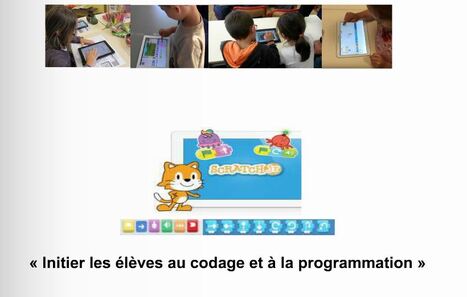
Intervention Michèle Drechsler CANOPE Mont Saint Aignan Académie de Rouen Initier les élèves au codage et à la programmation. 22 Mars 2017
Via Michèle Drechsler, Elena Pérez
Don't think outside the box…Think like there is no box. ~ Unknown One of the most rewarding experiences in writing my second book (The Kickstart Guide to Making GREAT Makerspaces, Fall 2017) has been having the honor of being able to highlight and showcase GREAT makerspaces far and wide. In doing that research, I discovered some …
Via EdTech@FAIS
|
With learning automation, the LMS is programmed to “learn” the skills that each individual employee needs to meet business goals. Algorithms tell the LMS computer code how to determine which skills are required, based on business objectives. The LMS then produces a customized learning plan for each employee based on gaps indicated by skill assessment results. No more writing assessments; you simply upload your existing content and the system writes the questions. As business goals change, the LMS, guided by the underlying algorithms, adjusts immediately and changes learning plans as needed to fill the newly identified skill gaps.
This new type of LMS has only become possible with the advent of machine learning. The algorithm provides detailed instructions that enables the LMS to discover the needs of the business and each individual in your organization. No matter how much things change, the system will continue to adjust learning plans automatically, responding to updating company objectives. Instead of trying to plan for every possibility, the “machine”—in this case, the LMS—“learns” what is needed by analyzing the data according to the instructions contained in the algorithm.
Via Edumorfosis, juandoming
SUBMIT A 1-2 PAGE CHAPTER PROPOSALDeadline - June 1, 2017This Call for Chapters is for a new edited book titled, Responsible Analytics and Data Mining in Education: Global Perspectives on Quality, Support, and Decision-Making to be published by Routledge Taylor & Francis Group. Authors are invited to submit a 1-2 page proposal for one of the publisher pre-approved chapters OR submit a proposal for a new chapter related to the responsible use of data analytics and data mining in education. Click on the following link for more information: https://big-data-in-education.blogspot.com
Via EDTECH@UTRGV
|
|
Rescooped by
michel verstrepen
from NumericEduc
April 20, 2017 2:11 AM
|
Higher Education Excellence. Online, Free and Open Courses
Via Claude Tran
|
|
Rescooped by
michel verstrepen
from E-learning francophone
April 18, 2017 6:01 PM
|
Nous avons eu le plaisir d’interviewer Catherine Becchetti-Bizot sur le colloque écriTech’8 pour nous parler du thème de cette 8ème édition : « Numérique & Savoirs : appropriation, scénarisation, construction et coconstruction des savoirs ». « Nous nous sommes interrogés sur les modes d’appropriation des savoirs avec le numérique », comment les élèves se les approprient de manière pérène. […]
Via Xavier Van Dieren
|
|
Rescooped by
michel verstrepen
from aect
April 18, 2017 12:19 PM
|
The increase in digital technology corresponds with the increase in the use of technology in both virtual and real-life classrooms. Although many advantages come with digitalized learning, there are also disadvantages that you should be aware of, including and not limited to minimal to zero face-to-face interaction in the classroom, and the lack of ability to work in person with your study partners and your teacher. Despite these disadvantages, overall digital technology has enhanced the future of learning and has enabled students and educators alike from all over the world to work together, spread knowledge, and increase learning opportunities for everyone.
Via Tim Boileau
|
|
Rescooped by
michel verstrepen
from PBL
April 18, 2017 12:18 PM
|
"Online learning has come a long way in the last few years.
"When I started learning to code, the options were limited—lots of books (not even e-books), some very basic online tutorials, and a whole lot of experimentation.
Online learning has come a long way in the last few years. There are interactive courses, tons of online tutorials, and one of my personal favorite ways to practice coding: games.
While a game alone probably isn’t going to teach you everything you need to know about coding, it can be a really incredible way to practice the skills you’re learning. It makes practice fun. And if you’re anything like me, you might suddenly realize you’ve spent the last four hours reinforcing your coding skills without even realizing it.
I’ve tried out some of the most entertaining and useful games for learning to code. Check out my favorites below."
Via John Evans, Alfonso Gonzalez
|
|
Rescooped by
michel verstrepen
from The 21st Century
April 16, 2017 1:13 AM
|
Students at the University of Central Florida are busy, and it’s not always with classes. They have sports to play, student organizations to run, even parties to go to. So to keep class schedules as flexible as possible, and to offer more sections without putting up new buildings, UCF leaders hav
Via Dr. Susan Bainbridge
|
|
Scooped by
michel verstrepen
April 6, 2017 9:11 AM
|
Games and gamification aren't the same. Learn some of the basics to get started building your own gamified courses and take them to the next level.
|
|
Rescooped by
michel verstrepen
from E-learning francophone
April 6, 2017 9:09 AM
|
En absence de consensus quant aux modalités d’évaluation de la qualité d’un #MOOC – les critères classiques de la #formation à distance étant passablement inadaptés à ce contexte – les taux de certification ont régulièrement été utilisés en guise d’indicateur de qualité du dispositif. Le mode de calcul de cet indicateur repose néanmoins sur un certain nombre d’hypothèses qui méritent d’être discutées. Au niveau de l’apprenant, cette manière de procéder suppose implicitement que l’obtention de la certification constitue la seule […]The post Comparer les taux de certification de MOOC. Tout un programme | La révolution MOOC appeared first on La Digital Learning Academy .
Via Xavier Van Dieren
During last week's Practical Ed Tech Live episode (join me this Thursday at 4pm EDT) I was asked about virtual reality, specificall
Via Dr. Tom D'Amico (@TDOttawa)
|
|
Rescooped by
michel verstrepen
from E-learning francophone
April 5, 2017 4:58 PM
|
Les enjeux du jeu Il existe une prédisposition humaine au jeu. La #ludification, en anglais #gamification, consiste à utiliser cette propension de l’humain pour rendre attractif la présentation de contenus. La compétition, le classement, la récompense, la reconnaissance, l’addiction à la réussite la gratification esthétique, l’accès à des bonus sont des leviers pouvant être activés pour garder un joueur connecté et qu’à cette occasion qu’il apprenne. La chimie du cerveau convoqué pour apprendre Les principes de la ludification s’appuient sur […]The post Les hormones en jeu pour apprendre | Thot Cursus appeared first on La Digital Learning Academy .
Via Xavier Van Dieren
|