Your new post is loading...

|
Rescooped by
michel verstrepen
from Technology in Education
October 7, 2020 4:56 AM
|
In “The Innovator’s Mindset,” I share the following: There are two reasons I share this quote with you that I have been thinking about, and although the ideas might …
Via Felix Jacomino
Frustrated with Zoom's instructional limitations, developers and entrepreneurs take matters into their own hands.
Via EDTECH@UTRGV
"Technology continues to accelerate, causing disruptions as well as opportunities for learning professionals. Three key themes to keep in mind are: it's about "learning and technology” not "learning technologies"; technology is changing how we live; and learning and work go hand in hand."
Via EDTECH@UTRGV
|
|
Rescooped by
michel verstrepen
from Digital Delights
October 5, 2020 4:44 PM
|
Massive Open Online Courses (MOOCs) came into the educational ecosystem attracting the attention of the public media, businesses, teachers, and learners from all over the world. The original courses were completely open and free, targeting the worldwide population. However, current MOOC providers have pivoted towards more private directions, and we often find that MOOC materials are completely closed within their hosting platforms and cannot be retrieved from them by their learners. This diminishes the potential of MOOCs by making content available to a small proportion of learners and severely limits the reusability of the educational resources. In this paper, we present a process that we call ‘unMOOCing’, in which we transform the resources of a MOOC into OERs. We taught a MOOC on Open Education in the UNED Abierta platform, and we ‘unMOOCed’ all of its educational resources, making them available to download by the learners that are taking the course. The results of the unMOOCing were very encouraging: the possibility of downloading the course resources was the most highly rated component of the course. Additionally, the two unMOOCed materials that were considered as most useful (presentations and contents in a PDF) were downloaded by 90% of the learners. Now that the majority of MOOC providers are moving towards a more closed educational approach, we believe that this paper sends a powerful message for bringing back the original MOOC concept of ‘Openness’ with the unMOOCing process, thus contributing to the wider dissemination and democratization of education across the globe.
Via Ana Cristina Pratas
|
|
Rescooped by
michel verstrepen
from :: The 4th Era ::
October 5, 2020 4:08 AM
|
Shemar, a 12-year-old from East Baltimore, is good at math, and Karen Ngosso, his fourth grade math teacher at Abbottston Elementary School, is one reason why. “I would try to pump him up and tell him, ‘You’re a good student,’” she said. But she knew that he didn’t get enough sleep, and he was often absent. His home situation, like those of many of her students, was unstable: his mother suffered from drug addiction, and they moved frequently.
Ngosso kept an eye on Shemar even after he started fifth grade, which is when I met him, in late 2018, at First & Franklin Presbyterian Church, a few blocks from the transitional housing where he and his mother were living. I volunteered to tutor Shemar, and once a week I picked him up from school and we’d do homework at a coffee shop.
Via Jim Lerman
|
|
Scooped by
michel verstrepen
October 4, 2020 3:36 AM
|
Dany-Robert Dufour sur L'inactuelle ✓ Notre école pourrait s'inspirer de la scholè grecque, Antiquité, pédagogie, psychologie, art, Platon, Kant, Arendt ✅
Beaucoup de dispositifs d’e-learning se réclament de la gamification ou du serious game – et beaucoup échouent à atteindre leur objectif premier : enseigner.
Cet article donne des clés pour réussir son dispositif d’e-learning (design, gamefication, solennité..)
Via Cap Métiers Nouvelle-Aquitaine , Bhushan Thapliyal, Elena Pérez
eTwinning est une plateforme rassemblant des enseignants au niveau européen et permet de concevoir et de réaliser ensemble des projets entre classes.
Via Elena Pérez
|
|
Rescooped by
michel verstrepen
from Learning & Technology News
October 3, 2020 3:50 AM
|
How can learning theories inform learning design and teaching practice in Higher Education? How can we assess how useful a learning theory is?
Via Nik Peachey
An online school builder that brings together live conferencing, payment-processing, and student management in one place. Virtually makes it easy to build and scale an online learning community. Create your own virtual classroom today.
Via Nik Peachey
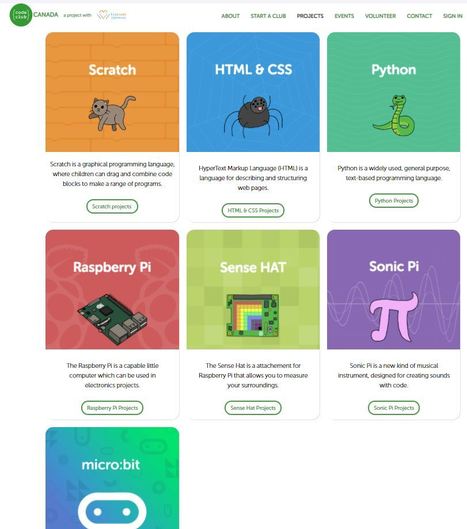
Our free Code Club projects help children improve their computer science skills using different programming languages like Scratch, Python, HTML, CSS, and more.
Via Dr. Tom D'Amico (@TDOttawa)
|
People often use the labels personalized and adaptive learning interchangeably, but they really mean different things.
Via Marta Torán, LGA
Juan Domingo Farnos (uno de mis mejores esquemas) “Los motivos centrales en los que las formas de enseñanza que difieren de la escolarización están condenados [en el argumento / Política / discurso educativo convencional] son que el cambio de la persona no es el motivo central de la empresa en la qu
Via juandoming
|
|
Rescooped by
michel verstrepen
from Digital Delights
October 5, 2020 4:45 PM
|
Instructional design is more than packaging content with a simple quiz. Let's look at how people learn and use resources today to build better courses.
Via Ana Cristina Pratas
Free resource of educational web tools, 21st century skills, tips and tutorials on how teachers and students integrate technology into education
Via Dr. Tom D'Amico (@TDOttawa)
|
|
Rescooped by
michel verstrepen
from Into the Driver's Seat
October 5, 2020 4:09 AM
|
Students are learning the drill: Enter class, squirt your hands with sanitizer, sit down, keep your mask on. Don’t get up without permission. Clean your space with a disinfecting wipe just before class ends. Leave nothing behind.
That’s the sterile part of freshman English class in the fall of 2020. The 58 minutes or so in between is the colorful part, when students still discuss theme, irony and characterization — when an unexpected story development can prompt gasps from teenagers. “Oh, my gosh, No!” …. “He sold his watch? Oh, no!” they cried at the plot twist during a group reading of literary trickster O. Henry’s 1905 story, “The Gift of the Magi.”
Wyoming Junior High English teacher Shantel VanderGalien can still get the most out of a bombshell ending, even in a subdued setting where students sometimes stay quiet behind their masks. “In my classroom when the doors shut, this is the same. The masks stink; the limited interaction stinks, but who we are as teacher and student is essentially the same,” said VanderGalien, her eyes misty.
Via Jim Lerman
|
|
Rescooped by
michel verstrepen
from Digital Delights
October 4, 2020 8:54 AM
|
The COVID-19 pandemic has given the entire country a crash course in virtual education and digital education platforms. School leaders have been forced to consider a set of very imperfect options as they struggle to reopen their schools. This three-brief collection identifies key issues for school leaders to consider before adopting a digital platform or learning program that will impact curriculum and teaching, student assessment, and privacy/data security. To help ensure that school leaders adopt digital technology that reflects the school’s stated values and goals, the briefs offer recommendations to guide decisions about which digital learning products to choose, how to best use them in the current crisis, and which to abandon when the crisis has passed.
Via Ana Cristina Pratas
Everyday we select, watch content and pick goods based on our preferences. So, why do so many people believe that preferences do not exist in learning?
Via juandoming
Is critical thinking for kids? Absolutely! Critical thinking begins in childhood. What kind of thinker is your elementary school child? Learn how parents help keep young minds active throughout the year.
Via Grant Montgomery
|
|
Rescooped by
michel verstrepen
from Learning & Technology News
September 30, 2020 12:21 PM
|
The frustrations of educators and learners alike reflect the fact that education technology functions as a digital proxy for our oldest methods of teaching. Simply listening to a lecture is not effective in the real world, and yet that largely remains the default mode of education online.
Via Nik Peachey
|