Your new post is loading...

|
Rescooped by
michel verstrepen
from Freewares
September 2, 2021 4:50 PM
|
Il y a un an, je vous avais présenté Webp Converter Online, un outil en ligne gratuit pour convertir par lots des images PNG/JPG/SVG/BMP en WebP et inversement de WebP en PNG/JPG/iCO. Il se trouve que depuis, cette application en ligne a changé de nom (pour AnyWebP, tout simplement) et propose aussi un logiciel client utilisable sur ordinateur Windows ou Mac.
Via Freewares&Tutos
Training students for the workforce of tomorrow, Randolph Community College integrates all-in-one robotics solution into curriculum.
Via LGA, juandoming
Au fil du temps, en enseignant à distance et en présence, j'ai testé un grand nombre d'outils numériques auprès de mes étudiants. Je vous propose un répertoire de mes coups de cœur: des outils numériques gratuits et simples à utiliser. En partageant ce répertoire, je souhaite vous aider
Via Elena Pérez
Teaching relies on the seamless interaction between teacher and pupils. And putting the right building blocks in place is crucial for schools to embrace technology.
When it comes to technology, school leaders should start with the nuts and bolts of digital learning. Have classrooms got access to the right quality screens, interactive whiteboards and video set ups? Are teachers confident in using them?
Ensuring the basics are in place, and underpinned with connectivity, is a crucial first step for schools using digital to transform students’ learning experience.
Via Edumorfosis, juandoming
Lauper free template features colorful splashes of paint and a black background that make the colors really stand out.
Via Dr. Tom D'Amico (@TDOttawa)
"You’ve been called upon...
“My department needs training.”
“I have an employee who is struggling.”
“I don’t think the training we have is good enough.”
As a learning and development (L&D) professional, you have most likely heard these types of comments from a manager at some point in your career."
Via EDTECH@UTRGV
The various pedagogical approaches outlined above are ways in which our traditional, lecture-based classrooms can be transformed into spaces that allow students to attain more than intellectual growth; such should be the classrooms of 2030 and beyond. “Real-world challenges are highly complex, often ill-defined and interdisciplinary in nature, spanning multiple domains (social, economic, political, environmental, legal and ethical). Learners must have opportunities to reflect on their ideas, hone their analytical skills, strengthen their critical and creative thinking capacities, and demonstrate initiative. In particular, the ability to evaluate new inputs and perspectives, build new capacities and strengthen autonomy will be crucial”
Via Dr Peter Carey, LGA
Free resource of educational web tools, 21st century skills, tips and tutorials on how teachers and students integrate technology into education
Via Dr. Tom D'Amico (@TDOttawa)
Your digital PLN is essential to your growth as an educator--here's how to maximize it and benefit from digital and online connections.
Via LGA
|
|
Rescooped by
michel verstrepen
from Art of Hosting
August 29, 2021 2:23 AM
|
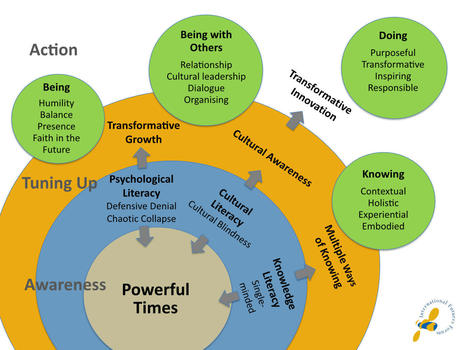
The Competence in Complexity programme offers a year-long process for participants to develop their 21st century competencies and to demonstrate them in practice in effective, transformative action. Next Programme October 2021 - October 2022 The programme is hosted in our online Atelier space, a dedicated virtual space for participants to connect, converse, share and access materials, resources and insights and to remain 'on campus' throughout in a dedicated community of practice. All workshops in the programme are conducted online to allow for international participation. The curriculum is designed around three modules (see graphic). Each is designed to be a valuable and rounded experience in itself. We recommend, however, that participants take the full programme in order to gain maximum benefit from a supported learning environment designed for slow, substantial growth and development over the course of a full year. Click the blue button above for a full programme description and other details about scheduling and fees. The programme is based on IFF’s books Dancing at the Edge: Competence, Culture and Organisation in the 21st Century by Maureen O’Hara and Graham Leicester, Three Horizons: The pattering of hope by Bill Sharpe, and Transformative Innovation: a guide to practice and policy for system transition by Graham Leicester. A distinctive approach to competence Dancing at the Edge takes a distinctive stand in relation to competence: We follow the OECD definition that competence is not an abstract achievement but “the ability to meet important challenges in life in a complex world”;
Via F. Thunus
|
|
Rescooped by
michel verstrepen
from Educational Technology News
August 27, 2021 11:50 AM
|
"NFT is a buzzword that's particularly difficult to explain—and it's perhaps even harder to imagine how it might play a role in education.
NFT stands for non-fungible token. That means this technology lets you create a digital file that is one-of-a-kind—and that has coded into it the proof of its authenticity as an original. NFTs use the blockchain, the same technical framework that makes bitcoin and other cryptocurrencies possible."
Via EDTECH@UTRGV
Humans are visual creatures. Though substance matters, you need to please the eye in order to grab their attention. This article features 5 aesthetics you should eliminate from your eLearning course design to increase its value.
Via EDTECH@UTRGV
|
|
|
Rescooped by
michel verstrepen
from Educational Technology News
September 2, 2021 4:49 PM
|
How educators are trying to maintain progress on digital divide
Via EDTECH@UTRGV
|
|
Rescooped by
michel verstrepen
from Raspberry Pi
September 2, 2021 2:07 AM
|
Robotics is an absolute entity that is present in the current tech industry and will be for the next decades of the future. Besides its career opportunities, it can also be a great subject to teach the kids.
Via F. Thunus
|
|
Rescooped by
michel verstrepen
from Educational Technology News
September 1, 2021 5:09 PM
|
Let's look at 3 examples of Collaborative Learning case studies in action, from using subject-matter expertise to boost course completion rates to supercharging new hire onboarding and building a decentralized culture of Collaborative Learning.
Via EDTECH@UTRGV
|
|
Rescooped by
michel verstrepen
from E-Learning-Inclusivo (Mashup)
September 1, 2021 11:07 AM
|
Instructional Design is a process that assists in the design, creation, and delivery of instructional resources, experiences, and courses. This discipline, also known as Instructional Systems Design (ISD), follows a multi-step approach to create various successful online courses effectively. In simpler terms, instructional design is about using our knowledge of how people learn to guide our instructional sequences and strategies to meet students' needs and desired learning outcomes.
The implementation of instructional design is carried out by specialists called instructional designers. They are involved in developing educational material, namely the formation of units, materials presentation, support materials, and much more. However, the list of responsibilities of instructional designers also includes the following items:
Via Edumorfosis, juandoming
Michael Sankey, Learning Futures, Griffith University This article was originally published in Chinese, as a peer reviewed article in the Journal of Distance Education in China. Citation: Sankey, M. (2020). Putting the pedagogic horse in front of the technology cart. Journal of Distance Education in China. 5, pp .46-53. DOI:10.13541/j.cnki.chinade.2020.05.006 Both the original Chinese version and an English…
Via Peter Mellow, LGA
|
|
Rescooped by
michel verstrepen
from Media, Business & Tech
August 30, 2021 2:38 PM
|
Des données Kantar TGI indiquent que les 15-34 ans sont des e-consommateurs exigeants. Pour 58% d’entre eux le prix est incontournable (contre 49% pour l’ensemble des Français).
Via Bruno Renkin
Over the past semester or two, as COVID has been disrupting most parts of our lives, I’ve been thinking more about teaching, learning, and assessment in my classes. This is more than just an opportunity to modify my practice when things go sideways. I think this pandemic has given us an opportunity to think deeply... Continue reading →
Via Dr. Tom D'Amico (@TDOttawa)
|
|
Rescooped by
michel verstrepen
from Fab-Lab
August 29, 2021 2:00 PM
|
"Pour l’anecdote, il y a encore trois ans, lorsque j’ai rendu mon rapport de la mission coworking à Julien Denormandie, le mot « tiers-lieux » était encore complètement inconnu. Aujourd’hui, c’est un concept-clef du nouveau tournant de la politique d’aménagement du territoire française."
Via Laurence
Shows how research on networks and systems change can be combined to give important information about success in networks. The Network for Nonprofit and Social Impact (NNSI) at Northwestern University examined 26 education networks across the United States focused, at least in part, on student achievement in their communities. Half the networks adhered more closely to the initial collective impact tenets, and the other half were networks matched to these collective impact networks based upon community characteristics. We compared networks from each group. The results are a robust comparison of various network designs, producing five critical insights.
Via june holley, Ricard Lloria, juandoming
|
|
Rescooped by
michel verstrepen
from Educational Technology News
August 27, 2021 11:50 AM
|
Have you been suddenly thrust into the “new normal” of mobile teaching? It’s not easy to have to wholly and quickly adapt to new technology. And you’re probably concerned about the limitations to mobile learning. Can it really deliver quality instruction? The answer is an absolute yes. So, let’s bust some of those myths right away.
Via EDTECH@UTRGV
|
|
Rescooped by
michel verstrepen
from :: The 4th Era ::
August 27, 2021 5:08 AM
|
Like many parents and guardians, I felt unprepared to take over the day-to-day management of my household’s learning during the pandemic. Despite being involved in online education for over a decade—first as the founding president of Khan Academy, and now as the product and UX director of Google for Education—I wasn’t ready for the challenges of this past year.
Via EDTECH@UTRGV, Jim Lerman
|