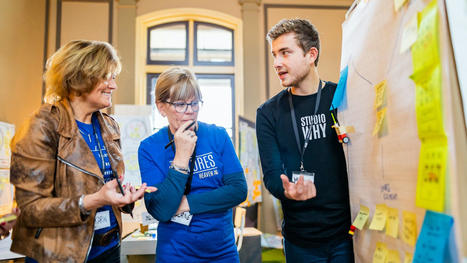
Quelles nouvelles pratiques pédagogiques mettre en place aujourd'hui pour innover en pédagogie ? Sans doute celles liées à l'incitation au travail collaboratif et à l'hybridation systémique, celle qui dépasse la simple addition entre présentiel et distanciel ! Conférence de Jean-Charles CAILLIEZ le 16 novembre 2021
Cybersecurity remains an area of struggle for many campuses. While education seems to trail behind industries like healthcare, finance, and public administration, there has been a slight increase in both the number of confirmed attacks of data disclosure in education, as well as in the variety of threats.
Institutions need to develop strategies that are comprehensive and that motivate the widespread ownership of responsibility. It is the perfect time for colleges to analyze the current patterns of breaches and develop cybersecurity practices that are theoretically sound and realistic.
Confused about what’s what in the virtual world? If so, you’re certainly not alone.
The simplest way to think about augmented reality (AR) and virtual reality (VR) is that they are a bridge between the digital and physical worlds, letting you take in information and content visually — the same way you take in the world.
The following is a handy guide to deciphering what’s what in the high-tech world of AR and VR.
Anyone who has tried to measure the success of a 1:1 program using the SAMR model knows that climbing the SAMR hierarchy — from the bottom rungs of substitution and augmentation to the holy grail of modification and redefinition — can sometimes feel more like climbing a Stairmaster than a ladder: You put in the effort but stay in the same place.
Juan Domingo Farnós A veces oímos la gente hablar de la importancia del conocimiento digital para los estudiantes del siglo 21. Algunos se centran en las habilidades en lugar de alfabetizaciones, otros en las competencias: La alfabetización digital se centra en por qué, cuándo, con quién, para quién. — —La alfabetización digital es fundamental para…
Nearly all of us have heard (or used) this maxim: practice makes perfect.
Malcolm Gladwell’s book, Outliers, inadvertently popularized a (false) corollary to the maxim, the idea that it takes 10,000 hours of practice to gain world-class expertise or skill level.
Host conferences, festivals, meetups, parties, workshops, and more in a colorful game-like 3D world. Camera shy? No problem. Use your mic to talk to others near you with our best-of-class 3D spatial audio. Done chatting? Just walk away.
I have to say that I really love this on so many levels. Great spatial audio and idea for shy students and younger learners. Will make online lessons so much more fun.
Just as formal education systems made a dramatic shift to digital since the start of the COVID-19 pandemic, on-the-job training is changing as well. The same forces that transformed classrooms have accelerated the adoption of more digital learning in workplace training—advancing a trend that was already underway.
“Yellow journalism was a style of newspaper reporting that emphasized sensationalism over facts. During its heyday in the late 19th century it was one of many factors that helped push the United States and Spain into war in Cuba and the Philippines, leading to the acquisition of overseas territory...
Anyone who has tried to measure the success of a 1:1 program using the SAMR model knows that climbing the SAMR hierarchy — from the bottom rungs of substitution and augmentation to the holy grail of modification and redefinition — can sometimes feel more like climbing a Stairmaster than a ladder: You put in the effort but stay in the same place.
Already have a website app & looking to build a mobile one? Seamlessly convert your existing web app into native Android and iOS. No coding skills required.
Somehow curiosity could prepare the brain for learning and long-term memory more broadly. This, it can be concluded that Curiosity boosts people's ability to learn and retain new information, thanks to key reward and memory centers in the brain. ...
The digital world is evolving rapidly and so must the way we educate students about navigating it. For over a decade now, digital citizenship has been mainly about the don'ts: Don't share your passwords, don't steal the intellectual property of others, don't post or share inappropriate content on social media.
The 5 competencies are simple and straight to the point. But also one that can be made into a presentation when trying to teach digital citizenship to students. If educators are trying to implement social media in the classroom then teaching and explaining digital citizen ship is a must. Much like the article said, schools present this topic as a list of things we can not do, rather we should be teaching it much like we teach student to love to read.
With regard to digital citizenship, individuals must not only be taught what not to do online, rather they be taught what to do so that they may have a clear understanding of how the digital world works.
To get content containing either thought or leadership enter:
To get content containing both thought and leadership enter:
To get content containing the expression thought leadership enter:
You can enter several keywords and you can refine them whenever you want. Our suggestion engine uses more signals but entering a few keywords here will rapidly give you great content to curate.


 Your new post is loading...