Your new post is loading...

|
Scooped by
michel verstrepen
July 22, 2023 4:15 AM
|
Following the 'buzz' generated by the development of ChatGPT at the end of 2022 and the questions it raised in higher education, UNamur's University Pedagogy Service (SPU) conducted a wide-ranging survey of Block 1 students in the 6 faculties. The results are surprising.
|
|
Scooped by
michel verstrepen
July 22, 2023 4:12 AM
|
Professeurs, chargés de cours, assistants, et experts pédagogiques de l’UNamur ont participé à un workshop pour évaluer et critiquer l’utilisation de ChatGPT dans le cadre de cours universitaires. De nombreux exemples de pratiques incluant l’IA dans l’enseignement ont été réalisés dans les cours proposés à l’UNamur ce quadrimestre. Une enquête a également été menée auprès des étudiants de bloc 1 sur leur utilisation et connaissance de l’intelligence artificielle.
O colunista Celso Niskier mostra a relação entre o machine learning e a inadimplência – ou melhor, ações preventivas à inadimplência com uso de tecnologia
Educação nunca sai de moda. Pelo contrário, a busca pelo saber tem se apresentado como uma variável crescente. Essa realidade deve ser sempre celebrada e incentivada, mas é preciso atenção e disciplina no que tange à gestão de recursos e à aplicação de capital para investimento, pois, em paralelo à curva de crescimento das matrículas, temos identificado similar ascensão da inadimplência nas IES particulares.
Via Inovação Educacional, juandoming
AI can enhance engagement and optimize learning. In this article, we explore some landscape-changing AI technologies in eLearning.
Via Alfredo Calderón, juandoming
Last September, I was sitting at a long table in the sunlit conference room of my school, looking around at the many new faces on my school’
Via EDTECH@UTRGV
As students begin to use ChatGPT to help them with homework, assignments and tutoring needs, it’s also important that educators speak with them about the limitations of artificial intelligence.
Via EDTECH@UTRGV
School districts used an average of 2,591 different ed tech tools in the 2022-23 school year, up slightly from 2,547 the previous year, according to a report from Instructure’s LearnPlatform, an ed tech company that helps districts research and choose digital learning products.
Via EDTECH@UTRGV
Juan Domingo Farnós Respondiendo al título cabe decir que el porqué es debido a que los aprendices (estudiantes) del Siglo XXI quieren y necesitan aprender cuándo, cómo, dónde (aprendizaje ubicuo) bajo su demanda teniendo en cuenta sus contextos y la personalización de lo que van a llevar a cabo, como consecuencia lo híbrido pierde la…
Via juandoming
Decktopus is an AI presentation maker, that will create amazing presentations in seconds. You only need to type the presentation title and your presentation is ready.
Via Nik Peachey
Preventing students from cheating and using AI to answer assignments completely is a challenging task. However, there are several strategies that educators can employ to minimize cheating and encourage authentic learning:
Via Nik Peachey
|
|
Scooped by
michel verstrepen
July 16, 2023 3:25 AM
|
Alors que ChatGPT et autres IA génératives investissent tous les champs de la société, l’Éducation nationale fait face à un nouveau défi d’adaptation. Pour cela, le réseau Canopé tente de sensibiliser et former les enseignants en prévision de la rentrée prochaine.
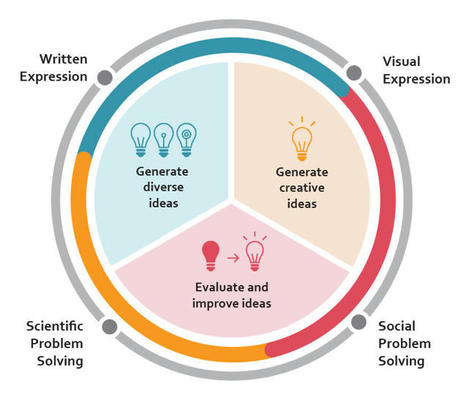
What is Creative Thinking?
Creative thinking is the way of thinking that leads to the generation of valuable and original ideas. All people are capable of engaging in creative thinking and practicing ‘everyday’ creativity (addressing everyday activities in a non-conventional way). Creative thinking can be applied not only to contexts related to the expression of imagination, such as creative writing or the arts, but also to other areas where the generation of ideas is functional to the investigation of issues, problems or society-wide concerns.
The PISA assessment will examine students’ capacities to generate diverse and original ideas, and to evaluate and improve ideas, across a range of contexts or ‘domains’. The assessment includes four domains: written expression, visual expression, social problem solving and scientific problem solving. In each of these domains, students engage with open tasks that have no single correct response. They are either asked to provide multiple, distinct responses, or to generate a response that is not conventional. These responses can take the form of a solution to a problem, of a creative text or of a visual artefact. Learn more / En savoir plus / Mehr erfahren: https://www.scoop.it/topic/21st-century-learning-and-teaching/?&tag=Creativity
Via Gust MEES
|
|
|
Scooped by
michel verstrepen
July 22, 2023 4:14 AM
|
Since its appearance in December 2022, ChatGPT, the conversational robot from OpenAI, an artificial intelligence company co-founded by Elon Musk, has continued to provoke astonished comments and worried questions, including: is the human brain still useful?
By Arianna Prothero
"Schools are falling short on vetting the apps and internet services they require or recommend that students use.
That’s among the findings of a comprehensive analysis of school technology practices by Internet Safety Labs, a nonprofit group that researches tech product safety.
Researchers analyzed more than 1,300 apps used in 600 schools across the country looking at what information the apps—and the browser versions of those apps—are collecting on students and who that information is shared with or sold to. Not protecting students’ personal information in the digital space can cause real-world harms, said Lisa LeVasseur, the founder and executive director of Internet Safety Labs and one of the co-authors of the report.
Strangers can glean a lot of sensitive information about individuals, she said, from even just their location and calendar data.
“It’s like pulling a thread,” LeVassuer said. “Even data that may seem innocuous can be used maliciously, potentially—certainly in ways unanticipated and undesired. These kids are not signing up for data broker profiles. None of us are, actually." (Data brokers are companies that collect people’s personal data from various sources, package it together into profiles, and sell it to other companies for marketing purposes.)
Only 29 percent of schools appear to be vetting all apps used by students, the analysis found. Schools that systematically vet all apps were less likely to recommend or require students use apps that feature ads. But in an unusual twist, those schools that vet their tech were actually more likely to require students use apps with poor safety ratings from the Internet Research Labs.
Although LeVassuer said she’s not sure why that is the case, it might be because schools with systematic vetting procedures wound up requiring that students use more apps, giving schools a false sense of security that the apps they approved were safe to use.
It’s also hard for families to find information online about the technology their children are required to use for school and difficult to opt out of using that tech, according to the report.
Less than half of schools—45 percent—provide a technology notice that clearly lists all of the technology products students must use, the researchers found. While not required under federal or most state laws, it is considered a best practice, the report said.
Only 14 percent of schools gave parents and students older than 18 years of age the opportunity to consent to technology use. Certifications can give a false sense of security Researchers for the Internet Safety Lab also found that apps with the third-party COPA certification called Safe Harbor—which indicates that an app follows federal privacy-protection laws for children—are frequently sharing student data with the likes of Facebook and Twitter. Safe Harbor certified apps also have more advertising than the overall sample of apps the report examined.
The certification verifies that the apps abstain from some important data privacy practices, like behavioral advertising, said LeVasseur. But school leaders may not be getting the data privacy protection for students that they believe they are. “Third-party certifications may not be doing what you think they are,” said LeVassuer.
But overall, apps with third-party certifications, such as 1EdTech, and pledges or promises, such as the Student Privacy Pledge or the Student Data Privacy Consortium, received better data privacy safety ratings under the rubric developed by the Internet Safety Labs.
In all, the Internet Safety Labs examined and tested 1,357 apps that schools across the country either recommend or require students and families to use. It created its sample of apps by assessing the apps recommended or required in a random sample of 13 schools from each of the 50 states and the District of Columbia, totaling 663 schools serving 456,000 students.
While researchers for Internet Safety Labs were only able to analyze the off-the-shelf versions of the apps schools used (they did not have access to school versions of these apps), the group estimates that 8 out of every 10 apps recommended by schools to students are of the off-the-shelf variety.
This is the second report from an ambitious evaluation of the technology used in schools by Internet Safety Labs. The first report, released in December, labeled the vast majority of those apps—96 percent—as not safe for children to use because they share information with third parties or contain ads."...
For full post, please visit: https://www.edweek.org/technology/districts-take-note-privacy-is-rare-in-apps-used-in-schools/2023/07 For report published by Internet Safety Labs, visit here:
https://internetsafetylabs.org/wp-content/uploads/2023/06/2022-K12-Edtech-Safety-Benchmark-Findings-Report-2.pdf
Via Roxana Marachi, PhD
15émes rencontres de la eformation 8 et 9 novembre 2023
[Save the date] Les 15èmes rencontres de la eformation auront lieu les 8 et 9 novembre 2023 à Paris. Comment améliorer l'efficience de l'apprentissage en ligne par l’évaluation ? Longtemps perçue comme anecdotique, la formation en ligne est aujourd’hui reconnue comme un mode d’apprentissage offrant de nouvelles opportunités pour les étudiants et les professionnels. Cependant, assurer l'efficience de l'apprentissage en ligne constitue un défi majeur pour les enseignants et les formateurs. Les risques de voir l’apprenant développer un sentiment d’isolement derrière son écran ou d'abandonner son processus de formation en cours restent importants. Questionnée dans sa forme et dans son efficacité dans le domaine éducatif, souvent rejetée et perçue comme une sanction dans le cadre de la formation professionnelle, l’évaluation semble pourtant un élément essentiel à la réussite d’un parcours d’apprentissage. Indispensable pour s’assurer de l’atteinte des objectifs pédagogiques, elle peut permettre d’améliorer l’engagement de l’apprenant ainsi que sa motivation lorsque du feed-back et du tutorat l’accompagnent. Repenser l’évaluation au-delà de l’évaluation sommative, intégrer le droit à l’erreur comme vecteur de progression, c’est également comprendre que ce processus est indispensable aux apprenants qui, en recevant des commentaires détaillés sur leurs performances, peuvent prendre conscience de leurs forces et de leurs faiblesses, réfléchir à leurs stratégies d'apprentissage et apporter des ajustements pour améliorer leurs performances. « Comment améliorer l’efficience de l’apprentissage en ligne par l’évaluation ? » sera la thématique de la 15ème édition des rencontres de la eformation qui se déroulera les 8 et 9 novembre 2023 à la Tour Séquoïa (Paris La Défense). Cette édition sera l’occasion d’explorer la place et le rôle de l’évaluation dans le processus d'apprentissage, à travers notamment l’alignement pédagogique, le processus de métacognition, le rôle du tutorat ainsi que les outils numériques disponibles au service de cette évaluation.
Via Vedrenne Guy
Companies that get reskilling right have a better shot at future proofing their workforce and can more easily negotiate rapid technological change. Those that don’t get it right risk being left in the dust—and paying the price. According to IDC, by 2025, 90% of organizations will be beset by IT skills shortages, at a cost of $6.5 trillion globally due to delayed product releases, diminished customer satisfaction, and loss of business.
Via Edumorfosis, LGA
As artificial intelligence, and in particular ChatGPT, infiltrates higher education, faculty remain on edge. The most prominent concern is the impact on academic integrity. Will technology induce cheating? How much bot input should be allowed while completing assignments? How do I teach in a world where everyone has a calculator for everything?
These concerns are not new. Issues like plagiarism, cheating (on tests or in admission scandals), and integrity have been the center of ethical conversations for many years. For the most part, these concerns are rooted in a cultural orientation that frames knowledge as property. Jonathan Lethem’s classic essay, “The Ecstasy of Influence,” explains as much: Despite the fact that creation is a social phenomenon, creativity is threatened by “the idea that culture can be property–intellectual property.”
Via Edumorfosis, LGA
Traditional school is not even preparing students for this modern world, let alone for the bizarre sci-fi future that’s about to knock down our door.
Via EDTECH@UTRGV
Discover the world of adaptive learning for personalized education. Unleash the transformative power of education in the digital age!
Via LGA
If you practice eLearning in your educational facility or organization, you know the importance of an LMS firsthand. It's the heart of every online learning program, as it helps to streamline and optimize the learning experience for both instructors and learners. Since technology is rapidly evolving, LMSs will inevitably do the same. Researching the future of LMS can help us know what to expect in terms of technological advancements so we can be ready to accept them and adapt accordingly. So, let's gaze into the crystal ball and see what tomorrow might bring in the world of LMSs.
Via Edumorfosis, LGA
Le manque de compétences numériques de base touche principalement les personnes les plus âgées, les plus modestes et les moins diplômés. Bonne nouvelle cependant, le taux d'illectronisme a baissé de trois points entre 2019 et 2021.
Via Bibliothèques-Médiathèques de Metz
Embracing eLearning for continuous learning creates a culture of growth and adaptability in the workplace.
Via LGA
|
|
Scooped by
michel verstrepen
July 16, 2023 3:24 AM
|
Alors que ChatGPT et autres IA génératives investissent tous les champs de la société, l’Éducation nationale fait face à un nouveau défi d’adaptation. Pour cela, le réseau Canopé tente de sensibiliser et former les enseignants en prévision de la rentrée prochaine.
|