To boldly go where only Astrophysicians have gone before. What I find interesting (and can roughly understand) in Astronomy & Space exploration these days.
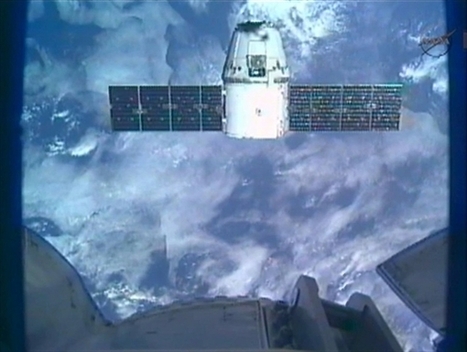
Today's arrival of a cargo spaceship at the International Space Station wasn't your typical outer-space delivery run: It was an emotional experience for many of the folks who watched NASA's webcast of the SpaceX Dragon's approach.
"I'm not going to lie, I'm a little choked up right now," Discovery News' Ian O'Neill wrote in a Twitter update. "But I suppose that happens when you watch history unfold."
"Our universe may exist inside a black hole. This may sound strange, but it could actually be the best explanation of how the universe began, and what we observe today."
Like shown in the picture, the top bottle being the black hole and the bottom our universe, filling from the above through a wormhole.
"We're now seeing a new generation of (hundred)-millionaires and billionaires who are interested in space," says space entrepreneur Peter Diamandis. "This is smart money investing in one of the largest commercial opportunities ever: going to space to gain resources for the benefit of humanity."
"The history of the entire observable universe, and all of the matter that ever was, has been modeled on a French supercomputer over a two-week span. Scientists are gearing up to repeat it again, twice."
Lots of interesting results to expect?
Yes. “The goal of our DEUS project is to understand the nature of the Dark Energy or in other words, the origin of the cosmic acceleration,” said Dr. Jean-Michel Alimi, a scientist with the Laboratoire Univers et Théorie of France’s National Center for Scientific Research (CNRS), who led the project.
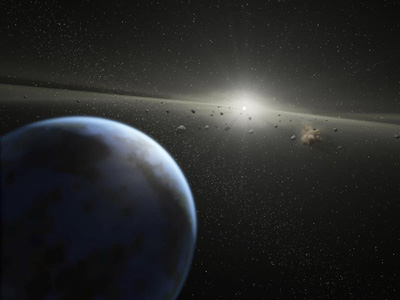
Thought Private Space Travel was cool? Well, Space Mining could soon be even cooler considering the economic potential.
Planetary Resources - a startup backed by no other than Google cofounder Larry Page -will "outline a plan to send an unmanned spacecraft to an asteroid and mine it for valuable metals and water that could be used in further space exploration or returned to earth."
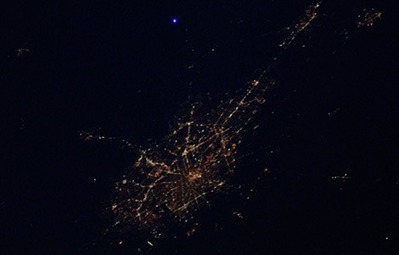
"Timelapse videos depicting the stars from low earth orbit, as viewed from the International Space Station. Images edited using Adobe Lightroom with some cropping to make the stars the focal point of each shot, and with manipulation of the contrast to bring out the stars a bit more."
Remember when Spaceships go light-speed in Star Wars? Well reality is even cooler.
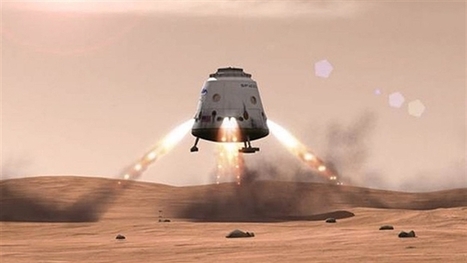
"Serial entrepreneur Elon Musk says SpaceX is developing a plan for trips to Mars that will eventually cost just $500,000 per seat. Musk founded SpaceX 10 years ago and interplanetary travel has always been one of his goals for the company. Few details were provided about the Martian voyage, but Musk did say we can expect to hear more about the plan in less than a year."
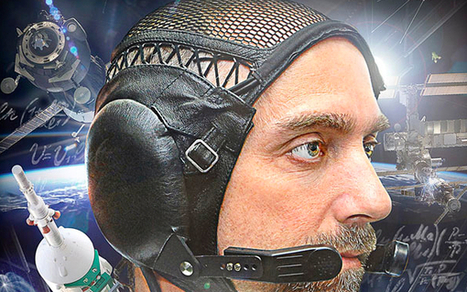
"Richard Garriott, age 50, was the 483rd person to leave planet Earth -- and he'd like you to be one of the first thousand."
He predicts competition will bring the cost of space travel down to really much more afordable levels than the millions he had to pay to go to the ISS in 2008.
But he also gave another reason to go to space: making money. Space will be full of opportunities for entrepreneurs, he told the ones at SxSWi.
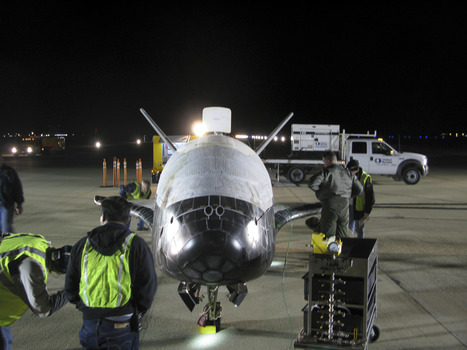
"The Air Force’s secretive X-37B space plane gets more mysterious by the day. Designed to spend up to nine months on unspecified errands in Earth’s orbit, the second copy of the Boeing-made craft, known as Orbital Test Vehicle 2, has now been in space for a year and two days — and is still going strong."
"The first commercial company in history to attempt to send a spacecraft to the International Space Station", Space X successfully launched the Falcon 9 rocket carrying the Dragon spaceship that will rendez-vous with the ISS.
Commercial Space Flight anyone?
Video shows launch at 2:02 and solar arrays opening at 13:37.
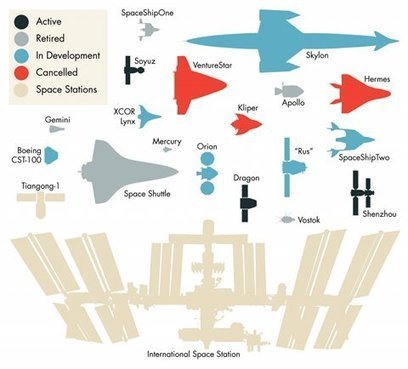
Astrochemist Markus Hammonds (aka Invader Xan) has made a nice graphic over on Supernova Condensate showing the relative sizes of a bunch of spacecraft. As you can see, the International Space Station is really huge these days.
Cosmologists use the mathematical properties of eternity to show that although universe may last forever, it must have had a beginning...
Very interesting pick that I rescooped from Sakis Koukouvis. It doesn't prove the big bang but could demonstrate that the universe must have had a beginning since we see it expand.
There is very little that’s easy about moon colonization. One of the bigger problems is setting up our hypothetical future colonists with living quarters.
So, interestingly, some people start to design ideas and plans for how to build such colonies. Here's a very creative one. Crazy? Maybe... But then the whole idea we would fly in big metal cylinders heavier than air probably was 3 centuries ago...
We tend to think of interstellar journeys as leaps into the void, leaving the security of one solar system to travel non-stop to another.
This is the idea of the "generation ship", a concept that generations would succeed one another on board of a gigantic ship that would cruise for hundreds of years to far away stars.
But there is another way. Why not start by colonizing the edge of our solar system, aka the Oort Cloud.
To get content containing either thought or leadership enter:
To get content containing both thought and leadership enter:
To get content containing the expression thought leadership enter:
You can enter several keywords and you can refine them whenever you want. Our suggestion engine uses more signals but entering a few keywords here will rapidly give you great content to curate.


 Your new post is loading...