Your new post is loading...

|
Suggested by
Vincent Lieser
February 16, 2011 4:20 AM
|
Replace controlled explosions by more clever ways ? Looks promising.
"Launching payloads into space is expensive, but high costs aside it’s also a horribly inefficient process. Conventional rockets are almost pure fuel, leaving only a small percentage (usually in the low single digits) of a launch vehicle's total weight available for payload. So NASA's Glenn Research Center in Ohio is looking into a whole new system of payload propulsion that uses lasers or microwaves to launch vehicles into orbit."

|
Suggested by
Sakis Koukouvis
February 9, 2011 2:50 PM
|
NASA's planet-hunting telescope is finding whole new worlds of possibilities in the search for alien life. An early report from a cosmic census indicates that relatively small planets and stable multi-planet systems are far more plentiful than previous searches showed.

|
Suggested by
axelletess
February 9, 2011 1:34 AM
|
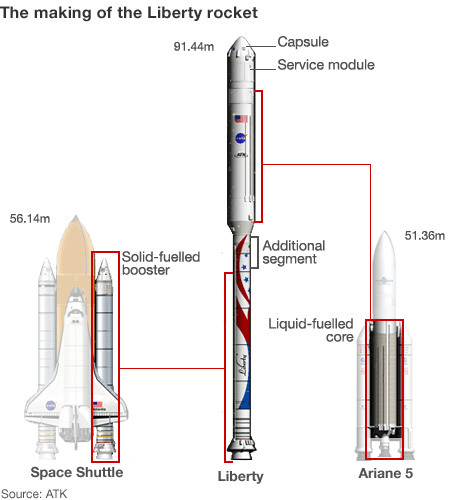
New rocket, made partly of Ariane 5, could lift astronauts.

|
Scooped by
Guillaume Decugis
February 6, 2011 11:14 AM
|
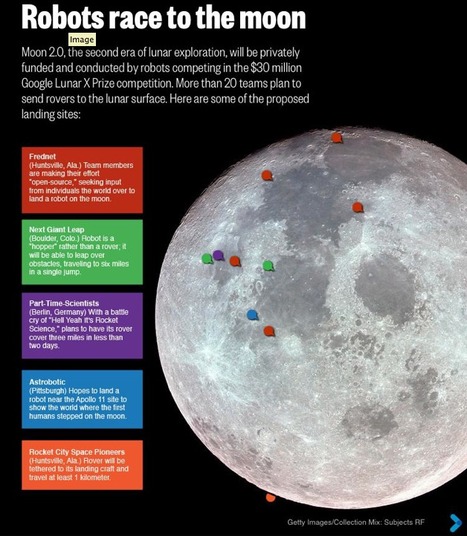
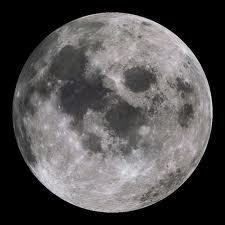
The ambitions for lunar exploitation are huge. Are they really about to start ?
|
|
Suggested by
Sakis Koukouvis
January 28, 2011 9:21 AM
|
From Antimatter-powered rockets to sun-powered spaceships and new types of exploration suits. In pictures
|
|
Suggested by
Sakis Koukouvis
January 27, 2011 9:02 AM
|
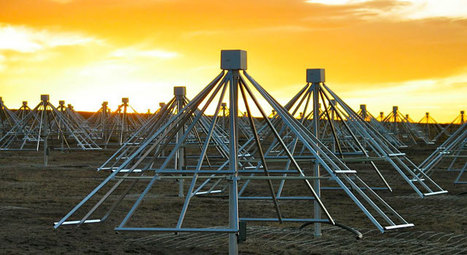
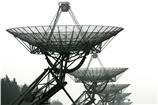
A group of JPL researchers and their colleagues will hunt for new and exotic objects in the sky by using ceiling-fan-size antennas.
|
|
Scooped by
Guillaume Decugis
January 20, 2011 11:28 AM
|
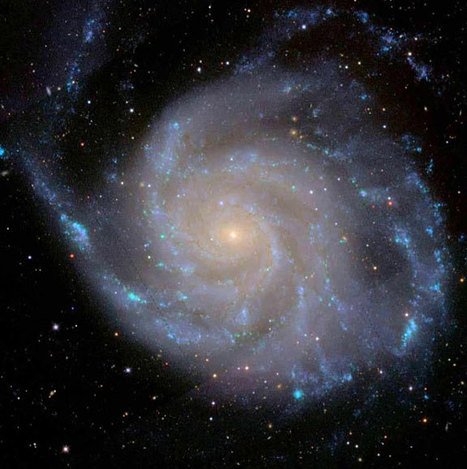
Massive black holes have been found at the centers of almost all galaxies, where the largest galaxies -- who are also the ones embedded in the largest halos of dark matter -- harbor the most massive black holes. This led to the speculation that there is a direct link between dark matter and black holes, i.e., that exotic physics controls the growth of a black hole. Scientists at the Max Planck Institute of Extraterrestrial Physics, the University Observatory Munich, and the University of Texas in Austin have now conducted an extensive study of galaxies to prove that black hole mass is not directly related to the mass of the dark matter halo but rather seems to be determined by the formation of the galaxy bulge.
|
|
Suggested by
Sakis Koukouvis
January 18, 2011 12:34 PM
|
With the discovery of vast amounts of water on the Moon, some frozen in the shadows of craters at the Lunar poles and some chemically bonded with the regolith, interest in lunar mining has arisen among commercial space entrepreneurs.
|
|
Suggested by
Sakis Koukouvis
January 17, 2011 2:51 AM
|
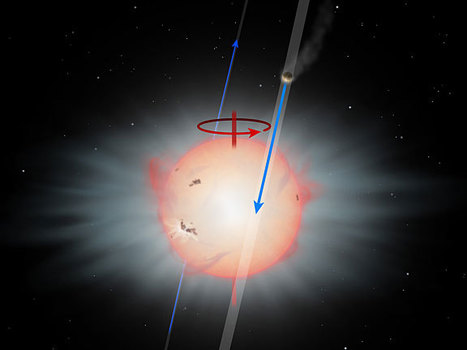
A research team led by astronomers from the University of Tokyo and the National Astronomical Observatory of Japan (NAOJ) has discovered that inclined orbits may be typical rather than rare for exoplanetary systems.
(Space Ref)

|
Suggested by
Avrel
January 10, 2011 3:52 AM
|
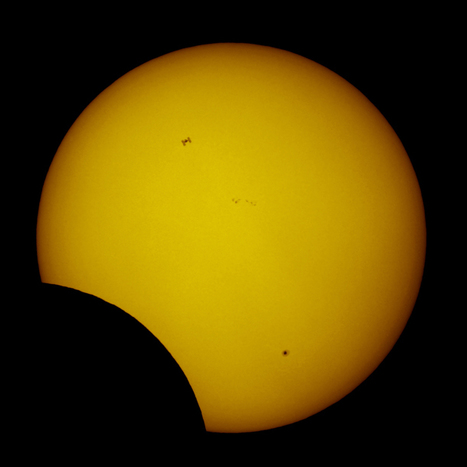
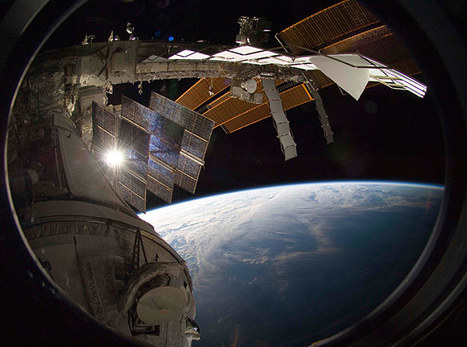
The silhouette of the Moon taking a dark bite out of the Sun is obvious enough, as are some interesting sunspots on the Sun’s face… but wait a sec… that one spot isn’t a spot at all, it’s the International Space Station! This was a double eclipse!
|
|
Scooped by
Guillaume Decugis
December 23, 2010 6:19 PM
|
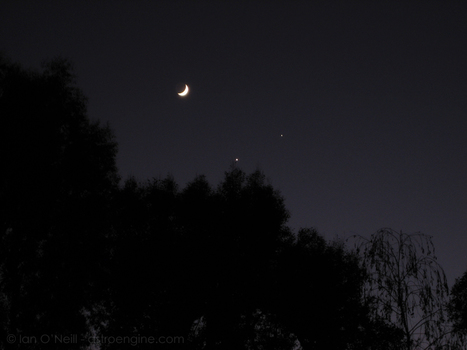
In the year 2 B.C., the strange motion of Jupiter past the bright star of Regulus and eventual conjunction with Venus may have inspired the "Three Wise Men"
|
|
Scooped by
Guillaume Decugis
December 17, 2010 1:26 PM
|
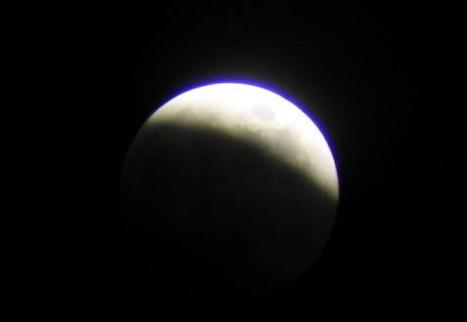
For a few hours on the night of Dec. 20 to Dec. 21, theattention of tens of millions of people will be drawn skyward, where themottled, coppery globe of our moon -will hang completely immersed f in thelong, tapering cone of shadow cast out into space by our Earth. If the weatheris clear, favorably placed skywatchers will have a view of one of nature's mostbeautiful spectacles: a total eclipse of the moon.
|
|
Scooped by
Guillaume Decugis
December 15, 2010 1:59 PM
|
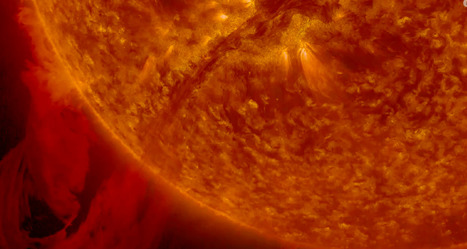
Watch an unusually long filament explode out from the Sun.
The filament had been seen hovering over the Sun's surface for over a week before it erupted earlier this month.
The image sequence was taken by the Earth-orbiting Solar Dynamics Observatory (SDO) in a color of ultraviolet light specifically emitted by helium. The explosion created Coronal Mass Ejections which dispersed high energy plasma into the Solar System. This plasma cloud, though, missed the Earth and so did not cause auroras. The above eruption and an unusually expansive eruption that occurred in August are showing how widely separated areas of the Sun can sometimes act in unison. Explosions like this will likely become more common over the next few years as our Sun moves toward Solar Maximum activity.
|
|
|
Suggested by
Sakis Koukouvis
February 10, 2011 4:44 AM
|
"By adding a laser and an ion funnel to the mass spectrometer, researchers may be better equipped to finding life on Mars."
I love the whole Alien hunt stuff but sometimes I wonder how far NASA is ready to leverage that in their P/R strategy to get funded.
|
|
Suggested by
Sakis Koukouvis
February 9, 2011 2:34 PM
|
|
|
Suggested by
Sakis Koukouvis
February 7, 2011 3:13 AM
|
Juste like Luke Skywalker's Tatoine, Earth could have 2 suns for a few weeks as soon as this year when Betelgeuse explodes.
|
|
Suggested by
Sakis Koukouvis
January 31, 2011 8:47 AM
|
Earth's previous attempts to contact intelligent, extraterrestrial life could be too disorganised or cryptic for non-human beings to decode, US physicists have reported. Hence the proposition they made of a Framework for extraterrestrial communications. But maybe, this is all a bad idea... Remember what Stephen Hawking said: http://bit.ly/eAx7Kz
|
|
Scooped by
Guillaume Decugis
January 28, 2011 9:28 AM
|
THE aliens are out there and Earth had better watch out, at least according to Stephen Hawking.
“We only have to look at ourselves to see how intelligent life might develop into something we wouldn’t want to meet." he said before continuing: “If aliens ever visit us, I think the outcome would be much as when Christopher Columbus first landed in America, which didn’t turn out very well for the Native Americans.”
|
|
Suggested by
Sakis Koukouvis
January 20, 2011 11:31 AM
|
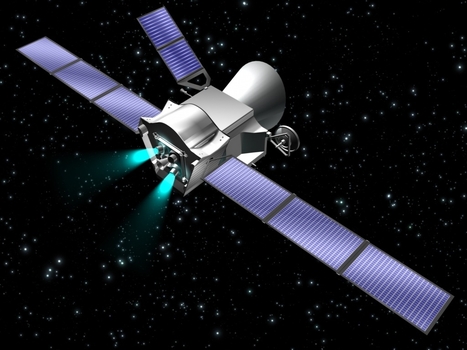
Scientists hope to answer many question about Mercury, such as is its core liquid or solid? They also want to know the origin of the many long marks across its surface, and whether there could be water and ice at the poles of this intensely hot planet.
|
|
Suggested by
Sakis Koukouvis
January 20, 2011 11:17 AM
|
NASA's Stardust-NExT spacecraft is nearing a celestial date with comet Tempel 1 at approximately 8:37 p.m. PST (11:37 p.m. EST), on Feb. 14. The mission will allow scientists for the first time to look for changes on a comet's surface that occurred following an orbit around the sun.
|
|
Suggested by
Sakis Koukouvis
January 17, 2011 10:18 PM
|
Flash animation lets you watch the sun under different conditions (wavelengths?) and zoom in, zoom out. Pretty cool!
SDO is designed to help us understand the Sun's influence on Earth and Near-Earth space by studying the solar atmosphere on small scales of space and time and in many wavelengths simultaneously.

|
Suggested by
Marc Rougier
January 10, 2011 6:49 PM
|
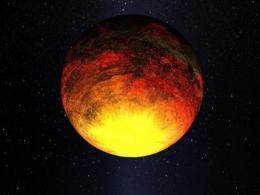
Get ready, we are moving!
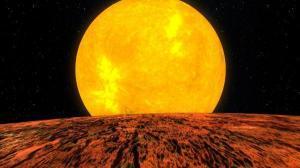
In fact not yet... as this exoplanet orbits it's sun in less than a day and is way too close to be habitable.
But still. There are more and more discoveries : our next home will ve discovered soon!
|
|
Scooped by
Guillaume Decugis
December 30, 2010 1:49 PM
|
Recent analysis of cosmic microwave background radiation could lead to the conclusion that observed microwave rings are echoes of a "cyclic universe".
These deductions have been met with some doubt within the astrophysics community, and three papers have already been written to rebut their claims. Until more is learned, it will have to remain a theory—but it's an awesome one.
|
|
Scooped by
Guillaume Decugis
December 21, 2010 5:54 PM
|
Several TwitPic users took advantage of the three-and-a-half-hour show, snapping pics and uploading them to the microblogging site.
|
|
Scooped by
Guillaume Decugis
December 15, 2010 2:07 PM
|
Beautiful...
(via The New Yorker)
|













![The Total Lunar Eclipse As Seen By Twitter Users [PHOTOS] | Good news from the Stars | Scoop.it](https://img.scoop.it/TSHoaCRrMU-YgfXO5KvQkTl72eJkfbmt4t8yenImKBVvK0kTmF0xjctABnaLJIm9)