


An intimate tour... in 1080p... of Earth's most impressive landscapes... as captured by astronauts with their digital cameras.

Good news from the Stars
10.8K views |
+0 today
To boldly go where only Astrophysicians have gone before. What I find interesting (and can roughly understand) in Astronomy & Space exploration these days.
Curated by
Guillaume Decugis
 Your new post is loading...
 Your new post is loading...
Your new post is loading...
 Scoop.it!
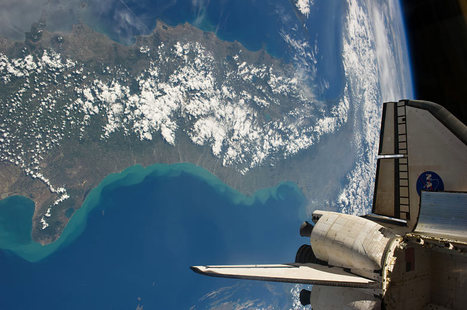
The space shuttle Endeavour docks with the International Space Station, with the Italian mainland below

Scoop.it!
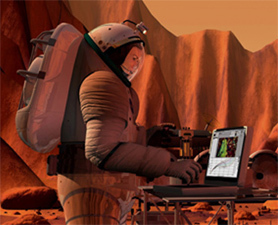
Interesting stuff on the Deep Space Network.
"We need a set of protocols that work on interplanetary distances, TCP/IP does not" according to Google's Chief Internet Evangelist via @vincentlieser
Scoop.it!
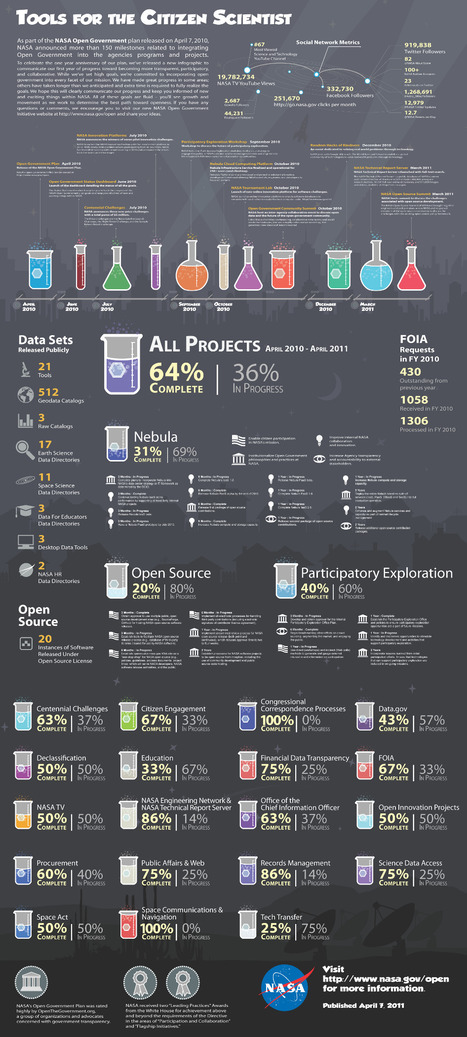
As part of the NASA Open Government plan released on April 7, 2010, NASA announced more than 150 milestones related to integrating Open Government into the agencies programs and projects.
Here's an update as an infographic.
Scoop.it!
Very promotional , yet interesting recap of the 30-years of the Space Shuttle program.
I remember watching John Young commanded STS-1 first Shuttle launch on TV with my grand-parents when I was 10. In spite of Challenger's and Columbia's tragedies, this program was quite something.
Scoop.it!

I’m not losing any sleep worrying about awaking one morning to see an alien mothership hovering over Washington D.C.
Scoop.it!

"For 50 years, humans have been flying in space, yet there are no astronauts living on Mars."
True. But why is that? Are we risk-averse now? Interesting post.
Scoop.it!

"We are the ones who will be most affected by the decisions you make today."
Here is what they recommend: a big push to open up space to commercial age and form partnerships between NASA and commercial spaceflight companies. "Everyone wins when NASA partners with the commercial spaceflight industry." or again "Allow NASA to explore the solar system again by embracing commercial spaceflight." And also a reminder that the youth can make things happen: "As NASA inspired and amazed the world by landing humans on the surface of the Moon in the late 1960s, the average age in NASA's Mission Control was only about twenty-eight."
Scoop.it!

Interesting post on the Icarius project. A 5-year plan to design an unmanned interstellar Spaceship.
The result? Not exactly the USS Enterprise...
Scoop.it!
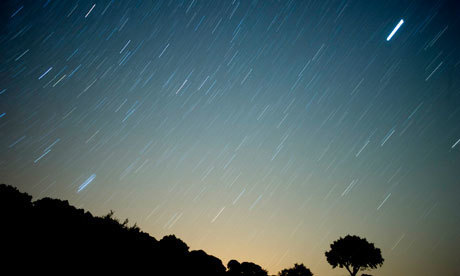
Fossils of algae-like beings in meteorites reported by astrobiologist Richard Hoover in Journal of Cosmology
Hoover claims that the lack of nitrogen in the samples, which is essential for life on Earth, indicates they are "the remains of extraterrestrial life forms that grew on the parent bodies of the meteorites when liquid water was present, long before the meteorites entered the Earth's atmosphere." By The Guardian
Scoop.it!
So a lone rock wandering in Space could be our next home? Makes me think of Space 1999...
"The radioactive decay of elements in a planet's core could keep it warm enough to maintain liquid water, even if it was no longer orbiting its star"
Scoop.it!
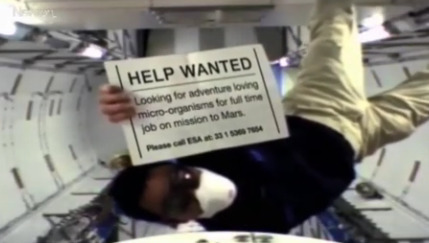
"Scientists seek reliable bacteria and algae to provide astronauts with oxygen and food on two-year round-trip to Mars. Ability to recycle human waste desirable" (The Guardian)
Scoop.it!
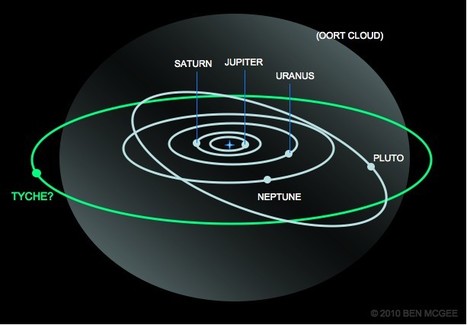
"We may have lost Pluto, but it looks like we might be getting Tyche. Scientists may soon be able to prove the existence of the gas giant, which could be four times the size of Jupiter, according to astrophysicists John Matese and Daniel Whitmire from the University of Louisiana at Lafayette."
For those following this topic, this apparently is the new name of the G1.9 Brown Dwarf Star that Spanish Astronomers claimed the discovery of last summer (see post here: http://t.co/shYC8Fk ). And it's apparently not a new discovery (NASA P/R again ?) since this article dated last April already mentioned the whole Nemesis/Tyche story: http://bit.ly/cVXSOs Per Wikipedia, "The use of the name "Tyche" for the planet may also be a reference to an earlier theory of the Solar System's structure that involved the Sun having a dim companion named Nemesis as it was proposed as a cause for mass-extinctions on Earth. Tyche was the name of the sister of Nemesis." http://bit.ly/es1eE5
|
Scoop.it!
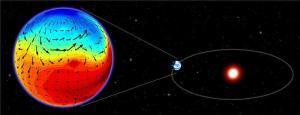
"The planetary system around the red dwarf Gliese 581, one of the closest stars to the Sun in the galaxy, has been the subject of several studies aiming to detect the first potentially habitable exoplanet."
A French Astrophysics team concluded that the planet named Gliese 581d can be considered the "first confirmed exoplanet that could support Earth-like life". But it doesn't mean it looks like Earth at all. See why in the article.
Scoop.it!
NASA Mars Science Laboratory (Curiosity Rover) Mission Animation
Released April 4, 2011, courtesy of NASA/JPL: "This artist's concept animation depicts key events of NASA's Mars Science Laboratory mission, which will launch in late 2011."
Scoop.it!
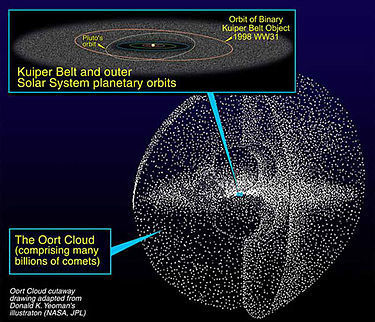
From
www

A few months ago I published here reports of the possible discovery by NASA of a new planet : Tyché. What was confusing was that just a few days before I saw an article about Spanish astronomers claiming the same but naming the object G1.9.
I asked Quora and here's the answer. Tyché, a hypothetical gas giant planet at the edges of the solar system, might exist but its existence is far from proven. G1.9 is a totally different thing (I removed the article which made the confusion from this topic of course).
Scoop.it!
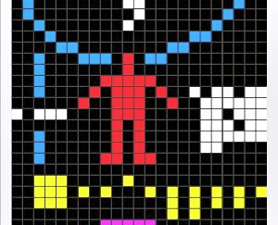
An interstellar message that means a lot to us may be inscrutable to E.T. because it is too anthropomorphic.
Scoop.it!

This is part of a Job listing incorporating the Virgin companies.
“prior spaceflight experience is an advantage” You bet! And I like this one to: "Preference will be given to those with experience of: - Spaceflight" Good luck, applicants! :-)
Scoop.it!

Did you buy your ticket yet? Anyway, you can always take a peek with this video.
Scoop.it!
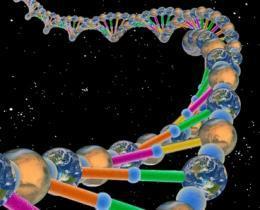
Are we all Martians? According to many planetary scientists, it's conceivable that all life on Earth is descended from organisms that originated on Mars and were carried here aboard meteorites. If that's the case, an instrument being developed by researchers at MIT and Harvard could provide the clinching evidence.
Scoop.it!
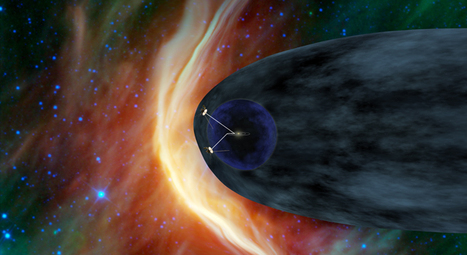
"In which direction is the sun's stream of charged particles banking when it nears the edge of the solar system?"
That's an answer not easy to get unless you're there. But more than 33 years after their launches, Voyager 1 and 2 are not only going to remain the only human spacecrafts in that area for decades, they're also fully functional. How's that for a long-lasting technology?
Scoop.it!
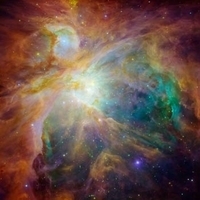
How do stars form and evolve? Stars are the most widely recognized astronomical objects, and represent the most fundamental building blocks of galaxies. The age, distribution, and composition of the stars in a galaxy trace the history, dynamics, and evolution of that galaxy. Moreover, stars are responsible for the manufacture and distribution of heavy elements such as carbon, nitrogen, and oxygen, and their characteristics are intimately tied to the characteristics of the planetary systems that may coalesce about them. Consequently, the study of the birth, life, and death of stars is central to the field of astronomy.
Scoop.it!

This would not be a good place for space tourism...
"This composite image of Arp 147, a pair of interacting galaxies located about 430 million light years from Earth, shows X-rays from the NASA's Chandra X-ray Observatory (pink) and optical data from the Hubble Space Telescope (red, green, blue) produced by the Space Telescope Science Institute (STScI) in Baltimore, Md." "The nine X-ray sources scattered around the ring in Arp 147 are so bright that they must be black holes, with masses that are likely ten to twenty times that of the Sun." Apparently, the collapse (explosion ?) happened some 15 million years ago.
Scoop.it!
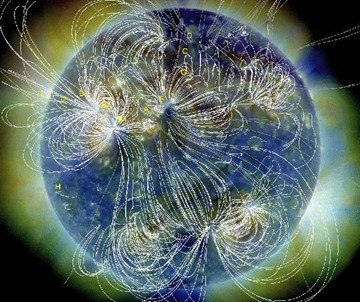
Understanding the sun is not easy. This eruption proved it again by shattering our previous beliefs on how the whole solar mechanic worked.
|






