


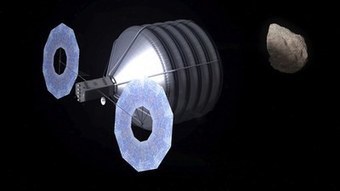
A NASA concept for a robotic spacecraft that would capture a small near Earth asteroid and direct it towards the Moon. (credit: NASA)

 Your new post is loading...
 Your new post is loading...
Your new post is loading...
 Scoop.it!
A NASA concept for a robotic spacecraft that would capture a small near Earth asteroid and direct it towards the Moon. (credit: NASA) 
No comment yet.
Sign up to comment
Scoop.it!
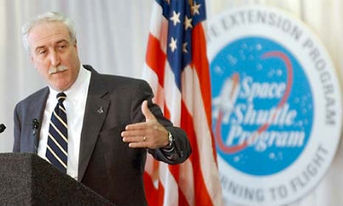
NASA’s irrational approach to risk undermines its mission and costs thousands of lives.
By Robert Zubrin, president of the Mars Society from the February 2012 issue Via Vincent Lieser
Guillaume Decugis's insight:
This is a great article that I discovered thanks to a comment by Vincent Lieser. However precious astronauts' lives are, they can not be assigned an inifinte cost without being heavily detrimental to other budget allocations that can save lives on earth and, more importantly, to the very mission of space exploration. Great read.
Scoop.it!

The commercial SpaceX rocket venture has launched Dragon cargo capsules to the International Space Station three times in the past year, and every time there's been a problem. Should NASA be upset?
Not really.
The fact that glitches have cropped up — and have been solved, with no impact on the multimillion-dollar cargo resupply missions — isn't a black mark against the California-based company. Rather, it's a sign that the designs for SpaceX's Dragon capsule and Falcon 9 are resilient in the face of the inevitable glitches associated with spaceflight. It's also a sign of things to come.
Via Stratocumulus
Guillaume Decugis's insight:
Interesting take on how to design future spacecrafts. Not for perfection but for robustness in order to make space flights both more reliable and affordable.

Vincent Lieser's comment,
March 6, 2013 3:25 PM
"Transplanted" to human spaceflight, that reminds me of Zubrin's take on the price of an astronaut's life : http://reason.com/archives/2012/01/26/how-much-is-an-astronauts-life-worth
Vincent Lieser's curator insight,
March 6, 2013 3:25 PM
"Transplanted" to human spaceflight, that reminds me of Zubrin's take on the price of an astronaut's life : http://reason.com/archives/2012/01/26/how-much-is-an-astronauts-life-worth
Scoop.it!

Planetary exploration is stuck in a Martian rut
Guillaume Decugis's insight:
Maybe. But is that bad? NASA was moon-obsessed in the 60's and achieved something great.
Scoop.it!

"New nonprofit foundation to move U.S. farther and faster toward its destiny as world leader in technical innovation, science, exploration and discovery" Via Vincent Lieser
Guillaume Decugis's insight:
This is a follow up to the rumour I published a few days ago and a confirmation that space traveler billionaire Denis Tito seems serious in considering a free return, low cost fly-by of the red planet five years from now. Any doubt that the private sector is now a serious contender in the space race? Read this.
Scoop.it!

Chromoscope shows you the view of the Universe that we get from Earth. The view is mostly dominated by our galaxy - The Milky Way - which is the band running horizontally across the middle. Via Dr. Stefan Gruenwald
Guillaume Decugis's insight:
Pretty cool way to play with zooming options and visible/non-visible light.
Scoop.it!

It may still be a few years away from practical use, but scientists have created a real tractor beam, like the ones featured in the "Star Trek" TV series and movies.
Guillaume Decugis's insight:
Sensational headline from the Huf Post but nevertheless a pretty cool discovery for particle physics.
Scoop.it!
Guillaume Decugis's insight:
Raisin bread, Einstein and the speed of light: a great explanation on the difference between motion and expansion.
Scoop.it!

Planet KOI 172.02 has yet to be confirmed, but it could potentially have water and life.
Guillaume Decugis's insight:
Earth 2.0?
Scoop.it!

A 2.1-billion year-old lump of rock that fell to Earth in Morocco is a new type of Martian meteorite, say scientists.
Guillaume Decugis's insight:
Crazy story of that rock that was blasted out of Mars by a meteor impact and fell back on earth after millions of years in the cosmos to reveal fascinating secrets on the presence of water on Mars.
Scoop.it!

A neutron star near the center of our galaxy erupted with hundreds of X-ray bursts that were powered by a barrage of thermonuclear explosions on the star's surface.
Guillaume Decugis's insight:
Interesting discoveries reported by NASA on neutron stars. What's amazing for me to (re)discover is how dense neutron stars are. The image shows how a neutron star compares to Manhattan and Brooklyn in NYC. Yet, it's mass is 500,000 that of the earth...

ThunderboltsProject's comment,
February 19, 2013 8:13 AM
There are no neutron stars: http://www.thunderbolts.info/wp/2013/01/14/electromagnetic-monsters/
Scoop.it!

A few months ago, physicist Harold White stunned the aeronautics world when he announced that he and his team at NASA had begun work on the development of a faster-than-light warp drive.
Guillaume Decugis's insight:
Follow up on that fascinating story. Too good to be true?

Szabolcs Kósa's curator insight,
November 28, 2012 5:27 PM
A still more glorious dawn awaits. Not a sunrise, but a galaxy rise. A morning filled with 400 billion suns. The rising of the milky way..." - Carl Sagan
Scoop.it!

"Gliese 581 g shot to the top of a list put out by researchers at the University of Puerto Rico at Arecibo’s Planetary Habitability Laboratory (PHL) after a new study marshaled support for its long-debated existence."
I started publishing news on the first exoplanets when I started this topic and there's been confusing news as research progresses and various theories are being debated. This is an interesting recap of the current status of these controversies and assumptions by Scientific American.
|
Scoop.it!

By Rob CoppingerSpace.com LONDON — A nonprofit organization that aims to land four astronauts on Mars in 2023 will kick off its two-year, televised search for Red Planet explorers this summer.
Guillaume Decugis's insight:
If it sounds crazy then maybe it is. But then again who said Columbus was sane?
Scoop.it!

The oldest known star appears to be older than the universe itself, but a new study is helping to clear up this seeming paradox.
Guillaume Decugis's insight:
Interesting paradox.
Scoop.it!
Guillaume Decugis's insight:
Good question...
Vincent Lieser's curator insight,
March 6, 2013 3:30 PM
Neil DeGrasse Tyson gives you the answer, before he slaps you in the face in an astounding video.
Scoop.it!
Liftoff of Falcon 9 and Dragon from Launch Complex 40 in Cape Canaveral, Fl. March 1, 2013.
Guillaume Decugis's insight:
Dragon made history last year by becoming the first private vehicle to dock the ISS and carry cargo back to earth.This is a video of its last launch - also bound to the ISS which it safely docked this morning.I hadn't realized yet how great the videos were from this launch thanks to the onboard cameras. This one gives you the full picture of the first ten minutes up until orbit.
Scoop.it!
Dennis Tito's nonprofit organization may want to launch astronauts toward the Red Planet in 2018.
Guillaume Decugis's insight:
Plan would not be to land but do just a round trip. Still doesn't it sound crazy (and awesom!) that private money could beat governments in the space race?
Scoop.it!

Traces of water have been detected within the crystalline structure of mineral samples from the lunar highland upper crust obtained during the Apollo missions, according to a University of Michigan researcher and his colleagues.
Guillaume Decugis's insight:
This puts the theory of the moon formation from a debris of the earth in question.
Scoop.it!

From
io9

It's one of the most iconic images in all of science fiction: the stretching of stars as a ship makes the jump to lightspeed. But as a group of physics students at the University of Leicester has revealed, it wouldn't actually look like this.
Guillaume Decugis's insight:
Blame the Doppler effect...
Scoop.it!
Brilliant answer from the US Geek in Chief on why we can't have a Death Star in spite of the petition. Awesome.
Scoop.it!

An analysis of planet candidates suggests at least one in six stars in the night sky hosts an Earth-sized planet - 17 billion in total.
Guillaume Decugis's insight:
This is based on extrapolating the results from obeserving 150,000 stars. There are some caveats to the study but the exciting news is that we don't seem to be falling short of earth-like planets.

Puneet Gupta's curator insight,
January 9, 2013 4:36 AM
This is based on extrapolating the results from obeserving 150,000 stars. There are some caveats to the study but the exciting news is that we don't seem to be falling short of earth-like planets.
Scoop.it!

Our universe may be one of many, according to numerous physics theories.
Guillaume Decugis's insight:
A good high-level recap of all the different theories behind the multiple universes concept (yes there are also multiple theories of multiple universes: isn't that meta?).

Ana Correia's curator insight,
December 23, 2012 10:39 AM
The universe we live in may not be the only one out there. In fact, our universe could be just one of an infinite number of universes making up a "multiverse."
Scoop.it!

You know the only thing lonelier than Sgt. Pepper's Hearts Club Band, and the Heartbreak Hotel, and the number one? Being alone and also not on Earth.
Guillaume Decugis's insight:
Interesting experiment to see whether a robot can actually relieved the stress of being alone inSpace just like anothehuman an companion would. Hopefully this robot isn't called HAL...
Scoop.it!

A new super-Earth planet that may have an Earth-like climate and be just right to support life has been discovered around a nearby star by an international team of astronomers.
Only 42 years away...
|







Amazingly enough, some say it's a plausible scenario that would cost "just" $2.6 Billion and could help missions to Mars.