Design thinking doesn't just apply to creating memorable products, services or experiences; it can also help you land a job you love. ..
I spoke with them recently about what advice they’d give to the thousands of applicants whose resumes we’re privileged to receive each year.
Here’s what they had to say about getting hired by design:
Be empathic. There are real people reviewing each resume and fielding calls from eager candidates.
Being proactive is good, but being pushy or aggressive can hurt your chances. Be as polite, professional, and respectful to the front-line HR person as you would be to a future boss.
At the Vista Innovation & Design Academy (VIDA), we utilize the highly renowned "Design Thinking" process as the base of our design & problem solving curriculum.
Dr. Eric Chagala, Founding Principal of Vista Innovation and Design Academy, discusses Design Thinking.
There’s been a lot of talk this year about empathy and the customer experience; Bruce Temkin even advocates for making 2014 the Year of Empathy.
What’s empathy?
Merriam-Webster defines empathy as: the feeling that you understand and share another person’s experiences and emotions; the ability to share someone else’s feelings.
We’re not so far apart. I advocated for making 2014 the Year of the Journey Map. To me, the two go hand in hand; after all, journey maps are created by walking in your customer’s shoes. (That alone is the fundamental underlying premise for journey mapping.) And empathy is all about understanding and sharing the needs and feelings of others.
This is a basic tenet of good design, but lately “empathy” has started to feel like more of a buzzword (sorry, Jeffrey). All buzzwords start with good ideas, though. And empathy is at the heart of what we do as “makers” (another word that makes me cringe, but feels correct here).'
I started thinking around this topic after An Event Apart Seattle, where several speakers touched on empathy from different angles. I wanted to add my voice to the conversation, and hopefully put some clarity around what empathy should mean to all of us, no matter our role, in the creation of products and services.
Suppose you are part of a thriving business and need to branch out and find that next big thing. Or say you want to change a behavior, like getting people...a lot of people...to use less energy in their homes. How would you go about it?
Design thinking is a powerful tool to tackle the unknown.
It’s a means of going on an expedition, without a map, without even knowing the destination, but with the confidence that you’ll end up somewhere great.
The Patient Experience: Empathy + Innovation Summit brings together patient experience leaders, healthcare CEOs, nursing leaders, policy makers and major stakeholders for presentations, debate and candid discussion of key issues that drive patient experience.
Attendees will hear how they strive to
deliver the best clinical, physical
and emotional experience
to patients and families...
Since the first Patient Experience: Empathy + Innovation Summit in 2010, more than 2,400 healthcare leaders from 45 states, 37 countries and 730 healthcare organizations have attended.
The ability to empathise is a crucial skill that web designers, writers and managers require. But, empathy needs more than an intellectual understanding.
If you spend anytime at all reading the plethora of articles on designing or running websites, it won’t take you long to encounter the word empathy.
The user centric movement obsesses (rightfully so) about understanding users. We create personas, customer journeys and empathy maps. We run focus groups, user test sessions and emotional response tests.
Sim Van der Ryn has been a teacher, writer, researcher, and practitioner of design for forty years. A leading authority on ecologically sustainable architecture and design, he is Emeritus Professor of Architecture at the University of California, Berkeley, where he has taught since 1961.
Sim is author of numerous books including his most recent, Design for an Empathic World: Reconnecting People, Nature, and Self. "He advocates for “empathic design”, in which a designer not only works in concert with nature, but with an understanding of and empathy for the end user and for ones self. It is not just one of these connections, but all three that are necessary to design for a future that is more humane, equitable, and resilient."
"In Design for an Empathic World, Sim Van Der Ryn weaves the architecture of empathy for self, others and nature into a vibrant, compassionate whole. Brimming with gratitude, Van Der Ryn tells stories from his life as an architect, teacher and thought leader.
In this short talk, Seung Chan Lim (Slim) shares two stories from a research he conducted at both the Rhode Island School of Design and Brown University on what it means to "make something," how it works as a creative process, and why it matters to our lives.
The stories illustrate how humility & courage help the artist develop their empathy in relation to the "others" they interact with in the creative process.
Empathy is your tool for understanding how people think and feel. Schooling your thoughts to think and feel the way someone else does is a powerful way to do a lot of things, including design and guiding the direction of your work.
Conventional design methods begin with a solution already sketched out, then spend time, effort, and money trying to get this idea to be successful. Empathy looks at the background reasoning that motivates a person to do something. Using empathy you can see a broader landscape of possible solutions and opportunities for your organization.
====================
Using empathy you can see a broader
landscape of possible solutions
and opportunities for
your organization.
=========
Free yourself from existing solutions and current constraints.Clarify who you are solving the problems for.Simplify your way of looking at difficult problems.Decide with confidence what to create so that it will support what people intend to do.
Dave McColgin works at Artefact Group, which is a technology product design company. He wrote an article and white paper on, "Why you should invest in empathy."
A major step in the product design process is to empathize with the users needs in relation to designing any product. In this interview Dave walked me, step by step, through his article.
The 'Empathy: Design tool and outcome' whitepaper. "describes additional background on the concept of empathy and answers design-related questions like:
How can decision makers get a better intuitive sense of their customers to complement the faceless data?
What are some creative ways that working teams can get a deeper sense of walking in their customers' shoes?
How can you recognize when there is an opportunity to increase empathy among customers?
How does technology act against empathy today and what can we do about it?
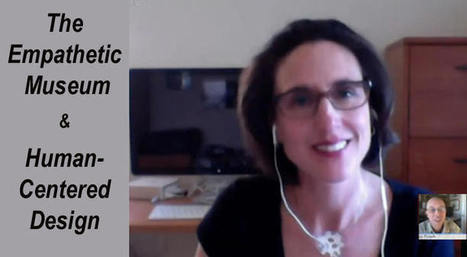
Dana Mitroff Silvers is a web strategy and implementation consultant and workshop facilitator with experience launching digital products in museums, nonprofits, and educational organizations.
A theme in her current work is how mission-driven organizations can integrate principles of human-centered design into their practice.
She writes, "One of the core principles of design thinking is its focus on human values at every stage of the process. And empathy for the people for whom you’re designing is fundamental to this process... There have been several recent discussions about empathy in museum practice, ranging from Regan Forrest’s writings about empathy in the context of interpretation on the Interactivate blog to Gretchen Jenning’s write-up about The Empathetic Museum at AAM to Suse Cairns’s post on the Museum Geek blog, On the paradoxes of empathy.
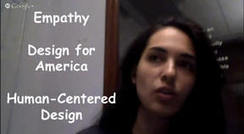
Julian Bongiorno is a Fellow at Design for America. Graduating from Columbia in 2013, Julian comes to DFA with a degree in Mechanical Engineering and an explosive passion for innovation. As a DFA Fellow, Julian hopes to unite the various studios by inspiring and producing life-changing projects that improve communities.
In this interview Julian shared his personal experience and insights into the nature of empathy as related to Human-Centered Design. We also talked about his personal needs for empathy. Julian shared his story of how he became interested in Human-Centered Design.
He wants to have a deeper and ongoing empathic connection with people he is designing for. Being a designer is not just a 9 to 5 kind of a job, but is an empathic way of being in the world.
EMPOWER EMPATHY was created by Emily Pinna in 2014. Inspired by refugee children recently arrived in Baltimore who experienced bullying at school, she is determined to make change happen by promoting empathy and understanding between children.
It was a very grim day, when I began to notice the profound lack of empathy in education, particularly in public education...
Design thinking captured my attention because empathy is one of the modes of the process. In this student-driven, human-centered, multi-disciplinary problem solving approach, empathy is not only a mode, but the essence of the process.
Simply going through the steps of design thinking serves as a practice for cultivating empathy. ....
Analytical thinking is great. It’s the way you learned to be step-by-step—to collect data, analyze it and come up with a conclusion, like you did in science class. It is really useful, and I hope people keep doing it. It's very important.
Design thinking is more experimental
and less step-by-step.
It's fuzzier.
It's intuitive.
It's empathic.
We often say that it’s integrative thinking, where you put together ideas from different sources—it’s synthesis. This is a way of thinking that is not quite so linear, but you can build confidence in it if you do it over and over again....
- But the basic premise of design thinking revolves around empathy, being understanding of what other people want, and how the world is put together from a social and emotional point of view...
- They can make something that is not project-based a little bit project-based by bringing in our focus on empathy for other people for instance, or making it real in some way. If you have no choice but to do the curriculum that is outlined, you have to figure out a way to get some of these concepts—empathy, prototyping, synthesis—included...
Papa & Yo creator Vander Caballero gave an impassioned hour-long presentation during the Game Narrative Summit at GDC 2014 earlier this year about the state of empathy games -- titles like Gone Home, That Dragon, Cancer, Beyond: Two Soulsand Papa & Yo that are designed explicitly to challenge the player on an emotional level.
One Grade 7 assignment I have done the past few years is a trial set during the Industrial Revolution, where students must answer the question: Should children be allowed to work in factories?
What role does empathy play in the every day lives of a doctor, an actor, and a designer?
These three disciplines will be explored to better understand the concept and how each person applies it in their respective fields. Using empathy as common ground, Experiencing Empathy seeks to shed light on the importance of medicine, acting and design both learning from and benefiting one another
=============================
Experiencing Empathy seeks to shed light on the importance of medicine, acting and design ===========
There is a long tradition of developing empathy through direct experience of other people’s lives. Much of it has been aimed at understanding the lives of those living in poverty.
In the late 1920s George Orwell dressed up as a tramp and wandered the streets of East London with vagabonds and beggars, a period of his life described in his book Down and Out in Paris and London. More recently, the British journalist Polly Toynbee wrote about her time trying out a variety of minimum wage jobs (Hard Work: Life in Low-Pay Britain), a path also followed by the American social commentator Barbara Ehrenreich (Nickle and Dimed: On (Not) Getting By inAmerica). These examples are well known.
So I would like to tell you about one of
the most extraordinary forgotten instances
of experiential empathetic adventuring.
It happened exactly forty years ago.
In the mid 1970s Patricia Moore, aged twenty-six, was working as an industrial designer at ...
Seung Chan Lim, better known as Slim, is the director for project Realizing Empathy.
Realizing Empathy is a project that asks what it means to make something, how it works as a process, and why it matters to our lives. It explores these questions across disciplines such as fine arts, performing arts, design, science, and engineering.
He says, "As a designer, I must find ways to harness the most complex of technologies into an experience that is not only pleasant, but also empowering and meaningful. As an engineer, I must make sure that I can not only talk the above talk, but also walk the above walk. As a strategist, I must make sure that the talk is not only talked, but heard, and the walk is not only walked, but seen....
What I have learned from this experience is that making things is analogous to engaging in an empathic conversation with another person."
Patrick Quattlebaum is Managing Director of Adaptive Path, an experience strategy and design company. Patrick is also an in demand consultant who helps organizations envision, architect, and manifest new product and service experiences. He’s a passionate strategist, designer, humanist, storyteller, facilitator, and teacher.
In this dialog we discussed his article and explored ways to increase and practice our personal empathy skills.Patrick writes, "We, the design community, talk (and write and speak) a lot about empathy. We lament the empathy deficit in our companies and clients and cry "something must be done about this."
We tout personas, empathy maps, experience maps, and other methods as empathy deficit reducers that lead to better experiences (and profits). Some, at the extremes, position human-centered designers as Platonic figures releasing stakeholders from the shadows of opinion and faceless analytics into the reality of human emotions, needs, and desires.
We talk a lot about other people's empathy. But what about your own? What about mine? "
Indi Young is a user experience consultant, author, founding partner at Adaptive Path.
"My book about empathy and generating better
services and products for the people you
support via mental model diagrams is
gaining more and more attention."
I'm happy to teach a workshop for your organization or help your team through the method... Empathy is your tool for understanding how people think and feel. Schooling your thoughts to think and feel the way someone else does is a powerful way to do a lot of things, including design and guiding the direction of your work."
"Giselle recently graduated from Cornell University where she majored in Psychology. As a pre-med, Giselle spent every summer volunteering around the world where she learnt the importance of intercultural and interdisciplinary work, something she now strives to apply in every facet of her life.
Excited to make an impact in cities at home and abroad, Giselle hopes to use her work as a Design for America fellow to help other students find the same passion and excitement for human-centered design that has fueled and informed her projects for the last four years." Sub Conference: Human-Centered Design
Rob Calvey is a Post-Baccalaureate Fellow at Design for America. In this interview we talked about Empathy, Human Centered Design and Design For America. Rob is working on a process manual for Design For America and is writing about empathy.
Edwin also interviewed Rob about his personal needs for empathy in the design process.
To get content containing either thought or leadership enter:
To get content containing both thought and leadership enter:
To get content containing the expression thought leadership enter:
You can enter several keywords and you can refine them whenever you want. Our suggestion engine uses more signals but entering a few keywords here will rapidly give you great content to curate.


 Your new post is loading...