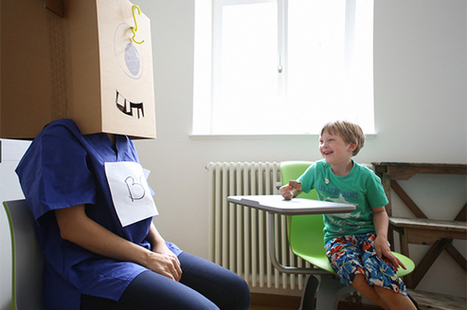
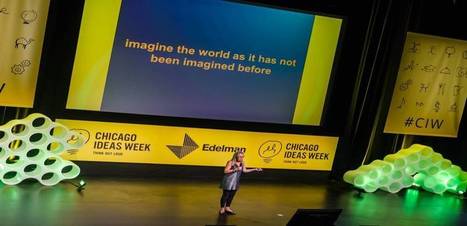
Not long ago I was invited to the first Aging 2.0 event in Berlin, to speak about design thinking and our experiences in gaining empathy for older people at the HPI School of Design Thinking.
Here’s an edited version of what I said – essentially 2 easy lessons to keep in mind when designing solutions for older people. You can also check this beautiful visualisation of my talk by Giovanni Ruello.
An IDEO researcher practicing "creative listening."What would an Argentinian car mechanic know about childbirth? If you’re Jorge Odon, father of five, quite a bit. Or at least enough to design a low...
By practicing “creative listening,” he was able to step out of his expertise and identify value in an idea that came from a complete outsider, with the intention of building on it and making it better.
This same skill is key to good improv theater: actors listen to the words of the previous actor and, despite never having heard them before, build on them to continue the narrative. Improvisers call it the “Yes, and” rule. ...
=============================
By practicing “creative listening,” he was able to step out of his expertise and identify value in an idea that came from a complete outsider,
For many in the innovation field, the hardest task is listening – real listening, deep listening. To listen without building a mental model or rushing to a conclusion is a cultivated skill.
To listen to a person’s summary of your product or service and honor their experience as the only experience that matters is not only a great courtesy, but it can be a competitive advantage; that is, if you are willing to collect feedback from a lot of customers and apply adaptive intelligence.
Social is design, as we have seen, is all about people: with and for people. In order to come closer to understanding the complexity of problems, feelings, habit, needs and opportunities, designer...
Empathic design, co-design, participatory design are some of the terms used to indicate a work done with people involving them directly in the design process. These methods allow the creation of empathy between designer and user and the discovery of design opportunities. Many of them are taken from Ethnography and some were (and are ) practiced in Architecture.
This is the presentation I gave at UX Brighton (2013). Behind every screen sits a user, waiting to be engaged. Whether you reach them or not will depend on how
In realm of design, design-thinking is rooted in empathy, where you try to see from the perspective of a user of a given design or product. There is a lot more to design thinking than that, but in a nutshell it is about human centered design where empathy is king.
Empathy in Human Services
In the social services field I’ve been striving to lead new thinking in, there is also a focus on empathy when designing quality support services. For example, in the old days of social services, an institution or bunch of “experts” would often end up designing irrelevant services because the service model was not based on what the client needed and wanted but on what the system needed. In other words, there was a lack of empathy for the individual needs and wishes of the client.
The powerhouse brother team, David Kelley and Tom Kelley, is coming out with a new book this month. Creative Confidence: Unleashing the Creative Potential Within us All...
The notion of empathy and human-centeredness is still not widely practiced in many corporations. Business people rarely navigate their own websites or watch how people use their products in a real-world setting. And if you do a word association with “business person,” the word “empathy” doesn’t come up much.
======================
What do we mean by empathy in terms of
creativity and innovation?
=========
What do we mean by empathy in terms of creativity and innovation? For us, it’s the ability to see an experience through another person’s eyes, to recognize why people do what they do. It’s when you go into the field and watch people interact with products and services in real time—what we sometimes refer to as “design research.” Gaining empathy can take some time and resourcefulness.
From Object Gallery in Sydney, and a lively conversation in tandem with the exhibition CUSP: Designing into the Next Decade.
The topic of the panel is The Heart of It, and it asks if design can humanise medical technologies? How to show empathy with patients through design; and how to remove or greatly reduce stigma that can often be attached to medical technologies.
Quality-management programs can’t give you the kind of empathetic connection to consumers that increasingly is the key to opening up new business opportunities. All the B-school-educated managers you hire won’t automatically get you the outside-the-box thinking you need to build new brands — or create new experiences for old brands. The truth is we’re moving from a knowledge economy that was dominated by technology into an experience economy controlled by consumers and the corporations who empathize with them....
======================
Understanding, empathy, problem-solving —
these are the heuristic managerial skills
needed today, argues Martin,
who advises Procter & Gamble ..
========
Daniel Pink argues that left-brain linear, analytical, and computer-like thinking are being replaced by right-brain empathy, inventiveness, and understanding as skills most needed by business...
A manager plans team-building activities to increase a team's effectiveness. If team members develop better listening skills, such as empathy, they can become more attuned to group needs.
They can communicate more often in response to this emotional information. Showing concern for a speaker's needs makes the speaker feel that he is being heard.
Play a Listening Game
Team-building activities promote good listening. A manager can vary Dr. Carl Rogers' listening game by assigning employees to choose a partner and try this activity. The first partner speaks honestly for 30 seconds while the other partner listens.
The second partner must restate what his partner said. This process continues until the second partner can restate the first speaker's main point and the first speaker is satisfied. Then the partners switch roles and play the game again.
====================
Play a Listening Game
Team-building activities promote good listening.
A manager can vary Dr. Carl Rogers' listening game
by assigning employees to choose
a partner and try this activity.
==========
Teach Empathy's Relationship to Customer Service ...
“Journalists naturally need to be empathetic,” Leticia Britos Cavagnaro told Poynter via Skype. Britos Cavagnaro, adjunct faculty at Stanford School of Engineering’s Technology Ventures Program and associate director of National Center for Engineering Pathways to Innovation (Epicenter), co-teaches the d.school’s creativity and innovation class with Tina Seelig.
Most people come to a “story with an idea, a perspective or a hypothesis,” she said; being empathetic means having the “ability to talk to someone and really let go of those preconceptions.”
The goal of empathy is to gain insight or “put myself in the shoes of the other person or the many different stakeholders,” Britos Cavagnaro said.
Use empathy by asking open-ended questions and actively listening to uncover people’s needs and motivations.
The ability to see the world through the eyes of others can help companies develop new products
Empathy is the ability to see the world through someone else’s eyes. It’s far more than just being a nice person. If properly developed, empathy can give you and your company a distinct competitive edge. Negotiating a contract, dealing with workplace conflicts, coming up with a marketing campaign, or dreaming up the next must-have consumer gadget all require the ability to see the world through eyes that aren’t your own.
Sadly, managers and human resource departments too often neglect the interpersonal skills that are so essential to achieving results.
Perhaps you can’t teach it but you maybe can inspire it. Empathy requires putting oneself in a position to understand another person’s experiences and ultimately their needs, and in any classroom that is no simple lesson to learn—but it is exactly what Interior Architecture Professor Sarah Sherman is attempting to do in her Graduate 5 Healthcare Studio.
“In order to design a healthcare facility a student must deeply understand the users of the space,” Professor Sherman explains. She emphasizes that the design of healthcare facilities provides a unique opportunity to affect people at a critical point in their life.
This summer I completed my first “MOOC” (Massive Open Online Course) through Stanford University's “Design Thinking Action Lab." The course description caught my interest: “Stanford d.school lecturer and Epicenter Associate Director Leticia Britos Cavagnaro and her team will take you on a journey to learn the Design Thinking process.
This methodology for human-centered creative problem solving is used by companies and organizations to drive a culture of innovation. The Design Thinking Action Lab will provide the inspiration, tools and support you need to discover the joy of learning by doing as you tackle an innovation challenge in the real world.” My sincere gratitude goes to Dr. Cavagnaro for an excellent and dynamic MOOC experience!
Empathy, not technology, is the mother of innovation: that was the surprising lesson learnt by a group of MBA students and entrepreneurs at a workshop led by IDEO and Google Labs at Silicon Valley
Very true: Innovation happens at the intersection of feasibility (what technology can achieve), viability (what makes business sense), and people (understanding the human experience).
Tom and David Kelley of the award-winning Palo Alto-based global design firm IDEO have been helping private and public sector organizations innovate, grow and bring to market new ideas for 35 years...
The notion of empathy and human-centeredness is still not widely practiced in many corporations.
Business people rarely navigate their own websites or watch how people use their products in a real-world setting.
And if you do a word association with “business person,” the word “empathy” doesn't come up much.
What do we mean by empathy in terms of creativity and innovation? For us, it’s the ability to see an experience through another person’s eyes, to recognize why people do what they do. It’s when you go into the field and watch people interact with products and services in real time—what we sometimes refer to as “design research.” Gaining empathy can take some time and resourcefulness. But there is nothing like observing the person you’re creating something for to spark new insights.
And when you specifically set out to empathize with your end user, you get your own ego out of the way.
We’ve found that figuring out what other people actually need is what leads to the most significant innovations. In other words, empathy is a gateway to better and sometimes surprising insights that can help distinguish your idea or approach.
Learn how to apply foundational design-thinking techniques to a current project through case study, instruction, and real-time working activities.
In this free webinar, you will learn how design-thinking techniques can improve your work. The session will combine a case study, instruction, and real-time working activities to advance an active project in your work and/or life.
Stanford d.School instructors, Perry Klebahn and Jeremy Utley, are infamous for getting professionals and executives to step out of their comfort zone and take action. Their instruction has led to tide changes in thinking and approaching the development of new products and services. Join them for an hour to get a taste of their approach and what design thinking could offer you and your project.
The ability to empathise is recognised as a crucial soft skill that web designers, writers and managers require. However, empathy needs more than an intellectual understanding.
If you spend anytime at all reading the plethora of articles on designing or running websites, it won’t take you long to encounter the word empathy.
The user centric movement obsesses (rightfully so) about understanding users. We create personas, customer journeys and empathy maps. We run focus groups, user test sessions and emotional response tests.
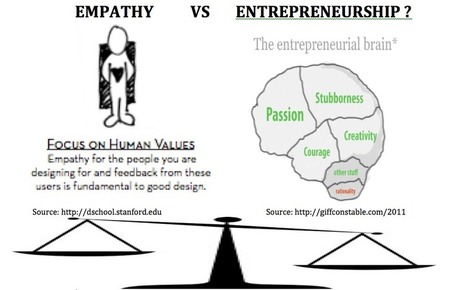
While social entrepreneurs like Ashoka’s Bill Drayton or Oxford Business School’s Pamela Hartigan are quite right that you cannot be truly profitable if you are not wired for empathy, this does not mean that it’s not hard. It’s not just technology and social media that’s to blame. Based on my own experience, there is something that happens from that “road to Damascus moment” (essential to the foundational tales of many social entrepreneurs from Jacqueline Novogratz’s moment of finding a boy in Africa wearing her old blue sweater to John Woods discovering the need for libraries in the Himalayas) in which a stubborn, passionate person is confronted with the immediate and direct experience of an obstacle that they are determined to remove, come hell or high water.
================
you cannot be truly profitable if
you are not wired for empathy,
========
But now as people strive to create the most social change and demonstrate the data of their impact, does something still get lost? One of our queen word smiths, Monika Smyczek, asked over a late-night “Launchathon” (our own version of hackathons where we dissected and championed one another’s businesses) the key question that anyone must ask as they try to retain empathy in the DNA of an organization: “How do you scale Gandhi?”
We, the design community, talk (and write and speak) a lot about empathy. We lament the empathy deficit in our companies and clients and cry "something must be done about this."
We tout personas, empathy maps, experience maps, and other methods as empathy deficit reducers that lead to better experiences (and profits). Some, at the extremes, position human-centered designers as Platonic figures releasing stakeholders from the shadows of opinion and faceless analytics into the reality of human emotions, needs, and desires.
=====================
We tout personas, empathy maps, experience maps, and other methods
as empathy deficit reducers that lead
to better experiences (and profits).
==========
We talk a lot about other people's empathy. But what about your own? What about mine?
Stories are a natural part of user experience. They help create connections between a design team and the people who will use the product. You've probably been telling stories all along - but haven't thought about how to use them effectively as part of your UX practice
This is the second post in a 6-part series from Ziba's Industrial Design Director, Paul Backett, on rethinking design education. Read the Introduction to the series,Teach Less, Integrate More here.
Great designers are great empathizers. It's what separates a design that has soul from one that's simply well-realized. In my experience as a design director and as a teacher, it's become painfully clear that the ability to connect with users is something design students must learn, as crucially as they need sketching and CAD.
Unfortunately, the most common student design project has students designing with themselves as the target user. Research becomes a box to be ticked, and certainly never integrated into the design process.
The real world, though, is full of unfamiliar design targets, and schools have a responsibility to teach the difficult skill of taking on their perspectives.
What students need to learn is not just empathy, but extreme empathy—the flexibility to inhabit the mind of someone dramatically unlike themselves.
To get content containing either thought or leadership enter:
To get content containing both thought and leadership enter:
To get content containing the expression thought leadership enter:
You can enter several keywords and you can refine them whenever you want. Our suggestion engine uses more signals but entering a few keywords here will rapidly give you great content to curate.


 Your new post is loading...