The ability to see the world through the eyes of others can help companies develop new products
Empathy is the ability to see the world through someone else’s eyes. It’s far more than just being a nice person. If properly developed, empathy can give you and your company a distinct competitive edge. Negotiating a contract, dealing with workplace conflicts, coming up with a marketing campaign, or dreaming up the next must-have consumer gadget all require the ability to see the world through eyes that aren’t your own.
Sadly, managers and human resource departments too often neglect the interpersonal skills that are so essential to achieving results.
Snowboarding giant Burton is able to innovate without focus groups because it couldn't possibly do otherwise. When every person on your team is steeped in sports and the outdoors, solving design problems becomes very personal. One of Ziba's creative directors worked for several years as a designer at Burton.
He recalls how one day a senior designer walked in with a photo of a snowboarder's calf, covered in bruises from a long day on the slopes. "Fix this!" he demanded, and both of them immediately knew that this was a problem worth solving
. They began to look for a solution. Empathy with the user is a powerful tool for innovation. It gives you insight into the problem, but even more important, it makes you care about the outcome.
The importance of developing deep connections with the people you serve.
A few years ago, my publisher asked me to write a book about innovation. They’d read some of the articles I’ve written on the subject over the years, and they wanted more. And although I was flattered, I had to tell them no. The world didn’t need another book on innovation — there are too many as it is. I instead made them a counter-offer: Maybe what the world needed was a book about empathy.
===========
Maybe what the world needed was
a book about empathy.
=====
At Jump Associates, my colleagues and I have had the chance to collaborate with some of the world’s most amazing companies. And if there’s one thing that we’ve learned in all that time, it’s that companies prosper when they’re able to create widespread empathy for the world around them.
That’s why I ended up writing Wired to Care, which shows how great companies around the world, from Nike to IBM, benefit from building a culture of widespread empathy for the people they serve.
Q: What activities can we practice in order to get better at empathy?—from a UXmatters reader
Jordan has a unique perspective on empathy. “I grew up with Asperger’s Syndrome, which, in my case, led to many awkward situations. I had speech impediments and ticks and didn’t understand why people did the things they did. Simple interactions with groups were extremely stressful.
Over the years, I’ve gotten help through speech therapy and psychoanalysis, but I still have trouble understanding people. When I was young, there were dozens of tricks I used to help develop my sense of empathy. The overarching strategy for me was to develop an interest in what motivates others and, especially, what motivates their responses.
The most effective techniques I used to develop empathy were and still are as follows:
drama—
music—
talking aloud—
curiosity and asking questions—
==========================
“Develop an interest in what motivates others and, especially, what motivates their responses.”
Surveys reveal 80 percent of companies believe they deliver superior customer experience, yet only 8 percent of their customers agree.
If you take someone out for a romantic dinner, do you wear a grungy outfit or ignore your date at the restaurant? Not if you want the relationship to continue. Yet, many corporations expend tremendous resources wooing new customers without a clear understanding of what it takes to create and sustain a positive customer experience.
To create a great customer experience—one that encourages brand loyalty and advocacy—it’s essential to have a deep understanding of experiences that trigger the emotions and motivations that drive your customer’s brand preference and behavior.
Practice empathy and improve your work and home life.
You may find this hard to believe, but I’ve never once in my life met a person whose goal it was to purposefully create a terrible user experience. Granted, that may have been the occasional outcome of some efforts, but I’m positive that was not the intention.
What these people may have been unintentionally leaving out was empathy. And ditching personal empathy is something that anyone who works with more than one person on a design project is susceptible to.
So how do you practice empathy? It’s really pretty simple. Put down your phone, your tablet, step away from your high-tech gadgets and go talk to people.
"The problem is it’s easy not to be empathetic with people. It’s easy to be self-centered and focused on the end goal rather than the end user. It takes a lot less mental and emotional effort to look at a deadline and just churn out work so you can hit it."
Design Thinking is a human-centered, prototype-driven process for innovation. In this half-day workshop, participants experienced firsthand the complete Design Thinking cycle through a hands-on, highly interactive session.
We’ve all heard the rallying cry for user-centered design, but even those of us who ascribe to that ideal often fall back on our own biases and instincts when it comes to making decisions about how people experience our content and our services.
Sadly, this often means we make decisions we think will be good for our "users"—that anonymous, faceless crowd—rather than actually trying to understand the perspectives, surroundings, capabilities, and disadvantages of the actual people who we are here to serve.
Every decision we make affects the way real people experience our products. We’ve all heard the rallying cry for user-centered design, but even those of us who ascribe to that ideal often fall back on our own biases and instincts when it comes to making decisions about how people experience our content and our services.
Sadly, this often means we make decisions we think will be good for our "users"—that anonymous, faceless crowd—rather than actually trying to understand the perspectives, surroundings, capabilities, and disadvantages of the actual people who we are here to serve.
In this session, Aaron Gustafson will explore why empathy is a good thing, how empathy empowers creativity, and how we, as a community, can inject more empathy into our work.
Let’s face it, 1000 might look like a long list but spare a thought for gazillions of brands that never made it onto the radar. So what’s the difference between the elite few here and the vast majority of also-rans? Empathy.
These 1000 brands understand people, they’re relevant and meaningful and they have a role to play in the real world. In the absence of those connections no amount of conspicuous creativity is going to help.
In this article Pete Smart shares what he's learned from travelling 2517 miles to try to solve 50 problems in 50 days using design.
Empathetic understanding is a vital tool in fostering innovation. If we can better understand the people we are designing for, the better our decisions, designs and results will be. Travelling 2517 miles taught me that if we wish to innovate, we must go beyond analyzing people’s experiences and try and make them our own.
Understanding people better often requires us to get outside and get our hands dirty but, in doing so, allows us to better analyze and solve. In thewords of Diego Rodriguez, partner at IDEO:
“In doing, there is knowing. Doing is the resolution of knowing.”
More and more academics, design professionals and business executives are talking about the importance of empathy as a first step to creativity and innovation, the benchmarks of the so-called new economy.
Empathy they say -- not apathy, not sympathy -- is fast becoming the secret to corporate success.
Wired magazine said empathy is "a revolutionary force for change ... social co-operation and mutual aid will be key forces from product marketing methods to informing policy and peace initiatives."
John M. Eger Chair of Communications and Public Policy and Director of the Creative Economy Initiative, San Diego State University
==========================
Empathy they say
- not apathy, not sympathy - is fast becoming the secret to corporate success. ============
Empathy is one of the most important skills a UX Designer can possess. But if it's so important to be empathic, how should we go about improving?
In a previous post I wrote that empathy
was a core skill for becoming an effective
user experience designer.
Several people commented that the concept of empathy as being something you could learn (and therefore be taught) was new to them—surely this is a character trait that you either have, or you don’t?
Products, messaging, and services have the potential to contribute to a more empathic society, better able to face the scale of our shared problems. As an EPIC member and ethnographer, empathy is your livelihood. In this workshop, we seek to apply your expertise in a new way.
How can our research identify opportunities to create more empathy-rich experiences for our users? What can our designs incorporate to seize these opportunities? In this workshop, we will share examples and co-develop strategies with the goal of actualizing design for preferable outcomes, while also providing a novel approach to innovation.
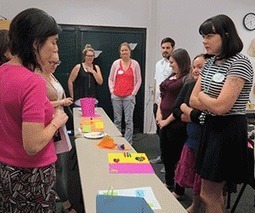
Apart from that brief outburst, the faces of the participants in our Human-Centred Design (HCD) workshop are crinkled with concentration as they calculate the number of carbs they consumed in their last meal.
They're not trying the newest low-carb diet, but putting themselves in the shoes of someone with diabetes--feeling, first-hand, what it's like to count their blood glucose levels to ensure they adjust their insulin intake correctly.
That walk-a-mile-immersion exercise is just one example of the methods we use to build rapid empathy in which we (as researchers and designers) help our audience (students, clients) to quickly understand the challenges that people face with a product, service, or process. Interestingly, the rapid bit is where the audience actually makes a connection, experiencing empathy for others. As humans, we're wired to feel empathy, so all we need to do is tap into that innate capacity.
===========================
That walk-a-mile-immersion exercise is
just one example of the methods we
use to build rapid empathy
==============
Karsten Fischer
CEO, PDD, global product and service design and innovation consultancy
"You never really know a man until you understand things from his point of view, until you climb into his skin and walk around in it." Harper Lee, To Kill a Mockingbird.
Atticus Finch knew that the key to understanding people was building empathy for them. In this post we explore the role of empathy in innovation and our experiences with rapid empathy-building exercises. So, what is the role of empathy in design and innovation?
Big Idea: "Developing Empathic Leaders Through Design"
Currently the Director of Operations for Design for America (DFA) and a lecturer at the Segal Design Institute at Northwestern University, Sami Nerenberg, a San Francisco native, is passionate about the intersection of design education and local/social impact.
Imagine interdisciplinary student teams and community members using design to create local, social impact. What about teaching human-centered design to young adults and collaborating community partners through extra-curricular, university-based, student-led design studios that tackle national challenges in education, health, economy and the environment?
The Course Thread Program allows UC Berkeley undergraduates to explore intellectual themes that connect courses across departments and disciplines.
Without creating new majors or minors, the program instead highlights connections between existing courses. Course Threads help students see the value in educational breadth while also pursuing a more in-depth and well-rounded knowledge on one particular topic.
Empathic design is a user-centereddesign approach that pays attention to the user's feelings toward a product (Crossley 2003).[1][2] The empathic design process is sometimes mistakenly referred to as Empathetic design.[3]
The foundation of empathic design is observation and the goal is to identify latent customer needs in order to create products that the customers don’t even know they desire or, in some cases, solutions that customers have difficulty envisioning due to lack of familiarity with the possibilities offered by new technologies or because locked in an old mindset. Empathic design relies on observation of consumers as opposed to traditional market research[4] which relies on consumer inquiry with the intention to avoid possible biases in surveys and questions, and minimizes the chance that consumers will provide false information.
Observations are carried out by a small team of specialists, such as an engineer, a human-factors expert, and a designer. Each specialist then documents their observations and the session is videoed to capture subtle interactions such as body language and facial expressions.
I was struck by how their notion of empathy as starting point for positive solutions is similar to design thinking.
Design thinking is a human-centered methodology for fostering creativity and tackling complex problems through innovative solutions, and empathy is the lynchpin of this process.
Empathy as a meme?
There have been several recent discussions about empathy in museum practice, ranging from Regan Forrest’s writings about empathy in the context of interpretation on the Interactivate blog to Gretchen Jenning’s write-up about The Empathetic Museum at AAM to Suse Cairns’s post on the Museum Geek blog, On the paradoxes of empathy.
Over and over, one of the big lessons in design thinking seems to be don’t assume—discover directly. The insights gained from talking directly to users informs our understanding of their needs,
Have you ever noticed how sometimes an idea you are exploring just seems to be everywhere you turn? Right now, for me, the idea is design thinking. In April, I not only went to one workshop, but by the time the month was over, I had experienced three introductory design thinking workshops.
In these sessions, I spent time redesigning the morning experience, re-conceptualizing weddings, and, the one most useful to my world, rethinking the student orientation experience at my institution, John F Kennedy University in Berkeley, CA.
Susan Spero, Ph.D., a faculty member in the Museum Studies program at John F. Kenney University in Berkeley, CA.
Dev Bootcamp is an intense 9-week bootcamp to train software engineers. 90% placement rate. Located in San Francisco, CA and Chicago, IL
I'm Karim Bishay, Head of Admissions for Dev Bootcamp. We get asked a lot about our teaching philosophy and why empathy is so important to us. I put together answers to two of the most common versions of this question to help you better understand one of the most important subjects we hope to engage our students.
=====================
We get asked a lot about our teaching
philosophy and why empathy is
so important to us.
========
QUESTION TWO: What is Engineering Empathy?
We believe most software projects fail for human reasons, not technical ones. So while true, deep technical understanding is necessary for the success of a software project, it's nowhere close to sufficient.
Engineering Empathy is a philosophy and an approach that we have developed to make sure that we’re training our students to become better at learning, working in teams, and dealing with whatever their job or life throws at them. We've crafted and are always improving on our Engineering Empathy curriculum.
Jackie is President of The Acho Group, a strategy and leadership consulting firm. Prior to founding The Acho Group in 2005, she was a Partner in the global strategy firm McKinsey & Company. Jackie has worked for industrial, scientific, academic, nonprofit, and economic development clients on a variety of issues, with particular focus on growth, strategy, technology commercialization, and leadership development for more than 18 years.
Jackie’s work includes developing uncommon and productive collaborations across organizations and internal boundaries, even among competitors.
As a user experience consultant, I coach my clients on
how to build empathy within their organizations
for customers and colleagues.
Outsourcing empathy to one department or team — whether it be user experience, design, product, marketing, or even engineering — hurts the company tremendously, resulting in an even less effective product design and greater discord amongst teammates.
To get content containing either thought or leadership enter:
To get content containing both thought and leadership enter:
To get content containing the expression thought leadership enter:
You can enter several keywords and you can refine them whenever you want. Our suggestion engine uses more signals but entering a few keywords here will rapidly give you great content to curate.


 Your new post is loading...