Understanding how people experience the world is key to developing new services.
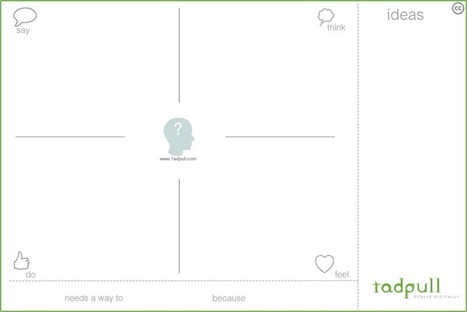
The Empathy map, based on a template developed by Osterwalder and Pigneur, in Business Model Generation, 2010, enables people commissioning and designing services to walk in the shoes of potential service users, and consider those excluded from current service provision.
You can down load an Empathy Map A2 - it can also be printed at A3 size.
Tools needed – Maps and ‘sharpie’ type pens. Can be done individually or in groups of up to six people. Time – between 30-60minutes.
Technology is definitely key in CfA’s work helping government become more engaging, but there’s also a secret sauce that makes it work – empathy.
These efforts to understand user needs and observe users were basically efforts to empathize with the users, or in other words to “gain empathy to who they are and what is important for them.” As Jacob Solomonputs it: “An empathetic service would ground itself in the concrete needs of concrete people. It’s not about innovation, big data, government-as-a-platform, transparency, crowd-funding, open data, or civic tech. It’s about people.”
=======================
What the team learned in this process was that the ideal experience for would be “direct, empathetic and would meet clients where they are.”
We always try to make new products and services with users, not just for them. Again and again, we have seen that this is the best way to ground your own ideas in their needs and behaviours.
Here are a number of tools and techniques we use to do this:
1 - Workshops...
2 - In depth user interviews...
3 - Mapping existing user journeys...
4 - Observations...
5 - Low fidelity sketches...
6 - Live prototypes: ‘sketching with software'....
Bruce Temkin, widely recognized as a customer experience visionary, has released his annual listing of customer experience trends to watch.
Bruce Temkin, widely recognized as a customer experience visionary, has released his annual listing of customer experience trends to watch. Headlining the list for 2014 is Temkin's call to name 2014 "The Year of Empathy."
"As companies increasingly focus on customer experience in 2014, they will recognize that their organizations lack a deep understanding and appreciation for their customers," states Bruce Temkin, Managing Partner of Temkin Group.
===========================
In 2014, we'll hear more executives talking
about the need to build 'empathy' for
customers, making 'empathy'
THE CX word for 2014.
======================
Here are some additional highlights from Temkin's list of customer experience trends for 2014:
This week, I’m headed to the Future of Storytelling summit, an unusual cross-disciplinary unconference exploring exactly what it says on the tin. Among the presenters is neuroeconomics pioneer Paul Zak, director of the Center for Neuroeconomic Studies and author of The Moral Molecule: The Source of Love and Prosperity.
======================
this short film on empathy,
neurochemistry, and the dramatic arc
=============
In this short film on empathy, neurochemistry, and the dramatic arc, directed and edited by my friend Kirby Ferguson and animated by Henrique Barone, Zak takes us inside his lab, where he studies how people respond to stories.
Get to know what the folks you want to engage think, do, care about and hate via personas and this new Empathy Map tool.
The Empathy Map is a proven framework for strong connections with the folks you need to act—to give, to volunteer, to take whatever action you need to move your mission forward.
The Map highlights key elements of your supporters’ environment, behavior, concerns and aspirations, enabling you to hone your messages, tone and channels to what’s most important to them (and so most likely to be digested, and acted on). That’s relevance, and relevance rules.
The designer uses a simulation device to gain first-hand insights into particular impairments or disabilities, for example clouded glasses to simulate sight loss or weighted gloves to reduce dexterity.
=========================== The experience of using such a device can prompt an empathic understanding of users with disabilities
or special conditions, ===============
The experience of using such a device can prompt an empathic understanding of users with disabilities or special conditions, and a greater appreciation of how inappropriate design can disable.
Clients as well as designers can benefit from such tools. However this method complements but does not replace speaking to real people with disabilities. Also described as role playing.
It’s time to identify key customer experience trends for next year. We did a pretty good job of identifying 13 CX trends for 2013 and many of those trends will continue on into 2014, so they remain on this year’s list.
We expect CX to gain even more momentum next year as 2014 brings us deeper into what Temkin Group has labeled the Era of CX Professionalism.
Based on what we see emerging in CX, we believe that 2014 will be The Year of Empathy, which is the 14th trend. Here are 14 CX trends to watch for in 2014, followed by some advice for each item:
Martin Luther King Teaches CX + Empathy
Join Me in Making 2014 the Year of Empathy
14 Customer Experience Trends for 2014 (The Year of Empathy)
A&W Canada Sparks Customer Empathy With Real-Time Feedback
We’re recruiting for a few different levels of experience, from a year to a career. The stuff you’ll get involved in, and the way in which you’ll get involved, will differ depending on your training and experience to date.
As a business designer, you will play a key role in Empathy’s process. You will help to uncover and unlock insights, and drive the use of those insights to design organisation direction and human experiences.
Types of projects you’ll be involved in include:
Product design projects (including product, service, environment and experience design projects)Value proposition, business position and strategy developmentCustomer insight projectsTraining and coaching on using design in business.
Empathy, a community focus, and team preparation are among the human/humanity-centered principles for design and innovation in the developing world.
IDEO’s Aaron Sklar and Sally Madsen discuss working with foundations, nongovernmental organizations and social entrepreneurs in “Design for Social Impact,” published in the spring issue of Ergonomics in Design.
At Start Empathy we believe everyone can master empathy. It can guide our daily thoughts, words and actions. It can alter our character. And it can also inspire and improve our work.
Last year, 60 Minutes did an interview with David Kelley, CEO and founder of IDEO, the world’s leading innovation and design firm. David Kelley took host Charlie Rose on a tour through his design thinking while entertaining stories of the Apple products on which he and colleague Steve Jobs collaborated.
What sets Kelley’s business apart and what allows IDEO to flourish is the practice of seeing design through an empathetic lens, making products intuitive and accommodating for consumers.
Empathy maps are a powerful tool for understanding your users and learning how they experience your product, service or a problem you're looking to solve.
Since we published last month’s article on Personas we’ve had a few questions asking what the difference is between personas and empathy mapping.
EMPATHIC ENGAGEMENT: True engagement leads to lasting connection. But it cannot be attained with reports and quant data.
We help companies to gain real insight on their target consumer and open the door to true engagement. Then, our Studio team, an in-house team of designers and storytellers, brings it all to life.
The Course Thread Program allows UC Berkeley undergraduates to explore intellectual themes that connect courses across departments and disciplines. Without creating new majors or minors, the program instead highlights connections between existing courses.
Course Threads help students see the value in educational breadth while also pursuing a more in-depth and well-rounded knowledge on one particular topic. Course Thread topics include: Human Rights, Cultural Forms in Transit, The Historical & Modern City, Visible Language, Humanities & Environment, Human-Centered Design, Old Things, and Sciences & Society.
Every decision we make affects the way real people experience our products. We’ve all heard the rallying cry for user-centered design, but even those of us who ascribe to that ideal often fall back on our own biases and instincts when it comes to making decisions about how people experience our content and our services.
Sadly, this often means we make decisions we think will be good for our "users"—that anonymous, faceless crowd—rather than actually trying to understand the perspectives, surroundings, capabilities, and disadvantages of the actual people who we are here to serve.
In this session, Aaron Gustafson explores why empathy is a good thing, how empathy empowers creativity, and how we, as a community, can inject more empathy into our work.
============================
Aaron Gustafson explores why empathy is a good thing, how empathy empowers creativity ===========
Empathy, a community focus, and team preparation are among the human/humanity-centered principles for design and innovation in the developing world.
IDEO’s Aaron Sklar and Sally Madsen discuss working with foundations, nongovernmental organizations and social entrepreneurs in “Design for Social Impact,” published in the spring issue of Ergonomics in Design.
We use empathy mapping to brainstorm and then prioritise ideas and requirements from a group of stakeholders.
The real benefit of the method is that is it democratic, in as much as everyone in the group has the same voice and the same vote – no one person can dominate the outcome. We find it a valuable way to tease opinions out of clients and stakeholders, and help them see how the group as a whole sees the respective importance of those ideas.
The Institute of Design (D.School) at Stanford has become one of the most talked about institutions recently because of the methodology they are spreading around the world to improve our lives through a collaborative approach that inspires human centered innovations. Last week I had the absolute privilege of being a part of the Design Thinking Hawaii boot camp which was focused on improving the education system in Hawai’i.
==================
What is empathy?
To feel what someone else feels.
To walk in another’s shoes.
=============
The 3 ways to empathize
Immerse: Become the user and actually live their experiences. A great example of this comes from Tim Brown’s book “Change by Design” when IDEO was designing for Robert Porter who is the CEO of the SSM DeParul Health Center in Saint Louis. Their challenge was to design a better experience for ER patients. Instead of analyzing and brainstorming new ideas automatically, they actually had one of their designers become a patient in the emergency room and see what the patient experience was like.
Useful, especially when it comes to working practically with people, rather than over them as "superiors." Human beings (especially Americans) don't always respond well to power, especially when it's illegitimate and not directed towards their well being, health and quality of life.
I'm sure this is culture sensitive. But for the US, this could work.
Learn how to capture users' feedback to build a better experience using this free UX tool from Tadpull.
Our take on the Empathy Map came about as a way to distill and organize qualitative data. We start every project by interviewing and observing current and potential customers to better understand their pain points and aspirations.
========================
Our take on the Empathy Map came
about as a way to distill and organize
qualitative data.
==============
Then, as we sift through pages of raw notes, sketches, audio/video files and photos, we use the empathy map to glean the juicy parts and make it visual to help drive the User Persona and eventually the Creative Brief.
This one-day workshop will be held as part of the CHI 2014 annual ACM SIGCHI Conference on Human Factors in Computing Science, held in Toronto, Canada between the 26th April and 1st May 2014.
The role of empathy has come to prominence in HCI as the community deals with issues in medical, health and emotionally charged contexts. In such settings empathizing with others is crucial in understanding the experience of living with specific conditions or to be sensitive to the emotions of potentially vulnerable participants. HCI also becomes implicated in designing new tools and technologies that support empathic relations. This workshop aims to develop a richer conceptual and practical understanding of empathic engagement and design methods in this context to support and shape an agenda for future research.
================
Enabling Empathy in Health and Care:
Design Methods and Challenges
============
W31: Enabling Empathy in Health and Care: Design Methods and Challenges
Anja Thieme - Newcastle University, United Kingdom
John Vines - Newcastle University, United Kingdom
Jayne Wallace - University of Dundee, United Kingdom
Rachel Clarke - Newcastle University, United Kingdom
Petr Slovák - Vienna University of Technology, Austria
John McCarthy - University College Cork, Ireland
Michael Massimi - Microsoft Research, United Kingdom
Andrea Grimes Parker - Northeastern University, USA
Bruce Temkin, widely recognized as a customer experience visionary, has released his annual listing of customer experience trends to watch.
Bruce Temkin, widely recognized as a customer experience visionary, has released his annual listing of customer experience trends to watch. Headlining the list for 2014 is Temkin's call to name 2014 "The Year of Empathy."
"As companies increasingly focus on customer experience in 2014, they will recognize that their organizations lack a deep understanding and appreciation for their customers," states Bruce Temkin, Managing Partner of Temkin Group.
=====================================
In 2014, we'll hear more executives talking
about the need to build 'empathy' for customers,
making 'empathy' THE CX word for 2014.
======================
Here are some additional highlights from Temkin's list of customer experience trends for 2014:
To get content containing either thought or leadership enter:
To get content containing both thought and leadership enter:
To get content containing the expression thought leadership enter:
You can enter several keywords and you can refine them whenever you want. Our suggestion engine uses more signals but entering a few keywords here will rapidly give you great content to curate.


 Your new post is loading...










Very interesting... try the other links as well...:-)))