To stem the transmission of COVID-19, establishments were closed, including schools. Thus, the education system adapted distance learning. Distance learning or DL is a modality wherein the teaching and learning processes are happening remotely. Readiness: The Key To ODL In The Time Of Pandemic.
To respond to the challenges posed by COVID cases worldwide, schools offered distance learning (DL) as the available learning method in this time of the pandemic. According to Justin Simon (2021), pre-pandemic there were only 6.6 million students enrolled in distance learning but this figure skyrocketed to 400 million due to the spread of COVID-19. Because schools were closed and not allowed to accommodate students in their classrooms, distance learning was offered. DL has now become the new normal in education.
Love to learn? Discover thousands of FREE online courses and MOOCs from top universities and companies on Class Central.
Via Oliver Durrer swissleap.com
Out of Office was not intended to be a book about working during a pandemic. The book’s authors, Charlie Warzel and Anne Helen Petersen, are partnered journalists who transitioned from N.Y.C. to remote Montana work a few years back.
The book that Warzel and Petersen set out to write was more a “best practices” for what we once called telecommuting. The book they ended up writing is much more interesting.
In examining when and how remote employment succeeds and fails, Warzel and Petersen discovered that the challenge is not with working remotely but our entire relationship with work.
There are many threats to the future of universities. These include the need to ensure environmental sustainability, to be responsive to the way people access information today (and will do tomorrow), to reduce the dependence on overseas student income while addressing global inequalities in access to higher education, and policies which allow teaching income to be subverted to subsidise research and a reward system for academics that prioritises research over educational excellence. The adoption of the competitive business model may not lead to programmes that reflect societal, national and global educational needs, and reduces the potential benefits of collaboration across the higher education sector. Intrusive managerial oversight is preferred to the placing of trust in academics, centralised inner city ivory towers preclude engagement with local communities and industries, and there is a failure to engage with modern learning technologies. Many of these issues have been brought into focus by the COVID-19 pandemic. The Distributed University for Sustainable Higher Education, a new open-access book, describes the problems facing the sustainability of the higher education system, and proposes the ‘Distributed University’ as a solution to many of the problems.
In this video, Laci makes her case against cancel culture. She highlights 5 ways that cancel culture fails as a method of justice, or actively perpetuates injustices.
Higher education officials are bombarded with pitches for how the latest emerging technologies are going to upend their students’ learning experiences and professors’ instructional methods. From online courses to learning management systems to autograders to AI-enabled “tutors,” schools have no shortage of products claiming to offer transformative change.
"It is time to question the assumptions under which higher education has been operating and creatively redesign who education is for, what’s provided..."
The four-day workweek has come to an American college.
D’Youville College in Buffalo, N.Y., turned heads last week when it announced that staff and administrators would shift to a four-day, 32-hour workweek—down from the five-day, 37.5-hour week they previously worked—without any reduction to their pay or benefits. The private college is launching the four-day workweek on a trial basis, with plans to assess how it’s working, and whether there have been any changes in student satisfaction, after six months.
Some revolutions take place with all the stealth and subtlety of Fourth of July fireworks. But others take place silently, and when they’re over, their triumph is so invisible and so complete it’s as if they never happened.
In retrospect, these revolutions seem inevitable, inexorable and irreversible.
That latter kind of revolution is transforming higher education. We’re all aware of certain aspects of that revolution, but its full scope and implications rarely draw the attention they deserve.
The revolution that is currently transforming higher education isn’t, of course, the first. During the 20th century, we witnessed several:
The Guardian’s Jerusalem correspondent Oliver Holmes examines the series of combustible events that coincided to trigger the worst violence in Israel and Gaza since 2014
Education, especially College Education, is facing an existential crisis. Partially due to demographic factors, and in part due to decisions made by policy-makers at national, local, and academic levels, colleges and universities are struggling to stay afloat. What's more, there are signs that conditions are likely to get far worse for the academic world for at least the next couple of decades. The question this raises ultimately comes down to "what is it that we as a society want out of our education institutions, and what is likely going to need to change for them to survive moving forward?"
In "Active Literacy" Heidi Hayes Jacobs focuses on the crucial function of literacy as the foundation for all learning regardless of age or content area.
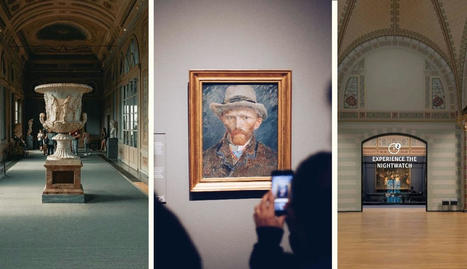
Culture up your day without leaving the comfort of your home with these free online museum tours from around the world.. Explore this storyboard about Museums by TheCollector on Flipboard.
To get content containing either thought or leadership enter:
To get content containing both thought and leadership enter:
To get content containing the expression thought leadership enter:
You can enter several keywords and you can refine them whenever you want. Our suggestion engine uses more signals but entering a few keywords here will rapidly give you great content to curate.


 Your new post is loading...