From
baos
Get Started for FREE
Sign up with Facebook Sign up with X
I don't have a Facebook or a X account


|
Scooped by
Dennis Swender
onto ED 262 KCKCC Sp '26 April 5, 2025 11:30 AM
|
 Scoop.it!


 Your new post is loading...
 Your new post is loading...
Your new post is loading...
Scoop.it!

Sign inBefore you continue to GoogleWe use cookies and data toDeliver and maintain Google servicesTrack outages and protect against spam, fraud, and abuseMeasure audience engagement and site statistics to understand how our services are used and enhance the quality of those servicesIf you choose to “Accept all,” we will also use cookies and data toDevelop and improve new servicesDeliver and measure the effectiveness of adsShow personalized content, depending on your settingsShow personalized ads, depending on your settingsIf you choose to “Reject all,” we will not use cookies for these additional purposes.Non-personalized content is influenced by things like the content you’re currently viewing, activity in your active Search session, and your location. Non-personalized ads are influenced by the content you’re currently viewing and your general location. Personalized content and ads can also include more relevant results, recommendations, and tailored ads based on past activity from this browser, like previous Google searches. We also use cookies and data to tailor the experience to be age-appropriate, if relevant.Select “More options” to see additional information, including details about managing your privacy settings. You can also visit g.co/privacytools at any time.More optionsPrivacy Policy Terms of Service
Dennis Swender's insight:
READ the entire description before accepting or rejecting this.
Scoop.it!

Teaching via a screen makes it harder to read student understanding and sustain attention. These practical strategies show how educators can keep online students invested Via EDTECH@UTRGV

EDTECH@UTRGV's curator insight,
January 30, 2:07 PM
"[W]ith a multitude of digital distractions vying for students’ attention, online teaching requires intentional pedagogical adjustments."
Scoop.it!

By Olina Banerji Jun 16, 2023 Jeff Maggioncalda, the CEO of Coursera, can’t hide his excitement about AI. He has ChatGPT on his phone and his iPad, and our 45-minute conversation is peppered with references to Coursera’s newest personal learning assistant, “Coach.” The interview culminates with an on-the-spot demonstration. “Coach is going to be both reactive and proactive for learners. It’s going to be a thinking and writing partner in multiple languages,” he says, typing questions into the chatbot on his iPad. In response, Coach throws up explanations, summarizes lessons, links videos and suggests further courses for the learner to check out. Maggioncalda calls Coach a “hands-on, interactive” tool, one that lets learners set their own pace with the material. And it’s not the only high-tech strategy that Coursera employs to shepherd users through courses. The company also uses a customizable assignments generator that it acquired, for an undisclosed amount, from a Bulgarian startup in 2019. Being one of the first, and largest, online learning platforms in the world, Coursera has gained some insights from its 124 million-strong user base about what it really takes to help people succeed in its digital classes. “We’ve noticed that the earlier we introduce these assignments into a course, the retention rates improve,” Maggioncalda says. Still, completion rates among people who have paid for a Coursera course hover around 50 percent, according to figures shared by the company. Coursera’s tinkering with engagement tools points to a stark hypothesis about what may be hurtling toward the American higher education system. The next decade could belong to the nontraditional, online learner — but only if the companies and universities that offer remote courses figure out how to ferry such students across the river of distraction and land them safely on the far shore equipped with skills and credentials. Demand is out there. It comes from people like Lyndsay Stueve, who works as a full-time global vendor operations expert while raising four kids who are in middle and high school. Stueve started her online learning journey four years ago — first in community college, and then at the University of Florida. She’s now completing an online MBA from Western Governors University (WGU). Stueve’s been an online learner throughout. Stueve says she needs the flexibility and choice of an online setting. “I like that WGU doesn’t force us into a semester system, with three to four classes every semester. Online, I can choose to go from one class to another, without any time constraint,” she explains. But learning online remains a hard nut to crack. Evidence that it works has often been contradictory or disappointing. Today’s online courses are evolved cousins of the early MOOC, or massive open online course. Earlier experiments did not prove as transformative as some advocates hoped, with few students completing the classes they started. There are some clear changes in the way online courses are being structured now. Insight about this comes from institutions like the University of Maryland Global Campus (UMGC), a fully online college that has been operational for more than 20 years, which makes it fertile ground to understand how adults really learn online. Every minute that we have with an adult learner is a minute they aren’t spending on another priority. — Greg Fowler “The adult learner doesn’t care about what 18-year-old, residential students care about. Every minute that we have with an adult learner is a minute they aren’t spending on another priority,” says Greg Fowler, the president of UMGC. Fowler says this realization pushes his team to carefully pick out what to put in each 20-minute video lesson, and how to reinforce that learning quickly. “We definitely know that we have to make these courses shorter,” agrees Rene Kizilcec, director of the Future of Learning Lab at Cornell University, who’s studied online student behavior closely. Yet how adults really learn online is difficult to pinpoint, because they are so heterogeneous, says Kizilcec. Different priorities and expectations make one-size-fits-all programming impossible. What is clear, however, is that adult learners bring high expectations to online learning. So for this segment of higher education to grow, companies and colleges will have to figure out how to meet those standards. Adult learners aren’t shy about pushing back on course structures that don’t work for them, Fowler says. “We can’t approach this simply as an authoritarian relationship, where the instructor has the power, and the students just do what the instructor says,” he says. “We get lots of students who raise their hand and say, ‘I don't think I’m getting what I came here for.’” Goldilocks ProblemsChirag Garg, a researcher with IBM, lives in San Francisco and wants to transition to an AI role in a few months. In fact, his company is going to demand new skills from him, so Garg looked for a course that would teach him all the fundamentals of artificial intelligence while being flexible with his work schedule. He landed on Stanford’s “AI Principles and Techniques” online course, and he’s three weeks in. “I like how the course topics are sequenced. I’ve done courses before where there wasn’t much of a structure, and I wasn’t motivated to finish them,” says Garg. He also wasn’t paying for those, while such courses at Stanford run at over $1,500 a pop. The kind of structure that Garg likes isn’t easy to create online. The first thing that platforms or universities have to do is subvert the linear semester system, and design shorter learning periods instead. “What I’ve observed is that a lot of universities who put the semester system online abandoned it after a while. That’s a crucial change,” says Kizilcec. I’ve done courses before where there wasn’t much of a structure, and I wasn’t motivated to finish them. — Chirag Garg The self-paced nature of these courses is a better fit for adult learners who might have to deal with issues like sickness or job loss. But with self-paced courses, warns Kizilcec, the fear is that the pendulum may swing too much in the other direction — toward no accountability. It’s a dance that Sourabh Bajaj is familiar with. He’s one-third of the founding trio behind CoRise, a tech upskilling platform that works largely with companies to get their employees up to speed on their technical capabilities. Bajaj is convinced that the flexibility of an online course has to come with some riders. Most online courses have some form of demerits built into them if learners miss too many lectures, or turn in assignments late. CoRise, though, actually makes learners pencil live lectures into their calendars. “It creates a cadence. Adults possibly struggle more than younger students to figure out when to study. If you get the option, you’re always going to punt on studying,” Bajaj says. CoRise claims to have an 80 percent completion rate across its courses, and Bajaj boils it down to a tight eight to 10 hours a week of watching videos and doing assignments. “It’s hard to balance a hyper-structured environment with just the right amount of personalization,” Bajaj says. When it comes to personalization, CoRise is experimenting with both human intervention and AI bots. “Some reminders, information, nudges can be automated,” Bajaj says. “But some problems escalate, where people have to come in and motivate learners. We check in with them at different points to figure out how they are feeling.” For Garg, the Stanford student, a human helper doesn’t always seem necessary. He says he often turns to ChatGPT with his doubts, and they are solved on the spot, cutting short the long time it can take to receive feedback in an online course. Yet for support with more complex assignments, Garg wants a professor to step in. “It’s too much to type into a chatbot. With a human being, I can just screenshot my question,” he says. Humans in the LoopAdults come into the education system at different points in their lives, with different needs. Some are trying higher ed for the first time, while others tried college before but didn’t complete it, and still others have advanced degrees but want training in a specific skill or subject. Online courses have to cater to all that. Yet there are some insights that cut across this diversity, Kizilcec explains. “One intervention that we tried had some of the best short-term effects on engagement. We asked people to find a study buddy, and get them to hold them accountable for their progress. They tell their buddy, ‘I'm going to do this course. Check in with me every week.’ We asked people to do that and plan ahead. We saw that they had more engagement in the course at the beginning,” Kizilcec says. The study buddy or cohort system means some part of the course has to be synchronous — people logging in at the same time — in largely asynchronous courses. Stanford’s online courses are trying to work around this issue, and faculty have turned their Zoom office hours into a group coaching session. “There is a live discussion amongst learners about how they can apply what they learned in their course to their daily lives. Hearing classmates can validate their own experiences,” says Jennifer Gardner, director of online executive education courses at the Stanford Graduate School of Business. Dakota Lillie, a current online student with Stanford, thinks the peer connections — fostered through discussions and Slack channels — are a major appeal of the program. “It’s been designed in a way where you can participate [with others] when you want. I like the competition with other students,” Lillie says. In contrast, Stueve, at WGU, shudders at the thought of doing another remotely planned group project or discussion. “I’ve been in experiences where I’ve had to pick up the slack in a group project. I don’t really log onto the Slack channels because I don’t need an external accountability partner,” Stueve says . What Stueve does rely on though, is a personal mentor, who can keep her in sight of her goals. At UMGC, Fowler says this kind of support network is something the university is actively building. There is some “peer mentoring,” but a large part of the experience is also delivered by what Fowler calls “success coaches” who reach out if a remote student is struggling in a course. “A coach can see that a student got the same question wrong four times in one lecture. And the student may not reach out, but the coach will help them get over it,” Fowler says. Without this kind of intervention, online students can simply disappear from courses and institutions, Fowler adds, putting them at risk of becoming another one of the 40 million Americans who have “some college and no degree.” Lifelong LearnersInnovations in adult learning currently defy clear patterns. Small tweaks — like better feedback systems, study buddies, guides — have indicated a direction, but scaling these services could mean universities and platforms are either shelling out or charging students higher tuition. (Of course, retaining more students can also pay off for programs in the long run.) Yet if companies and colleges figure out how to help adult students learn, then these institutions may be able to better focus on what adult students learn. And that’s important in a world where evolving technology makes it essential for people to continually refresh their knowledge and skills. “We talk a lot about the future of work but not enough about how learning will happen,” Kizilcec says. “There’s going to be a lot of work interspersed with learning.” In addition to tinkering with how a course is structured, CoRise has also been putting work into what’s actually being taught. For adult learners, course content should be tightly linked to what is motivating students to enroll, Bajaj says. In many cases, that’s the desire to land a better job, or to gain skills for work. For that reason, CoRise has moved away from relying on knowledge “taxonomies” and toward making content explicitly relevant to online learners, who may not have time for or interest in studying every possible topic. Bajaj takes the example of a machine learning (ML) course. “Computer vision isn’t relevant for most companies. Very few companies have image data. But every ML course still has computer vision and it wastes precious learner time. We’re trying to change that,” Bajaj says. Three months into a ML engineer job, you don’t need to know everything, he adds, so getting the relevant skills from an online course is important. Recognizing micro-skills or issuing microcredentials is another way that course providers are trying to meet adult learners where they are in order to take them where they’re trying to go. Fowler says UMGC is now trying to figure out how existing skills in learners can be “tagged” in a workplace, and if they can be awarded credit for that. “People are going to need more skills just to keep working. We’re trying to figure out how they can do that without taking time off to do a course,” he says. Indeed, the learners of the future may zigzig between work and school in a way that might completely transform how online courses are designed. Kizilcec believes that the path to being a nontraditional learner — potentially a majority of students in the future — needs to start earlier. “We need to think about how lifelong learners are created at [the] college or high school level. You can’t expect the traditional, residential college to take care of that,” says Kizilcec. The year of the MOOC may be long over. But the institutions trying to teach new-age learners online are just getting started. Olina Banerji is a writer and reporter covering edtech, educational innovation, clean energy and health care. Via Charles Tiayon, Mar AG

Charles Tiayon's curator insight,
June 16, 2023 10:58 PM
"By Olina Banerji Jun 16, 2023 Jeff Maggioncalda, the CEO of Coursera, can’t hide his excitement about AI. He has ChatGPT on his phone and his iPad, and our 45-minute conversation is peppered with references to Coursera’s newest personal learning assistant, “Coach.” The interview culminates with an on-the-spot demonstration. “Coach is going to be both reactive and proactive for learners. It’s going to be a thinking and writing partner in multiple languages,” he says, typing questions into the chatbot on his iPad. In response, Coach throws up explanations, summarizes lessons, links videos and suggests further courses for the learner to check out. Maggioncalda calls Coach a “hands-on, interactive” tool, one that lets learners set their own pace with the material. And it’s not the only high-tech strategy that Coursera employs to shepherd users through courses. The company also uses a customizable assignments generator that it acquired, for an undisclosed amount, from a Bulgarian startup in 2019. Being one of the first, and largest, online learning platforms in the world, Coursera has gained some insights from its 124 million-strong user base about what it really takes to help people succeed in its digital classes. “We’ve noticed that the earlier we introduce these assignments into a course, the retention rates improve,” Maggioncalda says. Still, completion rates among people who have paid for a Coursera course hover around 50 percent, according to figures shared by the company. Coursera’s tinkering with engagement tools points to a stark hypothesis about what may be hurtling toward the American higher education system. The next decade could belong to the nontraditional, online learner — but only if the companies and universities that offer remote courses figure out how to ferry such students across the river of distraction and land them safely on the far shore equipped with skills and credentials. Demand is out there. It comes from people like Lyndsay Stueve, who works as a full-time global vendor operations expert while raising four kids who are in middle and high school. Stueve started her online learning journey four years ago — first in community college, and then at the University of Florida. She’s now completing an online MBA from Western Governors University (WGU). Stueve’s been an online learner throughout. Stueve says she needs the flexibility and choice of an online setting. “I like that WGU doesn’t force us into a semester system, with three to four classes every semester. Online, I can choose to go from one class to another, without any time constraint,” she explains. But learning online remains a hard nut to crack. Evidence that it works has often been contradictory or disappointing. Today’s online courses are evolved cousins of the early MOOC, or massive open online course. Earlier experiments did not prove as transformative as some advocates hoped, with few students completing the classes they started. There are some clear changes in the way online courses are being structured now. Insight about this comes from institutions like the University of Maryland Global Campus (UMGC), a fully online college that has been operational for more than 20 years, which makes it fertile ground to understand how adults really learn online. Every minute that we have with an adult learner is a minute they aren’t spending on another priority. — Greg Fowler “The adult learner doesn’t care about what 18-year-old, residential students care about. Every minute that we have with an adult learner is a minute they aren’t spending on another priority,” says Greg Fowler, the president of UMGC. Fowler says this realization pushes his team to carefully pick out what to put in each 20-minute video lesson, and how to reinforce that learning quickly. “We definitely know that we have to make these courses shorter,” agrees Rene Kizilcec, director of the Future of Learning Lab at Cornell University, who’s studied online student behavior closely. Yet how adults really learn online is difficult to pinpoint, because they are so heterogeneous, says Kizilcec. Different priorities and expectations make one-size-fits-all programming impossible. What is clear, however, is that adult learners bring high expectations to online learning. So for this segment of higher education to grow, companies and colleges will have to figure out how to meet those standards. Adult learners aren’t shy about pushing back on course structures that don’t work for them, Fowler says. “We can’t approach this simply as an authoritarian relationship, where the instructor has the power, and the students just do what the instructor says,” he says. “We get lots of students who raise their hand and say, ‘I don't think I’m getting what I came here for.’” Goldilocks ProblemsChirag Garg, a researcher with IBM, lives in San Francisco and wants to transition to an AI role in a few months. In fact, his company is going to demand new skills from him, so Garg looked for a course that would teach him all the fundamentals of artificial intelligence while being flexible with his work schedule. He landed on Stanford’s “AI Principles and Techniques” online course, and he’s three weeks in. “I like how the course topics are sequenced. I’ve done courses before where there wasn’t much of a structure, and I wasn’t motivated to finish them,” says Garg. He also wasn’t paying for those, while such courses at Stanford run at over $1,500 a pop. The kind of structure that Garg likes isn’t easy to create online. The first thing that platforms or universities have to do is subvert the linear semester system, and design shorter learning periods instead. “What I’ve observed is that a lot of universities who put the semester system online abandoned it after a while. That’s a crucial change,” says Kizilcec. I’ve done courses before where there wasn’t much of a structure, and I wasn’t motivated to finish them. — Chirag Garg The self-paced nature of these courses is a better fit for adult learners who might have to deal with issues like sickness or job loss. But with self-paced courses, warns Kizilcec, the fear is that the pendulum may swing too much in the other direction — toward no accountability. It’s a dance that Sourabh Bajaj is familiar with. He’s one-third of the founding trio behind CoRise, a tech upskilling platform that works largely with companies to get their employees up to speed on their technical capabilities. Bajaj is convinced that the flexibility of an online course has to come with some riders. Most online courses have some form of demerits built into them if learners miss too many lectures, or turn in assignments late. CoRise, though, actually makes learners pencil live lectures into their calendars. “It creates a cadence. Adults possibly struggle more than younger students to figure out when to study. If you get the option, you’re always going to punt on studying,” Bajaj says. CoRise claims to have an 80 percent completion rate across its courses, and Bajaj boils it down to a tight eight to 10 hours a week of watching videos and doing assignments. “It’s hard to balance a hyper-structured environment with just the right amount of personalization,” Bajaj says. When it comes to personalization, CoRise is experimenting with both human intervention and AI bots. “Some reminders, information, nudges can be automated,” Bajaj says. “But some problems escalate, where people have to come in and motivate learners. We check in with them at different points to figure out how they are feeling.” For Garg, the Stanford student, a human helper doesn’t always seem necessary. He says he often turns to ChatGPT with his doubts, and they are solved on the spot, cutting short the long time it can take to receive feedback in an online course. Yet for support with more complex assignments, Garg wants a professor to step in. “It’s too much to type into a chatbot. With a human being, I can just screenshot my question,” he says. Humans in the LoopAdults come into the education system at different points in their lives, with different needs. Some are trying higher ed for the first time, while others tried college before but didn’t complete it, and still others have advanced degrees but want training in a specific skill or subject. Online courses have to cater to all that. Yet there are some insights that cut across this diversity, Kizilcec explains. “One intervention that we tried had some of the best short-term effects on engagement. We asked people to find a study buddy, and get them to hold them accountable for their progress. They tell their buddy, ‘I'm going to do this course. Check in with me every week.’ We asked people to do that and plan ahead. We saw that they had more engagement in the course at the beginning,” Kizilcec says. The study buddy or cohort system means some part of the course has to be synchronous — people logging in at the same time — in largely asynchronous courses. Stanford’s online courses are trying to work around this issue, and faculty have turned their Zoom office hours into a group coaching session. “There is a live discussion amongst learners about how they can apply what they learned in their course to their daily lives. Hearing classmates can validate their own experiences,” says Jennifer Gardner, director of online executive education courses at the Stanford Graduate School of Business. Dakota Lillie, a current online student with Stanford, thinks the peer connections — fostered through discussions and Slack channels — are a major appeal of the program. “It’s been designed in a way where you can participate [with others] when you want. I like the competition with other students,” Lillie says. In contrast, Stueve, at WGU, shudders at the thought of doing another remotely planned group project or discussion. “I’ve been in experiences where I’ve had to pick up the slack in a group project. I don’t really log onto the Slack channels because I don’t need an external accountability partner,” Stueve says . What Stueve does rely on though, is a personal mentor, who can keep her in sight of her goals. At UMGC, Fowler says this kind of support network is something the university is actively building. There is some “peer mentoring,” but a large part of the experience is also delivered by what Fowler calls “success coaches” who reach out if a remote student is struggling in a course. “A coach can see that a student got the same question wrong four times in one lecture. And the student may not reach out, but the coach will help them get over it,” Fowler says. Without this kind of intervention, online students can simply disappear from courses and institutions, Fowler adds, putting them at risk of becoming another one of the 40 million Americans who have “some college and no degree.” Lifelong LearnersInnovations in adult learning currently defy clear patterns. Small tweaks — like better feedback systems, study buddies, guides — have indicated a direction, but scaling these services could mean universities and platforms are either shelling out or charging students higher tuition. (Of course, retaining more students can also pay off for programs in the long run.) Yet if companies and colleges figure out how to help adult students learn, then these institutions may be able to better focus on what adult students learn. And that’s important in a world where evolving technology makes it essential for people to continually refresh their knowledge and skills. “We talk a lot about the future of work but not enough about how learning will happen,” Kizilcec says. “There’s going to be a lot of work interspersed with learning.” In addition to tinkering with how a course is structured, CoRise has also been putting work into what’s actually being taught. For adult learners, course content should be tightly linked to what is motivating students to enroll, Bajaj says. In many cases, that’s the desire to land a better job, or to gain skills for work. For that reason, CoRise has moved away from relying on knowledge “taxonomies” and toward making content explicitly relevant to online learners, who may not have time for or interest in studying every possible topic. Bajaj takes the example of a machine learning (ML) course. “Computer vision isn’t relevant for most companies. Very few companies have image data. But every ML course still has computer vision and it wastes precious learner time. We’re trying to change that,” Bajaj says. Three months into a ML engineer job, you don’t need to know everything, he adds, so getting the relevant skills from an online course is important. Recognizing micro-skills or issuing microcredentials is another way that course providers are trying to meet adult learners where they are in order to take them where they’re trying to go. Fowler says UMGC is now trying to figure out how existing skills in learners can be “tagged” in a workplace, and if they can be awarded credit for that. “People are going to need more skills just to keep working. We’re trying to figure out how they can do that without taking time off to do a course,” he says. Indeed, the learners of the future may zigzig between work and school in a way that might completely transform how online courses are designed. Kizilcec believes that the path to being a nontraditional learner — potentially a majority of students in the future — needs to start earlier. “We need to think about how lifelong learners are created at [the] college or high school level. You can’t expect the traditional, residential college to take care of that,” says Kizilcec. The year of the MOOC may be long over. But the institutions trying to teach new-age learners online are just getting started. Olina Banerji is a writer and reporter covering edtech, educational innovation, clean energy and health care." #metaglossia_mundus 
Mar AG's curator insight,
December 16, 2025 2:12 PM
El artículo subraya que el futuro del aprendizaje online dependerá de la capacidad de las instituciones para ayudar a los estudiantes adultos a cruzar la denominada “river of distraction”, uno de los principales obstáculos para mantener la motivación en entornos digitales. En el aprendizaje de lenguas extranjeras, esta dificultad se ve acentuada por la necesidad de constancia y autorregulación.
Al mismo tiempo, el texto reconoce que la demanda de este tipo de enseñanza no deja de crecer, especialmente entre estudiantes adultos que buscan conciliar formación, vida familiar y responsabilidades laborales. Por ello, universidades y plataformas deben diseñar propuestas flexibles pero estructuradas, que acompañen al alumnado y le permitan avanzar de forma clara hacia el desarrollo de competencias lingüísticas y acreditaciones relevantes, manteniendo así la motivación a largo plazo.
Scoop.it!

In 2025, higher education shifted from expansion to impact, with institutions now judged on graduate readiness and research relevance. This structural reinvention was driven by AI's integration, the erosion of the degree as the sole competence marker, and a global reality demanding adaptable, outcome-driven learning. Universities are now continuous talent-development platforms, prioritizing skills and lifelong learning for relevance. Via EDTECH@UTRGV
EDTECH@UTRGV's curator insight,
January 6, 11:54 AM
"For decades, universities were assessed on expansion, that is, more campuses, higher enrolments, global rankings and physical infrastructure. That era is now decisively over."
Scoop.it!

The integration of AI in higher education is explored and considered in relation teaching and learning. Meet the AI avatar professor Via EDTECH@UTRGV
EDTECH@UTRGV's curator insight,
November 24, 2025 12:28 PM
"Similar to AI convergence in the medical profession, the marriage between AI professors and human professors,... will likely be a bumpy one."
Scoop.it!

A tool called “Your activity off Meta technologies” helps you manage how Facebook and Instagram look at your online activities.
Learn more / En savoir plus / Mehr erfahren:
https://www.scoop.it/topic/social-media-and-its-influence
https://www.scoop.it/topic/social-media-and-its-influence/?&tag=Facebook
https://www.scoop.it/topic/social-media-and-its-influence/?&tag=Privacy
Via Gust MEES, Dr. Russ Conrath

Gust MEES's curator insight,
October 11, 2025 2:26 PM
A tool called “Your activity off Meta technologies” helps you manage how Facebook and Instagram look at your online activities.
Learn more / En savoir plus / Mehr erfahren:
https://www.scoop.it/topic/social-media-and-its-influence
https://www.scoop.it/topic/social-media-and-its-influence/?&tag=Facebook
https://www.scoop.it/topic/social-media-and-its-influence/?&tag=Privacy

ameliabiber367@gmail.com's comment,
December 9, 2025 7:03 AM
Thank you so much for providing such excellent information. If you are interested in purchasing a luxurious ready-to-move-in villas in Greater Noida at an affordable price, call 8375000707. https://www.villasinnoida.com/villas-in-greater-noida.php 
Digitalmedia's comment,
February 3, 7:01 AM
Unlock the full potential of your brand with our expert PR, Retail, and Social Media services. From building buzz to boosting sales and crafting a standout digital presence, we’ve got your brand covered. Visit - www.tlmconsultancy.com
Scoop.it!

What students considering entering the AI field should keep in mind when pursuing a college degree. Via EDTECH@UTRGV
EDTECH@UTRGV's curator insight,
November 19, 2025 11:13 AM
"[S]tudents should focus on programs that emphasize the fundamentals of AI rather than how to use certain AI tools."
Scoop.it!

Meet Luma - Your Friendly AI Note-Taking Companion. Physical notes to digital in seconds. Luma AI generates templates, sorts your notes, organizes by tags, and helps you build better habits. Share instantly with one click. Focus mode for distraction-free meetings. Via Ana Cristina Pratas
Scoop.it!

Americans will observe October 13 differently this year, some as Columbus Day, others as Indigenous Peoples Day, and many as a regular workday. While it remains a federal holiday, only some states give employees a paid day off., US Buzz, Times Now
Scoop.it!

At this point the Zoom call has almost come to define learning and working in the age of COVID-19. But a few months ago, people began realizing tha Via Ana Cristina Pratas
|
Scoop.it!

The age of AI and Robots is here, you may be worried that robots will take your jobs. There are some jobs that have a low risk of being taken over by AI. Via EDTECH@UTRGV
EDTECH@UTRGV's curator insight,
January 29, 8:27 AM
"The following 65 occupations were all determined to have a job automation risk probability of 0.0% based on the abilities, knowledge, skills, and activities that are required to perform the job well."
Scoop.it!

What is Diagnostic Teaching? Diagnostic teaching is a step-by-step, intentional process for pinpointing exactly why a student is struggling. Via EDTECH@UTRGV
EDTECH@UTRGV's curator insight,
January 30, 3:17 PM
"The big idea behind Diagnostic Teaching is to illuminate and remove barriers to student understanding. When students have problems, you need to be able to systematically identify and fix them."
Scoop.it!

AI and digital tools are reshaping higher ed. Can they bridge the cost-value gap? Explore new insights today! Via EDTECH@UTRGV
EDTECH@UTRGV's curator insight,
January 6, 11:51 AM
"Once seen as a futuristic concept, artificial intelligence is now transforming how students learn. From automating mundane tasks like note-taking to providing targeted, real-time feedback, AI is adding layers of personalization and efficiency to education like never before." 
Ana Moñino's curator insight,
January 10, 12:34 PM
Pero, ¿podría realmente la Inteligencia artificial sustituir a un profesor/a? De esto justamente trata este artículo en el que se reflexiona acerca de cómo se usa y debe ser utilizada la IA para que se considere una buena herramienta que promueva el aprendizaje.
Es innegable que el uso de las nuevas tecnologías ha aumentado exponencialmente y que gracias a él tenemos acceso al llamado e-learning, no solo en nuestras aulas, sino en cualquier parte. Estas por supuesto son mucho más baratas y accesibles que los recursos personales (un profesor), pero a la vez no incluye las capacidades interactivas y emocionales de una persona. Es por ello, que aunque el concepto de IA ha modificado la educación tal y como la veíamos anteriormente, no puede sustituir a un profesor/a en sí, pero sí que puede, usándose como herramienta, generar aprendizajes mucho más creativos y eficientes. Y para ello, los gobiernos deberían preocuparse en formar a profesionales en este tipo de herramienta.
Scoop.it!

As digital learning becomes the norm and AI accelerates, identity fraud will only get more sophisticated and schools must protect students. Via EDTECH@UTRGV
EDTECH@UTRGV's curator insight,
January 7, 12:23 PM
"From deepfakes in admissions to synthetic students infiltrating online portals and threatening high-value research information, AI-powered identity fraud is rising fast, and our educational institutions are alarmingly underprepared."
Scoop.it!

EDTECH@UTRGV's curator insight,
November 24, 2025 12:34 PM
"I set out this semester to look more carefully for AI work. Some of it is quite easy to notice... But there is a difference between recognizing AI use and proving its use. So I tried an experiment."
Scoop.it!

College-for-all is collapsing as skills-based hiring reshapes opportunity. Employers, not universities, now define the future of work. Via Dr. Russ Conrath
Scoop.it!

One grant will facilitate the adoption of underrepresented languages in new technologies; the other will train students in research methods related to conducting field work in those languages. "The two-year BCS grant provides $268,000 in funding to create automatic speech recognition systems that can transcribe oral data from Mauritian Creole, spoken predominantly in communities on the island off the west African coast and Guadeloupean and Martiniquan Creole, two languages spoken on islands in the Caribbean. These tools would replace the time-consuming task of manual transcription, which is largely responsible for their omission from many current devices. “I call these ‘critical languages’ because we’re talking about data and resources that are absent from what’s being used and developed in all kinds of AI technologies. We have data on European languages, but not for these underrepresented languages. Developing widely accessible tools like speech recognition requires training data from the target language,” says Henri, an expert in contemporary creole linguistics. “For a vast number of the world’s languages, this essential data simply doesn’t exist.” The OISE grant, a $686,700 project, is an expanded version of a two-year grant Henri previously received. Like its predecessor, the current five-year project is designed specifically for students to gain international research experience. The earlier grant had students working in Guadeloupe, but the current grant will involve five different countries (Guadeloupe, Martinique, Haiti, Mauritius, and Seychelles) and will train both undergraduate and graduate students from across the U.S. The students will learn how to conduct linguistic fieldwork and will receive instruction on how best to write for publication and conference presentations. Each year, six U.S. students will conduct research in one of the five countries. Beginning in the summer of 2026, Henri will accompany students to Mauritius, where they’ll spend five weeks with an international team of mentors immersed in the local language. Each student will have an individualized research topic and will be trained in traditional documentary methods and modern computational approaches to create appropriate protocols to collect data related to that topic from native speakers. As part of the experience, students will participate in the UB Creolist Workshop. Developed by Henri when she arrived at UB in 2020, the workshop brings together scholars from across the U.S. with students to discuss new research in creole linguistics. “Projects like this provide valuable data while at the same time provide students with experience that can encourage them to continue working with these important underrepresented languages,” says Henri. “My first experience was super successful recruiting students from around the U.S. who later applied to UB.” It is all work for Henri that is driven by a personal passion. She’s one of those speakers — her native language is Mauritian creole. “These languages have been and still remain the object of prejudice. People don’t think of them as legitimate languages, a sentiment sometimes expressed by native speakers,” she says. “My goal has always been to demonstrate that these are complete and complex languages, worthy of serious study. Ultimately, they offer a unique window into human cognition. “These projects can help change the negative perception and raise awareness to the importance of creole languages.” Media Contact Information Via Charles Tiayon
Charles Tiayon's curator insight,
November 19, 2025 11:32 PM
One grant will facilitate the adoption of underrepresented languages in new technologies; the other will train students in research methods related to conducting field work in those languages.
"The two-year BCS grant provides $268,000 in funding to create automatic speech recognition systems that can transcribe oral data from Mauritian Creole, spoken predominantly in communities on the island off the west African coast and Guadeloupean and Martiniquan Creole, two languages spoken on islands in the Caribbean.
These tools would replace the time-consuming task of manual transcription, which is largely responsible for their omission from many current devices.
“I call these ‘critical languages’ because we’re talking about data and resources that are absent from what’s being used and developed in all kinds of AI technologies. We have data on European languages, but not for these underrepresented languages. Developing widely accessible tools like speech recognition requires training data from the target language,” says Henri, an expert in contemporary creole linguistics. “For a vast number of the world’s languages, this essential data simply doesn’t exist.”
The OISE grant, a $686,700 project, is an expanded version of a two-year grant Henri previously received. Like its predecessor, the current five-year project is designed specifically for students to gain international research experience. The earlier grant had students working in Guadeloupe, but the current grant will involve five different countries (Guadeloupe, Martinique, Haiti, Mauritius, and Seychelles) and will train both undergraduate and graduate students from across the U.S.
The students will learn how to conduct linguistic fieldwork and will receive instruction on how best to write for publication and conference presentations.
Each year, six U.S. students will conduct research in one of the five countries. Beginning in the summer of 2026, Henri will accompany students to Mauritius, where they’ll spend five weeks with an international team of mentors immersed in the local language. Each student will have an individualized research topic and will be trained in traditional documentary methods and modern computational approaches to create appropriate protocols to collect data related to that topic from native speakers.
As part of the experience, students will participate in the UB Creolist Workshop. Developed by Henri when she arrived at UB in 2020, the workshop brings together scholars from across the U.S. with students to discuss new research in creole linguistics.
“Projects like this provide valuable data while at the same time provide students with experience that can encourage them to continue working with these important underrepresented languages,” says Henri. “My first experience was super successful recruiting students from around the U.S. who later applied to UB.”
It is all work for Henri that is driven by a personal passion. She’s one of those speakers — her native language is Mauritian creole.
“These languages have been and still remain the object of prejudice. People don’t think of them as legitimate languages, a sentiment sometimes expressed by native speakers,” she says. “My goal has always been to demonstrate that these are complete and complex languages, worthy of serious study. Ultimately, they offer a unique window into human cognition.
“These projects can help change the negative perception and raise awareness to the importance of creole languages.”
Media Contact Information Bert Gambini News Content Manager Humanities, Economics, Social Sciences, Social Work, Libraries Tel: 716-645-5334 gambini@buffalo.edu"
https://www.buffalo.edu/news/releases/2025/11/henri-inclusive-language.html #Metaglossia #metaglossia_mundus
Scoop.it!
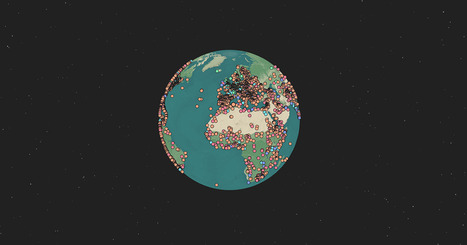
Explore 6,000 years of battles, inventions, philosophers and more... on an interactive 3D globe. Via Nik Peachey

Nik Peachey's curator insight,
November 21, 2025 11:20 AM
Wonderful - Globe of History - Interactive 3D globe visualizing 6,000 years of history. Explore battles, philosophers, inventions and more on an interactive 3D map. Filter by era and category to see how history unfolds across the globe. https://www.globeofhistory.com/
Scoop.it!

A new app called Sway is being tested on university campuses to facilitate constructive conversations on difficult topics. Via EDTECH@UTRGV
EDTECH@UTRGV's curator insight,
October 9, 2025 9:52 AM
"The software, called Sway, matches students with opposing views to discuss difficult topics and then attempts to facilitate conversation."
Scoop.it!
" "University students (N = 208) were trained on argumentation strategies and studied a dual-position argumentative text on a controversial topic using one of three learning methods: notetaking, correct teaching, or misteaching."
Scoop.it!

This story was published by a Voices of Change fellow. Learn more about the fellowship here.I was a kid who thrived on the positive reinforcement o Via Ana Cristina Pratas
|