
The integration of AI in higher education is explored and considered in relation teaching and learning. Meet the AI avatar professor
Get Started for FREE
Sign up with Facebook Sign up with X
I don't have a Facebook or a X account


|
Scooped by
EDTECH@UTRGV
onto Educational Technology News November 24, 2025 12:28 PM
|
 Scoop.it!
The integration of AI in higher education is explored and considered in relation teaching and learning. Meet the AI avatar professor

 Your new post is loading...
 Your new post is loading...
Your new post is loading...
Scoop.it!
Watch this video to learn more about the fully online, accelerated, project-based Master of Education in Educational Technology at the University of Texas Rio Grande Valley. For more information, visit: https://www.utrgv.edu/edtech/index.htm
EDTECH@UTRGV's insight:
This 30-hour accelerated program designed to prepare persons in K-12, higher education, corporate, and military settings to develop the skills and knowledge necessary for the classrooms and boardrooms of tomorrow. Students in this program have the opportunity to earn one or more graduate certificates in E-Learning, Technology Leadership, and Online Instructional Design.

Katlego Mofokeng's curator insight,
May 19, 2025 3:46 PM
Using technology in education proves affective in helping students/ learners accelerate their learning progress.

Elena Galeote's comment,
December 29, 2025 6:51 AM
Desde mi punto de vista, el Master of Education in Education Technology responde de manera acertada a las necesidades actuales del ámbito educativo, donde la integración pedagógica de la tecnología es cada vez más importante. El enfoque basado en proyectos potencia un aprendizaje significativo, ya que permite a los maestros diseñar y aplicar recursos digitales directamente en sus contextos escolares. Además, el formato online y acelerado facilita la actualización profesional continua, lo que considero clave para mejorar la práctica docente y promover una educación más creativa y eficaz.
Scoop.it!

AI is doing more than changing jobs—it's changing how people think under pressure. A classroom revealed what’s quietly disappearing, and what education must now protect.
EDTECH@UTRGV's insight:
"AI pushes anxious minds toward safety, shrinking curiosity and original thought. Technology matters—but attention, judgment, and taste matter more."
Scoop.it!

"Higher education today stands at a crossroads unlike any in living memory, buffeted by disruptions that arrive not gradually, as in past technological shifts, but with breathtaking speed and scope. The arrival of generative artificial intelligence, tools that can draft essays and solve complex problems or even mimic human creativity, has upended long-held assumptions about teaching, learning, and assessment almost overnight."
EDTECH@UTRGV's insight:
"Surveys reveal a patchwork reality: some campuses integrate AI into curricula through pilot programs and updated assessments, while others cling to traditional methods, fearing loss of rigor."
Scoop.it!

"The Experiment: Testing Tools Through Their Own Output Before we dive in, a disclosure: this piece is highly experimental. I am using the voice-to-text tools I’m discussing to actually write the sections about them. Aside from some manual paragraphing and subheading tweaks to keep it readable, what you see is the raw (or AI-refined) output."
EDTECH@UTRGV's insight:
"When evaluating AI for the classroom, you don’t need marketing gloss; you need to see the “warts and all” reality of the output."
Scoop.it!

As digital learning becomes the norm and AI accelerates, identity fraud will only get more sophisticated and schools must protect students.
EDTECH@UTRGV's insight:
"From deepfakes in admissions to synthetic students infiltrating online portals and threatening high-value research information, AI-powered identity fraud is rising fast, and our educational institutions are alarmingly underprepared."
Scoop.it!

For educators, using artificial intelligence in the classroom only makes sense if they have a real say in its development.
EDTECH@UTRGV's insight:
"We need to be part of the conversation, learn how to use these tools, and influence their next iteration."
Scoop.it!

Artificial intelligence is reshaping classrooms nationwide. Experts share how schools can adopt AI responsibly, ensuring equity, ethics, and human-centered teaching remain at the forefront.
EDTECH@UTRGV's insight:
"Across perspectives, one theme stands out: AI should amplify human teaching, not replace it."
Scoop.it!

The AI landscape will keep shifting—new tools, faster models, endless possibilities. But clarity, not speed, will determine who succeeds.
EDTECH@UTRGV's insight:
"The leaders who thrive are the ones who adapt with purpose, aligning every experiment with strategy and using AI to elevate, not erode, human skills."

Nik Peachey's curator insight,
Today, 5:30 AM
"The leaders who thrive are the ones who adapt with purpose, aligning every experiment with strategy and using AI to elevate, not erode, human skills."
Scoop.it!

"High completion rates in AI courses don't always equal high adoption. If your organization is "training" but not "transforming," you might be falling into one of these four common traps. Here is how to use a diagnostic-first operating system to fix the disconnect."
EDTECH@UTRGV's insight:
"The problem isn't your Instructional Design. The problem is that we are treating AI adoption as a content challenge when it is actually a workflow challenge."
Scoop.it!

AI and digital tools are reshaping higher ed. Can they bridge the cost-value gap? Explore new insights today!
EDTECH@UTRGV's insight:
"Once seen as a futuristic concept, artificial intelligence is now transforming how students learn. From automating mundane tasks like note-taking to providing targeted, real-time feedback, AI is adding layers of personalization and efficiency to education like never before."
Scoop.it!

When student work looked like McKinsey memos, an NYU business school professor used AI oral exams to test real learning.
EDTECH@UTRGV's insight:
"The assignments looked brilliant. The understanding didn't. That's when an NYU business school professor decided to fight AI-assisted coursework with AI-powered oral exams."
Scoop.it!
From
www

"Artificial intelligence is past the novelty stage. We’re now deciding whether it will scale as an engine for human progress or as an opaque system we can’t fully trust. The answer won’t be found in bigger models alone. It will come from architectures that make intelligence reliable: transparent, auditable, aligned with human intent, resilient and guided in production."
EDTECH@UTRGV's insight:
"What we build today determines who benefits tomorrow. Without trusted AI, governments, enterprises, startups, investors and everyday users can’t move from optimism to operating discipline."
Scoop.it!

From
futurism
The tech industry is making sure kids will be hooked on AI for generations -- in a huge experiment students never consented to.
EDTECH@UTRGV's insight:
"AI companies are rapidly making inroads into education before the dust can settle on any of these urgent questions."
|
Scoop.it!

Explore 2026 smart glasses, from Android XR 70 degree view and Gemini AI to Spectacles with 6 DOF, so you can pick the right fit fast.
EDTECH@UTRGV's insight:
"Smart glasses in 2026 will transform wearable technology with advanced AR, AI, and ecosystem integration, catering to both personal and professional needs."
Scoop.it!

An engineering professor teaches students to harness AI’s flaws for creative expression.
EDTECH@UTRGV's insight:
"Students learn to recognize AI’s limitations and harness its failures to reclaim creative authorship."
Scoop.it!

From
OxfordRubric
"The rapid emergence of artificial intelligence (AI) tools in educational contexts presents both significant opportunities and material risks for schools. While AI has the potential to enhance teaching, personalise learning and reduce administrative burden, its uncritical or poorly governed adoption may undermine safeguarding, pedagogical integrity, professional judgement and teacher/pupil agency. This paper presents the Oxford Rubric™ as a principled, school‑ready framework for assessing whether the use of AI in school settings is appropriate, ethical, and sound. The framework comprises five criteria"
EDTECH@UTRGV's insight:
"Safety, Efficacy, Accountability, Transparency, and Agency. Together, these criteria provide a coherent lens through which school leaders, teachers, governors, regulators, and policymakers can evaluate AI tools, practices, and policies in a way that is aligned with child‑centred education, professional standards, and long‑term learning outcomes."
Scoop.it!

"What has September to November 2025 taught us about the future of learning? Since September 2025, the AI landscape in education has transformed at a pace that would make your head spin - it certainly has mine. I've been tracking these developments across LinkedIn posts, classroom experiments, and late-night deep dives into model capabilities..."
EDTECH@UTRGV's insight:
"We can’t predict every change. What matters is developing the professional judgment to evaluate new tools quickly, the pedagogical understanding to deploy them appropriately, and the critical thinking to recognise when we’re using AI to enhance learning versus when we’re using it to simply automate old processes that never shif the pedagogical dial."
Scoop.it!
From
uxdesign
"AI agents, synthetic users, deep research, staying relevant as a UX researcher can feel like a challenge that resets every week. Teams across product, design, and engineering are moving faster than ever, often powered by the same underlying AI technologies."
EDTECH@UTRGV's insight:
"As products become cheaper to build and AI spreads across nearly every workflow, teams now face a new foundational decision: how much AI should this feature contain?"
Scoop.it!

In today’s connected world, school safety extends far beyond hallways. Experts highlight how to protect students through cybersecurity, digital literacy, and trust-centered policies.
EDTECH@UTRGV's insight:
"In an era where student data is currency and misinformation spreads at viral speed, digital security has become just as critical as physical protection."
Scoop.it!

Forget identifying AI slop, 'Fingerprinting real media' could be 2026's hottest trend
EDTECH@UTRGV's insight:
"Slop fills our feeds, and it's up to us to discern what is real. But what if 2026 represents the dawn of a new approach, a flipping of the script where we no longer chase identifying what's artificially created and instead fingerprint the real?"
Scoop.it!
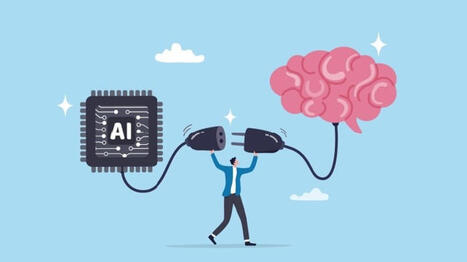
AI creates a paradox: making learning easier while making it more essential. The solution is to adopt the "Centaur" model.
EDTECH@UTRGV's insight:
"After AI defeated grandmaster Garry Kasparov, a new form of the game emerged where human-AI teams, or "Centaurs," consistently outperformed both AI alone and humans alone. This paradigm—Human + AI > AI alone—is the key to unlocking future professional growth."
Scoop.it!

In 2025, higher education shifted from expansion to impact, with institutions now judged on graduate readiness and research relevance. This structural reinvention was driven by AI's integration, the erosion of the degree as the sole competence marker, and a global reality demanding adaptable, outcome-driven learning. Universities are now continuous talent-development platforms, prioritizing skills and lifelong learning for relevance.
EDTECH@UTRGV's insight:
"For decades, universities were assessed on expansion, that is, more campuses, higher enrolments, global rankings and physical infrastructure. That era is now decisively over."
Scoop.it!

Rand research indicates teachers of young students want and need more training in ed tech, curricula and supporting diverse learners.
EDTECH@UTRGV's insight:
"About 30% of preschool teachers in public schools said they used generative artificial intelligence in their job during the 2024-25 school year, according to research by Rand Corp. released in December. That’s low compared to K-12 teachers, with high school educators incorporating AI at the highest rate at 69%."
Scoop.it!

"Despite concerns about screen time, more preschool teachers are using artificial intelligence products in their classrooms, according to a new report."
EDTECH@UTRGV's insight:
"[A]s AI is evolving and the entire edtech landscape is evolving, it’s making it harder for teachers to know what is high and low quality... So this is probably more important than ever.”
Scoop.it!

More than two dozen states and Puerto Rico have issued AI education guidance, and unsurprisingly, the recommendations fall short.
EDTECH@UTRGV's insight:
"So far, state guidance has been heavy on frameworks and glossaries and light on clear, actionable policies and resources. No state guidance has emerged as a clear model to emulate."
Scoop.it!

AI-fueled technologies make communicating in other languages easier than ever, but it still can’t replace the transformative value of learning a new language.
EDTECH@UTRGV's insight:
"[W]hat’s the value of learning another language when AI can handle tourism phrases, casual conversation and city navigation? The answer... lies not in fleeting encounters but in cultivating enduring capacities: curiosity, empathy, deeper understanding of others, the reshaping of identity and the promise of lasting cognitive growth."
|








"Similar to AI convergence in the medical profession, the marriage between AI professors and human professors,... will likely be a bumpy one."