


Video content has exploded in popularity, and it’s no wonder. Consumers find video engaging, compelling and convincing — so much so that they’re anywhere from 64% to 85% more likely to buy after…

 Your new post is loading...
 Scoop.it! Video content has exploded in popularity, and it’s no wonder. Consumers find video engaging, compelling and convincing — so much so that they’re anywhere from 64% to 85% more likely to buy after… 
lynnegibb's curator insight,
May 18, 2017 4:20 AM
This this could be really useful!

Rosemary Tyrrell, Ed.D.'s curator insight,
July 20, 2017 11:33 AM
Always helpful to find some free resources for creating videos! 
Bart van Maanen's curator insight,
July 23, 2017 8:24 AM
Lekker grasduinen in muziekjes? Hier is een lijstje mogelijkheden.
Sign up to comment
Scoop.it!

Critical instructional design moves toward learning that blends a new form of rigor with agency through a practice of inquiry, empathy, and emergence. Via Ana Cristina Pratas, Mark E. Deschaine, PhD
Scoop.it!

It’s commonly heard that using a professional voice actor for eLearning is out of the question since there are no funds for it, or that using a professional voice actor for the backlog of eLearning projects waiting to be completed would put a major crimp in ROI. ROI is simply calculated as the gain or return / cost of instruction. This got me thinking: What exactly ROI might be when it comes to eLearning and through what lens is it measured? Here are a few scenarios for measuring eLearning ROI. Via Edumorfosis
Scoop.it!

A survey of 1,000 16-24 year olds, commissioned by Jisc, found that three quarters (75%) of higher education students surveyed believe that having staff with the appropriate digital skills is an important factor when choosing a university. 99% of students think that technology is becoming increasingly important in education, while 62% believe technology keeps them more engaged. Via Nik Peachey 
Nik Peachey's curator insight,
May 8, 2017 7:21 AM
Increasingly what I see is universities wanting to do the same things they have always done and in the same way but with a dash of digital delivery.
Scoop.it!
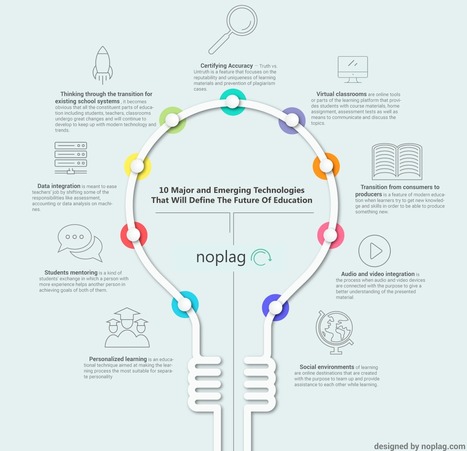
"Innovative technologies change the way we used to learn and that happens incredibly quickly. What major technologies will define the future of modern education? ...." Via Leona Ungerer, juandoming, Stephania Savva, Ph.D 
Jimena Acebes Sevilla's curator insight,
May 7, 2017 12:56 PM
La mejor tecnología y su influencia en el futuro de la educación
Scoop.it!
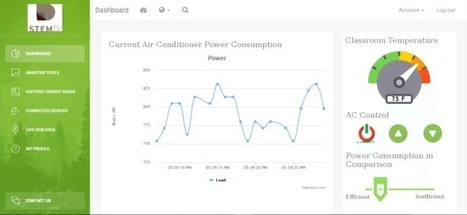
The primary goal of this paper is to operationalize the connectivism approach into a new learning model with additions from problem-based and contextual learning that can be effectively implemented together, to improve socioeconomically diverse learners' educational outcomes (attitude and persistence) in STEM (Science, Technology, Education and Mathematics) areas. Via THE OFFICIAL ANDREASCY 
THE OFFICIAL ANDREASCY's curator insight,
March 4, 2017 2:03 AM
Connectivism is a learning theory introduced by George Siemens which discusses the way we learn in the digital era. This paper explores the potential of operationalizing connectivism through a new learning model adopting and adapting perspectives from problem-based learning and contextual learning. These three pillars are described to explain what and why to learn in a given context. The authors even proceed to explain how the model is adapted for a specific course design.
Really insightful and useful for educators in all levels, but mainly for Higher Education. 
Marta Torán's curator insight,
May 4, 2017 3:24 PM
Un estudio muy interesante. El futuro del aprendizaje social. Aprendizaje basado en problemas. Aprendizaje contextual. 
Oskar Almazan's curator insight,
May 6, 2017 1:48 PM
"Since learning is a social phenomenon, social technologies can help develop the capacity to learn beyond classroom boundaries. For example, social learning can help students experience the distributed nature of knowledge, discover and navigate connections of ideas, entities, and events, while nurturing and maintaining social connections (Smidt, Thornton, & Abhari, 2017). Social technologies also help students learn about diversity through social exchange and encourage students to practice respect and tolerance in diverse social settings. "
Scoop.it!

edWeb is a free online community for professional educators, offering networking, resource sharing, collaboration, and professional development webinars.
Scoop.it!

Using a webcam recorder to add webcam footage to a video is a simple way to increase engagement and help viewers connect with your content. Whether you’re trying to add webcam footage to the corner of a training video or you want to start a video with a live introduction, this post will walk you through the steps to add webcam footage to a video. For the example below, we’ll use Camtasia, since it is both a webcam recorder and video editor. If you don’t have it, you can download a trial here. Via Peter Mellow
Scoop.it!

Lecture capture began 10 years ago at DePaul University in Chicago when the College of Computing and Digital Media developed the Course OnLine system. Via Peter Mellow
Scoop.it!

Infographic with valuable YouTube and video insights to improve your video marketing strategy Via Peter Mellow 
Peter Mellow's curator insight,
April 28, 2017 9:19 PM
This article is Industry focused, but what are the implications for educational institutions? And not just from a marketing perspective, but pedagogically?
Scoop.it!

Peter Stuckey and Jimmy Lee, instructors in the Basic and Advanced Modeling for Discrete Optimization (MDO) MOOCs, wanted to create a tutorial like feel for their weekly workshop solution videos. They opted for a conversational approach in these videos – much more informal than the style of their core video material. Via Peter Mellow
Scoop.it!

From classrooms to admissions offices, innovative use of video is fast becoming the norm. Via Peter Mellow |
Scoop.it!

Google Tools for Educators offers help videos for teachers on a number of key teacher technologies including Google Forms, Google Docs and Google Quizzes Via Ana Cristina Pratas
Scoop.it!

Gone are the days when the customary instruction by attending in the classroom was an objective. The headway of science and innovation conveys you to the adjustments in each circle of life. Alongside alternate parts of life, a few advancements have surfaced in the scholarly circles as well. Education is all the more effortlessly and… Via Melissa Spears, Mark E. Deschaine, PhD 
Melissa Spears's curator insight,
May 8, 2017 8:33 AM
No matter how busy you are online learning offers you a leeway to earn your degree. Here are the details. Start digging.
Scoop.it!

Even outside the AI community, there is a broad consensus that technological progress, and artificial intelligence in particular, will require big changes in the way education is delivered, just as the Industrial Revolution did in the 19th century. As factory jobs overtook agricultural ones, literacy and numeracy became much more important. Employers realised that more educated workers were more productive, but were reluctant to train them themselves because they might defect to another employer. That prompted the introduction of universal state education on a factory model, with schools supplying workers with the right qualifications to work in factories. Via Nik Peachey
Scoop.it!

What I mean when I say that MOOCs are dead is not that MOOCs no longer exist, but that MOOCs are no longer competing against universities for the same students. Continuing with the Coursera theme here, in August they became the last of the major MOOC providers to pivot to corporate training. While I did note the departure of Daphne Koller on this blog, I didn’t even bother to mention that pivot at the time because it seemed so unremarkable, but really it is. Via Nik Peachey 
Becky Roehrs's curator insight,
May 9, 2017 9:50 AM
I love taking MOOC's, but would never want my (public) institution to waste money on creating or maintaining a MOOC ..what a waste of public money! Let the private schools throw their dollars away-we'll be glad to take the courses we like and ignore the rest.
It was obvious, IMO, from day one, MOOC's were not set up for a self-sustaining business model, and were building courses on the backs of faculty who were donating their time and materials to corporations (quite a few of the MOOC providers are not non-profit, in spite of their "good intentions").
Corporate training is their only hope..until then, take the courses while they are free!
Scoop.it!

According to a recent comScore study, physicians spend 48% of their online time on professional sites. According to the study, the top sites in HCP and General Health Content are part of the WebMD network, while for the Social Media category, Sermo is the first one. Source: comScore Via Plus91
Scoop.it!
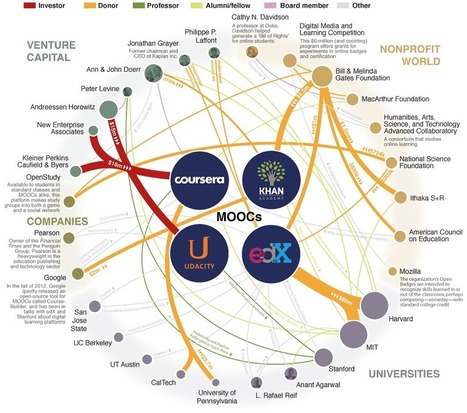
The recent emergence of Massive Open Online Courses, commonly known as MOOCs, is revolutionizing the online education world and is having a profound impact on higher education. With the growing adoption of MOOCs, the number of MOOC providers has also increased many folds. Below is a comprehensive and up-to-date list of MOOC providers; might be helpful to all interested. Via Dr. Stefan Gruenwald 
Usein González's curator insight,
January 14, 2014 9:51 PM
Una de las nuevas metodologías de aprendizaje colaborativo está tomando fuerza a nivel mundial mi experiencia en estos cursos son muy didacticos, excelentes videos de apoyo y bien documentados.
Scoop.it!
Our rapidly changing technological landscape is having a massive impact on social and economic inequality. Dr Craig Holmes, Senior Research Fellow at the Institute for New Economic Thinking at the Oxford Martin School, considers how automation is changing the nature of innovation, employment and education, and how this in turn perpetuates inequality. Via Edumorfosis
Scoop.it!

This is the poster we are presenting at the Coursera conference 2017 next week.
This link will display a high res version to view and/or download. Via Peter Mellow
Scoop.it!

What is green screen? And why use it? Get all the ins and outs. Learn how to make your first chroma key video on the cheap with this step-by-step guide. Via Peter Mellow
Scoop.it!

Students see live-streaming video of classrooms as an intrusion, prompting a debate in China about privacy, educational ethics and helicopter parenting. Via Peter Mellow
Scoop.it!
Open source hardware: http://lightboard.info The Lightboard is a glass chalkboard pumped full of light. It's for recording video lecture topics. You fac Via Peter Mellow 
Daniel Collins's curator insight,
May 3, 2017 1:39 AM
For those who like to present with a board, the lightboard allows you to do this in front of a video camera!
Scoop.it!

Jeanette Hoorn’s Sexing the Canvas: Art and Gender MOOC was the first University of Melbourne MOOC that didn’t rely on the use of PowerPoint slides. Due to the subject matter and Jeanette’s desire to transport learners into the world of art, location shoots at the National Gallery of Victoria, Museum of Modern Art and The Huntington galleries took place.
Via Peter Mellow |






