


There are multiple reasons for high dropout rates in online classes. But it's possible to improve course completion rates. Read to know how.
Via EDTECH@UTRGV

 Your new post is loading...
 Scoop.it! There are multiple reasons for high dropout rates in online classes. But it's possible to improve course completion rates. Read to know how. Via EDTECH@UTRGV No comment yet.
Sign up to comment
Scoop.it!

"With increasing pressure for social media platforms to be more transparent about their data collection and disbursement methods, colleges and universities are a natural step on the path for individuals being more mindful of how their data is being mined and used. But unlike websites and social media platforms, institutions actually use the data to determine how campus services are marketed, how academic interventions should be deployed, and how security methods can be improved." Via EDTECH@UTRGV
Scoop.it!

"Should you try to be funny when you teach online? Sometimes, yes - as long as you do it right!" Via EDTECH@UTRGV 
EDTECH@UTRGV's curator insight,
May 8, 2018 6:10 PM
We have to be careful with humor. Sometimes it backfires when students interpret things too literally.
Scoop.it!

As digital learning technologies continue to grow and develop at pace we need to match that development with an ever deeper understanding about how we connect the right tools to the specific learning need. Any money spent on a scalable learning technology that doesn’t meet the learning needs is still money wasted, however ‘cost effective’ the cost-to-learner ratio is. Via Nik Peachey 
Nik Peachey's curator insight,
May 10, 2018 12:57 AM
Bit promotional at the end but a solid argument. 
Kim Flintoff's curator insight,
May 10, 2018 10:23 PM
As digital learning technologies continue to grow and develop at pace we need to match that development with an ever deeper understanding about how we connect the right tools to the specific learning need. Any money spent on a scalable learning technology that doesn’t meet the learning needs is still money wasted, however ‘cost effective’ the cost-to-learner ratio is.
Scoop.it!

Allowing students to bring mobile devices into class can boost collaboration and improve learning outcomes. 
Julie Lindsay's curator insight,
May 2, 2017 5:51 PM
Yes, and also schools should not ban faculty from using mobile devices
Scoop.it!

Scoop.it!

There’s a link between the amount of diversity in employees’ Twitter networks and the quality of their ideas.
Scoop.it!
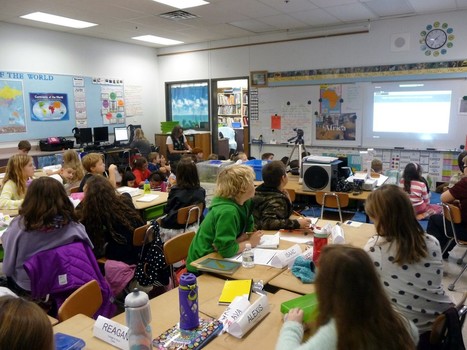
You’ve probably heard about the benefits of digital learning: It’s engaging, student-centered, often collaborative, and can increase student achievement. Via Edumorfosis
Scoop.it!

The BBC has made its sound effects archive available to the public for free for the first time. Via Elizabeth E Charles, Bhushan Thapliyal
Scoop.it!

As we approach the exam season, SEN/ALN coordinators across the land are going to be getting things in place ready to support those learners with additional needs for the upcoming exams. One thing …
Scoop.it!

Our Chrome extension has been updated with a brand new look! It's now simpler than it's ever been to create great screencasts in seconds. Via Dr. Tom D'Amico (@TDOttawa)
Scoop.it!

Teachers in the U.S. are slightly more likely to see student use of digital devices as having a positive rather than negative effect on the overall education of students. In contrast, they are far more negative about the effects of those devices on students' physical and mental health.
The nationally representative March 5-12 poll of U.S. teachers finds that more than four in ten K-12 teachers say students' use of digital devices has a "mostly helpful" effect on students' education, while 28% of teachers instead describe the effect of these devices as "mostly harmful."
Meanwhile, an overwhelming majority of teachers in the U.S. (69%) believe students' use of digital devices has mostly harmful effects on students' mental health; a slightly smaller share of teachers (55%) express this concern with respect to students' physical health. Via LGA, Edumorfosis
Scoop.it!
|
Scoop.it!

"A new study from Arizona State University suggests that online courses may be better equipped to help retain students and to keep them on the path to graduation, according to a report from Campus Technology." Via EDTECH@UTRGV
EDTECH@UTRGV's curator insight,
May 9, 2018 6:19 PM
If designed and facilitated correctly, online courses can be as good as, and in some cases, better than face-to-face courses. 
Sebastian Rios Restrepo's curator insight,
May 11, 2018 10:34 AM
According to a study held by Arizona State University, online learning has proven to be the path to retain students and help them graduate earlier. Furthermore, the fact of not having to travel long roads to a campus and follow a schedule as well as the option to take classes from their homes has propitiated a comfortable environment that can adjust to the life style of the students. On the other hand, even if the students that take online classes are graduating earlier, this does not mean that they have a deeper view of the technical and framework insights of the career, instead since there are no opportunities to go further with teacher's support or apply framework to real life, then there are more possibilities to forget the topic. For which it is still needed of a pedagogical view and process through a classroom education in dig deeper on the content of the subjects.
In my opinion, even though online classes can help students that have a job or adjusted schedules to take classes and reach a degree, if you really want to learn about the topics and subjects that make up your carrier, then it is much better to take face to face classes in a classroom where if you have any doubt it can be easily solved and also you will have the opportunity to think out of the box and be guided by a tutor.
Scoop.it!

Using the right tools the wrong way won't produce results. Ed tech companies need to develop methodology, not just technology. Via EDTECH@UTRGV
Scoop.it!

MiniTool ShadowMaker is all-in-one system backup and data protection solution that can back up system and disk easily and quickly. Via MiniTool Software
Scoop.it!

Teaching online is a unique experience for faculty and students. Although I love the online environment for some courses, it does present its own challenges. One of those challenges is how to engage online students in activities that push them to go beyond simply reading, interpreting, and interacting. After all, the idea (in most cases) is that the student can apply their learning, knowledge, and skills in their respective fields of study. As such, we are constantly seeking ways to engage students in learning that goes beyond the “click-through” material. Via Edumorfosis
Scoop.it!

Jana Craig-Hare et al. The Effect of Socioscientific Topics on Discourse within an Online Game Designed to Engage Middle School Students in Scientific Argumentation, Journal of Education in Science, Environment and Health (2017). DOI: 10.21891/jeseh.325783
Scoop.it!

AN ATTACK on Russian forces in Syria on January 5th by 13 home-made drones is a good example of “asymmetric” warfare. On one side, exquisite high-tech weapons. On the other, cheap-as-chips disposable robot aircraft. Ten of the drones involved attacked a Russian airbase at Khmeimim.
Scoop.it!

Read this article from James Malone to find 15 great tools for creating amazing visual content for content marketing and social medi Via massimo facchinetti, Bhushan Thapliyal
Scoop.it!

From
9to5mac

In this step-by-step video walkthrough, we discuss and demonstrate a multitude of iPad-centric multitasking tips for iOS.Most iPad users will be aware of the existence of some of these features, b…...
Scoop.it!

GeoGebra is a favorite ed tech resource of math teachers all over the globe. PowerPoint is the default presentation tool on millions o Via Dr. Tom D'Amico (@TDOttawa)
Scoop.it!

Online education has seen tremendous growth in the last decade and student enrolment in web-based classes continue to grow. For many institutions, online learning has even become a substantial revenue stream. In principle and in theory, online learning offers numerous possibilities to practice educational inclusivity. It has the ability to reach an unlimited number of students from anywhere, at any time. Learners have the freedom to work at their own pace and build their own learning paths. It can be a convenient and flexible option for faculty and students alike. Yet, our experiences as instructors of online courses in a university setting begin to paint a slightly different story. Via Alfredo Calderón, Edumorfosis
Scoop.it!
OpenupEd is, worldwide, one of the largest MOOC providers for higher education. We consider MOOCs (Massive Open Online Courses) to be: online courses designed for large numbers of participants,that can be accessed by anyone anywhere as long as they have an internet connection,are open to everyone without entry qualifications, and offer a full/complete course experience online for free. Via Elizabeth E Charles |






