Your new post is loading...

|
Rescooped by
Dennis Swender
from Edumorfosis.it
January 10, 2019 1:45 PM
|
Many companies reluctantly spend a lot of money sending employees on training courses that can last for days. During these, employees are unable to complete their daily work, which might distract them, or they are answering emails and miss important information. Often, these formal ways of learning are the only time employees receive training, which does not only cost the company money but also productivity.
Organisational learning objectives always want new employees to get up to speed as soon as possible. However, formal learning only makes up about 10% of our preferred way of learning. The other 90% are exposure to new tasks and learning through experience (Jennings’ 70-20-10 model). This is known as social learning. Let’s discuss how to implement ‘the other 90%’ at the workplace.
Via Edumorfosis
|
|
Rescooped by
Dennis Swender
from Creative teaching and learning
January 10, 2019 1:42 PM
|
"The following is the latest installment of the Toward Better Teaching advice column. You can pose a question for a future column here. Dear Bonni: How ..."
Via Leona Ungerer
|
|
Rescooped by
Dennis Swender
from Into the Driver's Seat
January 10, 2019 1:41 PM
|
"One of my favorite phone apps is Google Slides. If you don’t have it installed on your phone app I highly recommend getting it. Slides are multimedia and collaborative. With an open canvas what can you not do?
Anytime Anywhere Learning
"Years ago, before Google Apps, this was the push in my district. Students could learn anytime, anywhere thanks to the laptop program. Mobile devices obviously have taken that idea to whole new levels. Google Slides allow students to capture images straight to the Slides app (even in offline) to find connections between what they are learning at school and where they are outside of school."
Via Jim Lerman
|
|
Rescooped by
Dennis Swender
from Educational Technology News
January 10, 2019 12:26 AM
|
Sue Ekimoglou of New Jersey's Gloucester High School explains why teaching Advanced Placement math courses online improved her practice and taught students to take more control of their learning.
Via EDTECH@UTRGV
|
|
Rescooped by
Dennis Swender
from Tools for Teachers & Learners
January 9, 2019 11:38 PM
|
Engage your students in open and exploratory dialogues in the classroom with Talkwall. Expand your dialogic teaching.
Via Nik Peachey
|
|
Rescooped by
Dennis Swender
from Tools for Teachers & Learners
January 9, 2019 11:36 PM
|
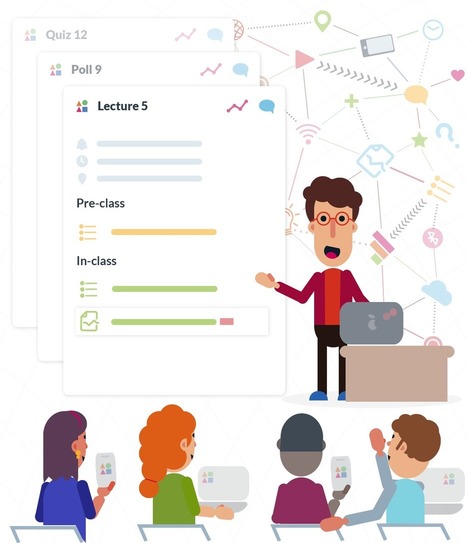
Acadly converts any university classroom into a smarter classroom for free. Move beyond clickers to free live polls, quizzes, Q&A, attendance, video & discussions. Add analytics, IM and file-sharing. This is active learning simplified.
Via Nik Peachey
|
|
Rescooped by
Dennis Swender
from Learning with Technology
January 9, 2019 11:18 PM
|
A lot has changed since Yahoo and AOL were the homepages of choice. Today's visualization looks at the largest internet giants from 1998 to today.
Via NextLearning
|
|
Rescooped by
Dennis Swender
from education
January 9, 2019 11:16 PM
|
|
|
Rescooped by
Dennis Swender
from Online Student Engagement
January 8, 2019 1:47 AM
|
Since then, I've tried lots of different strategies in my classes and, despite the fact that our world has become more connected through social technologies in recent years (that are easy to use and often free), I still have students who regularly share with me that my class is different -- because they feel like they know me and they feel like I care. This isn't to say that online instructors who use voice/video and interactive tools to design and facilitate their courses are the only instructors who care. But these strategies are key to my ability to be present in the experiences of my students. And they're key to my ability to share my inflection, my concern, and my enthusiasm for them -- nuances text cannot convey.
Via Peter Mellow, Kim Flintoff
|
|
Rescooped by
Dennis Swender
from Online Student Engagement
January 8, 2019 1:46 AM
|
It’s no longer acceptable to upload video lectures to a website and call it a course. We need to start redesigning courses from scratch to find new ways to engage students.
Via Kim Flintoff
|
|
Rescooped by
Dennis Swender
from Online Student Engagement
January 8, 2019 1:45 AM
|
"Often times, tips for engaging learners in corporate online learning include external features and novel delivery methods. These range from using animations, “real-life” scenarios, game-design, leaderboards, and badges. But with learners actually spending more time learning and developing themselves outside of the corporate learning infrastructure, knowing what is appealing for them could have us directing our efforts and attention in a more focused approach that leads to greater engagement, activity and—more importantly—results. Here are some tips based on learner preferences that could give you the results that you are seeking."
Via EDTECH@UTRGV, Kim Flintoff
|
|
Scooped by
Dennis Swender
January 7, 2019 1:39 PM
|
The world of influencenrs is quite the bubble; these people care about likes, follows, views, comments and engagement. But we want to know - what do normal people really think about social media influencers? The findings of a survey of 4,000 people i
|
|
|
Rescooped by
Dennis Swender
from Creative teaching and learning
January 10, 2019 1:44 PM
|
"Simply put, educators are some of the most dynamic, creative, brilliant people on the planet. When we work alone, our effectiveness will be capped at our own potential. When we work together, our brilliance will only be capped by our own egos and pride ..."
Via Leona Ungerer
|
|
Rescooped by
Dennis Swender
from Edumorfosis.it
January 10, 2019 1:42 PM
|
The online degree market has been one of the fastest-growing and most resilient segments of American higher education over the last two decades.
Today, more than three million students pursue higher education fully online, representing a $20-billion market. While online students are still only about 15 percent of all higher education enrollment in the U.S., it’s an area that is likely to continue to grow and make up a larger piece of the overall pie, given growing interest from students, more offerings from colleges, and increasing acceptance by employers
However, as the online degree market reaches a state of maturity, it is entering an entirely new era in its evolution – an era characterized by a changing competitive landscape, new technological developments and consumer preferences, and growing overlap with non-degree learning.
Via Edumorfosis
|
|
Rescooped by
Dennis Swender
from Educational Technology News
January 10, 2019 1:41 PM
|
A few weeks ago I asked a group of teachers to describe a lesson where technology was used effectively to impact learning. After som
Via EDTECH@UTRGV
|
|
Rescooped by
Dennis Swender
from Tools for Teachers & Learners
January 9, 2019 11:38 PM
|
It’s clear that the more you use Epigrammar the more time it is likely to save you and the more efficient the whole process will become. A bonus feature of the site is that you and your students will also be creating a form of e-portfolio that will enable you and students to look back over their work and assess progress.
Via Nik Peachey
|
|
Rescooped by
Dennis Swender
from Tools for Teachers & Learners
January 9, 2019 11:37 PM
|
Well here finally is a genuine example of something we can use to save time and effort. Quillionz is an AI-powered question generator that can help you to take any text from anywhere and create a range of comprehension or test questions around it.
Via Nik Peachey
|
|
Scooped by
Dennis Swender
January 9, 2019 11:35 PM
|
Why spend so much time on generating questions for your courses? Automate question generation with Quillionz: AI-powered, fastest, auto-question generator. Take any text and create a range of test questions around it in seconds.
|
|
Rescooped by
Dennis Swender
from Online Student Engagement
January 8, 2019 1:47 AM
|
Discover the secret recipe for creating engaging eLearning courses. Only 4 ingredients required!
Via EDTECH@UTRGV, Kim Flintoff
|
|
Rescooped by
Dennis Swender
from Online Student Engagement
January 8, 2019 1:46 AM
|
I used to think that when students were disengaged it was their own fault, and while sometimes that is still true, I have found in my years of teaching that a lot of the fault lies with me as the teacher. Yet, realizing that I may be the cause of my students disengagement is hard to swallow. It certainly has not done wonders to my self-esteem, and yet, there is something liberating about realizing that while I am a part of the problem, that also means that I can fix it.
Via Nik Peachey, Kim Flintoff
|
|
Rescooped by
Dennis Swender
from Online Student Engagement
January 8, 2019 1:45 AM
|
We often talk about the importance of learner motivation in eLearning. In fact, we’ve even said that motivation is often more important than the specific content when seeking to maximize the impact of instruction – particularly in eLearning, where relatively few social or external environmental factors are likely to inspire learners.
This has a great deal of surface value, in that motivation is actually a factor in all of human activity. For example, it’s been over 95 degrees here every day for the last week, and my motivation to work outside has plummeted. Of course, lacking motivation affects my level of effort. If willing effort is the only result of creating motivation, then saying that “designing for learner motivation in eLearning is important” is not really that significant. Of course it’s true, but it is so general a statement that this insight gains us very little in trying to really improve instruction. But actually, our focus on motivation has very specific importance in instruction.
Via Kim Flintoff
|
|
Rescooped by
Dennis Swender
from The Student Voice
January 8, 2019 1:43 AM
|
Our laws offer students very little protection against the wiles of the technology industry.
Via Peter Mellow
|