Your new post is loading...
In order to create as accurate as possible computational models of stem cell behavior, the LCSB’s Computational Biology Group led by Prof. Antonio del Sol applied a novel approach. “Stem cells live in a niche where they constantly interact with other cells and extra-cellular components. It is extremely difficult to model such a plethora of complex molecular interactions on the computer. So we shifted perspective. We stopped thinking about what external factors were affecting the stem cells, and started thinking about what the internal state of a stem cell would be like in its precisely defined niche.” The novel approach led to in a new computational model developed by Dr. Srikanth Ravichandran of the Computational Biology Group: “Our model can determine which proteins are responsible for the functional state of a given stem cell in its niche – meaning whether it will divide or remain in a state of quiescence. Our model relies on the information about which genes are being transcribed. Modern cell biology technologies enable profiling of gene expression at single cell resolution.” It was previously unknown why most of the stem cells in the brain of old mice remain in a state of quiescence. From their computational model, the researchers at the LCSB identified a molecule called sFRP5 that keeps the neuronal stem cells inactive in old mice, and prevents proliferation by blocking the Wnt pathway crucial for cell differentiation.
Via Krishan Maggon

|
Rescooped by
Dr. Stefan Gruenwald
from Popular Science
June 10, 2019 2:21 PM
|
A 2019 Intel ISEF finalist used a plant hormone and extra fertilizer to boost the numbers of multi-leafed clovers — including lucky four-leafed plants — she could reliably grow. According to superstition, a four-leaf clover brings good luck. Wouldn’t it be nice to be able to grow your own whenever you wanted? A 17-year-old researcher from Japan has found a way to do just that. The shamrock, maybe the most familiar type of clover, belongs to two species in a genus called Trifolium. That name, which comes from Latin, means three leaves. And it well describes this plant. Only one shamrock in every few thousand has more than three leaves, notes Minori Mori, a 12th grader at Meikei High School in Tsukuba, Japan. Some companies sell clover seeds that will grow into plants that are more likely to produce four leaves. But even in plants grown from these seeds, four-leafed ones remain rare. Minori wondered if she could somehow boost the odds of getting four-leafed clovers. The teen showcased her success here at the Intel International Science and Engineering Fair, or ISEF. This competition was created by Society for Science & the Public. (The Society also publishes Science News for Students.) The 2019 event, which was sponsored by Intel, brought together more than 1,800 finalists from 80 countries.
Via Neelima Sinha
|
|
Rescooped by
Dr. Stefan Gruenwald
from Papers
June 10, 2019 2:11 PM
|
Surviving fragments of genetic material preserved in sediments allow metagenomics researchers to see the full diversity of past life — even microbes. The moment an organism dies, its body begins to decompose. Its cells rupture, and their contents spill into the environment. What scientists have realized over the past two decades is that even though the physical structure of a body disappears, its DNA can last for centuries. Eske Willerslev, an evolutionary geneticist at the University of Copenhagen, has found this DNA in the least likely places, including the soil underneath glaciers, in caves and more. His work has helped rewrite the natural histories of many locations around the globe by reconstructing ecosystems as much as 450,000 years old, and maybe older. He claims the idea came to him as a graduate student. “It was the autumn, and I saw leaves falling from the trees, and I saw a dog take a crap on the street,” he recalled, all of which set him to wondering: “‘What happens to that DNA? Could it somehow be preserved in the sediments or in the soil where it was put?’”
Via Complexity Digest
|
|
Rescooped by
Dr. Stefan Gruenwald
from Soggy Science
June 10, 2019 2:05 PM
|
A large space object about a mile wide is believed to have crashed into Earth around 1.2 Billion (bn) years ago. The location of an ancient impact crater made by the biggest asteroid ever to hit Britain has been traced to a spot under the sea between mainland Scotland and the Outer Hebrides. Researchers at Oxford and Aberdeen universities found signs of the violent collision in Scotland on a field trip in 2008, but have only now pinpointed where the asteroid came down. Tests on rocks near Ullapool in north-west Scotland revealed that an object about a mile wide had crashed into a spot in the Minch, a strait that separates the mainland and northern Inner Hebrides from Lewis and Harris, six miles west of the village of Lochinver. The 38,000 mph collision, which thumped a 12-mile-wide crater into the ground, happened 1.2 bn years ago, when most life on Earth was still in the oceans and plants had yet to take root on land. At the time, what is now Scotland was a semi-arid land that lay close to the equator. “The impact would have sent huge roiling clouds of dust and gas at several hundred degrees in all directions from the impact site,” said Ken Amor, an Oxford researcher who led the latest study. What is left of the crater is submerged in 200-meter-deep water and covered in sediment.
Via Grant W. Graves
|
|
Scooped by
Dr. Stefan Gruenwald
June 10, 2019 1:22 PM
|
A new study on polar ice sheet melt warns that global sea levels could rise by almost six feet by the year 2100, an estimate twice as high as previously predicted. The newly modeled sea level rise would devastate parts of major cities around the globe, and displace hundreds of millions of people. The study was published Monday in the Proceedings of the National Academy of Sciences [PNAS]. Future sea level rise (SLR) poses serious threats to the viability of coastal communities, but continues to be challenging to project using deterministic modeling approaches. Nonetheless, adaptation strategies urgently require quantification of future SLR uncertainties, particularly upper-end estimates. Structured expert judgement (SEJ) has proved a valuable approach for similar problems. The researchers findings, using SEJ, produce probability distributions with long upper tails that are influenced by interdependencies between processes and ice sheets. They find that a global total SLR exceeding 2 m by 2100 lies within the 90% uncertainty bounds for a high emission scenario. This is more than twice the upper value put forward by the Intergovernmental Panel on Climate Change in the Fifth Assessment Report. Despite considerable advances in process understanding, numerical modeling, and the observational record of ice sheet contributions to global mean sea-level rise (SLR) since the Fifth Assessment Report (AR5) of the Intergovernmental Panel on Climate Change, severe limitations remain in the predictive capability of ice sheet models. As a consequence, the potential contributions of ice sheets remain the largest source of uncertainty in projecting future SLR. The upper limit for sea level rise by 2100 has previously been estimated between 1.7 and 3.2ft. – the range given in the fifth assessment report from the Intergovernmental Panel on Climate Change (IPCC), the leading international body for the assessment of climate change, in 2013. But many scientists believe that was a conservative estimate. The rate of glacier melt in Greenland and Antarctica is accelerating, and the authors of the report say current prediction models don’t account for significant uncertainties in how melting ice sheets could affect sea level rise.
|
|
Scooped by
Dr. Stefan Gruenwald
June 10, 2019 1:11 PM
|
Everything you need to know about SETI, the Drake equation, ’Oumuamua, and hot tubs. Astronomers recently revised the estimate of their progress in scouring the universe for fingerprints of alien technology (including just the search for radio waves). They’ve sampled a portion of the galaxy equivalent to a hot tub’s worth of ocean water. Congratulations, SETI! But since it would take 166,875,000,000,000,000 hot tubs to fill the ocean, you might wonder why SETI scientists even bother. Well, the thing is that, if smart extraterrestrials are out there, and if humans ever find them, it’s statistically likely their civilization will be a lot older than ours. Since a little more than 25 years ago, NASA has had no SETI programs. Scientists, though, aren’t that easy to stop—especially not when the end result of their quest could be some kind of cosmic salvation. And so the former NASA team privatized their efforts, and began a program called Project Phoenix, backed by some of Silicon Valley’s early tycoons. For nine years, from 1995-2004, they did the work they’d planned to do under NASA’s banner on their own terms, through the nonprofit SETI Institute. From Arecibo, Green Bank, Jodrell Bank Observatory in England, and the Parkes radio telescope in Australia, they sought after radio broadcasts from the great beyond. After the dawn of the new millennium, the SETI Institute built its own telescope in partnership with Berkeley, funded by the late Paul Allen. While the team intended to construct 350 antennas, cost overruns mean the Allen Telescope Array stopped at 42 dishes. In 2011, Berkeley and the Institute parted ways, and SRI—one of those big-time defense-oriented nonprofits, and also the one that did the DoD’s men-who-stare-at-goats projects—operates the telescope for the SETI Institute, sharing observation time with the scientists. Today (2019), these scientists aim the antennas at friendly-seeming planets the Kepler Space Telescope has found, nearby dwarf-star systems, and whatever some scientist says is weird and so is (maybe, perhaps) aliens. The Institute now has company, though: In 2015, billionaire Yuri Milner announced that he was giving $100 million to other SETI scientists, to look for extraterrestrial radio and lasery signals over the next 10 years. Today, strangely, the same scientist—Andrew Siemion—leads both the SETI Institute’s alien-hunting division and Milner’s Breakthrough Listen program. That’s not quite the consolidation of power it would have been just a few years ago—because more groups are turning their scopes skyward and searching for smart life. Astronomer Shelley Wright leads a laser search called NIROSETI from the University of California, San Diego, and her team is starting up a wide-view search called PANOSETI. An organization called METI International, meanwhile, also does optical searches, primarily with the Boquete Observatory in Panama and with volunteers’ personally owned telescopes. UC Santa Barbara scientists are planning the Trillion Planet Survey, to look for extremely energetic signs of smart life.. At Penn State, astronomer Jason Wright helped start the PSETI Center, which does research and has a formalized SETI education program. Telescopes in Sardinia, the Netherlands, and Western Australia have also done some looking. In short, the people searching for smart aliens are multiplying. Which is good for any field’s research trajectory: the more minds you have in more different places having different conversations and making different plans, the more creative and diverse your strategy set will be. That’s particularly important for SETI, given that we know legit little about if and how all this seeking might turn into a find.
|
|
Scooped by
Dr. Stefan Gruenwald
June 10, 2019 1:01 PM
|
Astronomers have captured images of young still-forming planets around a very young star. And these images are proving an important hypothesis correct. Stars form from massive clouds of mostly hydrogen called molecular clouds. Molecular clouds are gravitationally unstable and the gas tends to clump together. Eventually, one of these clumps starts snowballing and getting larger and larger. As it does so, the cloud flattens out like a pancake, and starts rotating, and when the central clump becomes dense enough, it ignites into a fusion and a star is born. Many stars are in binary systems, when two stars form from the molecular cloud. But the star at the center isn’t the only clump. Other, smaller clumps form in the rotating gas, and they can form into planets. Some of the gaseous planets, like Jupiter and Saturn in our own Solar System, can get really big. (Astronomers sometimes refer to Jupiter and Saturn as “failed stars” because they were on their way to becoming stars but couldn’t quite get there.) If you could freeze the process there, you would see a young star in the center of a flat, rotating cloud of gas. But in the gas you would see ring-shaped gaps, where planets are busy sweeping up material and becoming, well, planets. That process is called accretion. And it’s no longer a molecular cloud, now it’s called a “protoplanetary disk,” because it’s a disk shape and proto-planets are forming in it. And that’s exactly what astronomers do see. ALMA’s best image of a protoplanetary disk to date. This picture of the nearby young star TW Hydrae reveals the classic rings and gaps that signify planets are in formation in this system.
|
|
Scooped by
Dr. Stefan Gruenwald
June 10, 2019 12:57 PM
|
University of Glasgow physicists have found a new form of magnetic interaction which pushes a previously 2D phenomenon into the third dimension. Scientists say this development could open a range of possibilities for data storage and advanced computing. Findings published in the journal Nature Materials describe the team’s new method for passing information from tiny magnets on ultra-thin film, to magnets on another film below. The south pole of one magnet attracts the north pole of another. However, this applies to magnets of a size most people are familiar with, it can change as they shrink. At the nanoscale, where magnets may be just a few billionths of a meter in size, they interact with each other in new ways, including attracting and repelling each other at 90-degree angles instead of straight-on. Scientists can exploit these properties to encode and process information in thin films covered in a single layer of nanoscale magnets. This innovation adds both literal and metaphorical extra dimension to spintronics, which is the field of science dedicated to data storage, retrieval and processing. Spintronic systems have numerous benefits including low power consumption, high storage capacity and greater robustness. In the past, spintronics was behind significant technological advances i.e. magnetic hard disk drives, while today the functionality of magnetic systems in computers is confined to one plane. Now, the Glasgow team’s innovation has created potential for storage and computation. Dr Amalio Fernandez-Pacheco, an EPSRC Early Career Fellow in the University’s school of physics & astronomy, was the paper’s lead author. He said: “The discovery of this new type of interaction between neighbour layers gives us a rich and exciting way to explore and exploit unprecedented 3D magnetic states in multi-layered nanoscale magnets. “It’s a bit like being given an extra note in a musical scale to play with – it opens up a whole new world of possibilities, not just for conventional information processing and storage, but potentially for new forms of computing we haven’t even thought of yet.”
|
|
Scooped by
Dr. Stefan Gruenwald
June 10, 2019 12:47 PM
|
Astronomers, for the first time, have snapped an image of a faint, gassy ring swirling around the supermassive black hole at the center of our galaxy. This ring is part of the so-called accretion disk — stars, dust and gases — that surround most black holes. These materials are held close by the black hole's strong gravitational grip and the far edge represents the outer limits of its gravitational reach. In the case of the Milky Way's black hole called Sagittarius A*, the disk extends out a few tenths of a light-year from the black hole's event horizon — the point at which even light can't escape the black hole's grasp. There are a few types of gases that make up parts of this accretion disk, and scientists previously have only imaged the very hot, glowing ones, according to a statement from the National Radio Astronomy Observatory. Because these gases are so hot — at about 18 million degrees Fahrenheit (10 million degrees Celsius) — they give off X-rays that researchers could easily detect. But this accretion disk also has cooler hydrogen gas — 18,000 F (10,000 C) — though it hasn't been imaged before. The radiation in the area causes hydrogen atoms to constantly lose and gain their electrons, an activity that releases weak radio waves, according to the statement. The team detected these radio waves using the Atacama Large Millimeter/submillimeter Array (ALMA) observatory in Chile, and stitched the measurements together into the new image. Using radio wave signals, researchers took the first-ever image of the faint, cool ring of hydrogen gas that circles Sagittarius A*. The plus sign represents the black hole, the red coloring represents the gas moving away from our planet and the blue coloring represents the gas moving toward our planet. The cool hydrogen ring is about a hundredth of a light-year away from the black hole's event horizon, and contains an amount of hydrogen equivalent to a tenth of the mass of Jupiter, according to the statement. What's more, because of the so-called "Doppler effect," which makes light from objects moving toward our planet look slightly "bluer" and light from objects moving away from our planet look slightly "redder," the researchers concluded that the gas is rotating around the black hole. "We hope these new ALMA observations will help the black hole give up some of its secrets," lead author Elena Murchikova, an astrophysicist at the Institute for Advanced Study in Princeton, New Jersey, said in the statement. The researchers reported their findings June 5 2019 in the journal Nature.
|
|
Scooped by
Dr. Stefan Gruenwald
June 6, 2019 9:22 PM
|
|
|
Scooped by
Dr. Stefan Gruenwald
June 5, 2019 4:33 PM
|
Researchers have demonstrated a new reaction for generating oxygen that could help humans explore the universe and perhaps even fight climate change at home Science fiction stories are chock full of terraforming schemes and oxygen generators for a very good reason -- we humans need molecular oxygen (O2) to breathe, and space is essentially devoid of it. Even on other planets with thick atmospheres, O2 is hard to come by. So, when we explore space, we need to bring our own oxygen supply. That is not ideal because a lot of energy is needed to hoist things into space atop a rocket, and once the supply runs out, it is gone. One place molecular oxygen does appear outside of Earth is in the wisps of gas streaming off comets. The source of that oxygen remained a mystery until two years ago when Konstantinos P. Giapis, a professor of chemical engineering at Caltech, and his postdoctoral fellow Yunxi Yao, proposed the existence of a new chemical process that could account for its production. Giapis, along with Tom Miller, professor of chemistry, have now demonstrated a new reaction for generating oxygen that Giapis says could help humans explore the universe and perhaps even fight climate change at home. More fundamentally though, he says the reaction represents a new kind of chemistry discovered by studying comets. Most chemical reactions require energy, which is typically provided as heat. Giapis's research shows that some unusual reactions can occur by providing kinetic energy. When water molecules are shot like extremely tiny bullets onto surfaces containing oxygen, such as sand or rust, the water molecule can rip off that oxygen to produce molecular oxygen. This reaction occurs on comets when water molecules vaporize from the surface and are then accelerated by the solar wind until they crash back into the comet at high speed. Comets, however, also emit carbon dioxide (CO2). Giapis and Yao wanted to test if CO2 could also produce molecular oxygen in collisions with the comet surface. When they found O2 in the stream of gases coming off the comet, they wanted to confirm that the reaction was similar to water's reaction. They designed an experiment to crash CO2 onto the inert surface of gold foil, which cannot be oxidized and should not produce molecular oxygen. Nonetheless, O2 continued to be emitted from the gold surface. This meant that both atoms of oxygen come from the same CO2molecule, effectively splitting it in an extraordinary manner. "At the time we thought it would be impossible to combine the two oxygen atoms of a CO2 molecule together because CO2 is a linear molecule, and you would have to bend the molecule severely for it to work," Giapis says. "You're doing something really drastic to the molecule." .
|
|
Scooped by
Dr. Stefan Gruenwald
June 5, 2019 4:29 PM
|
A rover scanning the surface of Mars for evidence of life might want to check for rocks that look like pasta, researchers report in the journal Astrobiology. The bacterium that controls the formation of such rocks on Earth is ancient and thrives in harsh environments that are similar to conditions on Mars, said University of Illinois geology professor Bruce Fouke, who led the new, NASA-funded study. New research focuses on filamentous microbes that make their living in hot springs and catalyze the formation of travertine rock. “It has an unusual name, Sulfurihydrogenibium yellowstonense,” he said. “We just call it ‘Sulfuri.’” The bacterium belongs to a lineage that evolved prior to the oxygenation of Earth roughly 2.35 billion years ago, Fouke said. It can survive in extremely hot, fast-flowing water bubbling up from underground hot springs. It can withstand exposure to ultraviolet light and survives only in environments with extremely low oxygen levels, using sulfur and carbon dioxide as energy sources. “Taken together, these traits make it a prime candidate for colonizing Mars and other planets,” Fouke said. And because it catalyzes the formation of crystalline rock formations that look like layers of pasta, it would be a relatively easy life form to detect on other planets, he said.
|
|
Rescooped by
Dr. Stefan Gruenwald
from Virus World
June 5, 2019 4:06 PM
|
A research team consisting of scientists from Kyoto University, Tokyo University of Science, National Institute for Physiological Sciences, and Tokyo Institute of Technology, report in the Journal of Virology the Medusavirus, a unique giant virus that gives pause to current theory on viral evolution. The name Medusavirus was given for the effect this virus has on its host, Acanthamoeba castellanii. Once infected, the amoeba forms cysts, a phenomenon called encystment. This is a typical response to environments hostile to survival, and leaves the amoeba with a hard, protective covering. Perhaps it was not a coincidence then that Medusavirus was found in the hot springs in northern Japan, the first giant virus to have been isolated from a heated environment. Along with the location of its discovery, Medusavirus holds a number of distinguishing features compared with other giant viruses. Its DNA codes for all five types of histones, the key proteins that help compact DNA within the nucleus. In fact, no other known virus has all five types. Further, Medusavirus encoded neither RNA polymerase nor DNA topoimerase II, whereas all other giant viruses encode at least one. These features could explain why the replication of Medusavirus DNA begins and completes in the host nucleus to eventually fill the amoeba nucleus with viral DNA, which again is unlike other giant viruses. Moreover, the morphology of the capsid surface was unique, in that it was covered with an extraordinary number of spherical-headed spikes. In addition, the amoeba genome encoded several capsid surface proteins. The existence of histone genes in Medusavirus and capsid protein genes in amoeba suggest lateral gene transfer going both directions -- host-to-virus and virus-to-host. Overall, the findings suggest that Medusavirus offers a new model for host-virus co-evolution and that the Medusavirus is a new family of large DNA viruses.
Via Juan Lama
|
|
|
Scooped by
Dr. Stefan Gruenwald
June 10, 2019 2:40 PM
|
The intuitive idea that objects influence each other because they're in physical proximity is soon to become another of those beliefs that turn out to be wrong when we look deeper. One persistent illusion is that physical objects only interact with other objects they are close to. This is called the principle of locality. We can express this more precisely by the law that the strengths of forces between any two objects falls off quickly—at least by some power of the distance between them. This can be explained by positing that the bodies do not interact directly, but only through the mediation of a field, such as an electromagnetic field, which propagates from one body to the other. Fields spread out as they propagate, with the field lines covering a constantly greater area—providing a natural explanation for the laws that say the forces between charges and masses fall off like the square of the distance between them. Locality is an aspect of an even more compelling illusion: that we exist within an absolute space, with respect to which we mark our positions as we move “through” it. Thus, Newton opined that motion is ultimately defined as change of position with respect to absolute space. If this seems obscure—because no measurement can establish a relation of a physical object to this imagined absolute space—Newton assured us that absolute space is seen by God, making your location relative to it an aspect of the divinity of the world. We humans must make do with relative positions and motions—which are defined relative to physical objects we can see. When locality, and space itself, emerge from averaging over fundamental processes involving a myriad of individual events, it is inevitable that locality will be disordered. Mostly, influences will be local, because most of the time, causally related events will end up close to each other in the emergent rough description we call space. But there will be many pairs of events that are causally related, that will end up far from each other—thus disordering space and locality. Could this disordering of locality serve to explain the quantum nonlocality inherent in entangled particles?Lee Smolin, a senior, and founding, faculty member at the Perimeter Institute for Theoretical Physics in Waterloo, Ontario, believes the answer is 'yes', and indeed has shown that this is the case in two different models of fundamental completions of quantum mechanics.
|
|
Rescooped by
Dr. Stefan Gruenwald
from Papers
June 10, 2019 2:16 PM
|
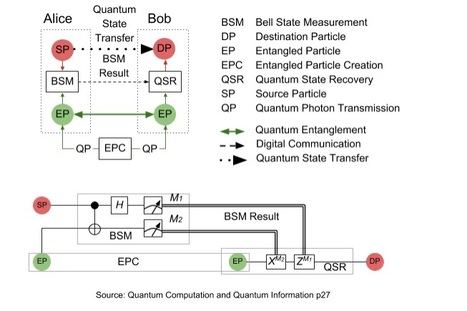
Qubit transmission protocols are presently point-to-point, and thus restrictive in their functionality. A quantum router is necessary for the quantum Internet to become a reality. We present a quantum router design based on teleportation, as well as mechanisms for entangled pair management. The prototype was validated using a quantum simulator. Recent advances in the generation and transmission of entangled photons - both in open space and through fiber optics - open the door to the deployment of a quantum network that will surpass the capabilities of the Internet in terms of security as well as access to quantum computation. The unit of information transfer is the qubit, rather than the standard bit, and it will enable a number of novel quantum applications, some of which have been already developed. Among them, the secure distribution of cryptographic keys, a quantum advantage in communication complexity, the solution of a number of coordination problems among people and institutions in totally private fashion, the provision of public goods without free riding and central controls. and quantum auctions with privacy concerns that exceed the capabilities of classical ones. Equally important, the quantum Internet will enable the access to future powerful quantum computers, which will be, of necessity, first available in the cloud. Presently, the practical implementation of quantum teleportation allows for the transmission of qubits over very large distances using quantum repeaters. Moreover, open space transmission from orbiting satellites has been demonstrated, which together with on-demand generation of solid-state quantum emitters opens the possibility of global quantum communication becoming a reality. But the existing quantum network architecture is mostly based on point-to-point communication and optical switches that at best mimic the old patch networks of telephony. Just as those patch networks were eventually replaced by automatic routers in the Internet, we still need to create and deploy quantum routers that will enable the transmission of quantum teleported photons from any source to any destination. A recent paper in this regard reports on the design and testing via quantum simulations of such a quantum router
Via Complexity Digest
Empirical evidences show that ecosystems with high biodiversity can persist in time even in the presence of few types of resources and are more stable than low biodiverse communities. This evidence is contrasted by the conventional mathematical modeling, which predicts that the presence of many species and/or cooperative interactions are detrimental for ecological stability and persistence. Scientists now propose a modeling framework for population dynamics, which also include indirect cooperative interactions mediated by other species (e.g. habitat modification). They were able to show that in the large system size limit, any number of species can coexist and stability increases as the number of species grows, if mediated cooperation is present, even in presence of exploitative or harmful interactions (e.g. antibiotics). This mainly theoretical approach thus shows that appropriate models of mediated cooperation naturally lead to a solution of the long-standing question about complexity-stability paradox and on how highly biodiverse communities can coexist.
Via june holley
|
|
Rescooped by
Dr. Stefan Gruenwald
from Popular Science
June 10, 2019 2:02 PM
|
Approach could revolutionize blood donation and transfusion. UBC postdoc Peter Rahfeld collected a human stool sample and isolated its DNA, which in theory would include genes that encode the bacterial enzymes that digest mucins. Chopping this DNA up and loading different pieces into copies of the commonly used lab bacterium E. coli, the researchers monitored whether any of the microbes subsequently produced proteins with the ability to remove A-defining sugars. At first, they didn’t see anything promising. But when they tested two of the resulting enzymes at once—adding them to substances that would glow if the sugars were removed—the sugars came right off. The enzymes also worked their magic in human blood. The enzymes originally come from a gut bacterium called Flavonifractor plautii, Rahfeld, Withers, and their colleagues report today in Nature Microbiology. Tiny amounts added to a unit of type A blood could get rid of the offending sugars, they found. “The findings are very promising in terms of their practical utility,” Narla says. In the United States, type A blood makes up just under one-third of the supply, meaning the availability of “universal” donor blood could almost double. But Narla says more work is needed to ensure that all the offending A antigens have been removed, a problem in previous efforts. And Withers says researchers need to make sure the microbial enzymes have not inadvertently altered anything else on the red blood cell that could produce problems. For now, the researchers are focusing on only converting type A, as it’s more common than type B blood. Having the ability to transform type A to type O, Withers says, “would broaden our supply of blood and ease these shortages.”
Via Neelima Sinha
|
|
Scooped by
Dr. Stefan Gruenwald
June 10, 2019 1:18 PM
|
What happens when two supermassive black holes collide? Combining the observing power of two future ESA missions, Athena and LISA, would allow us to study these cosmic clashes and their mysterious aftermath for the first time. Supermassive black holes, with masses ranging from millions to billions of Suns, sit at the core of most massive galaxies across the Universe. We don't know exactly how these huge, enormously dense objects took shape, nor what triggers a fraction of them to start devouring the surrounding matter at extremely intense rates, radiating copiously across the electromagnetic spectrum and turning their host galaxies into 'active galactic nuclei'. Tackling these open questions in modern astrophysics is among the main goals of two future missions in ESA's space science programme: Athena, the Advanced Telescope for High-ENergy Astrophysics, and LISA, the Laser Interferometer Space Antenna. Currently in the study phase, both missions are scheduled for launch in the early 2030s. "Athena and LISA are both outstanding missions set to make breakthroughs in many areas of astrophysics," says Günther Hasinger, ESA Director of Science. "With this unique opportunity to perform unprecedented observations of one of the most fascinating phenomena in the cosmos, the synergy between Athena and LISA would greatly increase the scientific return from both missions, ensuring European leadership in a key, novel area of research." Athena will be the largest X-ray observatory ever built, investigating some of the hottest and most energetic phenomena in the cosmos with unprecedented accuracy and depth.
|
|
Scooped by
Dr. Stefan Gruenwald
June 10, 2019 1:03 PM
|
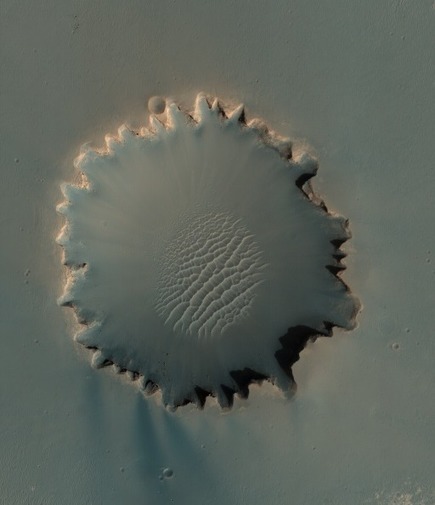
Like Earth, Mars has sand dunes, a lot of them, but scientists are now learning that the processes involved in their formation and movement can be quite different from what happens on our own planet. A team of planetary scientists from the University of Arizona (UA) has conducted the most detailed study yet of how sands move around on Mars, and how that movement differs from sand movement in deserts on Earth. The new research was led by Matthew Chojnacki at the Lunar and Planetary Laboratory (LPL) at UA and the peer-reviewed results were published in the current issue of the journal Geology on March 11, 2019. The team found that processes not involved in sand movement on Earth are very much involved in how sand gets transported on Mars, most notably large-scale features on the landscape and differences in landform surface temperature.
|
|
Scooped by
Dr. Stefan Gruenwald
June 10, 2019 12:58 PM
|
Simulations of large-scale networks of neurons are a key element in the European Human Brain Project (HBP). In a new perspective article scientists from the HBP argue why such simulations are indispensable for bridging the scales between the neuron and system levels in the brain. The authors describe the need for open general-purpose simulation engines that can run a multitude of different candidate models of the brain at different levels of biological detail. Comparing predictions derived from such simulations with experimental data will allow systematic testing and refinement of models in a loop between computational and experimental neuroscience. A wide variety of experimental techniques are used in neuroscience today to gain insight into neural function from measured brain signals. But to understand the complex nonlinear dynamics at play in the brain and to explain how the underlying activity gives rise to the signals, computational modeling is required. Simulations provide the crucial link between data generated by experimentalists and these models, a multi-author team, all affiliated with the European Flagship Human Brain Project, now writes in the new article “The scientific case for brain simulation”. The basis for such simulations has been created on the HBP’s Brain Simulation Platform, a part of the projects Research Infrastructure for brain science that is openly accessible to the neuroscience community. The platform provides a set of continuously improved brain network simulators and has driven the construction of computational models and simulations at various scales, from single neurons to large-scale brain-wide networks. As the terms can easily be confused, the researchers emphasize that simulation and model are not identical. While mathematical models can embody many different hypotheses about how the brain works in equations and experimental parameters, “brain simulators can be viewed as ‘mathematical observatories’ to test various candidate hypotheses. A brain simulator is thus a tool, not a hypothesis, and can as such be likened to tools used to image brain structure or brain activity”, the scientists write. Simulation in this context means using sophisticated software tools to set complex models of the brain that represent large numbers of interconnected neurons into motion – and to observe what testable predictions emerge from them. “The simulation does not represent the goal itself, but serves as a powerful new way for testing competing hypotheses about the brain”, explains Gaute Einevoll, Professor at the Norwegian University of Life Sciences (NMBU) and lead author of the paper. This then serves to enable a systematic “biological imitation game” where models that provide the best predictions of experimental data “win”. To illustrate the point, Einevoll draws an analogy to the history of physics: “Our project can be compared to Isaac Newton’s development of a new branch in mathematics. Newton needed to develop a type of mathematics called calculus to check whether his proposed law of gravitation of how masses such as planets attract each other was correct or not. With it, he could calculate the planetary paths in his model and verify that his theory was consistent with observations. With the simulation infrastructure we have developed, we can similarly test whether our candidate network models provide predictions that are consistent with brain measurements. This workflow will be important for further scientific progress, says Einevoll. While the creation of a detailed mathematical model has to integrate and generalize a wide range of data provided by experiments, the foundations of the network simulators are simpler and well established, the paper explains – “biophysical principles of how to model electrical activity in neurons and how neurons integrate synaptic inputs from other neurons and generate action potentials. These principles […] are the only hypotheses underlying the construction of brain network simulators. […] This is the reason why many models can be represented in the same simulator and why it is possible to develop generally applicable simulators for network neuroscience.”
|
|
Scooped by
Dr. Stefan Gruenwald
June 10, 2019 12:51 PM
|
Astronomers from UC Santa Cruz, Caltech and MIT proposed that a giant meteorite or comet the size of Pluto, more than 1,200 miles in diameter – sped toward ancient Mars at up to 21,600 miles an hour, crashed at a steep slant into the planet about 3.9 billion years ago, and blasted out the huge elliptical scar measuring 5,300 miles across that now forms all of the planet’s northern lowlands, while leaving the southern highlands relatively undamaged. An impact so big that it has left half the red planet at a lower elevation. If the theories are right, it blasted out the biggest crater that any planet has ever survived. It was a convulsion far bigger than the one that drove the dinosaurs to extinction on Earth. One region of the surface is the huge oval-shaped scar of the impact itself, covering more than a third of the Martian surface and including all the vast low-lying lands of the planet’s far north where the Phoenix spacecraft is now digging up buried nuggets of ice. The other is the even larger highland region to the south, marked by deep canyons, high mountains and the remains of giant volcanoes. NASA’s Mars Reconnaissance Orbiter and Mars Global Surveyor have provided detailed information about the elevations and gravity of the Red Planet’s northern and southern hemispheres. The mystery of the two-faced nature of Mars has perplexed scientists since the first comprehensive images of the surface were beamed home by NASA spacecraft in the 1970s. A giant northern basin that covers about 40 percent of Mars’ surface, sometimes called the Borealis basin, is the remains of a colossal impact early in the solar system’s formation, the new analysis suggests. At 8,500 kilometers (5,300 miles) across, it is about four times wider than the next-biggest impact basin known, the Hellas basin on southern Mars.
|
|
Scooped by
Dr. Stefan Gruenwald
June 10, 2019 12:42 PM
|
The world's largest organization of professional astronomers issued a statement complaining about SpaceX and Amazon plans to launch thousands of internet satellites that scientists worry could obstruct views of space and the night sky. Tech giants like Elon Musk’s SpaceX and Jeff Bezos’ Amazon have plans to launch constellations of thousands of satellites aimed at providing global internet access. But astronomers are worried that adding the masses of satellites to Earth’s orbit could screw up our view of the night sky, as well as disrupt scientific research. The Astronomical Union International — the world’s largest organization of professional astronomers with over 13,000 members — issued a statement last week to complain about SpaceX’s launch of its first batch of satellites at the end of May. While that launch only sent about 60 satellites into orbit, SpaceX eventually plans a network of satellites, called Starlink, that would consist of nearly 12,000 satellites flying in low Earth orbit (within 1,200 miles of the planet’s surface). Roughly half of those satellites are reportedly expected to launch within the next six years.
|
|
Scooped by
Dr. Stefan Gruenwald
June 6, 2019 11:20 AM
|
Though abundant in water, air, and common foods, it’s unclear how it might affect our health. Tiny pieces of plastic scientists call microplastics are everywhere in our environment these days. They sit at the bottom of the sea, mix into beach sand, and blow in the wind. They’re also inside us. Last October, microplastics were found in fecal samples from eight people participating in a pilot study to research how much humans might be inadvertently consuming plastic. Now, a new study in the journal Environmental Science and Technology says it's possible that humans may be consuming anywhere from 39,000 to 52,000 microplastic particles a year. With added estimates of how much microplastic might be inhaled, that number is more than 74,000. A microplastic particle is any piece of plastic smaller than five millimeters, but many are much smaller and only visible under a microscope. The study reviewed existing research on microplastics found in beer, salt, seafood, sugar, alcohol, and honey. To calculate how often one person might eat each of those items in a year, the study looked at recommendations made by the U.S. Department of Agriculture. Currently, the existing research on microplastics in food represents only 15 percent of the calories consumed by the average person. The research team also looked at studies that reviewed the amount of microplastics in drinking water and air. People who meet their recommended water intake through tap water ingest an additional 4,000 plastic particles annually, while those who drink only bottled water ingest an additional 90,000, the study found. What that means for our health is still totally unclear.
|
|
Scooped by
Dr. Stefan Gruenwald
June 5, 2019 4:30 PM
|
Physicists at the National Institute of Standards and Technology (NIST) have teleported a computer circuit instruction known as a quantum logic operation between two separated ions (electrically charged atoms), showcasing how quantum computer programs could carry out tasks in future large-scale quantum networks. Quantum teleportation transfers data from one quantum system (such as an ion) to another (such as a second ion), even if the two are completely isolated from each other, like two books in the basements of separate buildings. In this real-life form of teleportation, only quantum information, not matter, is transported, as opposed to the Star Trek version of "beaming" entire human beings from, say, a spaceship to a planet. Teleportation of quantum data has been demonstrated previously with ions and a variety of other quantum systems. But the new work is the first to teleport a complete quantum logic operation using ions, a leading candidate for the architecture of future quantum computers. The experiments are described in the May 31, 2019 issue of Science. "We verified that our logic operation works on all input states of two quantum bits with 85 to 87% probability -- far from perfect, but it is a start," NIST physicist Dietrich Leibfried said. A full-scale quantum computer, if one can be built, could solve certain problems that are currently intractable. NIST has contributed to global research efforts to harness quantum behavior for practical technologies, including efforts to build quantum computers. For quantum computers to perform as hoped, they will probably need millions of quantum bits, or "qubits," as well as ways to conduct operations between qubits distributed across large-scale machines and networks. Teleportation of logic operations is one way do that without direct quantum mechanical connections (physical connections for the exchange of classical information will still be needed). The NIST team teleported a quantum controlled-NOT (CNOT) logic operation, or logic gate, between two beryllium ion qubits located more than 340 micrometers (millionths of a meter) apart in separate zones of an ion trap, a distance that rules out any substantial direct interaction. A CNOT operation flips the second qubit from 0 to 1, or vice versa, only if the first qubit is 1; nothing happens if the first qubit is 0. In typical quantum fashion, both qubits can be in "superpositions" in which they have values of both 1 and 0 at the same time. The NIST teleportation process relies on entanglement, which links the quantum properties of particles even when they are separated. A "messenger" pair of entangled magnesium ions is used to transfer information between the beryllium ions
|
|
Scooped by
Dr. Stefan Gruenwald
June 5, 2019 4:26 PM
|
Anybody who has been passed by an ambulance at high speed has experienced a physical effect called the Doppler shift: As the ambulance moves toward the listener, its motion compresses the siren's sound waves and raises the sound pitch. As the ambulance moves away from the listener, the sound waves get dilated and the pitch is lowered. A listener wearing a blindfold could use this Doppler shift pattern to track the motion of the ambulance. In a paper published by the Proceedings of the National Academy of Science, the authors, Rolf Mueller, professor of mechanical engineering in the College of Engineering, and his doctoral student, Xiaoyan Yin, demonstrate that the ears of bats come with a "built-in ambulance" that creates the same physical effect. Yin and Mueller think the study of ear-generated Doppler shifts in bat biosonar could give rise to new sensory principles that could enable small, yet powerful sensors. An example of this type of sensor would be for drones that can operate in dense foliage or autonomous underwater vehicles navigating near complex underwater structures. “The animals move their ears fast enough so that sound waves that impinge on the ears are transformed by the motion of the ear surfaces and shifted to higher or lower frequencies,” said Mueller. “In fact, the bat species studied (horseshoe bats and Old World Roundleaf bats) can move their ears so fast that Doppler shifts of around 350 Hz can be created. This is about seven times larger than the smallest Doppler shift the animals have been shown to be able to detect.” Doppler shifts have long been known to play an important role in the biosonar system of bats such as the species studied by Mueller and Yin. The bats have the enviable ability to hunt in very dense vegetation, but to accomplish this, they have to solve the problem of how to distinguish a moth, their preferred prey, from hundreds of leaves that surround it.
|