A new codec (data coding system) called Enhanced Low Delay Advanced Audio Coding (AAC-ELD) developed by researchers at the Fraunhofer Institute for Integrated Circuits IIS has solved a major problem with Skype and other videoconference calls: latency (annoying sound delay between participants).
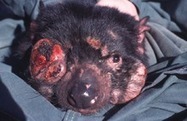
Australia’s Tasmanian devil is more beloved now as it faces extinction from an infectious cancer called Devil facial tumor disease (DFTD). The devils spread it through fighting and mating. The sore tumors grow so large the animal can no longer eat. As of 2006, it was estimated that the Tasmanian Devil could be extinct between 10 and 20 years, with only aproximately 20,000 to 50,000 left. Since there is no cure, it’s a race to keep healthy ones in captivity as the only means to keep DFTD from spreading. It’s still unnerving because no one wants to see a species become potentially extinct in captivity like the thylacine (Tasmanian Tiger) did in 1936.
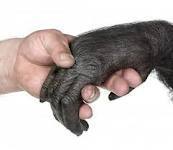
For years, scientists believed the vast phenotypic differences between humans and chimpanzees would be easily explained by their genes -- the two species must have significantly different genetic makeups. However, when their genomes were later sequenced, researchers were surprised to learn that the DNA sequences of human and chimpanzee genes are nearly identical. The difference lies in the insertion and deletion of large pieces of DNA near genes which are highly variable between humans and chimpanzees and may account for major differences between the two species.
Candiru (English and Portuguese) or cañero (Spanish), also known as toothpick or vampire fish, are a number of genera of parasitic freshwater catfish in the Trichomycteridae family. All are native to the Amazon River. Although some candiru species have been known to grow to a size of 40 centimetres (16 inches) in length, others are considerably smaller. These smaller species are known for an alleged tendency to invade and parasitize the human urethra by swimming up the urine stream. However, despite ethnological reports dating back to the late 19th century, the first documented case of the removal of a candiru from a human urethra did not occur until 1997.
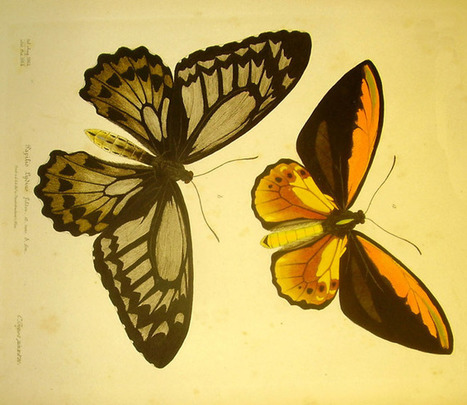
Dozens of butterfly species are endangered or threatened. A handful are shown in this photo gallery, but most don’t even have a picture on the internet. If they disappear, their beauty could be remembered as nothing more than a disembodied name.
Prize purse of $10 million: A 30-day contest to launch January 2013 to see which laboratory can accurately and economically sequence 100 human genomes has been tweaked to focus on the genetics of people over the age of 100. While quality, speed and accuracy of the testing is improving, the companies involved, including LIFE, Illumina and Complete Genomics, all have their own standards. http://tinyurl.com/7nlvqs2
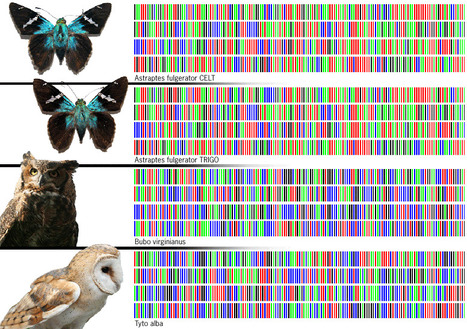
DNA barcoding is a technique for characterizing species of organisms using a short DNA sequence from a standard and agreed-upon position in the genome. DNA barcode sequences are very short relative to the entire genome and they can be obtained reasonably quickly and cheaply. The cytochrome c oxidase subunit 1 mitochondrial region (COI) is emerging as the standard barcode region for higher animals. It is 648 nucleotide base pairs long in most groups, a very short sequence relative to 3 billion base pairs in the human genome, for example.
The entire DNA sequence of a woman who lived to 115 has been pieced together by scientists. The woman, who was the oldest in the world at the time of her death, had the mind of someone decades younger and no signs of dementia. She appeared to have some rare genetic changes in her DNA, some of them might have protected her against dementia and other diseases of later life. The woman was born prematurely and was not expected to survive. But she lived a long and healthy life, and entered a care home at the age of 105. She eventually died from a stomach tumor, having been treated for breast cancer at the age of 100.
Right now is such an exciting time to be alive, as science and technology hurtles humanity forward at such incredible rates. Who would’ve thought ten years ago that we’d have one touch access to all the information in the world, on our phones!
When a bacterial cell divides into two daughter cells and those two cells divide into four more daughters, then 8, then 16 and so on, the result, biologists have long assumed, is an eternally youthful population of bacteria. However, new research concludes that not only do bacteria age, but that their ability to age allows them to improve the evolutionary fitness of their population by diversifying their reproductive investment between older and more youthful daughters.
Caenorhabditis elegans, as the roundworm is properly known, is a tiny, transparent animal just a millimeter long. In nature, it feeds on the bacteria that thrive in rotting plants and animals. It is a favorite laboratory organism for several reasons, including the comparative simplicity of its brain, which has just 302 neurons and 8,000 synapses, or neuron-to-neuron connections. These connections are pretty much the same from one individual to another, meaning that in all worms the brain is wired up in essentially the same way. Such a system is considerably easier to understand than the human brain, a structure with billions of neurons, 100,000 miles of biological wiring and 100 trillion synapses.
The Royal Society just uploaded every article older than 70 years, and the entire collection is searchable online. Along with Newton’s first research paper, the Philosophical Transactions of the Royal Society contain roughly 69,000 articles, including original research by Robert Boyle, William Herschel, Joseph Lister, Michael Faraday and others; Benjamin Franklin’s famous kite-lightning experiment; bizarre accounts of students hit by lightning; and ruminations on what Moon Citizens would glimpse as they looked at Earth, among many other tales.
Two teams of astronomers have discovered the largest and farthest reservoir of water ever found in the universe. It's 12 billion light years away, and holds at least 140 trillion times the amount of water in all the Earth's oceans combined.
It manifests itself as a colossal mass of water vapour, hidden in the distant APM 08279+5255 quasar. Quasars are bright and violent galactic nuclei fuelled by a supermassive black hole at their centre.
This quasar holds a black hole that's 20 billion times more massive than the sun, and after gobbling down dust and gas it belches out as much energy as a thousand trillion suns. The water vapor is spread around the black hole in a gaseous region spanning hundreds of light years.
.Water is one of the planet's weirdest liquids, and many of its most bizarre features make it life-giving. Unlike many liquids, it takes a lot of heat to warm water up even a little, a quality that allows mammals to regulate their body temperature. Researchers recently found that the hydrogen-oxygen bonds are slightly longer than deuterium-oxygen ones, which is what you would expect if quantum uncertainty was affecting water's structure (Physical Review Letters, DOI: 10.1103/physrevlett.107.145501).
We are used to the idea that the cosmos's physical constants are fine-tuned for life. Now it seems water's quantum forces can be added to this "just right" list.
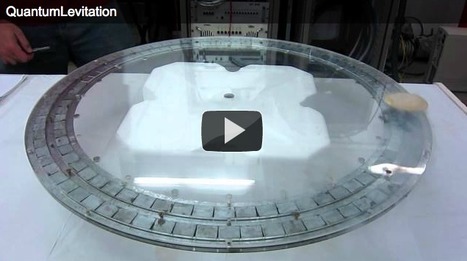
A superconducting object in a magnetic field levitates because it is trapped in place.
When a single crystal sapphire wafer coated with a ~1µm thick yttrium barium copper oxide is cooled below -185ºC the ceramic layer becomes a superconductor. Due to the Meissner effect, the superconductor will attempt to expel all the magnetic field from inside. As the superconductor is extremely thin, the magnetic field penetrates in discrete quantities called flux tubes. Inside each magnetic flux tube superconductivity is locally destroyed. The superconductor will try to keep the magnetic tubes pinned in weak areas (e.g. grain boundaries). Any spatial movement of the superconductor will cause the flux tubes to move. The resistance to movement offsets the force of gravity and traps the superconductor in place.
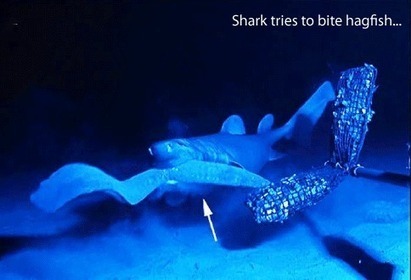
The hagfish looks like an easy meal. Its sinuous, eel-like body has no obvious defences, but any predator that moves in for a bite is in for a nasty surprise. The hagfish releases a quick-setting slime that clogs up the predator’s gills, causing it to gag, choke and flee. Scientists have known about this repulsive defence for decades, but Vincent Zintzen has finally filmed it in the wild. His videos also prove that hagfish, generally thought to be scavengers of the abyss, are also active hunters that can drag tiny fish from their burrows.
Hagfish are sometimes classed as fish although that’s in dispute, for they lack both backbones and jaws. Instead, their mouths contain a wide plate of cartilage, armed with two rows of horny teeth. It uses these to rasp away at carcasses that sink from above. Watch a dying whale settle on the ocean floor, and it will soon be covered in writhing hagfishes.
They are disgusting feeders. They burrow deep into corpses and eat their way out, and can even absorb nutrients through their skin. And if they’re threatened or provoked, they produce slime – lots of slime, oozing from the hundreds of pores that line their bodies. The slime consists of large mucus proteins called mucins, linked together by longer protein threads. When it mixes with seawater, it massively expands, becoming almost a thousand times more dilute than other animal mucus.
Looking at tiny structures through a fancy microscope is part of nanotechnologists' recent accomplishments. However, it has so far been difficult to observe atomic structures inside individual organic molecules. However, a novel method has been developed recently, which enables researchers to take an "X-ray view" inside individual molecules. The method may facilitate the analysis of organic semiconductors and many biomolecules such as proteins.
Medical textbooks are brought to life in 2012 by interactive graphs and figures, customized quizzes, beautiful multimedia, social media integration, and an innovative user interface.
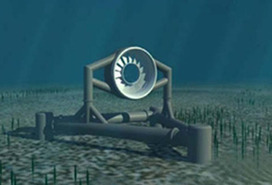
Wind energy continues to be an important part of renewable resources. However, other promising forms of renewable energy exist. Coastal states have a potential source of renewable energy in waves and tidal currents. Snohomish PUD is evaluating the use of tidal energy as a renewable energy source and detailed studies have been performed at seven locations in and around Puget Sound for tidal generators. These devices are similar to windmills but generate energy by using tidal currents to drive turbines located on the seabed.
A genetic algorithm (GA) is a search heuristic that mimics the process of natural evolution. This heuristic is routinely used to generate useful solutions to optimization and search problems. Genetic algorithms belong to the larger class of evolutionary algorithms (EA), which generate solutions to optimization problems using techniques inspired by natural evolution, such as inheritance, mutation, selection, and crossover. Annual GECCO conferences are arranged to award the best genetic algorithms.
Individual differences in intelligence are strongly associated with many important life outcomes, including educational and occupational attainments, income, health and lifespan. Data from twin and family studies are consistent with a high heritability of intelligence, but this inference has been controversial. We conducted a genome-wide analysis of 3511 unrelated adults with data on 549 692 single nucleotide polymorphisms (SNPs) and detailed phenotypes on cognitive traits.
Nothing compares with the giant crystals found in Cueva de los Cristales, or Cave of Crystals. The limestone cavern and its glittering beams were discovered in 2000 by a pair of brothers drilling nearly a thousand feet below ground in the Naica mine, one of Mexico's most productive, yielding tons of lead and silver each year. The geologic processes that create lead and silver also provide raw materials for these gigantic crystals,. But as news spread of the massive crystals' discovery, the question confronting scientists became: How did crystals ever grow so big?
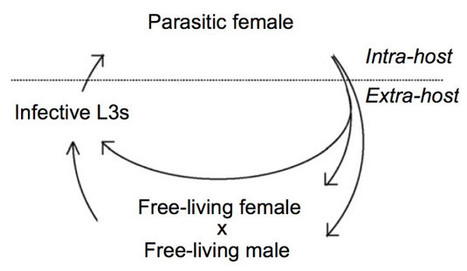
The little roundworm Strongyloides ratti has distinct parasitic and free-living adults, living in the rat small intestine and the soil, respectively. Reproductive parasitic adults have a maximum lifespan of 403 days. By contrast the maximum lifespan of free-living adults is only 5 days. Thus, the two adults of S. ratti have evolved strikingly different rates of aging. Parasitic nematode species are frequently longer-lived than free-living species, presumably reflecting different extrinsic mortality rates in their respective niches. Parasitic and free-living female Strongyloides ratti are morphologically different, yet genetically identical. The 80-fold difference in lifespan is the greatest plasticity in aging yet reported, must largely reflect evolved differences in gene expression.
Recent research has shown that the transcription and translation of genes, or even the presence of DNA in the cell, are not necessary for the daily ("circadian") rhythms to occur. This article gives a nice summary about the history of circadian rhythms discoveries.
To get content containing either thought or leadership enter:
To get content containing both thought and leadership enter:
To get content containing the expression thought leadership enter:
You can enter several keywords and you can refine them whenever you want. Our suggestion engine uses more signals but entering a few keywords here will rapidly give you great content to curate.


 Your new post is loading...