E-Learning-Inclusivo (Mashup)
1.1M views | +18 today
Follow
 
Rescooped by juandoming from Edumorfosis.it
onto E-Learning-Inclusivo (Mashup)
January 15, 2014 2:06 PM
Scoop.it!

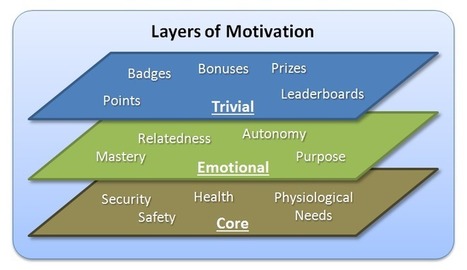
Layers of Motivation

Layers of Motivation | E-Learning-Inclusivo (Mashup) | Scoop.it

The more I consider motivation, the more I realise it is one of those things we in gamification use as a catch all. It’s a bit like how we treat the term “game mechanics” and, well, gamification!


Generally speaking, you will hear the terms intrinsic and extrinsic when motivation is spoken about. You will hear Deci & Ryan, Dan Pink, Maslow and more spoken about. However, when it comes down to it our argument is always the same.  Intrinsic motivation is always better than extrinsic rewards. At times you will also hear a futher comment that a balance of extrinsic rewards and intrinsic motivation will yield the best results.


I myself bang on about RAMP; relatedness, autonomy, mastery and purpose. I talk about supporting these motivators with well planned and thought out extrinsic rewards and nudges. However, It seems to me that motivation has several layers and we only seem to speak about one or two of them. There is a more fundamental and core level of motivation that we all seem to ignore.  I have spoken about it before here, but I wanted to make my case more clearly!


Let’s think about your job for a moment. Most go to work for one reason, to earn money. Money leads to security. It provides you shelter, it keeps your family safe, it provides food for you all. Before money and jobs and the like, this was all much more primal. You secured your family by physically protecting them. You hunted for food and you built shelters. Now, this is all handled for most by getting money. We don’t need to hunt or build huts for ourselves, we buy all of those things. If we extrapolate that, and take a look at Maslow’s hierarchy of needs again, we see the most core motivations for humans are physiological needs and safety / security.


Via Edumorfosis
No comment yet.
E-Learning-Inclusivo (Mashup)
Aprendizaje con TIC basado en los aprendices.
Curated by juandoming
Your new post is loading...
Rescooped by juandoming from Education 2.0 & 3.0
Today, 8:14 AM
Scoop.it!

The Role of Faculty in the University of the Future

The Role of Faculty in the University of the Future | E-Learning-Inclusivo (Mashup) | Scoop.it
In the age of AI, the true future of higher education lies not in replacing faculty but in freeing them to do what only humans can—build meaningful re

Via Yashy Tohsaku
No comment yet.
Rescooped by juandoming from e-learning-ukr
Today, 8:11 AM
Scoop.it!

Critical thinking, expertise and intelligence

Critical thinking, expertise and intelligence | E-Learning-Inclusivo (Mashup) | Scoop.it
And that's the correct educational order

Via Vladimir Kukharenko
No comment yet.
Rescooped by juandoming from Notebook or My Personal Learning Network
March 31, 8:04 AM
Scoop.it!

« Mon précieux » : pourquoi les universitaires protègent leurs ressources pédagogiques et leurs données (mais partagent volontiers leurs articles) – Chaire UNESCO RELIA

« Mon précieux » : pourquoi les universitaires protègent leurs ressources pédagogiques et leurs données (mais partagent volontiers leurs articles) – Chaire UNESCO RELIA | E-Learning-Inclusivo (Mashup) | Scoop.it
Partager Javiera Atenas Javiera Atenas est maîtresse de conférences à la faculté de commerce, d’arts, de sciences sociales et de technologie de l’université du Suffolk, au Royaume-Uni. Elle dirige le certificat postuniversitaire en pratique pédagogique et enseigne l’analyse et la visualisation des...

Via Gilbert C FAURE
No comment yet.
Rescooped by juandoming from Education 2.0 & 3.0
March 25, 8:46 AM
Scoop.it!

Stanford Researchers Find Thin Evidence Behind AI Classroom Tools

Stanford Researchers Find Thin Evidence Behind AI Classroom Tools | E-Learning-Inclusivo (Mashup) | Scoop.it
While AI tools can momentarily improve student performance, Stanford University researchers caution that those gains may not persist once the technology is removed — raising questions about whether the tools are supporting learning or substituting for it.

Via Yashy Tohsaku
No comment yet.
Rescooped by juandoming from Educational Technology News
March 24, 11:23 AM
Scoop.it!

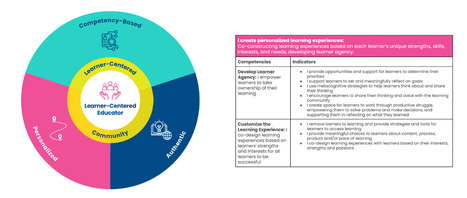
This is Our Opportunity to Create A Learner-Centered Path for AI Integration in Education

This is Our Opportunity to Create A Learner-Centered Path for AI Integration in Education | E-Learning-Inclusivo (Mashup) | Scoop.it

"In conversations across the country, I hear a growing mix of excitement and apprehension about the role of artificial intelligence in education. Many see the potential, yet most also sense a disconnect between what today’s AI tools produce and the kinds of learning experiences we want for young people. This tension is not incidental—it reflects a deeper issue in how AI currently “understands” teaching and learning.


Most generative AI tools carry a built-in bias toward traditional, teacher-directed instruction."


Via EDTECH@UTRGV
EDTECH@UTRGV's curator insight, March 24, 10:34 AM

"AI will not generate that future on its own. We must design and input the pedagogical foundations that guide it."

Scooped by juandoming
March 22, 6:47 AM
Scoop.it!

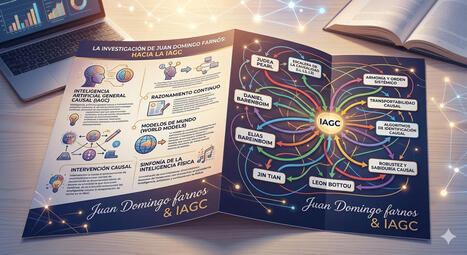
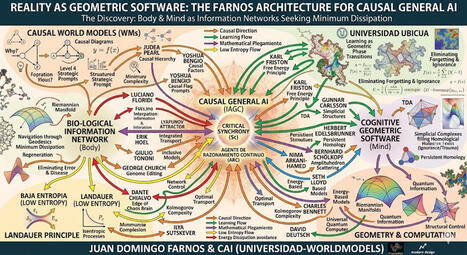
Sincronizando el propósito humano y la ejecución de las máquinas mediante el motor de la IAGC: La arquitectura de la causalidad como puente con la realidad de los World Models. –

Sincronizando el propósito humano y la ejecución de las máquinas mediante el motor de la IAGC: La arquitectura de la causalidad como puente con la realidad de los World Models. – | E-Learning-Inclusivo (Mashup) | Scoop.it
Juan Domingo Farnos Abstract Español La IAGC de Juan Domingo Farnós representa la culminación de la "Escalera de la Causalidad" de Judea Pearl (2000), elevando la inteligencia desde la mera observación estadística hasta el razonamiento contrafactual ($L3$) puro. El sistema no solo predice, sino que interviene en la realidad siguiendo el rigor de los modelos…
No comment yet.
Scooped by juandoming
March 20, 3:03 AM
Scoop.it!

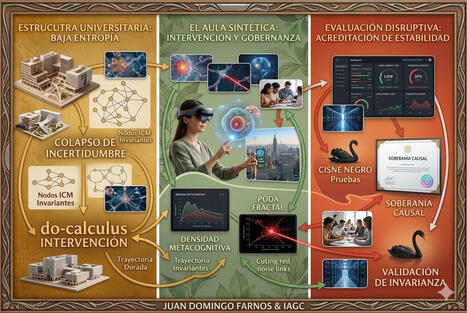
La RV/RA (IAGC de Farnós) en el aula universitaria: Mediciones y verificaciones –

La RV/RA (IAGC de Farnós) en el aula universitaria: Mediciones y verificaciones – | E-Learning-Inclusivo (Mashup) | Scoop.it
Juan Domingo Farnós Este Abstract Cuadrivalente sintetiza la arquitectura de la IAGC de Farnos y su implementación en la Educación Superior como un motor de ejecución de simulación basado en la Baja Entropía y la Causalidad Fractal. (Español) La presente investigación postula la transición de la Educación Superior hacia una Ingeniería del Razonamiento Humano mediante…
No comment yet.
Scooped by juandoming
March 17, 12:38 PM
Scoop.it!

Sistema de Validación Invariante con IAGC de Farnós: Reingeniería de roles para estudiantes y docentes en la Academia Descentralizada –

Sistema de Validación Invariante con IAGC de Farnós: Reingeniería de roles para estudiantes y docentes en la Academia Descentralizada – | E-Learning-Inclusivo (Mashup) | Scoop.it
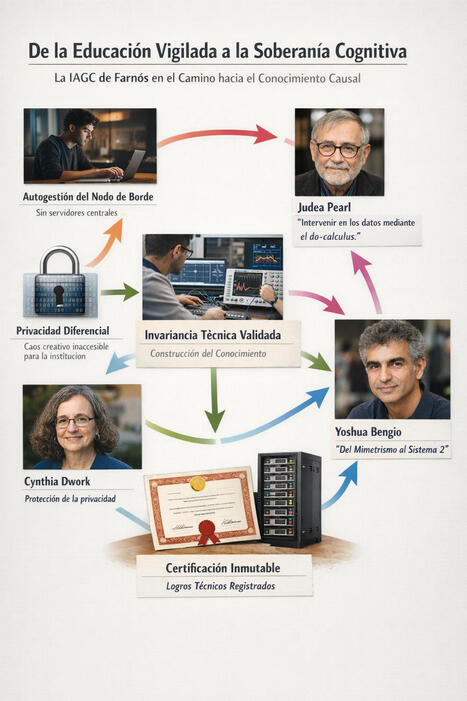
Juan Domingo Farnos Abstract (Español) Esta investigación define la transición de la educación vigilada hacia la Soberanía Cognitiva mediante la integración de la IAGC de Farnós. El sistema se fundamenta en la capacidad del estudiante para gestionar su propio Nodo de Borde, eliminando la dependencia de servidores centrales. Como señala Judea Pearl en su análisis…
No comment yet.
Rescooped by juandoming from Edumorfosis.it
March 15, 11:11 AM
Scoop.it!

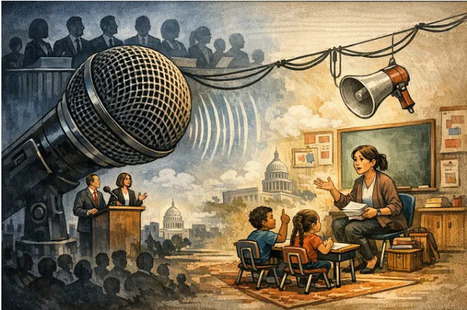
Education policy has a mic problem in the Age of AI. Everyone deserves a voice — but teachers should hold the mic, not consultants 

Education policy has a mic problem in the Age of AI. Everyone deserves a voice — but teachers should hold the mic, not consultants  | E-Learning-Inclusivo (Mashup) | Scoop.it

In education, authority and credibility are often misaligned. The voices that shape education policy are rarely those of current teachers. Firsthand insights gained from classroom experience take a backseat to the musings of outsiders. Frequently, those farthest from students dictate the narrative, while ever fewer actual teachers influence national discussions about teaching.


Via Edumorfosis
Edumorfosis's curator insight, March 15, 10:12 AM

Cuando las políticas educativas y marcos regulatorios provienen de los que están alejados de las aulas. No es lo mismo producir una política o marco desde la comodidad de una lujosa oficina. Las principales voces para la redacción de políticas y marcos deberían ser las de los profesores y estudiantes. Pero no, son los consultores externos y en algunos casos el liderato político (con sus asesores) los que redactan las políticas y marcos regulatorios a seguir. Mientras tanto, las voces de los principales protagonistas siguen siendo apagadas... 

Rescooped by juandoming from Help and Support everybody around the world
March 11, 9:49 AM
Scoop.it!

Is higher education broken? Not exactly. –

Is higher education broken? Not exactly. – | E-Learning-Inclusivo (Mashup) | Scoop.it
What does it mean for higher education to work? The problem with claiming (as I sometimes do) that higher education is broken and needs to be transformed is that it begs the question of what it mea…

Via Vladimir Kukharenko, Ricard Lloria
No comment yet.
Scooped by juandoming
March 7, 3:13 AM
Scoop.it!

Proyectamos la investigación autónoma y automatizada en la Universidad (IAGC-AGI de Farnós) –

Proyectamos la investigación autónoma y automatizada en la Universidad (IAGC-AGI de Farnós) – | E-Learning-Inclusivo (Mashup) | Scoop.it
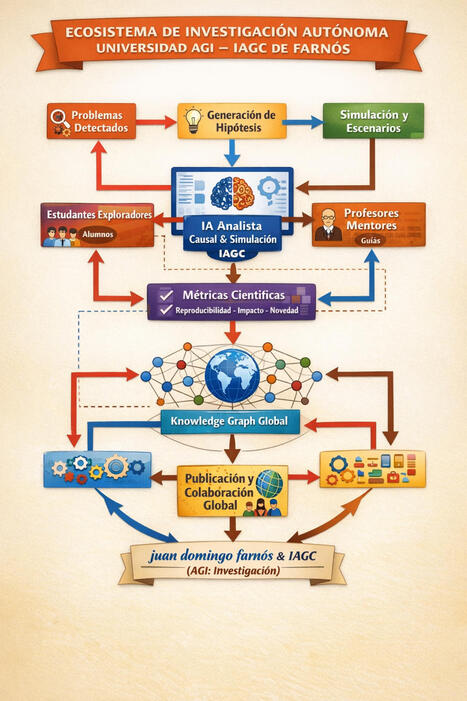
Juan Domingo Farnos ABSTRACT: Español La investigación educativa y científica enfrenta retos de velocidad, complejidad y colaboración interdisciplinaria. La Universidad AGI, impulsada por la Inteligencia Artificial General Causal (IAGC) de Farnós, redefine la investigación, transformando a los estudiantes en exploradores activos y a los profesores en mentores estratégicos. Este modelo permite la generación autónoma de…
No comment yet.
Rescooped by juandoming from gpmt
March 7, 2:43 AM
Scoop.it!

Lisa Nielsen: The Innovative Educator: Could the Future of AI Reconnect Us to What Mattered Most?

Lisa Nielsen: The Innovative Educator: Could the Future of AI Reconnect Us to What Mattered Most? | E-Learning-Inclusivo (Mashup) | Scoop.it

"Much of the conversation around artificial intelligence (AI) is framed in fear. White-collar professionals are increasingly anxious about AI replacing cognitive work once thought untouchable, a concern captured in The Atlantic’s piece on the worst-case future for white-collar workers. Blue-collar workers have their own version of this fear as employers test automation that shows up in the real world as robots and drones doing physical jobs once reserved for people, including delivery and warehouse work, like Amazon’s reported testing of humanoid delivery robots.


The anxiety is real. But what if we are asking the wrong question?"


Via EDTECH@UTRGV, michel verstrepen
EDTECH@UTRGV's curator insight, March 6, 2:49 PM

"Instead of asking how we preserve jobs as they exist today, what if we ask whether working less might actually be progress?"

Rescooped by juandoming from gpmt
March 4, 2:15 AM
Scoop.it!

College students and professors are making their own AI rules

College students and professors are making their own AI rules | E-Learning-Inclusivo (Mashup) | Scoop.it
More than three years after ChatGPT debuted, AI has become a part of everyday life — and professors and students are still figuring out how or if they should use it.

Via EDTECH@UTRGV, michel verstrepen
EDTECH@UTRGV's curator insight, March 3, 10:18 AM

"More than half of students who used AI for coursework had mixed feelings about it, reporting that it helps them sometimes but can also make them think less deeply."

Rescooped by juandoming from Education 2.0 & 3.0
Today, 8:13 AM
Scoop.it!

3 AI Fears in Higher Education

3 AI Fears in Higher Education | E-Learning-Inclusivo (Mashup) | Scoop.it
Across campuses, conversations about artificial intelligence are sometimes being framed by unease rather than enthusiasm. Leaders, faculty and student

Via Yashy Tohsaku
No comment yet.
Rescooped by juandoming from Metaglossia: The Translation World
March 31, 8:08 AM
Scoop.it!

Of translation, transgression, and transcreation: A conversation on knowledge across languages

Of translation, transgression, and transcreation: A conversation on knowledge across languages | E-Learning-Inclusivo (Mashup) | Scoop.it
The academics spoke about translation, authority, disciplinary boundaries, science communication, and AI and its risks.

"


Of translation, transgression, and transcreation: A conversation on knowledge across languages


The academics spoke about translation, authority, disciplinary boundaries, science communication, and AI and its risks.


Doyeeta Majumder, Anuj Misra, Bill Mak, Subha Prasad Sanyal & Biju Paul Abraham


Mar 29, 2026 · 08:30 pm


The 2026 Making and Unmaking Facts roundtable conference.


What do facts, data, and objectivity mean for literature and translation in South Asia today? “Making and Unmaking Facts”, a conference on the subject, was organised by Fact or Value, DECISION, and IIM Calcutta in February 2026 to explore this and related questions.


The conference examined how facts are made, stabilised, challenged and granted authority across different social and political contexts. It feels especially relevant now, when public life is increasingly shaped by debates around post-truth, misinformation, expertise and the question of who gets to decide what counts as fact.


Advertisement


The roundtable extended those concerns into a wider conversation about translation, authority, disciplinary boundaries, science communication, AI and the risks of both rigid certainty and corrosive relativism.


Anuj Misra, Professor of the History of Science and the History of Knowledge, Bill Mak, Professor of History of Science at the University of Science and Technology, John Mathew, Professor of the History of Science, Sourav Bhattacharya, Professor of Economics, Biju Paul Abraham, Professor of Public Policy, and translator Subha Prasad Sanyal were in conversation with academic Doyeeta Majumder at the conference.


Excerpts from the conversation.


Advertisement


Doyeeta Majumder (DM): I would like to begin with the question of language and translation, how the making and unmaking of facts is mediated through, and constantly has to encounter, the issue of translation, transpropriation, and encounters with other systems of knowledge and other times. Facts are made at a particular point in history, at a certain historical moment; then they can be challenged and unmade, and later they can recrystallise and new certainties might emerge. This process is mediated through acts of carrying across.


Translation is not merely the question of rendering something into another language; it often involves a completely different idiom of doing science. What are these idioms of knowledge-making in different times and cultures? How do encounters with the “other” make and unmake objectivities and certainties?


Anuj Misra (AM): It is interesting to consider the cognitive space one occupies when transporting a concept from one language into another. In doing so, one lives simultaneously in two worlds, the world that belongs to you and the one that does not. One must navigate how to bring something foreign into one’s own conceptual space.


Advertisement


While language does act as a mediator at this point, it has its own restrictions and strictures that delineate and shape what you are trying to understand and what you are trying to communicate. Much depends on tacit skill, your ability to introduce new words, your mastery of grammar, and your control over concepts. Many factors are already written into the translation process, including internal cognitive mediations that we do not hear about.


Equivalence, particularly in the context of translation studies, is never final. It is always in the process of being finalised, but never fully complete.


Bill Mak (BM): Translation is something I have worked on extensively, particularly in the course of my doctoral studies on Sino-Indian Buddhist translation. The translation of Indian Buddhist texts into Chinese was one of the largest human intellectual endeavours, taking nearly a millennium and becoming a collaborative project involving scholars from Central Asia, India and China.


Advertisement


Although there is, of course, a linguistic dimension, translation involves more than linguistic crossing; it involves crossing cultural identities, epistemologies and value systems. There can be many ways of perceiving such acts of crossing boundaries: it can be seen positively, as in “transcreation”, where something new is added. But it can also be perceived as transgressive, provoking negative reactions to such boundary-crossing.


We can see an example of such negative reactions in the case of Hindu numerals being introduced in China, where such attempts were either completely ignored or, worse, the bringers of such new knowledge were attacked by traditional scholars, and this new scholarship was then buried for centuries before being rediscovered. As a result, although the Chinese developed their own zero sign, they did not benefit from that earlier encounter with Indian astronomers.


Sourav Bhattacharya (SB): Two words seem to be of particular significance in this context: “transgression” and “expertise”. Keeping these two words in mind, let me ask: Is there also the question of protecting one’s turf? Expertise builds authority, but it is also the source of one’s livelihood. There may be reluctance to allow dilution. A grammarian, for instance, establishes rules to maintain purity, but in doing so creates boundaries that make translation more difficult.


Advertisement


During the Cold War, for instance, mathematicians in the US and the USSR worked on similar problems with little exchange, leading to duplication of effort. Might there be political efforts to protect intellectual territory that hinder translation and knowledge creation?


AM: Knowledge ownership is complex. Once a book is published, it no longer belongs solely to the author but to its readers. When knowledge systems are owned and possessed, transgression becomes possible because someone enters another’s intellectual territory.


We often speak of knowledge economies but rarely of knowledge parochialism. In certain societies, certain knowledge systems are codified in certain other kinds of practice. For example, although scholars of Sanskrit often paint a very secular picture of it, the dominant narrative is that Sanskrit is a sacred language, a language of the gods, thereby fortified and insulated from intrusion, creating a parochial view of its excellence, unnecessarily so. Yet alongside this existed secular forms such as marketplace Sanskrit and Buddhist Hybrid Sanskrit, which is a mix of Sanskrit with Pali and Prakrit languages. Thus, astrology, for example, which was practised in hybridised Sanskrit, much more readily absorbed foreign Perso-Arabic material because it was not parochialised. However, when knowledge is tied to economic survival, such as royal or administrative bureaux, new systems that threaten established practices are resisted.


Advertisement


At a philosophical level, once a work is created, can it truly be transgressed? Who is the victim in such a case?


John Mathew (JM): However, we must also think about societies that have been dominated and have become parochial by necessity, the Toda people, for example. In such cases, the transgression of knowledge boundaries has happened after the advent of colonialism, so there is a kind of protectionism in operation here.


AM: Of course, parochialism can also be thought of in terms of protectionism. In the short run, keeping itself closed off allows something to preserve itself until the imminent dangers have ceased, for a while. It certainly allows you to guard something until it can flourish again. Welsh is a great example, where people had to guard their language against English. They were even punished; it was extremely difficult for them even to learn their language. Very often, Welsh-speaking people miss a generation. So there is always a resurgence from the grandparents to the grandchildren, and the parents do not speak it. This happens regularly because, of course, they get narrowed and siloed into their own little communities.


Advertisement


DM: I was just thinking of Ramanujan and a certain way of doing mathematics that disappeared with him; there was no revival for that. It died with Ramanujan when other systems of calculation and proof took over.


BM: When discussing knowledge parochialism, I am reminded of academia today. In many academic departments, the buzzword is interdisciplinarity, yet economic pressures encourage departments to protect their funding and survival. Interdisciplinarity can become almost an irony: when a conference is designated “interdisciplinary”, it is usually hosted by a single department, by a single discipline, which is now feeling the pressure to open up to interdisciplinary discourse.


But are we empowered to produce credible and morally valuable knowledge within the current institutional and power structures of academia?


Advertisement


AM: Interdisciplinarity is an interesting term. The disciplines were themselves created by compartmentalising knowledge, assuming that expertise in the individual parts would eventually allow reconstruction of the whole. Interdisciplinarity then attempts to bridge an artificial divide with another artificial construct.


Bill and I are philologists. We look at ancient texts, we translate them, we understand their historical context, and then we bring the skills of philology and history to bear on them, and, to a certain extent, philosophy as well. We are not sociologists, but nine out of ten texts under discussion were probably texts that we had both read. So how does it really happen? I cannot claim the authority to stand up here and say I am a sociologist. I am not. But many of the texts you cite and talk about do not categorise themselves as sociological texts, or philosophical texts, or historical texts. They are texts. There is something they communicate. Once we understand communication, we can draw upon it in whatever field we wish to apply it to. So I think a better way, and this has happened in many universities, would be to abandon the idea of departments and instead create notions of themes, thematic discourse, where you build upon skills from law to sociology to medicine to talk about that theme and bring it to the fore, using them in very similar ways to how we use our skills in philology and philosophy at the same time when we look at a text.


JM: But there is also the tyranny of the invisible canon. Scholars often rely on recognised names, Spivak, Foucault, and construct their talks around them because it helps if the audience is familiar with and attuned to particular names rather than having to make the case for someone more obscure.


Advertisement


BM: In some academic contexts, historical work, say, work on the history of science, is taken seriously only if framed within sociological theory. One must preface presentations with references from sociology in order to be heard.


I do agree with Anuj that a thematic approach might be more productive. To a theme, we then apply different skills. From a pedagogical point of view, this would require students to develop a much broader repertoire of skills: science students with liberal arts exposure, and arts students with scientific literacy. The Chinese, for the longest time, had this tradition. Traditional Chinese scholars were often well-versed in literature, music, natural science, and philosophy. However, current educational trends often move in the opposite direction.


DM: My final question is about what kinds of conversations historians and philosophers of science, especially those originally trained in scientific disciplines, are having with practitioners in the fields whose histories or philosophies they study.


Advertisement


AM: Yes, in fact. But theoretical physics has become so obscure that the divisions between mathematics and philosophy have nearly erased themselves. Neither mathematicians nor philosophers understand what string theorists do, so they have created a universe in which, very often, they have to do both jobs themselves. When a string theorist talks about thirty-second dimensions of bosonic particles, it is almost impossible to understand what they mean. Only they understand that; for them, it is real. It is tangible. It is something they can play with. They see it, they visualise it, they understand what it really means. But they are very poor at communicating, and this is largely because they have never been called upon to communicate. They are very happy living monastic lives, doing mathematics, being left alone. And that is essentially how we have codified mathematicians in general: you do not understand a word of what they are talking about because the point of entry is so high.


This is where we break down. I teach a course on the history of mathematics, one concerned with thinking across the divide, where we have to bring people out of their irrational fear of mathematics. I have never heard anyone tell me that they are afraid of music, even though music is equally complicated. If I write music for you, or take you to a course in musicology, the point of entry is about as difficult as it is to get into string theory. But how is it that you are not afraid of music? Because there is something palpable about music, even cacophony. You can decide that you do not like this, but you can actually give it a listen. How do you give an equation a listen? And that is exactly what I teach in my course: how to listen to equations rather than look at the numbers and be afraid.


JM: Your reference to music is interesting. I once heard a TED Talk about the “music of the melting Arctic”, where climate data were rendered musically. It is interesting because you learn through music that everything is not hunky-dory, and this is more telling than anything any particular statistician could ever say.


Advertisement


I teach a course called Science, History and Theatre, and students actually have to write their own play at the very end. It has always been fascinating to see how much science can be communicated through the medium of the play. Do you have to use literal elements? Do you need to resort to a metaphor? What do you do? So often, a metaphor is employed in this particular case.


BM: The question of how the dialogue takes place is a very important one. And, of course, it is not only about how the dialogue takes place among scholars, but also about the specialist communicating with non-specialists, with other colleagues, or with the public. I think there have been some good developments: you have science communicators like Carl Sagan and Brian Cox, and they are very approachable and inviting. But you do not have these people in all disciplines.


What happens when this large and messy body of evidence is encountered by non-specialists? Since the specialists are not willing to take up the task, the generalist or non-specialist still feels like taking on the job. But maybe AI will bring down all these barriers and become a game-changer. When you go to either ChatGPT or the BBC, you have equal access to everything. Of course, the irony is, as I mentioned, that AI is neither artificial nor intelligent. It is not capable of actually discerning things on the basis of truth value. But at least it opens up the opportunity, the accessibility of expertise and knowledge.


Advertisement


SB: But you notice that ChatGPT, or such AI models, are much more open and permissive than regular referees, who are completely embedded within the field, which is perhaps something we were pointing out.


We have seen that facts are made, facts are unmade, facts are value-laden, and so on. But is there a risk of pushing this a bit too far, where there are multiple groups trying to produce facts, which become competing narratives? In today’s world, with social media, you end up in a scenario where people look at any fact, or anything spewed as fact, with deep scepticism, and then we end up with a situation of anarchy in the field of knowledge. I am particularly talking about laypeople here.


How do we determine what is too far?


Advertisement


BM: I think that, for laypeople, there is the fear of relativism, so everything becomes flat because it is equally accessible and there are competing narratives, and so on.


But ultimately, it is the human mind that needs to make the judgment. We develop all these matrices and indices to evaluate standards – they help us to make decisions, not to decide for us.


AM: In the context of the fear about relativism, I offer the idea of the “workable epistemology”. Practising mathematicians, take a financial mathematician, for instance, who does not constantly question the ontological status of the numbers on their desk during their job. But does that mean they are not qualified enough to reflect on numbers? Not at all. They certainly are qualified, if they wish to. So I think there is a certain level of workable realism when it comes to facts. It is like the weather service: when it tells you the weather in the morning, you tend to believe it. If it rains, you do not sue them.


Advertisement


The problem arises when facts are treated as sacred and immutable. As long as we understand the relativism of the fact that it can be reinterpreted again in the current moment, there is room for movement. This is the method of standpoint epistemology, in a sense: you believe in something for the moment, and that has the opportunity of changing later.


JM: But I often ask myself this question: for the lay public, how many narratives can be held simultaneously? I think it is important, because we are all inveterate classifiers and librarians, right? In some sense, we say, all right, beyond a particular point, when there is a profusion of narratives, it becomes really difficult to be able to talk about something.


So even if you say there are other ways of looking at things, is there a limit to how many of these narratives can be kept in mind at the same time?


Advertisement


AM: In certain situations where a fact has a direct implication for society, like the recent rise in the measles epidemic in the US because people are vaccine-resistant, despite a long history of proving how effective vaccines have been, and despite a mongered fear of vaccines essentially having caused autism without any substantial basis, we have created a complex social situation.


This harks back to that very problem again: we have created an alienation of science in society. People have picked one narrative or another and then applied it as they want to and used their own judgement on it. But they have not been given the decision-making framework. They have never been taught how to evaluate information. So rather than simply codifying the fact that vaccines do not cause autism, it would be a better idea to train people in how to interpret the fact. So, the question is about how many narratives? There can never be an answer to that. As many as needed. Look at the idea of ritual and religion.


People come up with the same practice, the same codified mass, the same codified thing. Still, there are differences in practice everywhere. In every religion, people will practise a ritual in the way they want to ritualise it, and this allows multiplicity to survive. Yet in a common practice, if you and I constitute a temple or a mosque together, we will codify that in some kind of subjective way. How will we be doing this one?


Advertisement


BM: I feel that there is a deeply human dimension to all these questions. There is a certain kind of laziness in thinking. You just do not want to apply yourself, to put yourself in your opponents’ or alternatives’ position. And I think, in our education system, there is this lack of emphasis on how to consider opinions from different points of view, and on the need for a sense of empathy in the sense of understanding things from different perspectives, whether of people with different values, different religions, different epistemologies, and so on.


DM: Perhaps the problem also lies in applying the same frameworks used to critique political or religious power to science without adjustment. Of course, training people to evaluate things for themselves would be the best-case scenario. But there are also very many times when people want to be told certain things and desire certainty. They may reject institutional expertise but accept alternative claims, such as miracle cures or confirmations of self-diagnoses, because doing so feels empowering or rebellious.


Subha Prasad Sanyal (SPS): If all claims can have truth value only in the epistemic context in which they are made, does this claim not then itself become true only in particular contexts? Is this position self-defeating?


Advertisement


AM: At a meta-philosophical level, yes, such arguments can become recursive. In fact, when Longinus talked about the idea that every judgement is particular to its universe of discourse, the rebuttal was exactly the same: well, is that judgement not also saying the same thing within the discourse? So yes, at the meta-level, if you keep debating the philosophical implications of it, you will be caught in an endless loop. However, this is where the difference lies. It is not necessary to have a conversation at the meta-level to see that it is by virtue of a fact’s being based on an onto-epistemic grounding that it is called a fact.


Biju Paul Abraham (BPA): As someone who reads Bengali literature in translation, one of the things I recognise about those translations is that they are not exact translations. There is possibly some element of transgression, some element of transcreation, perhaps, which has been done in order to help me understand. So, when I read it, I understand that there could be issues with the translation. It is not exact. But as a layperson, and I consider myself a layperson in that context, I am happy to have it because I get a limited experience of it. If you worry too much about the exactness of the translation, then the problem is that you come back to the kind of issue that Nirad C Chaudhuri raised. His books have long quotations in French, so when his publisher told him, “You know, it is an English book, and there are these French quotations in it. So why don’t you provide an English translation as well?” Chaudhuri said, “If you don’t know French, you shouldn’t be reading my books.” If you adopt that kind of attitude, there is so much that is lost.


AM: This is exactly the workable epistemology I am talking about. At the level of what it functions for, it is perfectly fine. As long as we understand at what level it functions, and what we are doing, it functions. But if you build your entire belief system about Bengali literature on the basis of your reading in translation, and codify that worldview into your absolute reality, that is the problem. As long as you allow yourself to be hospitable to yourself in a recurring sense, and we understand the fact that we are only entering someone else’s space, and I am happy that I have been welcomed there, and I feel hospitable there, and I learned something, and I do understand that there are limitations, then it is perfectly fine.


Advertisement


DM: This is how we work with the logic of periodisation when we teach history: dividing it up into ancient, medieval, and modern. And while you say that to first-year students, in the next class, or the next year, you say: but all of that is not really true, actually, constantly urging the questioning of those certainties.


Some things to think about, for me personally, are the questions about collective subjectivity: the kind of objectivity that is produced by that collective subjectivity; the use of personal discretion, rational discretion, both for the producers of knowledge and for the consumers of knowledge.


Doyeeta Majumder is an Assistant Professor of English at Jadavpur University.


Advertisement


Anuj Misra is Professor of the History of Science and the History of Knowledge at Freie Universität Berlin and leads the Max Planck Research Group “Astral Sciences in Trans-Regional Asia” (ASTRA).


Bill Mak is Professor of History of Science at the University of Science and Technology of China and Research Associate at the Needham Research Institute, Cambridge, with research interests in the history of science in Asia, Buddhist translation, and Sino-Indian studies.


John Mathew is Dean of the Arts and the Humanities and Professor of the History of Science at the Asian University for Women, where his work focuses on natural history, disease, and environmental history in South Asia.


Advertisement


Sourav Bhattacharya is Professor of Economics at IIM Calcutta, with interests spanning the economics of organisations, political economy, and development.


Biju Paul Abraham is Professor of Public Policy in the Public Policy and Management Group at IIM Calcutta.


Subha Prasad Sanyal is a Kolkata-based Bengali literary translator and winner of the 2018 Harvill Secker Young Translator’s Prize, noted for translating Hawa Hawa and Other Stories.


Fact or Value is an online forum with a focus on philosophy, intellectual history and aesthetics. They host lectures and design books on unusual subjects."


https://amp.scroll.in/article/1091632/of-translation-transgression-and-transcreation-a-conversation-on-knowledge-across-languages


#metaglossia


#metaglossia_mundus 


Via Charles Tiayon
Charles Tiayon's curator insight, March 31, 2:48 AM

The academics spoke about translation, authority, disciplinary boundaries, science communication, and AI and its risks.


"


Of translation, transgression, and transcreation: A conversation on knowledge across languages


The academics spoke about translation, authority, disciplinary boundaries, science communication, and AI and its risks.


Doyeeta Majumder, Anuj Misra, Bill Mak, Subha Prasad Sanyal & Biju Paul Abraham


Mar 29, 2026 · 08:30 pm


The 2026 Making and Unmaking Facts roundtable conference.


What do facts, data, and objectivity mean for literature and translation in South Asia today? “Making and Unmaking Facts”, a conference on the subject, was organised by Fact or Value, DECISION, and IIM Calcutta in February 2026 to explore this and related questions.


The conference examined how facts are made, stabilised, challenged and granted authority across different social and political contexts. It feels especially relevant now, when public life is increasingly shaped by debates around post-truth, misinformation, expertise and the question of who gets to decide what counts as fact.


Advertisement


The roundtable extended those concerns into a wider conversation about translation, authority, disciplinary boundaries, science communication, AI and the risks of both rigid certainty and corrosive relativism.


Anuj Misra, Professor of the History of Science and the History of Knowledge, Bill Mak, Professor of History of Science at the University of Science and Technology, John Mathew, Professor of the History of Science, Sourav Bhattacharya, Professor of Economics, Biju Paul Abraham, Professor of Public Policy, and translator Subha Prasad Sanyal were in conversation with academic Doyeeta Majumder at the conference.


Excerpts from the conversation.


Advertisement


Doyeeta Majumder (DM): I would like to begin with the question of language and translation, how the making and unmaking of facts is mediated through, and constantly has to encounter, the issue of translation, transpropriation, and encounters with other systems of knowledge and other times. Facts are made at a particular point in history, at a certain historical moment; then they can be challenged and unmade, and later they can recrystallise and new certainties might emerge. This process is mediated through acts of carrying across.


Translation is not merely the question of rendering something into another language; it often involves a completely different idiom of doing science. What are these idioms of knowledge-making in different times and cultures? How do encounters with the “other” make and unmake objectivities and certainties?


Anuj Misra (AM): It is interesting to consider the cognitive space one occupies when transporting a concept from one language into another. In doing so, one lives simultaneously in two worlds, the world that belongs to you and the one that does not. One must navigate how to bring something foreign into one’s own conceptual space.


Advertisement


While language does act as a mediator at this point, it has its own restrictions and strictures that delineate and shape what you are trying to understand and what you are trying to communicate. Much depends on tacit skill, your ability to introduce new words, your mastery of grammar, and your control over concepts. Many factors are already written into the translation process, including internal cognitive mediations that we do not hear about.


Equivalence, particularly in the context of translation studies, is never final. It is always in the process of being finalised, but never fully complete.


Bill Mak (BM): Translation is something I have worked on extensively, particularly in the course of my doctoral studies on Sino-Indian Buddhist translation. The translation of Indian Buddhist texts into Chinese was one of the largest human intellectual endeavours, taking nearly a millennium and becoming a collaborative project involving scholars from Central Asia, India and China.


Advertisement


Although there is, of course, a linguistic dimension, translation involves more than linguistic crossing; it involves crossing cultural identities, epistemologies and value systems. There can be many ways of perceiving such acts of crossing boundaries: it can be seen positively, as in “transcreation”, where something new is added. But it can also be perceived as transgressive, provoking negative reactions to such boundary-crossing.


We can see an example of such negative reactions in the case of Hindu numerals being introduced in China, where such attempts were either completely ignored or, worse, the bringers of such new knowledge were attacked by traditional scholars, and this new scholarship was then buried for centuries before being rediscovered. As a result, although the Chinese developed their own zero sign, they did not benefit from that earlier encounter with Indian astronomers.


Sourav Bhattacharya (SB): Two words seem to be of particular significance in this context: “transgression” and “expertise”. Keeping these two words in mind, let me ask: Is there also the question of protecting one’s turf? Expertise builds authority, but it is also the source of one’s livelihood. There may be reluctance to allow dilution. A grammarian, for instance, establishes rules to maintain purity, but in doing so creates boundaries that make translation more difficult.


Advertisement


During the Cold War, for instance, mathematicians in the US and the USSR worked on similar problems with little exchange, leading to duplication of effort. Might there be political efforts to protect intellectual territory that hinder translation and knowledge creation?


AM: Knowledge ownership is complex. Once a book is published, it no longer belongs solely to the author but to its readers. When knowledge systems are owned and possessed, transgression becomes possible because someone enters another’s intellectual territory.


We often speak of knowledge economies but rarely of knowledge parochialism. In certain societies, certain knowledge systems are codified in certain other kinds of practice. For example, although scholars of Sanskrit often paint a very secular picture of it, the dominant narrative is that Sanskrit is a sacred language, a language of the gods, thereby fortified and insulated from intrusion, creating a parochial view of its excellence, unnecessarily so. Yet alongside this existed secular forms such as marketplace Sanskrit and Buddhist Hybrid Sanskrit, which is a mix of Sanskrit with Pali and Prakrit languages. Thus, astrology, for example, which was practised in hybridised Sanskrit, much more readily absorbed foreign Perso-Arabic material because it was not parochialised. However, when knowledge is tied to economic survival, such as royal or administrative bureaux, new systems that threaten established practices are resisted.


Advertisement


At a philosophical level, once a work is created, can it truly be transgressed? Who is the victim in such a case?


John Mathew (JM): However, we must also think about societies that have been dominated and have become parochial by necessity, the Toda people, for example. In such cases, the transgression of knowledge boundaries has happened after the advent of colonialism, so there is a kind of protectionism in operation here.


AM: Of course, parochialism can also be thought of in terms of protectionism. In the short run, keeping itself closed off allows something to preserve itself until the imminent dangers have ceased, for a while. It certainly allows you to guard something until it can flourish again. Welsh is a great example, where people had to guard their language against English. They were even punished; it was extremely difficult for them even to learn their language. Very often, Welsh-speaking people miss a generation. So there is always a resurgence from the grandparents to the grandchildren, and the parents do not speak it. This happens regularly because, of course, they get narrowed and siloed into their own little communities.


Advertisement


DM: I was just thinking of Ramanujan and a certain way of doing mathematics that disappeared with him; there was no revival for that. It died with Ramanujan when other systems of calculation and proof took over.


BM: When discussing knowledge parochialism, I am reminded of academia today. In many academic departments, the buzzword is interdisciplinarity, yet economic pressures encourage departments to protect their funding and survival. Interdisciplinarity can become almost an irony: when a conference is designated “interdisciplinary”, it is usually hosted by a single department, by a single discipline, which is now feeling the pressure to open up to interdisciplinary discourse.


But are we empowered to produce credible and morally valuable knowledge within the current institutional and power structures of academia?


Advertisement


AM: Interdisciplinarity is an interesting term. The disciplines were themselves created by compartmentalising knowledge, assuming that expertise in the individual parts would eventually allow reconstruction of the whole. Interdisciplinarity then attempts to bridge an artificial divide with another artificial construct.


Bill and I are philologists. We look at ancient texts, we translate them, we understand their historical context, and then we bring the skills of philology and history to bear on them, and, to a certain extent, philosophy as well. We are not sociologists, but nine out of ten texts under discussion were probably texts that we had both read. So how does it really happen? I cannot claim the authority to stand up here and say I am a sociologist. I am not. But many of the texts you cite and talk about do not categorise themselves as sociological texts, or philosophical texts, or historical texts. They are texts. There is something they communicate. Once we understand communication, we can draw upon it in whatever field we wish to apply it to. So I think a better way, and this has happened in many universities, would be to abandon the idea of departments and instead create notions of themes, thematic discourse, where you build upon skills from law to sociology to medicine to talk about that theme and bring it to the fore, using them in very similar ways to how we use our skills in philology and philosophy at the same time when we look at a text.


JM: But there is also the tyranny of the invisible canon. Scholars often rely on recognised names, Spivak, Foucault, and construct their talks around them because it helps if the audience is familiar with and attuned to particular names rather than having to make the case for someone more obscure.


Advertisement


BM: In some academic contexts, historical work, say, work on the history of science, is taken seriously only if framed within sociological theory. One must preface presentations with references from sociology in order to be heard.


I do agree with Anuj that a thematic approach might be more productive. To a theme, we then apply different skills. From a pedagogical point of view, this would require students to develop a much broader repertoire of skills: science students with liberal arts exposure, and arts students with scientific literacy. The Chinese, for the longest time, had this tradition. Traditional Chinese scholars were often well-versed in literature, music, natural science, and philosophy. However, current educational trends often move in the opposite direction.


DM: My final question is about what kinds of conversations historians and philosophers of science, especially those originally trained in scientific disciplines, are having with practitioners in the fields whose histories or philosophies they study.


Advertisement


AM: Yes, in fact. But theoretical physics has become so obscure that the divisions between mathematics and philosophy have nearly erased themselves. Neither mathematicians nor philosophers understand what string theorists do, so they have created a universe in which, very often, they have to do both jobs themselves. When a string theorist talks about thirty-second dimensions of bosonic particles, it is almost impossible to understand what they mean. Only they understand that; for them, it is real. It is tangible. It is something they can play with. They see it, they visualise it, they understand what it really means. But they are very poor at communicating, and this is largely because they have never been called upon to communicate. They are very happy living monastic lives, doing mathematics, being left alone. And that is essentially how we have codified mathematicians in general: you do not understand a word of what they are talking about because the point of entry is so high.


This is where we break down. I teach a course on the history of mathematics, one concerned with thinking across the divide, where we have to bring people out of their irrational fear of mathematics. I have never heard anyone tell me that they are afraid of music, even though music is equally complicated. If I write music for you, or take you to a course in musicology, the point of entry is about as difficult as it is to get into string theory. But how is it that you are not afraid of music? Because there is something palpable about music, even cacophony. You can decide that you do not like this, but you can actually give it a listen. How do you give an equation a listen? And that is exactly what I teach in my course: how to listen to equations rather than look at the numbers and be afraid.


JM: Your reference to music is interesting. I once heard a TED Talk about the “music of the melting Arctic”, where climate data were rendered musically. It is interesting because you learn through music that everything is not hunky-dory, and this is more telling than anything any particular statistician could ever say.


Advertisement


I teach a course called Science, History and Theatre, and students actually have to write their own play at the very end. It has always been fascinating to see how much science can be communicated through the medium of the play. Do you have to use literal elements? Do you need to resort to a metaphor? What do you do? So often, a metaphor is employed in this particular case.


BM: The question of how the dialogue takes place is a very important one. And, of course, it is not only about how the dialogue takes place among scholars, but also about the specialist communicating with non-specialists, with other colleagues, or with the public. I think there have been some good developments: you have science communicators like Carl Sagan and Brian Cox, and they are very approachable and inviting. But you do not have these people in all disciplines.


What happens when this large and messy body of evidence is encountered by non-specialists? Since the specialists are not willing to take up the task, the generalist or non-specialist still feels like taking on the job. But maybe AI will bring down all these barriers and become a game-changer. When you go to either ChatGPT or the BBC, you have equal access to everything. Of course, the irony is, as I mentioned, that AI is neither artificial nor intelligent. It is not capable of actually discerning things on the basis of truth value. But at least it opens up the opportunity, the accessibility of expertise and knowledge.


Advertisement


SB: But you notice that ChatGPT, or such AI models, are much more open and permissive than regular referees, who are completely embedded within the field, which is perhaps something we were pointing out.


We have seen that facts are made, facts are unmade, facts are value-laden, and so on. But is there a risk of pushing this a bit too far, where there are multiple groups trying to produce facts, which become competing narratives? In today’s world, with social media, you end up in a scenario where people look at any fact, or anything spewed as fact, with deep scepticism, and then we end up with a situation of anarchy in the field of knowledge. I am particularly talking about laypeople here.


How do we determine what is too far?


Advertisement


BM: I think that, for laypeople, there is the fear of relativism, so everything becomes flat because it is equally accessible and there are competing narratives, and so on.


But ultimately, it is the human mind that needs to make the judgment. We develop all these matrices and indices to evaluate standards – they help us to make decisions, not to decide for us.


AM: In the context of the fear about relativism, I offer the idea of the “workable epistemology”. Practising mathematicians, take a financial mathematician, for instance, who does not constantly question the ontological status of the numbers on their desk during their job. But does that mean they are not qualified enough to reflect on numbers? Not at all. They certainly are qualified, if they wish to. So I think there is a certain level of workable realism when it comes to facts. It is like the weather service: when it tells you the weather in the morning, you tend to believe it. If it rains, you do not sue them.


Advertisement


The problem arises when facts are treated as sacred and immutable. As long as we understand the relativism of the fact that it can be reinterpreted again in the current moment, there is room for movement. This is the method of standpoint epistemology, in a sense: you believe in something for the moment, and that has the opportunity of changing later.


JM: But I often ask myself this question: for the lay public, how many narratives can be held simultaneously? I think it is important, because we are all inveterate classifiers and librarians, right? In some sense, we say, all right, beyond a particular point, when there is a profusion of narratives, it becomes really difficult to be able to talk about something.


So even if you say there are other ways of looking at things, is there a limit to how many of these narratives can be kept in mind at the same time?


Advertisement


AM: In certain situations where a fact has a direct implication for society, like the recent rise in the measles epidemic in the US because people are vaccine-resistant, despite a long history of proving how effective vaccines have been, and despite a mongered fear of vaccines essentially having caused autism without any substantial basis, we have created a complex social situation.


This harks back to that very problem again: we have created an alienation of science in society. People have picked one narrative or another and then applied it as they want to and used their own judgement on it. But they have not been given the decision-making framework. They have never been taught how to evaluate information. So rather than simply codifying the fact that vaccines do not cause autism, it would be a better idea to train people in how to interpret the fact. So, the question is about how many narratives? There can never be an answer to that. As many as needed. Look at the idea of ritual and religion.


People come up with the same practice, the same codified mass, the same codified thing. Still, there are differences in practice everywhere. In every religion, people will practise a ritual in the way they want to ritualise it, and this allows multiplicity to survive. Yet in a common practice, if you and I constitute a temple or a mosque together, we will codify that in some kind of subjective way. How will we be doing this one?


Advertisement


BM: I feel that there is a deeply human dimension to all these questions. There is a certain kind of laziness in thinking. You just do not want to apply yourself, to put yourself in your opponents’ or alternatives’ position. And I think, in our education system, there is this lack of emphasis on how to consider opinions from different points of view, and on the need for a sense of empathy in the sense of understanding things from different perspectives, whether of people with different values, different religions, different epistemologies, and so on.


DM: Perhaps the problem also lies in applying the same frameworks used to critique political or religious power to science without adjustment. Of course, training people to evaluate things for themselves would be the best-case scenario. But there are also very many times when people want to be told certain things and desire certainty. They may reject institutional expertise but accept alternative claims, such as miracle cures or confirmations of self-diagnoses, because doing so feels empowering or rebellious.


Subha Prasad Sanyal (SPS): If all claims can have truth value only in the epistemic context in which they are made, does this claim not then itself become true only in particular contexts? Is this position self-defeating?


Advertisement


AM: At a meta-philosophical level, yes, such arguments can become recursive. In fact, when Longinus talked about the idea that every judgement is particular to its universe of discourse, the rebuttal was exactly the same: well, is that judgement not also saying the same thing within the discourse? So yes, at the meta-level, if you keep debating the philosophical implications of it, you will be caught in an endless loop. However, this is where the difference lies. It is not necessary to have a conversation at the meta-level to see that it is by virtue of a fact’s being based on an onto-epistemic grounding that it is called a fact.


Biju Paul Abraham (BPA): As someone who reads Bengali literature in translation, one of the things I recognise about those translations is that they are not exact translations. There is possibly some element of transgression, some element of transcreation, perhaps, which has been done in order to help me understand. So, when I read it, I understand that there could be issues with the translation. It is not exact. But as a layperson, and I consider myself a layperson in that context, I am happy to have it because I get a limited experience of it. If you worry too much about the exactness of the translation, then the problem is that you come back to the kind of issue that Nirad C Chaudhuri raised. His books have long quotations in French, so when his publisher told him, “You know, it is an English book, and there are these French quotations in it. So why don’t you provide an English translation as well?” Chaudhuri said, “If you don’t know French, you shouldn’t be reading my books.” If you adopt that kind of attitude, there is so much that is lost.


AM: This is exactly the workable epistemology I am talking about. At the level of what it functions for, it is perfectly fine. As long as we understand at what level it functions, and what we are doing, it functions. But if you build your entire belief system about Bengali literature on the basis of your reading in translation, and codify that worldview into your absolute reality, that is the problem. As long as you allow yourself to be hospitable to yourself in a recurring sense, and we understand the fact that we are only entering someone else’s space, and I am happy that I have been welcomed there, and I feel hospitable there, and I learned something, and I do understand that there are limitations, then it is perfectly fine.


Advertisement


DM: This is how we work with the logic of periodisation when we teach history: dividing it up into ancient, medieval, and modern. And while you say that to first-year students, in the next class, or the next year, you say: but all of that is not really true, actually, constantly urging the questioning of those certainties.


Some things to think about, for me personally, are the questions about collective subjectivity: the kind of objectivity that is produced by that collective subjectivity; the use of personal discretion, rational discretion, both for the producers of knowledge and for the consumers of knowledge.


Doyeeta Majumder is an Assistant Professor of English at Jadavpur University.


Advertisement


Anuj Misra is Professor of the History of Science and the History of Knowledge at Freie Universität Berlin and leads the Max Planck Research Group “Astral Sciences in Trans-Regional Asia” (ASTRA).


Bill Mak is Professor of History of Science at the University of Science and Technology of China and Research Associate at the Needham Research Institute, Cambridge, with research interests in the history of science in Asia, Buddhist translation, and Sino-Indian studies.


John Mathew is Dean of the Arts and the Humanities and Professor of the History of Science at the Asian University for Women, where his work focuses on natural history, disease, and environmental history in South Asia.


Advertisement


Sourav Bhattacharya is Professor of Economics at IIM Calcutta, with interests spanning the economics of organisations, political economy, and development.


Biju Paul Abraham is Professor of Public Policy in the Public Policy and Management Group at IIM Calcutta.


Subha Prasad Sanyal is a Kolkata-based Bengali literary translator and winner of the 2018 Harvill Secker Young Translator’s Prize, noted for translating Hawa Hawa and Other Stories.


Fact or Value is an online forum with a focus on philosophy, intellectual history and aesthetics. They host lectures and design books on unusual subjects."


https://amp.scroll.in/article/1091632/of-translation-transgression-and-transcreation-a-conversation-on-knowledge-across-languages


#metaglossia


#metaglossia_mundus 

Scooped by juandoming
March 28, 4:58 AM
Scoop.it!

Creación y diseño con la IAGC de Farnós de Modelos del mundo (World Models) en la nueva Universidad: De la simulación estocástica (probailística) a la Arquitectura Causal de la Realidad –

Creación y diseño con la IAGC de Farnós de Modelos del mundo (World Models) en la nueva Universidad: De la simulación estocástica (probailística) a la Arquitectura Causal de la Realidad – | E-Learning-Inclusivo (Mashup) | Scoop.it
Juan Domingo Farnos Abstract: Español (Spanish) Esta investigación materializa la transición de la IA probabilística hacia la Inteligencia Artificial General Causal (IAGC), fundamentada en la arquitectura de la Universidad de Farnos. El núcleo del trabajo propone que el aprendizaje y la salud no son acumulaciones de datos, sino transiciones de fase geométrica en una Variedad…
No comment yet.
Scooped by juandoming
March 24, 11:26 AM
Scoop.it!

Rediseño Sistémico de la Universidad: La Integración Causal de la Investigación y la Docencia –

Rediseño Sistémico de la Universidad: La Integración Causal de la Investigación y la Docencia – | E-Learning-Inclusivo (Mashup) | Scoop.it
Juan Domingo Farnós ABSTRACT: Español La investigación de Juan Domingo Farnos establece un cambio de paradigma mediante la Inteligencia Artificial Generativa Causal (IAGC) y la Educación Disruptiva. El modelo propone una Estructura Universitaria de Baja Entropía, donde el diseño de software no es un estado estático, sino una métrica dinámica gestionada por el Agente de…
No comment yet.
Rescooped by juandoming from Inovação Educacional
March 24, 11:21 AM
Scoop.it!

Aprendizagem criativa em tempos de IA - O encontro entre duas viagens pedagógicas

Aprendizagem criativa em tempos de IA - O encontro entre duas viagens pedagógicas | E-Learning-Inclusivo (Mashup) | Scoop.it
O poema - citado por Resnick em sua fala - evidencia a valorização da diversidade, da expressão e da paixão por conhecer o mundo. Ao afirmar que “roubaram noventa e nove” das cem linguagens da criança, Loris Malaguzzi denuncia a tendência de restringir as formas de pensar, sentir e criar que as crianças naturalmente possuem. 

Resnick reconhece, nesse olhar, uma afinidade profunda com a aprendizagem criativa, proposta que defende em seu livro Jardim de Infância para a Vida Toda. Assim como Malaguzzi, ele acredita que a aprendizagem floresce quando há espaço para a imaginação, para o erro, para a experimentação e para o diálogo. A escola, nesse sentido, deve funcionar como um ateliê vivo - um ambiente em que crianças, jovens e adultos possam explorar ideias, construir projetos e dar forma às suas curiosidades e paixões.

Para que isso aconteça, Resnick propõe que os ambientes educativos cultivem os 4Cs - criatividade, curiosidade, colaboração e consciência - não como competências isoladas, mas como modos de estar no mundo. Criatividade para imaginar novas possibilidades; curiosidade para fazer boas perguntas; colaboração para aprender com e com os outros; e consciência para agir de forma ética e responsável diante dos desafios contemporâneos.

Via Inovação Educacional
No comment yet.
Rescooped by juandoming from gpmt
March 22, 4:13 AM
Scoop.it!

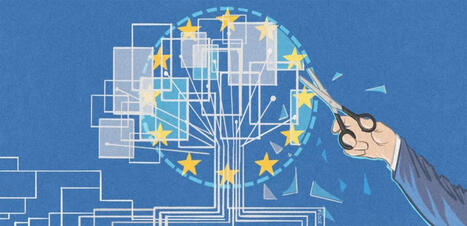
Les députés européens veulent repousser la régulation des systèmes d’IA à hauts risques ...

Les députés européens veulent repousser la régulation des systèmes d’IA à hauts risques ... | E-Learning-Inclusivo (Mashup) | Scoop.it

L’AI Act est entré en vigueur en août 2024 mais sa mise en application est progressive. Alors que les règles relatives aux systèmes d’intelligence artificielle à haut risque devaient s’appliquer à partir du 2 août 2026, des députés européens se sont prononcés pour le report de près d’un an et demi de ces mesures.


Via Intelligence Economique, Investigations Numériques et Veille Informationnelle, michel verstrepen
No comment yet.
Rescooped by juandoming from Inovação Educacional
March 20, 2:49 AM
Scoop.it!

Mais tecnologia, menos conexão. O paradoxo da educação no SXSW EDU 2026

Mais tecnologia, menos conexão. O paradoxo da educação no SXSW EDU 2026 | E-Learning-Inclusivo (Mashup) | Scoop.it

A educação sempre foi feita de encontros humanos. Ela acontece quando um professor percebe um aluno, quando um aluno se percebe sujeito do mundo, quando professor e aluno aprendem juntos. Quando um olhar encoraja e muda tudo ou quando uma pergunta é capaz de fazer uma revolução dentro da escola. Mas num mundo onde cada vez mais a tecnologia ganha território e as conexões humanas parecem se perder, como fazer para manter a escola viva? Pulsando.
No SXSW EDU 2026, que aconteceu entre os dias 9 e 12 de março, em Austin, EUA, a pergunta - e o medo - norteou 90% das palestras, painéis, workshops e rodas de conversa que estavam na programação. Títulos como “O que acontece com a escola quando algoritmos passam a ensinar?”, “Como promover saúde mental de jovens em tempos de IA?” ou "Como a IA pode ser uma aliada da educação?“, ocuparam salas imensas que lotavam de educadores e, certamente, tiraram o sono de muitos que estão preocupados com o avanço da tecnologia.
A questão é que a pergunta já não é mais se a inteligência artificial fará parte da educação ou não porque ela já está dentro das escolas. A inquietação agora é outra: na maneira como já está transformando o papel dos professores, o sentido da aprendizagem e a própria experiência de ser estudante.
As preocupações são legitimas e reforçam o paradoxo do nosso tempo que é “quanto mais tecnologia, menos conexão”. Por quê? O que está acontecendo? Dentro do campo da educação, estamos falando de plataformas de ensino-aprendizado que prometem fazer melhor -- e mais rápido -- aquilo que todo professor era capaz de ensinar até ontem.
Segundo dados recentes da UNESCO, mais de 60% dos sistemas educacionais do mundo já experimentam algum tipo de aplicação de inteligência artificial em ambientes de aprendizagem. Ao mesmo tempo, pesquisas do Pew Research Center indicam que mais da metade dos professores norte-americanos se dizem preocupados com o impacto dessas tecnologias na educação, especialmente em relação à autonomia docente e à integridade acadêmica. E essa tensão aparece de forma muito clara no SXSW EDU. Há entusiasmo, investimento e expectativa, mas também há medo. Muito medo.
Só que curiosamente, muitas das histórias inspiradoras apresentadas no evento não começaram com tecnologia, mas com experiências profundamente humanas. Educadores que perceberam que determinados alunos estavam sendo sistematicamente deixados para trás, mães que criaram novos modelos de escola porque seus filhos não conseguiam existir dentro das estruturas tradicionais de ensino e comunidades que decidiram reinventar a educação para responder a desafios locais.
Em muitos casos, a inovação educacional nasce justamente da tentativa de preencher lacunas deixadas pelo sistema formal. Como disse a educadora e pesquisadora Punya Mishra, da Arizona State University, durante um dos painéis do evento, “as tecnologias mudam rapidamente, mas as perguntas fundamentais da educação continuam sendo as mesmas: quem estamos tentando formar e para que tipo de mundo?”.
Esse movimento aparece em projetos voltados para estudantes negros, jovens imigrantes, crianças neurodivergentes e comunidades historicamente excluídas dos sistemas educacionais tradicionais. Em vários desses casos, a tecnologia surge menos como protagonista e mais como ferramenta para ampliar oportunidades de aprendizagem.
Um dos exemplos discutido no evento - e que eu mais gostei - envolve o uso de realidade virtual para ajudar crianças neurodivergentes a praticar interações sociais antes de enfrentarem situações reais, como conversar com colegas, interpretar expressões faciais ou lidar com conflitos cotidianos. Nesses casos, a tecnologia funciona como uma espécie de laboratório para a vida social. Ela não substitui a experiência humana, mas prepara o terreno para ela.
Uma das perguntas que surgiu na plateia após a apresentação questionava se educadores tinham dificuldade para fazer com que crianças do espectro autista colocassem os aparelhos de realidade virtual e é justamente aí que se dá a importância do humano na relação com a tecnologia e na intermediação dela. Os três educadores que estavam no palco foram categóricos ao dizer que alunos só se sentiam confortáveis e confiantes em colocar as “máscaras” após criarem vínculos com seus professores. Primeiro era preciso estabelecer relação com as crianças para só depois entrar a tecnologia.
Desta apresentação, outro tema desponta nas discussões do SXSW EDU que é o pertencimento. Educadores de diferentes países insistem que a escola precisa voltar a ser um espaço de conexão e comunidade, especialmente em um momento em que jovens enfrentam níveis crescentes de ansiedade, solidão e insegurança em relação ao futuro. Porque é na escola que crianças e adolescentes se sentem seguros e confiantes para desenhar uma possibilidade de mundo onde exista presente e futuro. Segundo a Organização Mundial da Saúde, cerca de um em cada sete adolescentes no mundo vive hoje com algum transtorno mental, o que impacta diretamente a construção de futuro. O sonho. E ainda assim, boa parte dos debates educacionais continua concentrada em desempenho acadêmico, inovação tecnológica ou transformação curricular. Quando o assunto saúde mental apareceu foi para discutir o uso da IA, os risco do uso de chatbots e as preocupações que giram em torno do tema. Agora como afirmou a pesquisadora e especialista em aprendizagem digital Audrey Watters em um dos debates do evento, “se a tecnologia entra na escola apenas como promessa de eficiência, ela corre o risco de ampliar desigualdades em vez de enfrentá-las”.
Talvez por isso, em muitos momentos do SXSW EDU, a conversa volte sempre à mesma pergunta: o que realmente importa ensinar em um mundo atravessado pela inteligência artificial? Criatividade, pensamento crítico, capacidade de colaboração e adaptação diante da incerteza aparecem com frequência nas respostas de educadores, pesquisadores e líderes de sistemas educacionais. O professor Yong Zhao, um dos estudiosos mais influentes do mundo em inovação educacional, resumiu o desafio de forma bastante direta ao afirmar que “se as escolas continuarem preparando alunos apenas para repetir respostas corretas, elas estarão formando estudantes para um mundo que já não existe”.
A inteligência artificial pode corrigir exercícios, organizar conteúdos, identificar padrões de aprendizagem e acompanhar o progresso de centenas de estudantes ao mesmo tempo. Pode ajudar professores a planejar aulas e até sugerir atividades personalizadas para cada aluno. O que ela ainda não consegue fazer é reconhecer um estudante em sua complexidade humana, perceber quando algo em sua vida pessoal interfere no aprendizado ou compreender que, muitas vezes, aprender é um processo que passa pela dúvida, pela frustração e pela descoberta.
Para o Brasil, essa discussão tem implicações urgentes. O país ainda enfrenta desafios estruturais de aprendizagem agravados pela pandemia, e dados recentes do Sistema de Avaliação da Educação Básica indicam que mais da metade dos estudantes brasileiros conclui o ensino fundamental sem domínio adequado de leitura e matemática. E aqui, no SXSW EDU a discussão não é mais quem vai sair da escola sabendo ler e escrever. É quem vai sair da escola com capacidades humanas de conexão.
Ao mesmo tempo, escolas públicas e privadas começam a experimentar ferramentas de inteligência artificial sem que professores necessariamente tenham formação adequada para utilizá-las pedagogicamente. Como alertou a especialista em políticas educacionais Linda Darling-Hammond, professora da Universidade Stanford, durante um dos discussões, “a tecnologia só melhora a educação quando fortalece o trabalho dos professores, e não quando tenta substituí-los”.
Ao final de quatro dias de debates no SXSW EDU, fica claro que a inteligência artificial já está redesenhando o cenário da educação global. Mas também fica evidente que a pergunta central do futuro da aprendizagem talvez não seja tecnológica, e sim profundamente humana. Em um mundo cada vez mais mediado por algoritmos, talvez o maior desafio das escolas seja justamente preservar aquilo que sempre esteve no coração da educação: a capacidade de reconhecer o outro, construir pertencimento e ajudar jovens a encontrar sentido em um mundo cada vez mais complexo.
Porque, no fim das contas, enquanto adultos discutem tecnologias capazes de transformar a forma como ensinamos, crianças e adolescentes continuam procurando exatamente aquilo que nenhuma inteligência artificial é capaz de oferecer: alguém que os veja, os escute e acredite que suas histórias importam. O olhar para com o outro precisa ser humano e isso o SXSW EDU não deixou dúvidas.


Via Inovação Educacional
No comment yet.
Scooped by juandoming
March 15, 11:14 AM
Scoop.it!

Validación científica & Evaluación científica por Pares en procesos educativos en la Universidad (Investigación con la IA General Causal de Farnós) –

Validación científica & Evaluación científica por Pares en procesos educativos en la Universidad (Investigación con la IA General Causal de Farnós) – | E-Learning-Inclusivo (Mashup) | Scoop.it
Juan Domingo Farnos . Abstract (Castellano) Esta investigación establece un cambio de paradigma en la arquitectura del conocimiento mediante la implementación de la Inteligencia Artificial Generativa Causal (IAGC) y los principios de la Educación Disruptiva. El trabajo se centra en el desarrollo del Software 3.0, un sistema fundamentado en el Agente de Razonamiento Continuo (ARC),…
No comment yet.
Rescooped by juandoming from Educación a Distancia y TIC
March 12, 9:07 AM
Scoop.it!

RIED: Alfabetización en datos: de víctimas del algoritmo a ciudadanos críticos

RIED: Alfabetización en datos: de víctimas del algoritmo a ciudadanos críticos | E-Learning-Inclusivo (Mashup) | Scoop.it
Blog de la "RIED. Revista Iberoamericana de Educación a Distancia". La Revista Iberoamericana de la Educación Digital.

Via LGA
No comment yet.
Rescooped by juandoming from e-learning-ukr
March 11, 9:42 AM
Scoop.it!

The Value of Structured Think-Aloud Methodologies in the Age of AI

The Value of Structured Think-Aloud Methodologies in the Age of AI | E-Learning-Inclusivo (Mashup) | Scoop.it
Learn how structured think-aloud methodologies help faculty assess higher-order critical thinking, metacognitive skills, and AI use in higher education.

Via Vladimir Kukharenko
No comment yet.
Rescooped by juandoming from Educational Technology News
March 7, 2:47 AM
Scoop.it!

Learning in the AI age: Education 5.0

Learning in the AI age: Education 5.0 | E-Learning-Inclusivo (Mashup) | Scoop.it
Learning in the AI age: Education 5.0 Patrick Blessinger Learning is for human flourishing, but only if we can see flourishing as something more than economic productivity, something more than employability, something more than credentials, though these things are very important.

Via EDTECH@UTRGV
EDTECH@UTRGV's curator insight, March 5, 3:11 PM

"[K]nowledge is now universally abundant and available to everyone, but it is fragmented, contested, and increasingly filtered through algorithms.

The aim of learning today should be to move from survival to meaning, from authority to participation, from control to co-creation, from power to rights, and from fragmentation to coherence."

Scooped by juandoming
March 4, 11:47 AM
Scoop.it!

Herramientas para medir cómo la IA GENERAL CAUSAL de Farnós afecta al aprendizaje autorregulado. (Educación disruptiva & IAGC) –

Herramientas para medir cómo la IA GENERAL CAUSAL de Farnós afecta al aprendizaje autorregulado. (Educación disruptiva & IAGC) – | E-Learning-Inclusivo (Mashup) | Scoop.it
Juan Domingo Farnos ABSTRACT (Español) La presente investigación (de Juan Domingo Farnos) establece un cambio de paradigma en la ingeniería del aprendizaje mediante la implementación de la Inteligencia Artificial General Causal (IAGC). Se parte de la premisa crítica de que las herramientas actuales son incapaces de medir con precisión el impacto de la IA en…
No comment yet.