Covering the last 365 days

Digital Marketing

Digital marketing on Scoop.it is alive where channels are being reworked: search splits across social platforms and AI answers, hospitality distribution moves deeper into platform control, and content marketing is judged by systems, software and measurable output. The subject area spans SEO, social media, content strategy, e-commerce, local marketing, advertising and sector-specific marketing in tourism, healthcare and pharma.

The page draws from 133 topics maintained by 82 curators, with selections from the last 365 days and activity as recent as 2026-10-02. The most visible sources in the corpus include YouTube, McKinsey, Kamyar Shah, LinkedIn, CNBC, HBR, PBS, Search Engine Journal and Hospitality Today, reflecting a mix of practitioner advice, platform news and management analysis.

What is moving now is execution. Consulting posts package AI with operations roles, search posts widen from Google rankings to social and AI discovery, and advertising items show how brand work is judged through trust and backlash. The recurring question is how marketers keep control when platforms, algorithms and buyers reshape the path to purchase.

Key figures

  • 133 topics
  • 82 curators
  • 8538079 views
  • October 2, 2026 last activity

Cross-cutting issues

1

Marketing advice is being sold as operating capacity

Consulting content is blending marketing, operations and AI into service packages that promise execution as much as strategy.
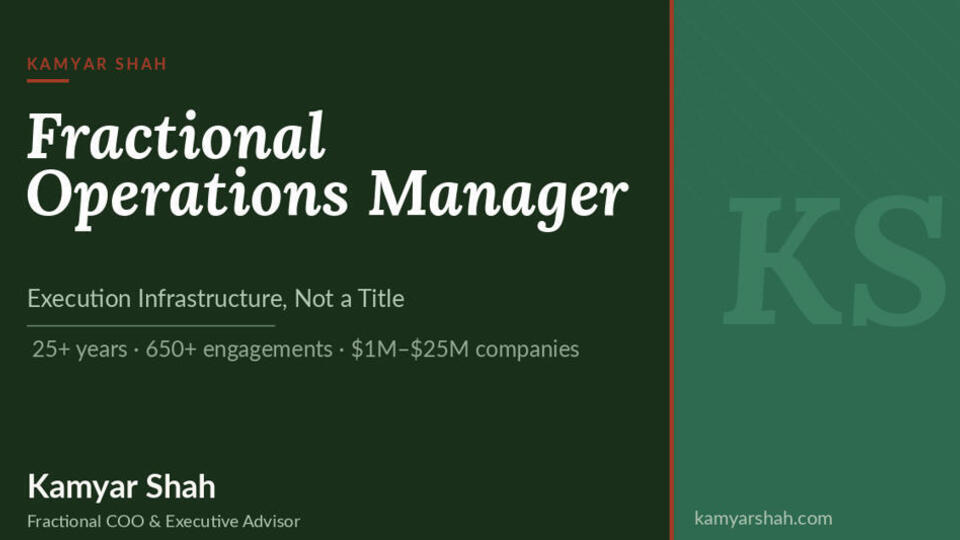
Fractional Operations Manager | Fractional COO - Fractional CMO - Kamyar Shah kamyarshah.com

Tampa Florida Marketing and From Around The web converge around a practical advisory offer rather than a broad theory of marketing. One topic presents fractional operations roles, including operations manager, director of operations and operational efficiency consulting. The other repeats the fractional COO language and adds AI as a service, tying technology positioning to day-to-day execution.

The pattern matters because the marketing promise is not only demand generation. It is packaged as management capacity, operating discipline and technology adoption in one offer. The same source appears across the posts, so the signal is less a market survey than a close look at how one consulting brand frames the overlap between operations and marketing.

The AI item sits beside operations consulting rather than apart from it. That placement shows how AI language is being sold as an implementation problem: what gets automated, who runs the work, and how business functions are coordinated. In this slice of the topic area, AI becomes part of service design.

For readers tracking digital marketing, the useful takeaway is the shift from channel advice to execution-led packaging. Fractional CMO language appears next to COO and operations titles, suggesting that marketing services are being positioned around accountability for systems, not just campaigns.

Further reading

2

Content marketing is becoming a managed system

The debate is moving from what to publish toward how content is planned, measured, scaled and paid for.

The changing role of the CMO | McKinsey mckinsey.com

OnMarketing: Marketing Tips for Growth brings the executive lens. Its McKinsey post connects the CMO role with customer-centric growth, C-suite alignment, measurement and AI. That places content work inside a broader management question: how marketing proves its contribution when leadership expects clearer links to growth.

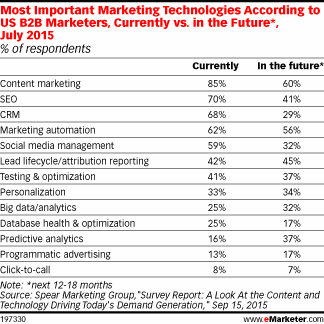
The steroidify topic supplies the tactical layer. Items from Econsultancy, Kissmetrics, eMarketer, Scoop.it and Rebekah Radice focus on rules, hubs, technology importance, software cost and business blogging. Together they describe content marketing as an operating system made of formats, tools and repeatable workflows.

The strongest thread is the move from making individual pieces to building assets that keep working. A content hub is framed as a media magnet, blogging is treated as a business practice, and software cost becomes part of the decision. Content is judged not only by creativity, but by structure and return.

That pressure explains why automation and measurement sit close to editorial guidance. Marketers are being asked to scale useful material, choose software carefully and justify spending. The topic area shows content marketing maturing into a budgeted process rather than a collection of isolated posts.

Further reading

Curators to follow

  • Roland Schegg

    Follows eTourism Trends and News, with recent selections on hospitality distribution, AI adoption, OTAs, reviews and pricing control.

  • Leona Ungerer

    Maintains consumer psychology coverage that brings advertising backlash, platform trust signals and brand-design reactions into the subject area.

  • nrip

    Maintains three topics in this subject area and has recent activity within the current 365-day window.

  • Brian Yanish - MarketingHits.com

    Maintains three topics in this subject area, adding breadth from a topic set that was active in late 2024.

Frequently asked questions

What does Digital Marketing cover on Scoop.it?

This page follows online marketing channels and campaigns across Scoop.it topics. The material includes SEO, social search, content marketing, social media advertising, e-commerce, local marketing, hospitality distribution and healthcare or pharma channel work. The emphasis is on practical execution, platform shifts and the way AI changes discovery, pricing and workflow.

How is AI changing digital marketing in these topics?

AI appears in several strands. Hospitality posts track distribution systems, pricing and automation readiness. Search posts cover AI Overview reporting and LLM SEO. Consulting posts package AI with operations services. Content marketing posts discuss software, measurement and systems, showing AI as part of marketing execution rather than a separate trend.

Why is search marketing getting more complicated?

Search is no longer treated as one ranking problem. Recent selections cover YouTube SEO, TikTok and Instagram search, Google Business Profile optimization, local versus national SEO, Search Console reporting for AI Overviews, LLM SEO and the choice between GEO, SEO and AEO. Marketers must plan for several discovery paths.

What role does content marketing play here?

Content marketing is presented as a system, not only a writing task. The material links CMO measurement, AI in marketing, content hubs, business blogging, rules for content work and software costs. The shared concern is how to scale useful content while proving that it supports growth and customer acquisition.

Why does hospitality appear in a digital marketing page?

The eTourism topic shows hotels facing pressure from OTAs, Google reviews, AI agents and automated bundling of the whole stay. Posts selected there describe concerns over pricing control, review visibility, platform packaging and the gap between AI adoption and strategic readiness in hospitality businesses.

Who feeds this digital marketing coverage?

The subject area includes 133 topics maintained by 82 curators, with activity recorded within the last 365 days and the latest activity on 2026-10-02. Recent visible contributors include C18 on hospitality distribution and C14 on consumer psychology, advertising reactions and platform trust signals.

Most quoted sources

  • youtube.com 2
  • mckinsey.com 2
  • kamyarshah.com 2
  • linkedin.com 2
  • youtu.be 2
  • cnbc.com 2
  • hbr.org 2
  • pbs.org 2
  • searchenginejournal.com 2
  • hospitality.today 1

This page was written by an AI from the public curation of Scoop.it topics. The posts, topics and curators it cites are real and linked directly.

Updated on October 3, 2026