


Via Back to the Roots

 Your new post is loading...
 Scoop.it! Via Back to the Roots 
No comment yet.
Sign up to comment
Scoop.it!
During arbuscular mycorrhizal symbiosis, arbuscule-containing root cortex cells display a proliferation of plastids, a feature usually ascribed to an increased plant anabolism despite the lack of studies focusing on purified root plastids. In this study, we investigated mycorrhiza-induced changes in plastidic pathways by performing a label-free comparative subcellular quantitative proteomic analysis targeted on plastid-enriched fractions isolated from Medicago truncatula roots, coupled to a cytological analysis of plastid structure. We identified 490 root plastid protein candidates, among which 79 changed in abundance upon mycorrhization, as inferred from spectral counting. According to cross-species sequence homology searches, the mycorrhiza-responsive proteome was enriched in proteins experimentally localized in thylakoids, whereas it was depleted of proteins ascribed predominantly to amyloplasts. Consistently, the analysis of plastid morphology using transmission electron microscopy indicated that starch depletion associated with the proliferation of membrane-free and tubular membrane-containing plastids was a feature specific to arbusculated cells. The loss of enzymes involved in carbon/nitrogen assimilation and provision of reducing power, coupled to macromolecule degradation events in the plastid-enriched fraction of mycorrhizal roots that paralleled lack of starch accumulation in arbusculated cells, lead us to propose that arbuscule functioning elicits a nutrient starvation and an oxidative stress signature that may prime arbuscule breakdown.
Jean-Michel Ané's insight:
Very interesting!
Scoop.it!

Alors qu’ils sont à la base de notre alimentation et de notre santé, les sols ne bénéficient d’aucune réglementation. Pour les protéger, plus de 400 associations se sont réunies pour la mise en place d’une législation européenne. Via La Bièvre - SMBVB

La Bièvre - SMBVB's curator insight,
December 11, 2016 12:42 PM
Les sols nous sont indispensables et pourtant nous les maltraitons sans en avoir conscience. Le sol est fragile, s'est constitué sur des millénaires et est détruit d'un coup de pelle mécanique ou à force de labours profonds qui en détruisent la structure. Il faut les préserver et cette sensibilisation doit aussi concerner la ville. En laissant de la place à la nature, en allant vers l'agriculture urbaine de plein sol, nous pouvons essayer de stopper ce mouvement d'artificialisation. Pour vous convaincre de l'intérêt des sols, vous pouvez lire cette BD.
Scoop.it!
The growing pollution of the environment with plastic debris is a global threat, which urgently needs biotechnological solutions. Enzymatic recycling not only prevents pollution but also would allow recovery of valuable building blocks. For that reason, we explored the existence of microbial polyesterases in microbial communities associated with the Sphagnum magellanicum moss, one key species within unexploited bog ecosystems. Indeed, this resulted in the identification of six novel esterases, which were isolated, cloned, and heterologously expressed in Escherichia coli. The esterases were found to hydrolyze the copolyester poly(butylene adipate-co-butylene terephthalate) (PBAT) and the oligomeric model substrate bis(4-(benzoyloxy)butyl) terephthalate (BaBTaBBa). Two promising polyesterase candidates EstB3 and EstC7, which clustered into the family VIII of bacterial lipolytic enzymes, were purified and characterized using the soluble esterase substrate p-nitrophenyl butyrate (KM = 46.5 and 3.4 μM, Topt = 48 °C and 50 °C, pHopt = 7.0 and 8.5, respectively). In particular EstC7 showed outstanding activity and a high preference for the hydrolysis of the aromatic ester bond in PBAT. Our study highlights the potential of plant-associated microbiomes from extreme natural ecosystems as a source for novel hydrolytic enzymes hydrolyzing polymeric compounds.
Scoop.it!

In many legumes, roots that are exposed to light do not form nodules. Here, we report that blue light inhibits nodulation in Lotus japonicus roots inoculated with Mesorhizobium loti. Using RNA interference, we suppressed the expression of the phototropin and cryptochrome genes in L. japonicus hairy roots. Under blue light, plants transformed with an empty vector did not develop nodules, whereas plants exhibiting suppressed expression of cry1 and cry2 genes formed nodules. We also measured rhizobial growth to investigate whether the inhibition of nodulation could be caused by a reduced population of rhizobia in response to light. Although red light had no effect on rhizobial growth, blue light had a strong inhibitory effect. Rhizobial growth under blue light was partially restored in signature-tagged mutagenesis (STM) strains in which LOV-HK/PAS- and photolyase-related genes were disrupted. Moreover, when Ljcry1A and Ljcry2B-silenced plants were inoculated with the STM strains, nodulation was additively increased. Our data show that blue light receptors in both the host plant and the symbiont have a profound effect on nodule development. The exact mechanism by which these photomorphogenetic responses function in the symbiosis needs further study, but they are clearly involved in optimizing legume nodulation.
Scoop.it!

The free-living legume symbiont Rhizobium leguminosarum is of significant economic value because of its ability to provide fixed nitrogen to globally important leguminous food crops, such as peas and lentils. Discovery based research into the genetics and physiology of R. leguminosarum provides the foundational knowledge necessary for understanding the bacterium's complex lifestyle, necessary for augmenting its use in an agricultural setting. Transposon insertion sequencing (INSeq) facilitates high-throughput forward genetic screening at a genomic scale to identify individual genes required for growth in a specific environment. In this study we applied INSeq to screen the genome of R. leguminosarum bv. viciae strain 3841 (RLV3841) for genes required for growth on minimal mannitol containing medium. Results from this study were contrasted with a prior INSeq experiment screened on peptide rich media to identify a common set of functional genes necessary for basic physiology. Contrasting the two growth conditions indicated that approximately 10% of the chromosome was required for growth, under both growth conditions. Specific genes that were essential to singular growth conditions were also identified. Data from INSeq screening on mannitol as a sole carbon source were used to reconstruct a metabolic map summarizing growth impaired phenotypes observed in the Embden-Meyerhof-Parnas pathway, Entner-Doudoroff pathway, pentose phosphate pathway, and tricarboxylic acid cycle. This revealed the presence of mannitol dependent and independent metabolic pathways required for growth, along with identifying metabolic steps with isozymes or possible carbon flux by-passes. Additionally, genes were identified on plasmids pRL11 and pRL12 that are likely to encode functional activities important to the central physiology of RLV3841. Perry BJ, Akter MS, Yost CK (2016). .Front Microbiol. 2016 Nov 22;7:1873. eCollection 2016. Via IvanOresnik
Scoop.it!
Academic letters of recommendation: a guide for the perplexed.
Scoop.it!

While it is well established that plants associating with arbuscular mycorrhizal (AM) and ectomycorrhizal (ECM) fungi cycle carbon (C) and nutrients in distinct ways, we have a limited understanding of whether varying abundance of ECM and AM plants in a stand can provide integrative proxies for key biogeochemical processes. We explored linkages between the relative abundance of AM and ECM trees and microbial functioning in three hardwood forests in southern Indiana, USA. Across each site's ‘mycorrhizal gradient’, we measured fungal biomass, fungal : bacterial (F : B) ratios, extracellular enzyme activities, soil carbon : nitrogen ratio, and soil pH over a growing season. We show that the percentage of AM or ECM trees in a plot promotes microbial communities that both reflect and determine the C to nutrient balance in soil. Soils dominated by ECM trees had higher F : B ratios and more standing fungal biomass than AM stands. Enzyme stoichiometry in ECM soils shifted to higher investment in extracellular enzymes needed for nitrogen and phosphorus acquisition than in C-acquisition enzymes, relative to AM soils. Our results suggest that knowledge of mycorrhizal dominance at the stand or landscape scale may provide a unifying framework for linking plant and microbial community dynamics, and predicting their effects on ecological function.
Via Francis Martin
Scoop.it!

Phylosymbiosis was recently proposed to describe the eco-evolutionary pattern, whereby the ecological relatedness of host-associated microbial communities parallels the phylogeny of related host species. Here, we test the prevalence of phylosymbiosis and its functional significance under highly controlled conditions by characterizing the microbiota of 24 animal species from four different groups (Peromyscus deer mice, Drosophila flies, mosquitoes, and Nasonia wasps), and we reevaluate the phylosymbiotic relationships of seven species of wild hominids. We demonstrate three key findings. First, intraspecific microbiota variation is consistently less than interspecific microbiota variation, and microbiota-based models predict host species origin with high accuracy across the dataset. Interestingly, the age of host clade divergence positively associates with the degree of microbial community distinguishability between species within the host clades, spanning recent host speciation events (~1 million y ago) to more distantly related host genera (~108 million y ago). Second, topological congruence analyses of each group's complete phylogeny and microbiota dendrogram reveal significant degrees of phylosymbiosis, irrespective of host clade age or taxonomy. Third, consistent with selection on host–microbiota interactions driving phylosymbiosis, there are survival and performance reductions when interspecific microbiota transplants are conducted between closely related and divergent host species pairs. Overall, these findings indicate that the composition and functional effects of an animal's microbial community can be closely allied with host evolution, even across wide-ranging timescales and diverse animal systems reared under controlled conditions.
Scoop.it!

The Wisconsin Institute for Discovery (WID) will usher in a new year with a new director: Jo Handelsman, a Yale University professor and the associate director for science in the White House Office of Science and Technology Policy.
Jean-Michel Ané's insight:
AWESOME NEWS!
Scoop.it!
Arbuscular mycorrhizal (AM) symbiosis plays an important role in ecosystem functioning, particularly in fragile environments. Little is known, however, about how AM fungus community composition responds to slope aspect. Our objective was to compare the AM fungus communities between sunny and shady slopes and to detect factors that influenced the distributions of AM fungi in arid ecosystems of the Daqingshan Mountains, Inner Mongolia, North China. AM fungus communities were evaluated based on small subunit ribosomal RNA genes (SSUs) using Illumina MiSeq sequencing. AM fungus community composition differed significantly between slope aspects, and sunny slopes had significantly higher AM fungus diversity and richness as well as spore density, total root colonization, arbuscule abundance, vesicle abundance, and hyphal colonization than shady slopes. Structural equation modeling (SEM) illustrated that the effects of slope aspect on AM fungus richness likely were mediated by available phosphorus, soil organic carbon, plant cover, and plant diversity. Available phosphorus was the principal factor that influenced AM fungus species richness, and soil organic carbon was the principal factor influencing spore density and total root colonization, suggesting that these factors especially might be responsible for differences between the AM fungus communities of different slope aspects. These findings elucidate the influence of slope aspect on AM fungus communities and may inform use of AM fungi in protection and restoration of vegetation with different slope aspects in arid ecosystems.
Scoop.it!

The formation of storage organs, such as spores and vesicles, is a central part of the life cycle of an arbuscular mycorrhizal fungus (AMF), but the conditions under which this occurs in AMF are not well understood. Here, quantity and distribution of storage organs formed by the arbuscular mycorrhizal fungus (AMF) Funneliformis mosseae within dead (excised) roots were characterised. ‘Trap roots’ (TR), separated from the growth substrate by a 30-μm mesh, supported hyphal growth and formation of storage organs of the AMF. Hyphae developed both inside and on the outside of the TR and also within air gaps of surrounding nylon mesh compartments, but formation of vesicles and spores was confined to the interior and to the surface of the TR. Up to 20 % of the TR length harboured newly formed storage organs, resulting in a number of about 60 per mg TR dry weight. The portion of TR length containing storage organs was greater in coarse (diameter >300 μm) than in thin (<150 μm) TR, irrespective of whether the TR were sourced from an AMF host or non-host plant. We conclude that the AMF’s extraradical mycelium produces its storage organs within dead roots in preference to air space in the substrate. Dead roots may indirectly supply nutrients to AMF (once they have been mineralised) or represent a protected space for the fungal structures to develop. The experimental technique described here allows for the preparation of AMF spores and vesicles of F. mosseae free of any mineral substrate. Via Philip Carella
Scoop.it!

Background: The presence of bacteria and fungi in medicinal or recreational Cannabis poses a potential threat to consumers if those microbes include pathogenic or toxigenic species. This study evaluated two widely used culture-based platforms for total yeast and mold (TYM) testing marketed by 3M Corporation and Biomérieux, in comparison with a quantitative PCR (qPCR) approach marketed by Medicinal Genomics Corporation.
Jean-Michel Ané's insight:
I am not so sure about the importance of this given that the main usage of Cannabis is... to burn it.
|
Scoop.it!

Click on the article title to read more.
Jean-Michel Ané's insight:
Excellent
Scoop.it!

We'd like to share this critical thinking skills cheatsheet for you to use with your students. Get them asking questions on any topic! Via Dr. Tom D'Amico (@TDOttawa)
Jean-Michel Ané's insight:
Easily applicable to grant proposals...

Character Minutes's curator insight,
May 5, 2017 12:34 PM
Great tool for teachers to use in the classroom.

Julian F Calvo's curator insight,
February 19, 2020 9:59 AM
This is an excellent idea for us to check how we can implement our topics and also, how learners can be interested on due to the fact that we are taking into account all the benefits they can have (this as an example of the WH questions) and also since they can discuss about what they like to learn and share in classes. In adition, thi is something I can implement in classes since learners will have the opportunity to improve this speaking skill trhough the discussion of this kind of topics and also, the ones their are interested on. Finally, students will be able to participate more ought to the increase of motivation they will have since our duty is to encourage them to use the second language they are learning.

Harold Quintero's curator insight,
September 26, 2020 2:37 AM
This is a very complete guide related to critical thinking questions that can allow us to help our students reflecting on the content we present them. These questions are also very useful for teachers in development to keep in mind while planning classes and preparing the material they are presenting to their students as it leads them to better select and adapt the content to students' needs and interests and have them engaged.
Scoop.it!

The recent accumulation of newly discovered fungal–bacterial mutualisms challenges the paradigm that fungi and bacteria are natural antagonists. To understand the mechanisms that govern the establishment and maintenance over evolutionary time of mutualisms between fungi and bacteria, we studied a symbiosis of the fungus Rhizopus microsporus (Mucoromycotina) and its Burkholderia endobacteria. We found that nonhost R. microsporus, as well as other mucoralean fungi, interact antagonistically with endobacteria derived from the host and are not invaded by them. Comparison of gene expression profiles of host and nonhost fungi during interaction with endobacteria revealed dramatic changes in expression of lipid metabolic genes in the host. Analysis of the host lipidome confirmed that symbiosis establishment was accompanied by specific changes in the fungal lipid profile. Diacylglycerol kinase (DGK) activity was important for these lipid metabolic changes, as its inhibition altered the fungal lipid profile and caused a shift in the host–bacterial interaction into an antagonism. We conclude that adjustments in host lipid metabolism during symbiosis establishment, mediated by DGKs, are required for the mutualistic outcome of the Rhizopus–Burkholderia symbiosis. In addition, the neutral and phospholipid profiles of R. microsporus provide important insights into lipid metabolism in an understudied group of oleaginous Mucoromycotina. Lastly, our study revealed that the DGKs involved in the symbiosis form a previously uncharacterized clade of DGK domain proteins. Via Francis Martin
Scoop.it!

LOCALIZER is a machine learning method for subcellular localization prediction in plant cells. LOCALIZER has been trained to predict either the localization of plant proteins or the localization of eukaryotic effector proteins to chloroplasts, mitochondria or nuclei in the plant cell.
Jean-Michel Ané's insight:
It looks pretty good.
Scoop.it!

Le concept d'organisme montre aujourd'hui ses limites : il faut désormais prendre en compte le fait qu'un animal ou une plante ne peut vivre sans les multiples microorganismes qui l'habitent.
Par Marc-André Selosse. Pour la Science > N°469 - novembre 2016
"... Les plantes et les animaux sont habités de microbes qui façonnent leurs traits : cela a conduit au concept d'holobionte (du grec holo, tout, et bios, vie), qui désigne l'unité biologique composée de l'hôte (plante ou animal) et de tous ses microorganismes. De plus en plus de biologistes substituent ce concept à la vision d'organismes isolés, car tous sont accompagnés. Comment se mettent en place les holobiontes ? En quoi cela modifie-t-il l'hôte ? Nous allons voir que la coexistence au sein de l'holobionte détermine l'évolution des partenaires."
[Image] Un champignon du genre Neotyphodium étend ses filaments au milieu du tissu cellulaire d'une graminée du genre Festuca. Ce champignon aide son hôte à se débarrasser des insectes et autres ravageurs en synthétisant divers alcaloïdes toxiques. Mais, sélectionné involontairement dans la graminée cultivée Kentucky 31, le champignon Neotyphodium a aussi empoisonné les vaches qui broutaient la graminée.
Via Bernadette Cassel
Jean-Michel Ané's insight:
A good article in French

Bernadette Cassel's curator insight,
December 12, 2016 6:31 PM
→ INRA - Journée plantes et philosophie - From www.bordeaux-aquitaine.inra.fr - Today, 12:17 AM
Scoop.it!
Current models of animal evolution focus on selection of individuals, ignoring the much faster selection of symbiotic bacteria. Here we take host-symbiont interactions into account by introducing a Population Genetics-like model of holobionts exposed to toxic stress. The stress can be alleviated by selection of resistant individuals (host and bacteria) and by secretion of a detoxification agent (″detox″). By defining a new measure, termed the ′Lamarckian′, we show that selection of resistant bacteria over one generation of hosts leads to stress-dependent increase in the tolerance of the hosts′ offspring. This benefit is mediated by co-alleviation of toxic and physiologic stress. Prolonged exposure leads to further adaptation by ′group selection′ of bacterial communities with higher detox per bacterium. These findings show that Lamarckian adaptation can arise via interactions between two levels of Darwinian selection within a holobiont system. The conclusions and modelling framework are applicable to diverse types of holobiont systems.
Scoop.it!
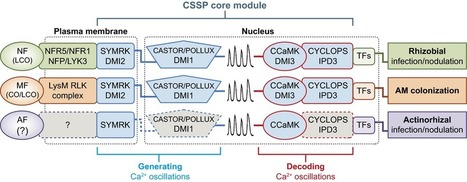
Root endosymbioses are beneficial associations formed between terrestrial plants and either bacterial or fungal micro-organisms. A common feature of these intracellular symbioses is the requirement for mutual recognition between the two partners before host-regulated microbial entry. As part of this molecular dialogue, symbiosis-specific microbial factors set in motion a highly conserved plant signal transduction pathway, of which a central component is the activation of sustained nuclear Ca2+ oscillations in target cells of the host epidermis. Here, we focus on recent findings concerning this crucial Ca2+-dependent signalling step for endosymbiotic associations involving either arbuscular mycorrhizal fungi or nitrogen-fixing Frankia actinomycetes, and in particular how this knowledge is contributing to the identification of the respective microbial factors.
Jean-Michel Ané's insight:
A must read...
Scoop.it!

Plant NF-Y transcription factors control a wide array of biological functions enabling appropriate reproductive and developmental processes as well as adaptation to various abiotic and biotic environments. In Medicago truncatula, MtNF-YA1 was previously identified as a key determinant for nodule development and establishment of rhizobial symbiosis. Here, we highlight a new role for this protein in compatibility to Aphanomyces euteiches, a root pathogenic oomycete. The Mtnf-ya1-1 mutant plants showed better survival rate, reduced symptoms, and increased development of their root apparatus as compared to their wild-type (WT) background A17. MtNF-YA-1 was specifically up-regulated by A. euteiches in F83005.5, a highly susceptible natural accession of M. truncatula while transcript level remained stable in A17, which is partially resistant. The role of MtNF-YA1 in F83005.5 susceptibility was further documented by reducing MtNF-YA1 expression either by overexpression of the miR169q, a microRNA targeting MtNF-YA1, or by RNAi approaches leading to a strong enhancement in the resistance of this susceptible line. Comparative analysis of the transcriptome of WT and Mtnf-ya1-1 led to the identification of 1509 differentially expressed genes. Among those, almost 36 defense-related genes were constitutively expressed in Mtnf-ya1-1, while 20 genes linked to hormonal pathways were repressed. In summary, we revealed an unexpected dual role for this symbiotic transcription factor as a key player in the compatibility mechanisms to a pathogen.
Scoop.it!

Plants do not grow as axenic organisms in nature, but host a diverse community of microorganisms, termed the plant microbiota. There is an increasing awareness that the plant microbiota plays a role in plant growth and can provide protection from invading pathogens. Apart from intense research on crop plants, Arabidopsis is emerging as a valuable model system to investigate the drivers shaping stable bacterial communities on leaves and roots and as a tool to decipher the intricate relationship among the host and its colonizing microorganisms. Gnotobiotic experimental systems help establish causal relationships between plant and microbiota genotypes and phenotypes and test hypotheses on biotic and abiotic perturbations in a systematic way. We highlight major recent findings in plant microbiota research using comparative community profiling and omics analyses, and discuss these approaches in light of community establishment and beneficial traits like nutrient acquisition and plant health.

Michael Fokin's comment,
December 8, 2016 7:14 PM
pls correct the link. in goes to annualreview through! your institute proxy
Scoop.it!
Orchids are highly dependent on their mycorrhizal fungal partners for nutrient supply, especially during early developmental stages. In addition to organic carbon, nitrogen (N) is probably a major nutrient transferred to the plant because orchid tissues are highly N-enriched. We know almost nothing about the N form preferentially transferred to the plant or about the key molecular determinants required for N uptake and transfer.
Scoop.it!
Plants growing in highly saline soils harbor unique communities of fungal root endophytes. We aimed to gain insight into how these communities are established in natural plant populations. We used cultivation-based and molecular approaches to examine root-endophytic colonization in the annual halophyte Salicornia patula at three time points over a 5-month period, from establishment to flowering. At the last sampling, the endophytic community of S. patula was compared to that in the related but perennial halophyte Arthrocnemum macrostachyum. The presence of root endophytes in S. patula was negligible at the first two sampling times, and remained low at the last sampling compared to A. macrostachyum. The latter species showed a well-established endophytic community in its roots that differed from that in S. patula, which was dominated by members of Pleosporales. Although such differences could be partially due to the host lifestyle, the possibility of a strong effect of the substratum could not be excluded. Altogether, our data indicate that the fungal endophytic colonization of roots is a slow process under salt stress. Therefore, we suggest that, in contrast to what is proposed for other systems, endophyte symbioses are unlikely to impact the development of the short-life-cycled S. patula living in these environments.
Scoop.it!
Stress induced by water deficit is considered to be a global problem and one of the most important factors limiting crop production in arid and semi-arid regions of the world. Application of certain microorganisms, including arbuscular mycorrhizal fungi (AMF), is considered to be an effective and sustainable strategy to mitigate the problem. A pot experiment was conducted in the field (from Feb. to Sep. in 2013–2014 in Isfahan, Iran) to assess the effectiveness of AMF inoculation on changes in biomass, essential oils, nutrient uptake and water-use efficiency of rose geranium (Pelargonium graveolens L.) experiencing stress induced by a deficit of water. The experiment was planned as a factorial experiment, using a completely randomized design, with two factors, including four AMF inoculation (non-mycorrhizal, Rhizophagus intraradices and Funneliformis mosseae inoculated, and the combination of both species) and three irrigation levels including well-watered (WW), moderate water deficiency (MWD) and severe water deficiency (SWD). The results indicated the occurrence of an adverse effect of water deficit on plant total biomass; however, AMF inoculation positively increased plant biomass compared to the non-inoculated ones under three irrigation levels. MWD condition resulted in higher essential oil (EO) content (12.4 %), water-use efficiency (WUE) (29.5 %) and glomalin-related soil proteins (GRSP) (19.1 %) in the plants compared to WW condition. Furthermore, all AMF inoculation improved EO content by at least 12 k%. The results also showed that severe water deficiency adversely affected the uptake of most nutrients by plants especially in non-inoculated plants. The results also revealed that, although EO production was under the control of irrigation regime, nutrient uptake was critically dependent on an association with mycorrhizae. Notwithstanding the fact that rose geranium can tolerate moderate drought stress, the high responsiveness of rose geranium to AMF under water deficiency stress confirms the key role of AMF in facilitating the production of this valuable crop in harsh environments. Dual infection of rose geranium with two AMF species could also synergistically affect biomass, essential oil content and mineral elements absorption.
|




