Your new post is loading...

|
Scooped by
Gilbert C FAURE
October 13, 2013 8:40 AM
|
is a personal Notebook Thanks John Dudley for the following tweet "If you like interesting snippets on all sorts of subjects relevant to academia, information, the world, highly recommended is @grip54 's collection:" La curation de contenus, la mémoire partagée d'une veille scientifique et sociétale
|
|
Scooped by
Gilbert C FAURE
June 30, 7:27 AM
|
MindMap AI promet de créer des cartes mentales avec l’IA, gratuitement.
Ce que j’ai aimé : l’édition manuelle libre, les exports pratiques, le passage de la carte au plan.
|
|
Scooped by
Gilbert C FAURE
June 28, 7:59 AM
|
The same LLM that scores 92 on the US medical licensing exam scores 44 when you point it at real clinical notes.
1️⃣ A new benchmark called BRIDGE tested 95 language models on 87 real clinical tasks, in 9 languages, from triage to billing codes.
2️⃣ The tasks came from 59 real clinical datasets, not exam questions. Real notes carry abbreviations, noise, and shorthand that exams strip out.
3️⃣ The best score any of the 95 models reached on real clinical text was 55.5 out of 100. None came close to reliable.
4️⃣ Exam scores badly overstate readiness. One model dropped from 92 on the licensing exam to 44 on real notes.
5️⃣ "Medical" in a model's name is not a quality signal. Most medically fine-tuned models scored worse than the general models they were built from.
6️⃣ Two mid-sized medical models bucked that trend, showing targeted adaptation on a current base model can work where scale alone does not.
7️⃣ Open-source models matched or beat the big proprietary ones, which weakens the case for paying premium prices on clinical text.
8️⃣ Showing the model five examples helped almost everything. Telling it to reason step by step usually made things worse.
9️⃣ Mapping notes to diagnostic codes stayed near 15% accuracy. Keep humans in the loop on coding.
🔟 Performance dropped in every language other than English, a real risk for health systems outside English-speaking markets.
✍🏻 Jiageng Wu, Bowen Gu, Ren Zhou, Kevin Xie, Doug Snyder, Yixing Jiang, Valentina Carducci, Richard Wyss, Rishi Desai, Emily Alsentzer, Leo Anthony Celi, Adam Rodman, Sebastian Schneeweiss, Jonathan H. Chen, Santiago Romero Brufau, MD, PhD, Kueiyu Joshua Lin, Jie Yang. BRIDGE: benchmarking large language models for understanding real-world clinical practice texts. Nature Biomedical Engineering. 2026. DOI: 10.1038/s41551-026-01719-2 | Behind Paywall | 36 comments on LinkedIn
|
|
Scooped by
Gilbert C FAURE
June 28, 4:42 AM
|
Série Marc Bloch & Intelligence économique - [5/5]
───
INFORMATION vs CONNAISSANCE : questionner d'abord
Marc Bloch observe, dans L'Étrange Défaite, que le renseignement militaire français souffrait d’une insuffisance qu’il analyse sans concession : « Toute connaissance étant, par elle-même, mouvement progressif de l’esprit et la connaissance d’événements par nature changeants ne pouvant, en outre, résulter que de l’examen de leur courbe, un compte rendu de recherches, pris isolément, sera toujours de peu de poids, s’il ne se raccorde aux comptes rendus précédents. Or, nos divers « bulletins » se suivaient, sans que, jamais ou presque jamais, leur lien fût apparent. »
Cette observation, formulée par un historien épris de rigueur, comme tout chercheur qui se respecte, Christophe Deschamps l'a également documenté dans sa thèse en intelligence économique, soutenue en décembre 2025 à l'Université de Poitiers. Son enquête auprès de vingt analystes professionnels français révèle que la capacité à formuler des hypothèses avant de collecter est « quasi absente des pratiques françaises ». La logique dominante reste l'inverse : on collecte d'abord, puis on cherche une explication à ce qu'on a trouvé. Ce faisant, on cherche une confirmation plutôt qu'une réponse.
Nicolas MOINET (cité par Deschamps) a qualifié ce défaut « d'ignorance savante » : croire que l’on sait parce qu'on a beaucoup de données. Le paradoxe est que plus les organisations investissent dans des outils de collecte sophistiqués, plus ce risque s'aggrave : l'abondance de données renforce l'illusion de connaissance sans améliorer la qualité du raisonnement.
Le cycle de la veille place systématiquement l'analyse après la collecte. Mais si ce séquencement est utile pour décrire le processus, il devient dangereux dès lors qu’il installe l'idée que l'on peut collecter de manière neutre, avant d’interpréter. Or il n'y a pas de collecte neutre, toute observation est orientée par un cadre d'interprétation préalable, explicite ou non. L'important est donc de savoir si le veilleur a formulé consciemment ses hypothèses, pour pouvoir les tester, voire les réviser.
Historien chercheur, Marc Bloch avait parfaitement identifié ce défaut : la méthode critique ne commence pas par les sources, elle commence par les questions que l'on pose aux sources. Un renseignement qui ne sait pas ce qu'il cherche ne trouvera, au mieux, que ce qu'il connaît déjà.
➜ Pour aller plus loin : Christophe Deschamps, La phase d'analyse dans le cycle de la veille stratégique, thèse de doctorat, Université de Poitiers, 2025
https://lnkd.in/eJJu229j
Ecole de Pensée sur la Guerre Economique - EPGE Arnaud de Morgny Philippe clerc Mounir Rochdi Institut des hautes études de défense nationale IHEDN Gilles RODRIGUEZ Clotilde Chagny
#MarcBloch #IntelligenceÉconomique #VeilleStratégique #Renseignement #AnalyseStratégique #BiaisCognitif #VeilleStratégique
|
|
Scooped by
Gilbert C FAURE
June 27, 8:34 AM
|
Every academic discipline has a randalekobold. Some. Have two.
If managed properly, i.e., killed with kindness, they can’t do much damage.
Be kind to your local randalekobold today!
#academichumor #academicjourney
|
|
Scooped by
Gilbert C FAURE
June 22, 10:04 AM
|
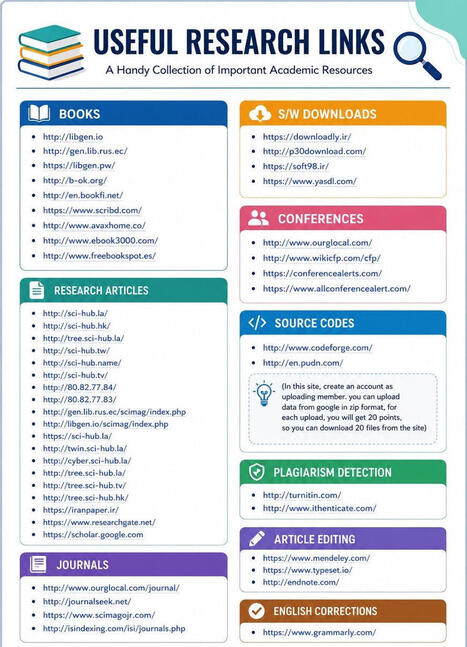
Useful Research web links
|
|
Scooped by
Gilbert C FAURE
June 22, 5:57 AM
|
Quickly write messages, take notes, or create content by turning your speech into well-written text. Powered by AI
|
|
Scooped by
Gilbert C FAURE
June 21, 3:59 AM
|
The impact factor (IF) is a limited metric. It's flawed.
Yet, it's influential. Less influential than many think, but more influential than it should be.
It's up to us -- the scientific community -- to avoid undue reliance on limited metrics and support broad and rigorous research evaluation.
This editorial makes specific suggestions that can help reduce undue influence of the IF.
We are all, in a sense, co-authors of the IF. It is not a number that descends from on high; it emerges from millions of individual citation decisions made by researchers like you. If we collectively cite the work that matters to us, in the journals that serve our field, the metrics will follow. We also have a collective responsibility to challenge how IF is used: in grant reviews, in hiring decisions, in promotion committees. If we believe that research should be judged on its own merit, we need to act on that belief, not just as editors, but as reviewers, as panel members, and as colleagues.
|
|
Scooped by
Gilbert C FAURE
June 20, 9:04 AM
|
This article argues that despite the remarkable advances of artificial intelligence (AI) in medicine —including demonstrated capabilities in image recognition, diagnosis, treatment planning, and even empathic communication in controlled settings—the core of medical practice remains irreducibly...
|
|
Scooped by
Gilbert C FAURE
June 19, 1:18 PM
|
Félicitations la Haute Autorité de Santé pour cette initiative !
L'IA prend une place de plus en plus importante dans les recherches santé des Français
👇
|
|
Scooped by
Gilbert C FAURE
June 19, 4:29 AM
|
Regrettably, I have to inform you that academia has made itself redundant.
This might be one of the biggest scandals I can imagine.
I’m probably just like you. I studied science because I was interested in how the world works.
> But then you enter the academic system...
Publication pressure and paper mills are challenges. But the real problem is hidden somewhere else:
Imagine someone repeatedly fakes western blots, assays, and microscopy images. You would assume that this would have consequences.
Consequences? Unlikely nowadays.
Leonid Schneider tried to get the fraudulent work of a professor corrected.
He wrote to the publishers. They said they would look into it, but never got back to him. Repeated follow-ups were met with silence, even from Nature!
He wrote to the funders. Their unbelievable response in this case:
You highlighted four fraudulent papers, but only one was funded by us. Thus, we have no responsibility in this case.
The university?
They don’t want to admit that their PIs fabricate data. Therefore, wrongdoing is covered up.
What about the scientists?
When the good professor received new funding (even after these wrong-doings were flagged), he moved to a new field.
When warned, scientists there didn’t want to endanger their reputation by speaking up.
And it’s not just a problem of a few individual cases.
In another great article written by Sholto David, he outlines how several papers published microscopy data for an entirely wrong antibody!
They stained a cytoskeleton protein instead of a nuclear one.
Yet the papers were still published in journals like Nature.
A friend of mine accidentally discovered that someone in their group had falsified data for an upcoming publication.
After the group leader heard about this, he wasn’t even eager to kick the person out.
A colleague of mine received a paper with completely falsified data for publication in their journal.
Of course, they rejected it. A little while later, he discovered the same paper, with different fake images, in another journal - a well-known journal.
During my master’s, a supervisor of mine once shared that, for their publication in a high-ranking Nature journal, none of the authors could even retrieve the primers for the PCR.
Yet it was a big story with many collaborating authors, so nobody cared.
But to my mind, the nail in the coffin comes from Thermo Fisher.
These guys falsified blots for their antibodies by copying or deleting bands.
And even after this was reported on LinkedIn, with thousands of people seeing it, you can still find the very same graphs online!
Why? Because nobody cares!
People cheat everywhere. But we have reached a point where even institutions would rather protect their image than talk about it.
Would you share your experience with scientific fraud?
We have to address this issue together.
#STEM #PhDLife #AademicPublishing #DataFabrication | 24 comments on LinkedIn
|
|
Scooped by
Gilbert C FAURE
June 18, 11:18 AM
|
Organisez votre succession sereinement
|
|
Scooped by
Gilbert C FAURE
June 16, 8:42 AM
|
|
|
|
Scooped by
Gilbert C FAURE
Today, 11:03 AM
|
Most experts compete by producing more. The ones who last build something readers come back to. Here is the model for moving from a voice people read to infrastructure people rely on to find their way
|
|
Scooped by
Gilbert C FAURE
June 29, 7:53 AM
|
🧬 16 syndromes familiaux à connaître en oncologie : un réflexe clinique qui peut changer une vie.
Lorsqu'un patient se présente avec un cancer, l'histoire familiale ne doit jamais être considérée comme une simple formalité. Derrière certains antécédents familiaux se cachent des syndromes de prédisposition génétique qui influencent le dépistage, le diagnostic, le traitement et la prévention chez les apparentés.
Cette infographie pédagogique résume 16 syndromes héréditaires majeurs, leurs gènes impliqués et les principales localisations tumorales associées.
📌 À retenir : • Un cancer du sein avant 40 ans doit faire évoquer une mutation BRCA ou un syndrome de Li-Fraumeni.
• Un cancer colorectal associé à des antécédents d'endomètre doit faire rechercher un syndrome de Lynch.
• Certaines tumeurs rares ou multiples peuvent être la première manifestation d'un syndrome héréditaire.
• Identifier ces patients permet d'améliorer la prise en charge de toute une famille.
Cette synthèse est destinée aux étudiants, internes, résidents, oncologues, chirurgiens, gastroentérologues, gynécologues et à tous les professionnels impliqués dans la prise en charge du cancer.
💡 En consultation, une bonne anamnèse familiale reste l'un des outils les plus puissants de la médecine de précision.
Quel syndrome héréditaire vous semble le plus fréquemment sous-diagnostiqué dans votre pratique ?
#Oncologie #Cancer #Génétique #Oncogénétique #MédecineDePrécision #Oncology #MedicalEducation #Residency #CancerCare #BRCA #LynchSyndrome #MedicalOncology
|
|
Scooped by
Gilbert C FAURE
June 28, 7:49 AM
|
Les controverses ayant entouré certaines figures de la vulgarisation scientifique, dont Etienne KLEIN, ne posent pas seulement la question du plagiat ou de l’attribution : elles révèlent une crise plus profonde de notre définition de l’originalité.
À l’âge de l’intelligence artificielle, le problème n’est plus seulement de savoir d’où vient une phrase. Il est de savoir si cette phrase a été intégrée, transformée, pensée — ou simplement déplacée.
Dans cet article, nous partons de la maxime d’Héraclite — « savoir n’est pas penser » — pour défendre une thèse simple : l’homme ne retrouvera pas sa singularité cognitive en accumulant davantage de savoir, mais en apprenant à porter, structurer et intégrer ce qu’il sait.
|
|
Scooped by
Gilbert C FAURE
June 27, 8:38 AM
|
A significant issue in medicine is the ability of the entity supposed to give an answer to a medical issue, to simply say "I don't know". We have all experienced doctors unable to pronounce the sentence that would have avoided a wrong answer, a misdiagnosis, a bad treatment. Now this issue is exploding in significance with the use of AI in medicine. And until this gets resolved we should all be skeptical of any response provided by AI.
A new preprint, from Akshat Dasula and colleagues, on acute kidney injury prediction from real EHR data, just provided more confirmation the problem is real and significant. On a clinical prediction task, an LLM reported about 0.94 confidence on the patients it got right and about 0.94 on the patients it got wrong. The number didn't move.
Across the few-shot setting the model's confidence sat near 0.94 while its accuracy swung between 54% and 74%. We usually complain that these systems are overconfident, reporting 90 when the truth is 70. This is worse and simpler: the confidence carried no information about correctness at all. Calibration assumes the score is merely off in magnitude. Here there is no signal to correct.
I almost filed it as the usual overconfidence story until I saw the second result. The LLM failed most precisely where the structured model was most certain, and held its own only where that model was unsure. It has no internal sense of which cases it can handle. It cannot feel the edge of its own competence, which is the one thing you most need a clinical tool to feel.
So where did a usable reliability signal come from? Not from the model. The authors built it from outside, comparing what the LLM attended to against what a tree-based model actually used, then turning that disagreement into a per-patient estimate of when to trust the LLM. Expected calibration error fell from 0.25 to 0.08, with no model internals and no retraining.
That is a judgment layer, described in the vocabulary of calibration. The model could not report its own trustworthiness, so the trustworthiness had to be built from outside it.
We keep waiting for these systems to learn to say "I am not sure." For now, something other than the model has to say it for them.
#PatientsUseAI #CriticalAIHealthLiteracy #HealthcareAI
|
|
Scooped by
Gilbert C FAURE
June 26, 8:53 AM
|
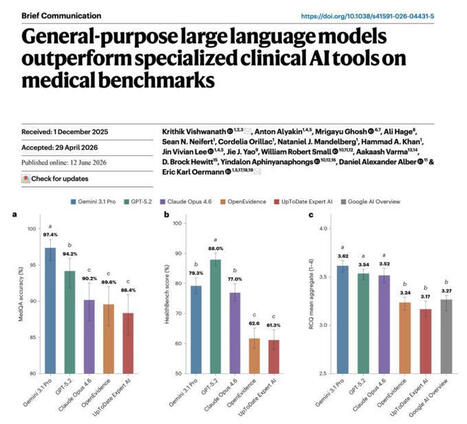
A new Nature Portfolio study has been getting attention in medical AI circles, and it's worth a look. It tested whether specialized clinical AI tools (OpenEvidence, UpToDate Expert AI) actually beat frontier generalists (ChatGPT's GPT‑5.2, Google's Gemini 3.1 Pro, Anthropic's Claude Opus 4.6). They don't.
A few additional thoughts worth the mention:
• It upends a commonly held belief, one that was never really evidence based, that medically "specialized" LLMs are more accurate than generalist models. The data points the other way, and shows the power of massive training and alignment without any domain specialization.
• Our research group illustrated similar findings in the field of cardiology (https://lnkd.in/gsiEAGF3). OpenEvidence merely matched proprietary GPT‑4o and lost outright to the open‑weight DeepSeek R1, while even general open‑weight models rivaled it with simple RAG.
• So a big factor in OpenEvidence's early spread likely had little to do with superior accuracy. It looks more like heavy capital chasing market share in a specific field, plus a reluctance by healthcare professionals to be seen "just using ChatGPT" like a commoner. A clinical wrapper felt more legitimate than the same or superior intelligence underneath.
• The integration story is solvable. HIPAA‑compliant environments for general models already exist, and with the appropriate legal agreements, hospitals can run them inside PHI‑containing workflows today.
• This is the opportunity for the companies building general LLMs. The study shows they already have the better model. The unsolved problem is implementation, integration, and trust.
Independent, real‑world evaluation needs to become the norm before any tool, specialized or general, enters the clinic.
#ClinicalAI #DigitalHealth #LLMs #HealthTech
|
|
Scooped by
Gilbert C FAURE
June 22, 5:58 AM
|
Chronos is the time most modern institutions know best. It is the time of clocks, calendars, deadlines and planning. Time as sequence, measurement, duration and control. It is the time behind roadmaps, milestones, quarterly targets, transition pathways and strategic horizons. Chronos is useful. Without it, coordination becomes difficult. Planning needs sequence. Responsibility needs dates. Collective action often needs a shared timeline.
Kairos adds another layer. It does not refer to time as quantity, but to time as quality: the right moment, the opening, the occasion, the window in which action becomes possible. In rhetoric, politics, strategy and social change, this matters deeply. A good idea can arrive too early, too late, or at a moment when the system is not yet ready to receive it.
Aion is less familiar, and perhaps for that reason more interesting. In Greek and Hellenistic traditions, Aion does not simply mean “time” in the ordinary chronological sense. It points toward age, lifetime, duration, epoch, eternity and cosmic time. In later Hellenistic and Roman iconography, Aion is often associated with circular imagery: the zodiac, the year, the seasons, and the larger rhythms through which life returns, transforms and continues.
That makes Aion a very different temporal figure from the old, bearded Father Time of Western imagination.
Chronos tends to be imagined as time that passes, measures and eventually runs out. Aion suggests something else: time as an encompassing order, a field of recurrence, a duration in which patterns return and worlds are renewed. Not the straight line of progress, but the circle. Not only the deadline, but the season. Not only the project plan, but the rhythm that makes repair and regeneration possible.
That distinction matters for how the future is imagined. Modern future-oriented language is often dominated by linear time. The future lies ahead. A route is mapped. Targets are set for 2030 or 2050. Milestones are defined, and progress is imagined as movement from here to there. That way of thinking is necessary, but incomplete. Many of today’s most urgent issues do not behave like straight lines. Climate, water, soil, care, trust, institutional memory and social resilience also move through cycles, rhythms, depletion, repair, relapse and regeneration. They unfold through feedback loops, seasonal pressures, generational effects and recurring vulnerabilities.
This is where Aion becomes more than a mythological curiosity. Aion helps name what linear planning often struggles to see: that futures are not only reached, but also reproduced; not only built, but also maintained; not only accelerated toward, but also carried by rhythms that can be damaged, restored or lost.| 66 commentaires sur LinkedIn
|
|
Scooped by
Gilbert C FAURE
June 22, 5:49 AM
|
🌍 Quelle vidéo sublime des flux d'aérosols dans notre monde ! La voici en version complète et HD sur le site du studio de la NASA https://buff.ly/47Ag6a7
Les principaux aérosols sont représentés dans les teintes suivantes :
🔴 Poussière et sable (rouge)
🔵 Sel marin (bleu)
🟢 Carbone organique (vert)
⚪ Sulfates (blancs)
Les aérosols sont de fines particules en suspension, émises par les activités humaines (échappements) ou naturelles (volcans, incendies de forêt, ouragans). Même si la pluie, le ruissellement et la végétation les absorbent ou les nettoient partiellement, leur impact sur la planète est colossal.
Ces flux jouent un rôle clé sur l'évolution du climat, par les aérosols carbonés.
https://buff.ly/3uCpmvQ
Mais ils sont essentiels aussi pour comprendre la pollution de l'air et la circulation des épidémies. C'est un enjeu géoscientifique autant qu'un enjeu de santé.
https://buff.ly/417ijaQ
Cette simulation mondiale sur un globe rotatif représente les flux des principaux aérosols de notre géosystème. Il donne a voir simultanément les températures de surface ; la présence de vapeur d'eau et de précipitations ; la dispersion des aérosols mondiaux provenant de la poussière, de la biomasse, des combustibles fossiles et des volcans ; et les vents qui transportent ces aérosols de la surface vers les niveaux supérieurs.
Les incendies planétaires ont été détectés par l'instrument MODIS de la NASA à bord des satellites Terra et Aqua. Franchement, ça donne une beauté fascinante.
Vous retrouverez la simulation ici en version HD
https://buff.ly/47Ag6a7
#earth #nasa #planète #climat #pollution #meteo #science
Pour me soutenir https://buff.ly/loHfEOF
Pour s'abonner à ma newsletter : https://buff.ly/46eBcKK
|
|
Scooped by
Gilbert C FAURE
June 21, 3:39 AM
|
Last episode, we discussed around the Brain behind LLM and this edition is a bit more deep-dive on how GraphRAG exactly works - Happy reading !
#TheDataAlchemist #Ontology #GraphRAG #DataArchitecture #AI
|
|
Scooped by
Gilbert C FAURE
June 20, 4:37 AM
|
Turns out AI tools erode abilities very quickly...
Nature says:
1. Colonoscopy study [1]:
Highly experienced physicians had is a 21% relative decline in finding adenoma when they couldn’t access AI.
“The physicians, who had all performed at least 2,000 colonoscopies during their careers, were given access to an AI system that analyses colonoscopy images. The tool was available to the specialists on some days but not on others.
When physicians began using it, their performance dropped significantly whenever the system was UNAVAILABLE.”
2. Software engineers couldn’t diagnose errors in codes [2]:
The average success score “was 50% in the AI group versus 67% in the non-AI group”
“The AI-assisted participants did particularly poorly on questions that required them to diagnose errors in the code, which suggests that they had failed to learn the concepts behind the code that they had just produced.”
📍 “Now you have this very odd disconnect between performance and learning. People can perform at a pretty high level, because they’re basically borrowing skills from the AI, but they are not developing those skills themselves.” - Kevin Crowston [Syracuse Univ.]
Basically:
GPS has de-skilled us in navigation.
Now, AI may be de-skilling us in general cognition.
___
p.s. I am still writing these posts myself.
Is it efficient? Perhaps no.
But at least, I like to think it keeps my cognition in shape.
References:
[1] Budzyń et al. Lancet Gastroenterol. Hepatol. 10, 896–903 (2025).
[2] Shen & Tamkin. ArXiv : 2601.20245 (2026). | 63 comments on LinkedIn
|
|
Scooped by
Gilbert C FAURE
June 19, 7:17 AM
|
We’re proud to spotlight one of our valued corporate partners: The Federal Reserve Bank of Kansas City
The Kansas City Fed is one of 12 regional Reserve Banks that, along with the Board of Governors in Washington, D.C., make up our nation's central bank.
They work in the public’s interest by supporting economic and financial stability, across our region and nation.
Partnerships like these matter because they help us in empowering Black-owned businesses and professionals throughout our community.
Thank you to the Federal Reserve Bank of Kansas City for your continued partnership and support 🙏🏽
#heartlandblackchamber #corporatepartner #kansascity #blackbusiness #entrepreneurship
|
|
Scooped by
Gilbert C FAURE
June 19, 4:03 AM
|
The free platform, called Journal Trends, could also allow integrity sleuths to spot low-quality publications.
|
|
Scooped by
Gilbert C FAURE
June 18, 5:40 AM
|
En médecine, une étude dont le volet clinique repose sur n=12 (12 participants), ça risque pas de changer les pratiques ou de faire beaucoup jaser. Si c'est de l'IA par contre...
Une étude dans Nature Medicine dit que les IA généralistes comme ChatGPT surpassent des IA spécialisées : OpenEvidence et UpToDate Expert AI.
Le titre est puissant. Mais l'étude, elle, ne l'est pas tant que ça.
L’étude se divise en deux volets : benchmarks et évaluation humaine
1️⃣ MedQA et HealthBench
Questions à choix de réponses de type USMLE et questions tirées d'un benchmark développé par OpenAI.
Ce sont deux benchmarks publics. Donc les modèles généralistes, entraînés sur d’immenses corpus web et académiques, peuvent avoir été exposés directement ou indirectement à une partie du matériel, du style de questions de réponse attendues.
À l’inverse, OpenEvidence et UpToDate Expert AI sont des outils cliniques spécialisés, conçus autour d’un usage de référence, de recherche documentaire et de récupération de contenu médical sélectionné (RAG).
Ce n’est pas une évaluation très juste.
2️⃣ Real Clinical Queries
La portion la plus proche du terrain : 100 questions cliniques réelles provenant d’un seul centre, NYU, évaluées à l’aveugle par 12 cliniciens.
Les auteurs nomment bien dans la publication leurs propres limites :
Échantillon limité, différences entre accès API et interface web, absence d’évaluation de la qualité des citations, de la latence et de l’intégration réelle dans les pratiques cliniques.
Ce n'est pas de la mauvaise science mais c'est une approche médiatique douteuse de transformer ça en conclusion simple genre « les IA généralistes battent les outils cliniques spécialisés ».
📜 En lecture critique, que ce soit pour un médicament pour évaluer un système IA, on se ramène toujours aux questions de base :
• Quel type d'étude, quelle méthodologie?
• Les résultats ont-ils une bonne validité interne ET externe?
• Quels sont les résultats? C'est beau les stats, mais sont-ils cliniquement significatifs?
• Sont-ils applicables à mon contexte?
• Y a-t-il des conflits d'intérêts chez les chercheurs?
Je ne crois pas qu'on puisse tirer de grandes conclusions de cette étude sinon que nous sommes encore loin d’avoir une bonne façon d’évaluer l’IA médicale.
Un benchmark, ce n’est pas un patient.
Un score, ce n’est pas un impact clinique.
Un titre puissant, ce n’est pas une preuve forte.
Avant de laisser une IA influencer une décision médicale, il va falloir exiger mieux que ça.
#LectureCritique #EvidenceBasedMedicine #ClinicalAI #MedTech
Avis? Commentaires? Pierre Beaupré Ilitea Kina Mathieu Pelletier, MD, FCMF Mathieu Moreau Pascale Breault Aude Motulsky Alexandre Hudon, BEng, MD, M.Sc (Éd), PhD, FRCPC| 21 commentaires sur LinkedIn
|
|
Scooped by
Gilbert C FAURE
June 16, 4:06 AM
|
Out of curiosity, I asked ChatGPT to create a visual representation of my professional life and daily routine based on everything it has learned about me over time.
To my surprise, it captured many aspects of my journey remarkably well medical educator, researcher, curriculum leader, mentor, reviewer, conference speaker, advocate for AI and immersive technologies in healthcare education, and most importantly, a lifelong learner.
While no AI-generated image can fully represent a person, this visual serves as an interesting reflection of how artificial intelligence can recognise patterns in our work, interests, values, and aspirations.
It is fascinating to see how AI not only supports our productivity but can also help us reflect on our professional identity and impact.
What do you think? How accurately would AI portray your professional journey?
#ArtificialIntelligence #MedicalEducation #DigitalHealth #Leadership #MedicalEducator #HigherEducation #AIinEducation #VirtualReality #MixedReality #AcademicLife
|


 Scoop.it!










![Turns out AI tools erode abilities very quickly... Nature says: 1. Colonoscopy study [1]: Highly experienced physicians had is a 21% relative decline in finding adenoma when they couldn’t acces... | Notebook or My Personal Learning Network | Scoop.it](https://img.scoop.it/3crGuiidAiZXFGXAW0FX3zl72eJkfbmt4t8yenImKBVvK0kTmF0xjctABnaLJIm9)