Your new post is loading...

|
Scooped by
Gilbert C FAURE
October 13, 2013 8:40 AM
|
is a personal Notebook Thanks John Dudley for the following tweet "If you like interesting snippets on all sorts of subjects relevant to academia, information, the world, highly recommended is @grip54 's collection:" La curation de contenus, la mémoire partagée d'une veille scientifique et sociétale
|
|
Scooped by
Gilbert C FAURE
Today, 4:09 AM
|
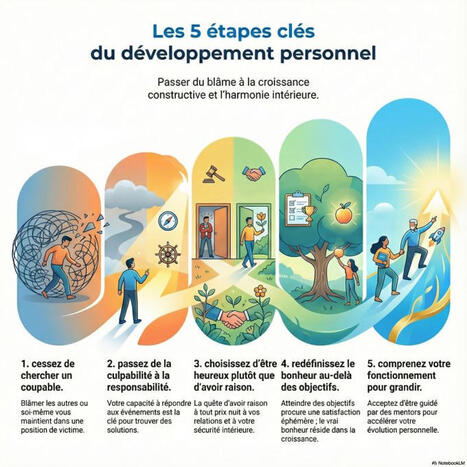
5 Marches pour arrêter de subir sa vie (et pourquoi atteindre vos objectifs ne vous rendra pas heureux)
On pense souvent que le développement personnel, c’est devenir une version "parfaite" de soi-même, accumuler des succès ou imposer sa nouvelle vérité aux autres (attention à l'ego du dév perso !).
Et si la clé n'était pas d'ajouter des choses, mais d'arrêter certains mécanismes toxiques ?
J’ai décortiqué une méthode en 5 étapes qui remet les pendules à l'heure. Voici pourquoi vous devez absolument vous y intéresser :
1️⃣ Arrêtez de chercher un coupable (même si c'est vous) Dès l'école, on nous apprend à demander "Qui a fait ça ?" pour punir. Résultat ? On blâme l'autre pour se dédouaner, ou on se blâme soi-même en s'écrasant sous la morale. Spoiler : dans les deux cas, vous restez une victime et rien ne se résout. La première étape, c'est de remplacer le blâme par l'envie de grandir.
2️⃣ Sortez du Triangle de Karpman Vous connaissez ce jeu infernal : Bourreau, Victime, Sauveur ?. Pour en sortir, il faut passer de la culpabilité à la responsabilité. Au lieu de chercher qui a tort, demandez-vous : "Quelle est la solution ?". C'est la seule façon de réactiver votre créativité et de quitter la position de victime.
3️⃣ Avoir raison ou être heureux ? Il faut choisir. Combien de fois avez-vous gâché une soirée juste pour prouver que vous aviez raison ? Quand on cherche à avoir raison à tout prix, il n'y a qu'un seul perdant : la relation. Cette étape vous apprend à lâcher vos certitudes (qui font de vous des "vieux cons" avant l'âge) pour privilégier l'harmonie.
4️⃣ L'arnaque des objectifs "Quand j'aurai la maison, le chien et la piscine, je serai heureux". Faux.. C'est une image d'Épinal qui mène souvent à la déprime une fois l'objectif atteint, car on se sent vide. Le bonheur ne s'obtient pas, il s'apprend en chemin.
5️⃣ Passez de l'état au fonctionnement Arrêtez de vous coller des étiquettes ("je suis comme ci", "il est pervers narcissique"). Adoptez une approche systémique : comprenez comment vous fonctionnez pour modifier ce qui ne vous convient pas. Et surtout, acceptez de vous faire guider par des mentors pour gagner du temps, comme on apprend à faire du vélo.
🚀 Envie de grandir plutôt que de juger ? Ces 5 étapes ne sont pas là pour vous donner des leçons, mais pour vous aider à comprendre votre propre système.
👉 https://lnkd.in/evNHxGHz
|
|
Scooped by
Gilbert C FAURE
Today, 3:58 AM
|
AUDIO • Diderot, audacieux au sein des Lumières, épisode 3/4 : L'Encyclopédie : la véritable œuvre de Diderot ?. Une série inédite proposée par France Culture. Écoutez Avec philosophie, et découvrez nos podcasts en ligne.
|
|
Scooped by
Gilbert C FAURE
Today, 3:41 AM
|
Don't copy and paste answers from ChatGPT. 🤯
ChatGPT writing is easily detectable.
Here are 10 tools to humanize AI-generated text:
1. Jettelly Humanize
https://bot.jettelly .com/humanize/
– Rewrites AI content with natural flow.
2. Hemingway App
http://hemingwayapp .com
– Simplifies complex sentences for conversational tone.
3. QuillBot
https://quillbot .com/
– Paraphrases content for readability.
4. Grammarly
https://www.grammarly .com/
– Adjusts tone for natural language.
5. ProWritingAid
https://prowritingaid .com/
– Fixes repetitive or formal phrases.
6. Slick Write https://slickwrite .com/
– Simplifies formal language.
7. Originality. ai https://www.originality .ai/
– AI detector with content refinement tips.
8. GPTZero https://gptzero .me/
– Helps personalize AI-generated text.
9. Readable https://readable .com/
– Enhances readability and flow.
10. Wordtune https://www.wordtune .com/
– Offers casual, varied rewrites.
These tools help make AI-generated text sound more authentic.
-----
To humanize AI-generated text effectively (without relying on ChatGPT-like patterns),
follow these steps using tools like https://lnkd.in/gjAhMbBc or similar platforms:
1. Rewrite with Nuance
AI detectors flag overly polished language. Use the tool to:
- Break long sentences into shorter, conversational ones.
- Add colloquial phrases (e.g., "kind of," "you know").
- Vary sentence structure to mimic natural human flow.
2. Inject Personality
AI lacks a distinct "voice." After processing the text:
- Add anecdotes or opinions: "In my experience…"
- Use humor or sarcasm where appropriate.
- Include minor grammatical quirks (e.g., starting sentences with "And" or "But")
3. Edit Manually
Tools aren’t perfect. Always refine the output:
- Read aloud to check rhythm.
- Replace jargon with simpler terms.
- Introduce typos sparingly (e.g., "teh" instead of "the").
4. Verify Authenticity
Test your humanized text with AI detectors like Originality.ai or GPTZero. Aim for a "likely human" score.
Example:
Original AI Output:
"Climate change poses significant risks to global ecosystems, necessitating immediate mitigation strategies."
Humanized:
"Let’s be real—climate change is messing with our planet big time. We can’t wait around; we’ve gotta act now before things get worse."
-----------------
🎁 FREE RESOURCES TO LEVEL UP '
Download Top Infographics Cheatsheet: https://lnkd.in/gNBgQkAb
100 ChatGPT Hacks Cheatsheet (𝐅𝐑𝐄𝐄 𝐏𝐃𝐅) :
👉🏻https://lnkd.in/gaFbjKeZ
--------------- | 24 comments on LinkedIn
|
|
Scooped by
Gilbert C FAURE
December 8, 4:31 AM
|
Excellent….le vrai rôle d’un professeur ! Évaluer en intégrant toutes les techniques pour apprendre …de la bonne vieille fiche mémorisée…à l’usage de l’IA …! 👏👏👏
|
|
Scooped by
Gilbert C FAURE
December 8, 4:21 AM
|
|
|
Scooped by
Gilbert C FAURE
December 8, 3:58 AM
|
|
|
Scooped by
Gilbert C FAURE
December 7, 1:24 PM
|
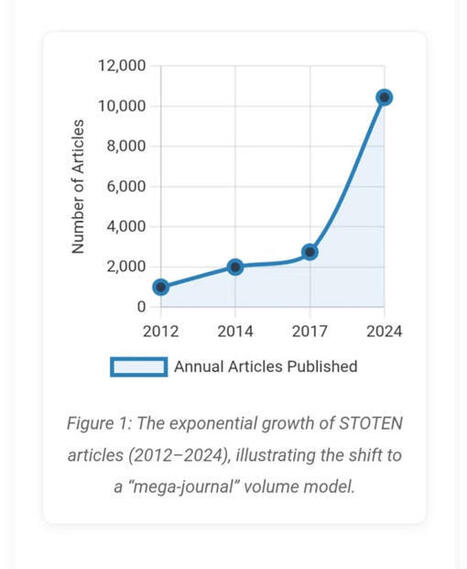
We recently published a paper in Nature Communications. The publication fee? Nearly $7000. My mistake for not doing the research before submitting. This is not a good use of increasingly scarce research money. In the future, my group is not going to be submitting to Nature family journals, or other 'fancy' titles that charge absurd publication fees. I am also not reviewing for them or supporting them in other ways. I'll spend my time and money on solid discipline-specific journals and nonprofit publishers. I recognize the pressure, particularly for junior colleagues and those competing for funding (most of us...), to publish in these places, and we need a culture shift and broad action to recognize quality rather than title. The current system needs to be replaced with something better (ideally fixing the very broken peer review system at the same time). Feel free to DM if you have ideas for solutions. | 212 comments on LinkedIn
|
|
Scooped by
Gilbert C FAURE
December 7, 4:41 AM
|
Une vidéo salutaire pour passer un bon week-end.
|
|
Scooped by
Gilbert C FAURE
December 7, 4:14 AM
|
Evidence in public health isn’t a single brick, it’s a dry stone wall.
Ogilvie et al. used this metaphor to describe how different pieces of evidence fit together to form something strong, flexible, and grounded in the real world.
Instead of treating health problems as linear and isolated, they suggest evidence must speak to three dimensions of complex systems:
1️⃣ Mechanisms — the interconnected causes behind health problems.
2️⃣ Dynamics — how these causes evolve over time through feedback and adaptation.
3️⃣ Patterns — the emergent outcomes we see at the population level.
And across these, three types of evidence are needed:
1️⃣ Causal (understanding why health problems occur),
2️⃣ Intervention (what actions can modify them), and
3️⃣ Implementation (how systems adapt and sustain change).
Together, these form nine types of evidence. A practical map for researchers, policymakers and practitioners who want to act systemically, not simplistically.
It’s a brilliant and thought-provoking read - one that challenges us to see evidence not as something to “prove what works,” but as something to help us understand, adapt, and evolve within the systems we seek to change.
Paper by Karien Stronks et al.
|
|
Scooped by
Gilbert C FAURE
December 6, 10:03 AM
|
Can you see which 2 publishers don't care about rigorous peer-review?
Authors: don't submit 😉
Experts: don't offer peer-review 🤑
Evaluators: consider systematic predatory publication as negative 🤥
|
|
Scooped by
Gilbert C FAURE
December 5, 7:35 AM
|
I’m grateful and proud to witness the Rome Coalition on health literacy and human rights building trust through inclusion be brought to live.
Today’s conference, hosted by Italy’s National Office Against Racial Discrimination in cooperation with the Council of Europe, and supported by the Ministers for Health and Family, Natality and Equal Opportunities, emphasized the vital role of health literacy as a human right.
The opening statements featured influential voices:
🔹Eugenia Maria Roccella, Minister for Family, Natality and Equal Opportunities, Italy
🔹Orazio Schillaci, Minister of Health, Italy
🔹Rafael Benitez, Director of Social Rights, Health and Environment, Council of Europe
The Rome Coalition is a result of dedicated efforts by the Council of Europe, the Italian government and a wide range of stakeholders from the European health literacy community and human rights stakeholders with a strong vision that health literacy is not just an individual skill. It is a societal responsibility, requiring systemic commitment from governments, institutions, and communities.
Thanks to all for your dedication!
Mattia Peradotto Rafael Benitez Laurence Lwoff Lorenzo Montrasio Lee Hibbard Guglielmo Bonaccorsi Chiara Lorini Assunta Morresi Luigi Palmieri Miguel Arriaga Cristina Vaz de Almeida stephan Van den Broucke Saskia Maria De Gani Vassiliki Karaouli Elvis Sala
and many more.
#HealthLiteracy #HumanRights #Equity #Inclusion #PublicHealth #TrustInHealthSystems
Quickly understand complex research papers with AI-powered explanations. Annotate PDFs, highlight text, and organize your thoughts on an infinite canvas. BYOK privacy, one-time purchase desktop app for researchers and students.
Via Nik Peachey
|
|
|
Scooped by
Gilbert C FAURE
Today, 4:14 AM
|
S'il y a un article scientifique à retenir cette année, c'est bien celui-là ⬇️
C'est une révolution dans l'IA appliquée à l'épidémiologie.
Vous connaissez surement le modèle GPT classique ;
il prédit le prochain mot d’une phrase.
Et bien ce modèle a été adapté aux données de santé longitudinales, avec la création du modèle Delphi‑2M. Il prédit alors le prochain événement de santé dans la vie d’un individu à partir de données de santé massives.
Un événement étant l'apparition d'une nouvelle maladie, d'une hospitalisation, d'un examen de santé ...
💡Chaque dossier médical devient une séquence, un peu comme une phrase.
En pratique, ce modèle est entraîné sur 400 000 individus du UK Biobank et validé sur 1,9 million de dossiers danois :
- il prédit les taux de +1 000 maladies en tenant compte de l’historique individuel,
- il atteint une précision équivalente à celle de modèles spécialisés par maladie,
- il génère des trajectoires de santé futures sur 20 ans, par pas de 5 ans, permettant d’estimer le risque global et d’alimenter des modèles sans utiliser de données réelles,
- il identifie des clusters de comorbidités et leurs interactions temporelles grâce à des approches explicables (SHAP), tout en révélant certains biais d’origine dans les données.
👉🏼 En bref : un modèle capable à la fois de prédire, de simuler et d'expliquer l’évolution des maladies dans des grandes cohortes.
Rien que çà ...
C'est par ici pour lire l'article : 📖"Learning the natural history of human disease with generative transformers" (PMID: 40963019 et sa correction PMID: 41225015).
------
Laurie Fraticelli, PhD, je partage des infos utiles et d'actualité en #sciences de la #santé. 🔔 Clique sur “suivre” pour ne rien rater !
|
|
Scooped by
Gilbert C FAURE
Today, 4:02 AM
|
Just sent my views on Ofcom's consultation on media literacy, here are some of the key points I've made:
1. Social media platform are profit driven organisations and have been the main source for online harms. Therefore, expecting them to develop media literacy programmes will not work. Citizens of all ages, and not just children and young adults, should have access to non-commercial orgnisations who can support them on media literacy.
2. As a society, we are beyond the point of hoping that social media companies will adopt recommendations, because these companies have been failing people and democracies for over a decade. Therefore, in order for social media companies to change how they currently operate, we need stricter rules and enforcement.
3. Many of the recommendations offered have been issues that platforms have promised to tackle but haven’t - from the failed Ad Library project and onto transparency, ‘privacy by design’, clearer terms of use or meaningful choices such as the consent mechanism – all have not been respected or applied by these companies, so why repeat recipes that do not work?
4. The current enforcement of big platform is inefficient because financial penalties for companies who earn potential fines within days is not deterring them.
5. Improving media literacy MUST come hand in hand with a better media ecosystem where journalists and trusted organisations have enough resources and trust so that people can use them. This also means that social media platforms must give trusted news sources and organisations prioritisation on their feeds.
6. Ofcom should set-up an independent audit organisation that will consist of academics, journalists, librarians, and other literacy organisations who will have unrestricted access to social media platforms data and execute quarterly audits. The organisation will pay these people through the tax taken from social media platforms.
7. But, this also means that the current business model of social media platforms of surveillance ad-tech needs to change as that is the main cause of most online harms. When the business model is built on spying on people over time and platforms, extracting their data and trading it while increasing engagement and attention - then there is no incentive for meaningful engagement online and we will see more disinformation, conspiracy theories and hate online – because it sells.
https://lnkd.in/eCGrzXGC
|
|
Scooped by
Gilbert C FAURE
Today, 3:44 AM
|
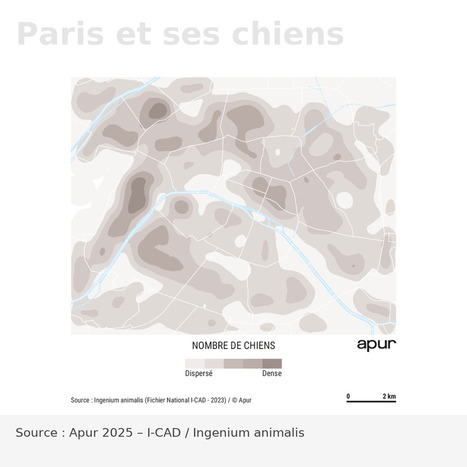
À Paris, l'Apur - Atelier parisien d'urbanisme a réalisé une géographie des animaux de compagnie.
Côté chiens, les arrondissements 15e, 16e et 17e forment le cœur canin de la capitale – surtout dans l’Ouest parisien. 77 000 chiens sont « domiciliés » à Paris.
Côté chats, le Nord-Est est leur royaume : Montmartre, mais aussi les 15e et 20e se distinguent. 146 000 chats peuplent Paris, soit +16 % en dix ans.
Source : Apur, 2025 (Fichier National I-CAD / Ingenium animalis).
#Paris #Ville #Data #Urbanisme #AnimauxDeCompagnie #Cartographie #Apur #DesignUrbain
|
|
Scooped by
Gilbert C FAURE
Today, 3:33 AM
|
En 3 ans, pour chercher de l'#information, #ChatGPT est devenu le réflexe premier aux dépens de Google, You Tube ou d'une assistant vocal. C'est un vrai bouleversement ! WEDEMAIN
|
|
Scooped by
Gilbert C FAURE
December 8, 4:25 AM
|
Day 23 - Process - #30DayMapChallenge
You see those red and blue “constellations” drawing themselves over Prague in Czech Republic?
This kind of map tells the story of a city through its flows, in the spirit of Erica Fischer’s design: a very subtle basemap, and mobility traces that become the real subject.
The idea is simple—let the data “write” the lived geography, here to compare walking vs. driving (or any other pair of modes) in Prague city center and its suburbs.
Practically, you start from anonymised mobility data (GPS traces from mobile apps or telecom operators), process and clean them for further contextual analytics.
Next comes behavioral analysis: map-matching the traces to the street network (OpenStreetMap), then classifying modes with algorithmic approach (speed, length, origin, distance to the segments, segments speciality, ....). This gives you “labeled” trajectories — here motors vehicules versus footfall —ready to layer on a map.
For the “Fischer-style” look, keep the background minimal (light gray, thin streets), then draw segments in semi-transparent layers with a short, high-contrast palette ( blue for cars, red for pedestrians).
For animation, you can progressively reveal trips in time slices (minute-by-minute or day-by-day accumulation), capture a video from your screen, and stitch them into a gif.
Source: CitiProfile
Tools: QGIS, FreeCam8, Gif Convertor
#30DayMapChallenge #mobilitydata #dataviz #gis #urbandata #walking
#transportation
|
|
Scooped by
Gilbert C FAURE
December 8, 4:09 AM
|
💠Edito Jacqueline Sala Veillemag 25 nov. 2025💠
Le charme discret des diagnostics, des matrices, des développements audacieux, des « roadmaps » continuent à séduire des auteurs brillants comme le prouvent Thierry Lafon, Stéphanie B.rochot, Marc Patard (PhD) ou Dr Mohamed Benabid … Mais l’art de la coordination, lui, ressemble à une partition qu’on répète inlassablement. Chacun défend sa gamme, mais l’orchestre joue en sourdine. La pensée se révèle en haut de la portée, l’action traîne en bas, hors tempo. Cela vaut également pour la mise en cohérence d’une stratégie effective d’IA comme le constate la Cour des Comptes.
Que ce soit dans les groupes de réflexions, les tables-rondes ou les instituts de recherche, le cerveau continue de tourner, mais le corps lui ne se met pas réellement en mouvement : la pensée et l’action ne regardent pas dans la même direction. Cela ressemble à une sorte de paralysie. Ce diagnostic posé par Philippe Baumard dès 2012 semble s’aggraver d’année en année.
Le passage à l’acte, le vrai, celui qui transforme une idée en résultat mesurable, demeure rare. On le célèbre comme une prouesse, alors qu’il devrait être la norme. À force de multiplier les comités et les synthèses, on finit par croire que la cogitation suffit à faire bouger le réel, elle devient presque un alibi.
Les idées sont vitales, elles posent les bases, fixent les horizons, mais ce sont les actes, la rigueur des faits, qui construisent l’histoire.
Mais demain sera un autre jour, et ouvrira la scène de l’action. Le meilleur reste à écrire, ou plutôt à vivre !
SOMMAIRE
1 -Intelligence économique 3.0 : Le système de Management de l'information stratégique SMISt. Thierry Lafon & Stéphanie Brochot
https://lnkd.in/e9FvaRqg
2 -Entre idées et influences : les coulisses des think tanks français. Entretien avec Marc Patard https://lnkd.in/eXHwS4ui
3 -26-30 janv. 2026. 26ème éd. de la conférence EGC. Extraction et gestion des connaissances https://lnkd.in/eGRxJPyc
4 -5-6 déc. Festival de l'OSINT. Entre investigation, cinéma documentaire et sphères artistiques et militantes. https://lnkd.in/e3ktrczB
5 -Intelligence artificielle: une stratégie française en panne de cohérence. La Cour des comptes https://lnkd.in/eybKVfvr
6 -Lutter contre la désinformation: savoirs, enjeux et pratiques par Dr Mohamed Benabid https://lnkd.in/erZRP55H
👁️🗨️L'avis éclairé de celle qui promeut l'IE depuis 29 ans déjà🙏.
CR451 - Centre de Recherche 451 AEGE - Le réseau d'experts en intelligence économique Portail de l'Intelligence Économique EEIE - École Européenne d'Intelligence Économique Master Intelligence Economique de l'IAE de Poitiers Institut des hautes études de défense nationale IHEDN Institut d'étude des crises de l'intelligence économique et stratégique Laboratoire CEREGE Master Intelligence Économique. IFIS - Université Gustave Eiffel Master S2IE - Stratégie Internationale et Intelligence Economique Master Intelligence Economique et Stratégies Compétitives
|
|
Scooped by
Gilbert C FAURE
December 8, 3:57 AM
|
|
|
Scooped by
Gilbert C FAURE
December 7, 1:21 PM
|
Give this fun activity a try! It’s a great way for students to learn how to build a positive and professional online presence. https://bit.ly/3JaHbJA
|
|
Scooped by
Gilbert C FAURE
December 7, 4:23 AM
|
|
|
Scooped by
Gilbert C FAURE
December 7, 4:11 AM
|
This is what happens when 1) manipulating rankings is encouraged or institutionalized and 2) these rankings are not properly curated. The Stanford list is a complete joke... and its name is bad publicity for Stanford, by the way!
Disclaimer: AFAIK, I am / was in the Stanford list, not in Clarivate's. Don't really care, have not checked for a long time.
|
|
Scooped by
Gilbert C FAURE
December 5, 10:26 AM
|
Chers étudiants du Master VSOC, je vous invite à suivre cette soutenance, qui s'annonce très riche d'enseignements et très bien ancrée dans les #SIC.
👉 https://lnkd.in/eE2KyuEC
#intelligenceeconomique
#renseignement
#analyse
#veille
#infocom
|
|
Scooped by
Gilbert C FAURE
December 5, 5:13 AM
|
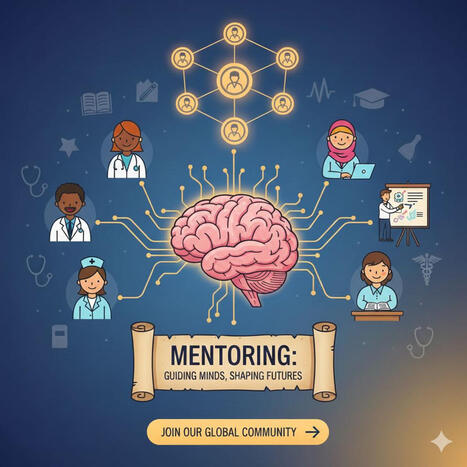
I’m excited to announce the next free mini-masterclass from Meducate Global Academy, this time focusing on Mentoring in Health Professions Education (and beyond!), led by my friend and colleague Subha Ramani, MBBS, MPH, MMEd, PhD, FAMEE, a true leader in the global health-professions education community.
Subha’s work has shaped how we think about modern mentoring relationships, how we support learners, and how we develop faculty who can mentor with purpose and impact. Subha is Associate Professor of Medicine at Harvard Medical School, a general internist at Brigham and Women’s Hospital, senior core faculty in the Harvard Macy Program, and Past President of AMEE. Her recent work including the 2024 “Mentoring in Health Professions Education: AMEE Guide No. 167” has helped shape how we understand mentoring relationships in health-professions teaching and learning. More about Subha here https://lnkd.in/dRnC5qcj.
This session will be a 30-minute mini-masterclass (maybe a little longer if the conversation takes off!) and will follow the same interactive, fast-paced style as our previous Academy mini-masterclasses. We will send out the dates and times for the sessions, and a link to sign up in early January.
I’m passionate about mentoring as well, and this year I was honored to receive the Frances M. Maitland Mentorship Award from the Alliance for Continuing Education in the Health Professions. Mentoring has played a huge role in my career, and it’s something I feel deeply committed to strengthening across our global community.
If mentoring , whether as mentor, mentee, or both, is important to you in education, clinical work, leadership, or life, I invite you to join our notification list. The masterclass will be offered at least twice to accommodate different geographies, beginning in January. Signing up will also give you early access to future mentoring-focused offerings from Meducate Global Academy.
And for those who want to go deeper, the Academy will also be offering longer, more formal mentoring masterclasses in 2026. And stay tuned for more topics and awesome faculty to be announced soon...
Sign up here:
👉 https://lnkd.in/dN3dSbTE
Looking forward to growing a global mentoring community together.
Feel free to share with your networks!
|
|
Rescooped by
Gilbert C FAURE
from Nik Peachey
December 5, 2:42 AM
|
Traditionally, we have thought of literacy as the ability to communicate through reading, writing, listening, and speaking. But in our digital age, we are as likely to use video, images audio and even gestures as modes of communication. The ability to understand and share information through a combination of these modes is known as multimodal literacy.
Via Nik Peachey
|