Your new post is loading...

|
Scooped by
Gilbert C FAURE
March 7, 2020 6:26 AM
|
Age-related neurosensory deficit of the inner ear is mostly due to a loss of hair cells (HCs). Development of stem cell-based therapy requires a better understanding of factors and signals that drive stem cells into otic sensory progenitor cells (OSPCs) to replace lost HCs.
|
|
Scooped by
Gilbert C FAURE
March 3, 2020 7:38 AM
|
|
|
Scooped by
Gilbert C FAURE
February 23, 2020 2:55 PM
|
Background Based on clinical, immunological and histopathological evidence, MOG-IgG-associated encephalomyelitis (MOG-EM) has emerged as a distinct disease entity different from multiple sclerosis...
|
|
Scooped by
Gilbert C FAURE
February 20, 2020 1:22 PM
|
Glial cells are abundant in the CNS and are essential for brain development and homeostasis. These cells also regulate tissue recovery after injury and their dysfunction is a possible contributing factor to neurodegenerative and psychiatric disease. Recent evidence suggests that microglia, which are also the brain’s major resident immune cells, provide disease-modifying regulation of the other major glial populations, namely astrocytes and oligodendrocytes. In addition, peripheral immune cells entering the CNS after injury and in disease may directly affect microglial, astrocyte and oligodendrocyte function, suggesting an integrated network of immune cell–glial cell communication. Interactions between immune cells and neurons are now widely believed to be important for the regulation of brain function. In their Review, Greenhalgh, David and Bennett highlight the importance of interactions between resident and infiltrating immune cells and the brain’s other major cellular population — glial cells — for brain function.
|
|
Scooped by
Gilbert C FAURE
February 7, 2020 1:17 PM
|
|
|
Scooped by
Gilbert C FAURE
January 14, 2020 7:50 AM
|
Abstract At steady state, the CNS parenchyma has few to no lymphocytes and less potent Ag-presentation capability compared with other organs. However, the meninges surrounding the CNS host diverse populations of immune cells that influence how CNS-related immune responses develop. Interstitial and cerebrospinal fluid produced in the CNS is continuously drained, and recent advances have emphasized that this process is largely taking place through the lymphatic system. To what extent this fluid process mobilizes CNS-derived Ags toward meningeal immune cells and subsequently the peripheral immune system through the lymphatic vessel network is a question of significant clinical importance for autoimmunity, tumor immunology, and infectious disease. Recent advances in understanding the role of meningeal lymphatics as a communicator between the brain and peripheral immunity are discussed in this review. Footnotes This work was supported by grants from the National Institutes of Health (AG034113, AG057496, and NS096967) to J.K. Abbreviations used in this article: AQP4 aquaporin-4 water channel DC dendritic cell EAE experimental autoimmune encephalomyelitis ISF interstitial fluid. Received July 17, 2019. Accepted November 15, 2019. Copyright © 2020 by The American Association of Immunologists, Inc.
|
|
Scooped by
Gilbert C FAURE
January 1, 2020 2:18 PM
|
|
|
Scooped by
Gilbert C FAURE
December 27, 2019 3:15 PM
|
PubMed comprises more than 30 million citations for biomedical literature from MEDLINE, life science journals, and online books. Citations may include links to full-text content from PubMed Central and publisher web sites.
|
|
Scooped by
Gilbert C FAURE
December 22, 2019 1:41 PM
|
IL-17-producing CD8+ (Tc17) cells are enriched in active lesions of patients with multiple sclerosis (MS), suggesting a role in the pathogenesis of autoimmunity. Here we show that amelioration of MS by dimethyl fumarate (DMF), a mechanistically elusive drug, associates with suppression of Tc17 cells. DMF treatment results in reduced frequency of Tc17, contrary to Th17 cells, and in a decreased ratio of the regulators RORC-to-TBX21, along with a shift towards cytotoxic T lymphocyte gene expression signature in CD8+ T cells from MS patients. Mechanistically, DMF potentiates the PI3K-AKT-FOXO1-T-BET pathway, thereby limiting IL-17 and RORγt expression as well as STAT5-signaling in a glutathione-dependent manner. This results in chromatin remodeling at the Il17 locus. Consequently, T-BET-deficiency in mice or inhibition of PI3K-AKT, STAT5 or reactive oxygen species prevents DMF-mediated Tc17 suppression. Overall, our data disclose a DMF-AKT-T-BET driven immune modulation and suggest putative therapy targets in MS and beyond. Dimethyl fumarate (DMF) is a therapy for multiple sclerosis (MS) with undetermined mechanism of action. Here the authors find that clinical response to DMF associates with decrease in IL-17-producing CD8+ T cells (Tc17), delineate molecular pathways involved, and show that DMF suppresses Tc17 pathogenicity in a mouse model of MS.
|
|
Scooped by
Gilbert C FAURE
November 27, 2019 2:43 PM
|
|
|
Scooped by
Gilbert C FAURE
November 21, 2019 5:39 AM
|
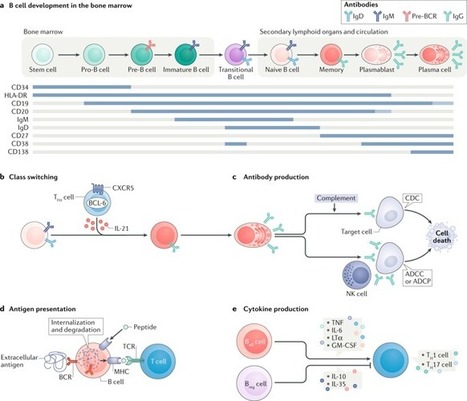
B cells are essential components of the adaptive immune system and have important roles in the pathogenesis of several central nervous system (CNS) diseases. Besides producing antibodies, B cells perform other functions, including antigen presentation to T cells, production of proinflammatory cytokines and secretion of anti-inflammatory cytokines that limit immune responses. B cells can contribute to CNS disease either through their actions in the periphery (meaning that they have an ‘outside-in’ effect on CNS immunopathology) or following their compartmentalization within the CNS. The success of B cell-depleting therapy in patients with multiple sclerosis and CNS diseases with an autoantibody component, such as neuromyelitis optica spectrum disorder and autoimmune encephalitides, has underscored the role of B cells in both cellular and humoral-mediated CNS conditions. Emerging evidence suggests B cells also contribute to the pathogenesis of neurodegenerative diseases, including Alzheimer disease and Parkinson disease. Advancing our understanding of the role of B cells in neuroinflammatory and neurodegenerative diseases could lead to novel therapeutic approaches. In individuals with inflammation of the central nervous system, B cells enter and accumulate in the cerebrospinal fluid, brain parenchyma and perivascular spaces. Here, Joseph Sabatino and colleagues review the contributions of B cells — both in the periphery and sequestered within the central nervous system — to the pathogenesis of several autoimmune and neurodegenerative diseases.
|
|
Scooped by
Gilbert C FAURE
November 18, 2019 1:31 PM
|
Microglia are tissue-resident macrophages of the CNS that orchestrate local immune responses and contribute to several neurological and psychiatric diseases. Little is known about human microglia and how they orchestrate their highly plastic, context-specific adaptive responses during pathology. Here we combined two high-dimensional technologies, single-cell RNA-sequencing and time-of-flight mass cytometry, to identify microglia states in the human brain during homeostasis and disease. This approach enabled us to identify and characterize a previously unappreciated spectrum of transcriptional states in human microglia. These transcriptional states are determined by their spatial distribution, and they further change with aging and brain tumor pathology. This description of multiple microglia phenotypes in the human CNS may open promising new avenues for subset-specific therapeutic interventions. Sankowski et al. have combined high-throughput techniques to characterize human microglia, identifying a spectrum of microglia phenotypes that are determined by localization, aging and glioblastoma.
|
|
Scooped by
Gilbert C FAURE
November 17, 2019 1:32 PM
|
PubMed comprises more than 30 million citations for biomedical literature from MEDLINE, life science journals, and online books. Citations may include links to full-text content from PubMed Central and publisher web sites.
|
AbstractObjective: Rituximab is used as an off-label treatment for relapsing-remitting multiple sclerosis (RRMS); however, the comparative efficacy and safety of rituximab versu
Via Krishan Maggon
IgG oligoclonal bands (OCBs) are present in the cerebrospinal fluid (CSF) of more than 95% of patients with multiple sclerosis (MS), and are considered to be the immunological hallmark of disease. However, the target specificities of the IgG in MS OCBs have remained undiscovered. Nevertheless, evidence that OCBs are associated with increased levels of disease activity and disability support their probable pathological role in MS. We investigated the antigen specificity of individual MS CSF IgG from 20 OCB-positive patients and identified 40 unique peptides by panning phage-displayed random peptide libraries. Utilizing our unique techniques of phage-mediated real-time Immuno-PCR and phage-probed isoelectric focusing immunoblots, we demonstrated that these peptides were targeted by intrathecal oligoclonal IgG antibodies of IgG1 and IgG3 subclasses. In addition, we showed that these peptides represent epitopes sharing sequence homologies with proteins of viral origin, and proteins involved in cell stress, apoptosis, and inflammatory processes. Although homologous peptides were found within individual patients, no shared peptide sequences were found among any of the 42 MS and 13 inflammatory CSF control specimens. The distinct sets of oligoclonal IgG-reactive peptides identified by individual MS CSF suggest that the elevated intrathecal antibodies may target patient-specific antigens.
Via Krishan Maggon
|
|
Scooped by
Gilbert C FAURE
from AUTOIMMUNITY
February 21, 2020 1:53 PM
|
Neuromyelitis optica spectrum disorders (NMOSD) are a type of neurological autoimmune disease characterized by attacks of CNS inflammation that are often severe and predominantly affect the spinal cord and optic nerve. The majority of individuals with NMOSD are women, many of whom are of childbearing age. Although NMOSD are rare, several small retrospective studies and case reports have indicated that pregnancy can worsen disease activity and might contribute to disease onset. NMOSD disease activity seems to negatively affect pregnancy outcomes. Moreover, some of the current NMOSD treatments are known to pose risks to the developing fetus and only limited safety data are available for others. Here, we review published studies regarding the relationship between pregnancy outcomes and NMOSD disease activity. We also assess the risks associated with using disease-modifying therapies for NMOSD during the course of pregnancy and breastfeeding. On the basis of the available evidence, we offer recommendations regarding the use of these therapies in the course of pregnancy planning in individuals with NMOSD. Neuromyelitis optica spectrum disorders (NMOSD) are a type of neurological autoimmune disease characterized by attacks of CNS inflammation. In this Review, the authors discuss the relationship between pregnancy outcomes and NMOSD disease activity, and outline potential treatment approaches.
|
|
Scooped by
Gilbert C FAURE
February 20, 2020 4:58 AM
|
|
|
Scooped by
Gilbert C FAURE
January 15, 2020 9:01 AM
|
Abstract Malaria is a deadly infectious disease caused by parasites of the Plasmodium spp. that takes an estimated 435,000 lives each year, primarily among young African children. For most children, malaria is a febrile illness that resolves with time, but in ∼1% of cases, for reasons we do not understand, malaria becomes severe and life threatening. Cerebral malaria (CM) is the most common form of severe malaria, accounting for the vast majority of childhood deaths from malaria despite highly effective antiparasite chemotherapy. Thus, CM is one of the most prevalent lethal brain diseases, and one for which we have no effective therapy. CM is, in part, an immune-mediated disease, and to fully understand CM, it is essential to appreciate the complex relationship between the malarial parasite and the human immune system. In this study, we provide a primer on malaria for immunologists and, in this context, review progress identifying targets for therapeutic intervention. Footnotes This work was supported by the Intramural Research Program of the National Institute of Allergy and Infectious Diseases, Laboratory of Immunogenetics and Laboratory of Malaria Vector Research of the National Institutes of Health. Abbreviations used in this article: BBB blood brain barrier CM cerebral malaria DON 6-diazo-5-oxo-l-norleucine ECM experimental CM HbS hemoglobin S HbSA heterozygous sickle cell trait iRBC infected RBC MRI magnet resonance imaging PbA P. berghei ANKA PfEMP1 P. falciparum erythrocyte membrane protein 1 p.i. postinfection SLE systemic lupus erythematosus. Received July 17, 2019. Accepted September 10, 2019.
|
|
Scooped by
Gilbert C FAURE
January 6, 2020 7:27 AM
|
Systemic sclerosis (SSc), a multi-organ disorder, is characterized by vascular abnormalities, dysregulation of the immune system, and fibrosis. The mechanisms underlying tissue pathology in SSc have not been entirely understood. This study intended to investigate the common and tissue-specific pathways involved in different tissues of SSc patients. An integrative gene expression analysis of ten independent microarray datasets of three tissues was conducted to identify differentially expressed genes (DEGs). DEGs were mapped to the search tool for retrieval of interacting genes (STRING) to acquire protein–protein interaction (PPI) networks. Then, functional clusters in PPI networks were determined. Enrichr, a gene list enrichment analysis tool, was utilized for the functional enrichment of clusters. A total of 12, 2, and 4 functional clusters from 619, 52, and 119 DEGs were determined in the lung, peripheral blood mononuclear cell (PBMC), and skin tissues, respectively. Analysis revealed that the tumor necrosis factor (TNF) signaling pathway was enriched significantly in the three investigated tissues as a common pathway. In addition, clusters associated with inflammation and immunity were common in the three investigated tissues. However, clusters related to the fibrosis process were common in lung and skin tissues. Analysis indicated that there were common pathological clusters that contributed to the pathogenesis of SSc in different tissues. Moreover, it seems that the common pathways in distinct tissues stem from a diverse set of genes.
|
|
Scooped by
Gilbert C FAURE
December 31, 2019 11:27 AM
|
The immune system is rapidly activated after ischemic stroke. As immune cells migrate and infiltrate across the blood-brain barrier into the ischemic region, a cascade of cellular and molecular biological reactions occur, involving migrated immune cells, resident glial cells, and the vascular endothelium. These events regulate infarction evolution and thus influence the outcome of ischemic stroke. Most immune cells exert dual effects on cerebral ischemia, and some crucial cells may become central targets in ischemic stroke treatment and rehabilitation.
|
|
Scooped by
Gilbert C FAURE
December 26, 2019 11:14 AM
|
|
|
Scooped by
Gilbert C FAURE
November 29, 2019 4:55 AM
|
Researchers at Karolinska Institutet have developed a new method to separate between two different types of a common herpes virus (HHV-6) that has been linked to multiple sclerosis.By analyzing antibodies in the blood against the most divergent proteins of herpesvirus 6A and 6B, the researchers were...
|
|
Scooped by
Gilbert C FAURE
November 27, 2019 2:45 AM
|
Fecal transfer from healthy donors is being explored as a microbiome modality. MicroRNAs (miRNAs) have been found to affect the microbiome. Multiple s…
|
|
Scooped by
Gilbert C FAURE
November 18, 2019 1:39 PM
|
|
|
Scooped by
Gilbert C FAURE
November 17, 2019 1:33 PM
|
PubMed comprises more than 30 million citations for biomedical literature from MEDLINE, life science journals, and online books. Citations may include links to full-text content from PubMed Central and publisher web sites.
|