Your new post is loading...

|
Scooped by
Gilbert C FAURE
January 31, 2025 1:23 PM
|
The peripheral immune system communicates with the brain through complex anatomical routes involving the skull, the brain borders, circumventricular organs and peripheral nerves. These immune–brain communication pathways were classically considered to be dormant under physiological conditions and active only in cases of infection or damage. Yet, peripheral immune cells and signals are key in brain development, function and maintenance. In this Perspective, we propose an alternative framework for understanding the mechanisms of immune–brain communication. During brain development and in homeostasis, these anatomical structures allow selected elements of the peripheral immune system to affect the brain directly or indirectly, within physiological limits. By contrast, in ageing and pathological settings, detrimental peripheral immune signals hijack the existing communication routes or alter their structure. We discuss why a diversity of communication channels is needed and how they work in relation to one another to maintain homeostasis of the brain. The peripheral immune system communicates with the brain through diverse anatomical routes to shape brain physiology. Here we discuss why such diversity is needed and explore how these routes are leveraged during development and hijacked in ageing.
|
|
Scooped by
Gilbert C FAURE
January 20, 2025 6:48 AM
|
A comprehensive study mapped neuronal IL-1R1 (nIL-1R1) expression in the mouse brain, highlighting its role in sensory processing, mood, and memory regulation.
|
|
Scooped by
Gilbert C FAURE
January 13, 2025 4:45 AM
|
Kwon HS, Koh SH. Monoclonal Antibodies-A New Horizon in Alzheimer's Treatment. J Clin Neurol. 2025 Jan;21(1):1-2. PubMed.
|
|
Scooped by
Gilbert C FAURE
January 9, 2025 2:58 AM
|
@BrainInflCollab: In 2017 Alina Sternberg, a psychiatrist, was hit with crushing fatigue and brain fog. Neurologists told her the symptoms were caused by depression. "No, I can enjoy my life and I know what depressi...…
|
|
Scooped by
Gilbert C FAURE
from Neuroimmunology TV
January 5, 2025 5:29 AM
|
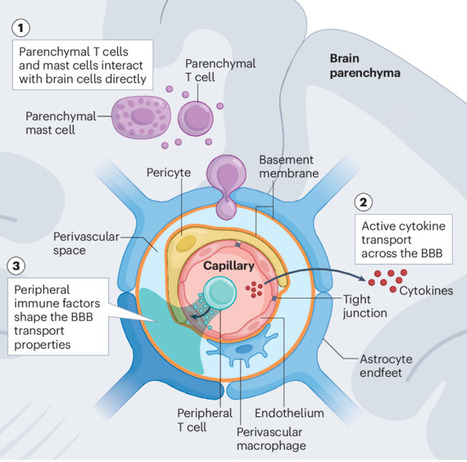
Peripheral immune regulation by Vit D protects against CNS inflammation by regulating the activation of microglia and astrocytes in the brain parenchyma and maintaining BBB integrity (92). Within the BBB, endothelial cells are joined together through tight junctions.
Via VENIER Thomas
|
|
Scooped by
Gilbert C FAURE
December 19, 2024 7:01 AM
|
The evolving pathophysiological landscape of Alzheimer’s disease (AD) research increasingly indicates an intricate interplay between the brain and the immune… | 18 comments on LinkedIn
|
|
Scooped by
Gilbert C FAURE
December 2, 2024 2:24 AM
|
medRxiv - The Preprint Server for Health Sciences...
|
|
Scooped by
Gilbert C FAURE
August 8, 2024 4:48 AM
|
Lymphatic-specific deletion of the Calcrl gene, encoding the CGRP receptor, alleviates facial expression of chronic migraine pain. To test whether MLVs contribute to the pathophysiology of chronic migraine pain, Calcrlfl/fl;Vegfr3CreERT2/+ (CalcrliLEC) mice with lymphatic-specific, temporal...
|
|
Scooped by
Gilbert C FAURE
June 4, 2024 1:48 PM
|
Immune cells instruct the development and persistence of adaptive and maladaptive pain states by modifying neural activity in the end organs, nerves, dorsa
|
|
Scooped by
Gilbert C FAURE
May 9, 2024 3:06 AM
|
|
|
Scooped by
Gilbert C FAURE
April 27, 2024 4:44 AM
|
|
|
Scooped by
Gilbert C FAURE
April 26, 2024 11:45 AM
|
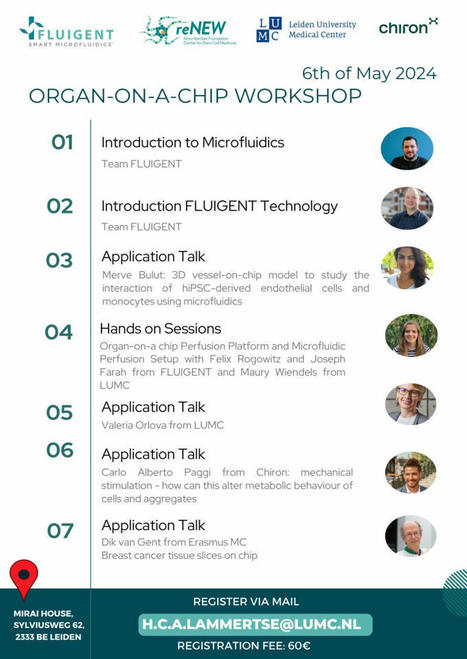
Great initiative from Fluigent on organ-on-chip technologies! Lot of invited speakers and the FLUIGENT team ready to show you some cool equipment and…
|
|
Scooped by
Gilbert C FAURE
April 7, 2024 4:19 AM
|
Sign in or join now to see posts like this one and more.
|
|
|
Scooped by
Gilbert C FAURE
January 20, 2025 1:39 PM
|
|
|
Scooped by
Gilbert C FAURE
January 16, 2025 4:13 AM
|
L’apport de l’immunologie dépasse la seule compréhension de la physiopathologie des déficits immunitaires, de l’allergie ou des maladies auto immunes mais…
|
|
Scooped by
Gilbert C FAURE
January 12, 2025 5:34 AM
|
Long COVID (also known as post-acute sequelae of SARS-CoV-2 infection [PASC] or post-COVID syndrome) is characterized by persistent symptoms that extend beyond the acute phase of SARS-CoV-2 infection, affecting approximately 10% to over 30% of those infected. It presents a significant clinical challenge, notably due to pronounced neurocognitive symptoms such as brain fog. The mechanisms underlying these effects are multifactorial, with mounting evidence pointing to a central role of cerebromicrovascular dysfunction. This review investigates key pathophysiological mechanisms contributing to cerebrovascular dysfunction in long COVID and their impacts on brain health. We discuss how endothelial tropism of SARS-CoV-2 and direct vascular infection trigger endothelial dysfunction, impaired neurovascular coupling, and blood–brain barrier disruption, resulting in compromised cerebral perfusion. Furthermore, the infection appears to induce mitochondrial dysfunction, enhancing oxidative stress and inflammation within cerebral endothelial cells. Autoantibody formation following infection also potentially exacerbates neurovascular injury, contributing to chronic vascular inflammation and ongoing blood–brain barrier compromise. These factors collectively contribute to the emergence of white matter hyperintensities, promote amyloid pathology, and may accelerate neurodegenerative processes, including Alzheimer’s disease. This review also emphasizes the critical role of advanced imaging techniques in assessing cerebromicrovascular health and the need for targeted interventions to address these cerebrovascular complications. A deeper understanding of the cerebrovascular mechanisms of long COVID is essential to advance targeted treatments and mitigate its long-term neurocognitive consequences.
|
|
Scooped by
Gilbert C FAURE
January 6, 2025 4:10 AM
|
I have started the new year reading many research articles on chronic inflammation. It is incredible to me how much chronic inflammation is a driver for almost…
|
|
Scooped by
Gilbert C FAURE
January 2, 2025 4:33 AM
|
The immune system is increasingly recognized as a key player in neurodegenerative diseases, with its roles ranging from being a primary driver (as in multiple…
|
|
Scooped by
Gilbert C FAURE
December 16, 2024 12:54 PM
|
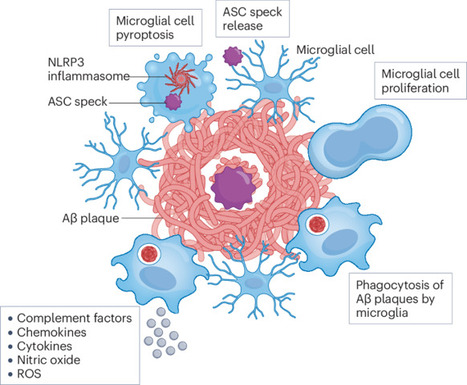
Increasing evidence points to a pivotal role of immune processes in the pathogenesis of Alzheimer disease, which is the most prevalent neurodegenerative and dementia-causing disease of our time. Multiple lines of information provided by experimental, epidemiological, neuropathological and genetic studies suggest a pathological role for innate and adaptive immune activation in this disease. Here, we review the cell types and pathological mechanisms involved in disease development as well as the influence of genetics and lifestyle factors. Given the decade-long preclinical stage of Alzheimer disease, these mechanisms and their interactions are driving forces behind the spread and progression of the disease. The identification of treatment opportunities will require a precise understanding of the cells and mechanisms involved as well as a clear definition of their temporal and topographical nature. We will also discuss new therapeutic strategies for targeting neuroinflammation, which are now entering the clinic and showing promise for patients. This Review provides an in-depth examination of how inflammation contributes to neurodegeneration in Alzheimer disease. The authors explore the impact of extrinsic factors, such as brain trauma, diet and infections, and host-intrinsic factors, such as the activity of microglial cells and other immune, vascular and neuronal cell populations, on disease development. They also highlight emerging drugs that target this inflammatory component for therapy of Alzheimer disease.
|
|
Scooped by
Gilbert C FAURE
November 9, 2024 4:33 AM
|
A look back at newsworthy stories of 2024...
In 2006, Sylvain Lesné and seven coauthors published a paper on Alzheimer’s disease, “A specific amyloid-beta protein assembly in the brain impairs memory,” in Nature, the world’s most prestigious scientific journal.
|
|
Scooped by
Gilbert C FAURE
June 4, 2024 4:26 AM
|
The immunometabolism of microglia determines not only their own fate but also that of neurons and their function during aging and neurodegeneration.
|
|
Scooped by
Gilbert C FAURE
May 6, 2024 11:38 AM
|
Scientists identify the brain cells that regulate inflammation, and pinpoint how they keep tabs on the immune response.
|
|
Scooped by
Gilbert C FAURE
April 26, 2024 12:52 PM
|
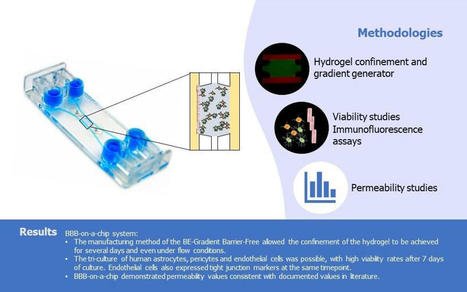
🔬 Exciting Developments in Blood-Brain Barrier Modeling: Introducing the BE-Gradient Barrier-Free Device 🔬
We are thrilled to share a landmark publication…
|
|
Scooped by
Gilbert C FAURE
April 24, 2024 4:46 AM
|
Adequate drug delivery across the blood-brain barrier is a critical factor in treating central nervous system (CNS) disorders. Inspired by swimming fish and the microstructure of the nasal cavity, Prof.
|